Texas Longhorns with newborn calf in Bluebonnets

Texas Longhorns with newborn calf in Bluebonnets

Please note I have a new phone number...

512-517-2708

Alan Maki

Alan Maki
Doing research at the LBJ Library in Austin, Texas

It's time to claim our Peace Dividend

It's time to claim our Peace Dividend

We need to beat swords into plowshares.

We need to beat swords into plowshares.

A program for real change...

http://peaceandsocialjustice.blogspot.com/2013/03/a-progressive-program-for-real-change.html


What we need is a "21st Century Full Employment Act for Peace and Prosperity" which would make it a mandatory requirement that the president and Congress attain and maintain full employment.


"Voting is easy and marginally useful, but it is a poor substitute for democracy, which requires direct action by concerned citizens"

- Ben Franklin

Let's talk...

Let's talk...

Saturday, April 13, 2013

The Question of Socialism (and Beyond!) Is About to Open Up in These United States

This is a really interesting, enlightening, thought-provoking and educational read; anyone who is open-minded would do well to read this and use this article as a basis for further discussion even though much about real socialism is ignored just like some of the most successful co-operative enterprises are not brought forward and discussed--- perhaps because they are a little too close to real socialism and the Gar Alperovitz  fails to mention the success of the Red Finn Cooperatives and the International Workers Order. And it is interesting universal social programs are not broached like a National Public Health Care System and a National Public Child Care System--- apparently out of fear of challenging the capitalist "market system" for which Alperovitz must think humanity can't do completely without.

But, this is worthwhile discussing. 

Additional reading might include "Socialism: Utopian and Scientific" since some of this being advocated borders on the utopian and even anarchistic side:
http://www.marxists.org/archive/marx/works/1880/soc-utop/index.htm


Check out my blog for further information about socialism:
http://socialismtheoryandpractice.blogspot.com/


Alan L. Maki


The Question of Socialism (and Beyond!) Is About to Open Up in These United States

Friday, 12 April 2013 00:00By Gar AlperovitzTruthout | News Analysis

Capitalism Crisis.(Photo: Shira Golding Evergreen / Flickr)With Americans' interest in socialism rising, we need to seriously consider alternative designs to the current system, argues Alperovitz, in this practical critique of some known models.
Little noticed by most Americans, Merriam Webster, one of the world's most important dictionaries, announced a few months ago that the two most looked-up words in 2012 were "socialism" and "capitalism."
Traffic for the pair on the company's website roughly doubled from the year before. The choice was a "kind of no-brainer," observed editor at large, Peter Sokolowski. "They're words that sort of encapsulate the zeitgeist."
Leading polling organizations have found converging results among younger Americans. Two recent Rasmussen surveys, for instance, discovered that Americans younger than 30 are almost equally divided as to whether capitalism or socialism is preferable. Another Pew survey found those aged 18 to 29 have a more favorable reaction to the term "socialism" by a margin of 49 to 43 percent.
Note carefully: These are the people who will inevitably be creating the next American politics and the next American system.
As economic failure continues to create massive social and economic pain and a stalemated Washington dickers, search for some alternative to the current "system" is likely to continue to grow. It is clearly time to get serious about a different vision for the future. Critically, we need to be far more sophisticated about what a meaningful "systemic design" that might undergird a new direction (whether called "socialism" or whatever) would entail.
Classically, the central idea undergirding various forms of "socialism" (and there have been many, many forms, some of which use the terminology, some not) is democratic ownership of "the means of production," or "capital," or more simply, "productive wealth." Quite apart from questions of exploitation, systemic dynamics (and "contradictions"), the core idea is simple and straightforward: Those who own wealth - and the corporations that operate it - have far more power to control any system than those who don't.
In a nation in which a mere 400 people own more wealth than the bottom 180 million together, the point should be obvious. What is new in our time in history is that the traditional compromise position - namely progressive, or social democratic or liberal politics - has lost is capacity to offset such power even in the modest (compared, for instance, to many European states) ways the American welfare state once represented. Indeed, the emerging direction is to cut back previous gains in many areas - not to sustain or enlarge them. Even Social Security is now on the table for cuts.
Perhaps the most important reason for the decline of the traditional reform option is the decline of labor: Union membership has steadily decreased from roughly 35 percent of the labor force in 1954, to 11.3 percent now - a mere 6.6 percent in the private sector.
Along with this decay, and give or take an exception here and there, major trends in income and wealth, in civil liberties, in ecological devastation (and the release of climate-changing gases), in poverty and many other important indicators have been "going South" for several decades.
It is, accordingly, not surprising that dictionary look-ups and polls show interest in "something else." If, as is likely, the trends continue, that interest is also likely to increase. But what, specifically, might that "something else" entail? And is there any reason to hope - even as interest in the word "socialism" grows in the abstract - that we might move from where we are to "some other system" that might nurture equality, liberty, ecological sustainability, even global peace, more than the current decaying one we now have?
New Models of Socialist Structures
The classic model of socialism involved state (national) ownership of most large-scale capital and industry. But it is now clear to most observers that the concentration of such ownership in the state also commonly brings with it a concentration of political power as well; hence, the model can be detrimental to democracy as well as liberty (to say nothing, in real world experience, of the environment).
Alternative places to locate ownership have been suggested by different traditions: in cooperatives, in worker-owned firms, in municipalities, in regions, even in neighborhoods. Some of the advantages and challenges involved in the various forms are also well-known:
Starting at the ground level, there appear in virtually all studies to be very good reasons - for small and medium-size firms - to arrange ownership through cooperatives and worker-owned and self-managed enterprises. This is where direct democratic participation is (or can be) strongest, where a new culture can be developed and where a very different vision of work can evolve. Very solid proposals have been offered in such books as John Restakis' Humanizing the Economy: Co-operatives in the Age of Capital and Richard Wolff's Democracy at Work: A Cure for Capitalism (on what he calls "worker self-directed enterprises").
On the other hand, for larger, significant-scale enterprises, worker-ownership may not solve some critical problems. When worker-owned large firms operate in a market-based system (as proposed by some progressive analysts), groups of workers in such firms may develop narrow interests that are not necessarily the same as those of the society as a whole. (It may be in their interests, for instance, to pollute the community's air and water rather than pay cleanup costs - especially when the firm faces stiff competition from other private or worker-owned companies.) Studies of worker-owned plywood companies in the Northwest found that all too easily workers developed narrow "worker-capitalist" attitudes (and conservative political views) as they competed in the marketplace. Nor does such ownership solve problems of inequality: Workers who "own" the garbage companies are clearly on a different footing, for instance, than specific groups of workers lucky enough to "own" the oil industry.
Often here - and in several other variants of socialist ideas - it is hoped that a new culture (or ideology) or progressive forms of taxation, regulation and other policies can offset the underlying tendencies of the models. However, there is reason to be skeptical of "after-the-fact" remedies that hope to counter the inherent dynamics of any model, since political power and interest group influence often follow from ownership irrespective of good intentions and the hope that progressive political ideals, or ideology, will save the day. If the attitudes nurtured by the plywood co-ops turn out to be the norm, then new worker-owned companies would likelynot generate strong support for regulations and taxation that help society at large but restrict or tax their own firm.
Let me stress that we simply do not know whether this might or might not be the case. It is, however, a mistake to assume either that socially responsible regulations can be "pasted on" to any institutional substructure (especially if they create costs to that substructure), or that institutions will automatically generate a sufficiently powerful cooperative culture and institutional power dynamic in favor of regulations and taxation even if it adds costs to their own institution and is detrimental to the material interests of those involved.
To get around some of these problems, some theorists have proposed democratically managed enterprises that are nonetheless owned by the broader society through one or another structural form. Although workers in the "self-managed" firm could gain from greater efficiency and initiative, major profits would go to the society as a whole. Still, note that in such cases, too, the incentive structure of the competitive market tends to create incentives to reduce costs - for instance, by externalizing environmentally destructive wastes. Also, when there are economies of scale, market-based systems generate very powerful pressures to adopt new technologies and prioritize growth (or lose out to other firms that also are under pressure to grow and adopt new technologies) - and this dynamic, too, runs counter to the needs of an ecologically sustainable future.) John Bellamy Foster's The Ecological Revolution, among other efforts, gives depth to the ecological foundational arguments further systemic designs must consider.
Designing for Community
We are clearly at the exploratory stage in connection with these matters, but the really important question is clearly whether a new model might inherently generate outcomes that do not require "after-the-fact" policy fixes or attempted fixes it is hoped the political system will supply. Especially since such "fixes" come out of a larger culture, the terms of reference of which are significantly set by the underlying economic institutions, and if these develop competitive and growth-oriented attitudes, the outcomes are likely to be different from those hoped for by progressive proponents. Lest we jump to any quick conclusions, it is again important to be clear that no one has as yet come up with a serious "model" that might both achieve efficiencies and self-directed management - and also work to create an equitable, ecologically sustainable larger culture and system. All have flaws.
Some of the problems and also some of the design features of alternatives, however, begin to suggest some possible directions for longer-term development:
For instance, a third model that has traditionally had some resonance is to locate primary ownership of significant scale capital in "communities" rather than either the state or specific groups of workers - i.e. in geographic communities and in political structures that are inclusive of all the people in the community. (By definition geographic communities inherently include not only the workers who at any moment in time may only include half the population, but also stay-at-home, child-rearing males or females, the elderly, the infirm, children and young people in school - in short the entire community.)
Community models also inherently "internalize externalities" - meaning that unlike private enterprise or even worker-owned companies that may have a financial interest in lowering costs by not cleaning up environmentally destructive practices, community-owned firms are in a different position: If the community chooses to continue such practices, it is polluting itself, a choice it can then examine from a comprehensive perspective - and in a framework that does not inherently pose the interests of the firm against community-wide interests.
Variations on this model include the "municipal socialism" that played so important a role in early 20th century American socialist politics - and is still evident in more than 2,000 municipally owned utilities, a good deal of new municipal land development and many other projects. "Social ecologist" Murray Bookchin gave primary emphasis to a municipal version of the community model in works likeRemaking Society: Pathways to a Green Future, and Marxist geographer David Harvey has begun to explore this option as well. (As Harvey emphasizes, any "model" would likely also have to build up higher level supporting structures and could not function successfully were it left to simply float in the free market without some larger supporting system.)
Current suggestive practical developments in this direction include a complex or "mixed" model in Cleveland that involves worker co-ops that are linked together and subordinated to a community-wide, nonprofit structure - and supported by something of a quasi-planning system (directed procurement from hospitals and universities that depend in significant part on public financial support). An earlier model involving joint community and worker ownership was developed by steelworkers in Youngstown, Ohio, in the late 1970s.
The Jewish theologian Martin Buber also offered a community-oriented variation based on cooperative ownership of capital in one geographic community. He saw this "full cooperative" (and confederations of such communities) as an answer the problems both of corporate capitalism and of state socialism. Buber's primary practical experimental demonstration was the Israeli cooperative commune (kibbutz), but the principle might well be applied in other forms. Karl Marx's discussion of the Paris Commune (and of the Russian village commune or mir) is also suggestive of possibilities in this direction.
In the various community models there is also every reason to expect that specific communities will develop "interests" that may or may not be the same as those of the society as a whole. (Again think of communities located on top of important natural resources versus others not so favored.) The formula based on community ownership, however, may have a potential advantage that might under certain circumstances - and with clear intent - help at least partly offset the tendency for any structural form to produce narrow interest-group ideas and power. This is the simple fact that a fully inclusive structure that nurtures ideals of "community" - as opposed to ideas of individual ownership, on the one hand, or worker-group ownership of specific firms, on the other - may offer greater possibilities for building a common culture of community, one in which norms of equal treatment and common interest are inherently generated by the structural design itself (at least within communities and possibly beyond.)
To the extent this is so, or could be nurtured, a systemic design based on communities (or joint worker-community ownership) might both allow for decentralization and also for the generation of common values. A subset of issues also involves smaller scale geographic community ownership, in the form of neighborhoods. And such a model might also include a mix of smaller scale worker-owned and cooperative forms, and even (larger scale) state and nationally owned public enterprise as well - a structural form that is now far more common and efficient in many countries around the world than is widely understood.
Questions of Scale
Social ownership by neighborhoods, municipalities, states, and, of course, nations (all with or without some formula of "joint" worker ownership) are not the only models based on the fact that geography is commonly inherently inclusive of all parties - and therefore potentially capable of helping nurture inclusive norms and inclusive cultures. A final formula (for the moment) for significant scale and ultimately large industry is also based on geography, but at a different level still. This attempts to resolve some of these problems (and that of genuine democratic participation) by defining the key unit as a region, a formula urged by the radical historian, the late William Appleman Williams, as especially appropriate to a very large nation like the United States. It is not often realized how very different in scale the United States is from most European nations: Germany, for instance, can be tucked into a geographic area the size of Montana. Nor have many faced the fact that our current 315 million-person population is likely to reach 500 million over coming decades (and possibly a billion by the end of the century, if the US Census Bureau's high estimate were to be realized.) During the Depression, various regional ownership models like the Tennessee Valley Authority were proposed, some of which were far more participatory and democratic in their design than the model that is currently in place. Legislation to create seven large-scale, publicly-owned regional efforts was, in fact, supported by the Roosevelt Administration at certain points in time.
Many other variations, of course, also have been proposed. The Parecon model, for instance, would attempt to replace a system of market exchanges with a system in which citizens would iteratively rank their preferences for consumer goods along with proposed amounts of proffered labor time. Proposals, like that of David Schweickart in After Capitalism, pick up on forms of worker self management, but also emphasize national ownership of the underlying capital. Seth Ackerman, in arecent essay for Jacobin, urges a worker-controlled model, but stresses the need for independent sources of publicly controlled investment capital. Other thinkers, like Michael Leobowitz in his book, The Socialist Alternative: Real Human Development, have taken inspiration from Latin America's leftward movement, and especially from Venezuela, to articulate a participatory vision of socialism rooted in democratic and cooperative practices. Joel Kovel in The Enemy of Nature argues that the impending ecological crisis necessitates a fundamental change away from the private ownership of earth's resources.
And, of course, the question of planning versus markets needs to be put on the list of design challenges. Planning has its own long list of challenges - including, critically, who controls the planners and whether participatory forms of planning may be developed drawing on smaller scale emerging experience and also on a much more focused understanding of what needs to be planned and what ought to be independent of public direction. (Also how the market can be used to keep a planning system in check.)
As noted, there is also the question of enterprise scale - a consideration that suggests possible mixes of different forms of social ownership: where to locate the ownership and control of very large scale firms is one thing; very small another; and intermediate still another. Most "socialist" models these days also allow for an independent sector that includes small independent capitalist firms, especially in the innovative high-tech sector.
Related to all this is the question of function: The development and management of land, for instance, is commonly best done through a geographic institution - i.e. a neighborhood or municipal land trust. Public forms of banking and finance tend also to be best anchored in (though operated independently of) cities, states and nations. Though medical practices must be local, social or socialized health systems tend to work best in areas that include large populations - i.e. states or nations. In some cases, quite apart from efficiency considerations, ecological considerations make regions especially appropriate. (One of the rationales, originally, for the Tennessee Valley Administration had to do with managing a very challenging river system.)
On the Ground Now
Finally, there is much to learn from models abroad - particularly Mondragon, on the one hand, and the worker-cooperative and other networks in the Emilia Romagna region of Italy, on the other. The first, Mondragon, has demonstrated how an integrated system of more than 100 cooperatives can function effectively (and in areas of high technical requirement) - and at the same time maintain an extremely egalitarian and participatory culture of institution control. The Italian cooperatives have demonstrated important ways to achieve "networked" production among large numbers of small units - and further, to use the regional government in support of the overall effort. Though the experience of both is extraordinary, simple extrapolations may or may not be possible: Both models, it is also important to note, developed out of historical contexts that helped create intense cultural and political solidarity - contexts also of extraordinary repression by fascist regimes, Franco in Spain, Mussolini in Italy. Finally, although the Emilia Romagna cooperatives are effective in their use of state policy, both models are best understood as institutional "elements" that may contribute to a potential national solution. Neither claims to, or attempts to, develop a coherent overall "systemic" design for a nation.
These various abstract considerations come down to earth when one realizes that there is far more going on, practically, on the ground related to the ownership forms than most people realize - a great deal that is not covered by the increasingly hobbled and financially constrained press. For a start, around 130 million Americans - 40 percent of the population - are members of one or another form of cooperative, a traditional collective ownership form that now includes large numbers of credit unions, agricultural co-ops dating back to the 1930s, electrical co-ops prevalent in many rural areas, insurance co-ops, food co-ops, retail co-ops (such as the outdoor recreational company REI and the hardware purchasing cooperative ACE), health-care co-ops, artist co-ops and many, many more.
There are also many, many worker-owned companies structured in ways different from traditional co-ops - indeed, around 11,000 of them, involving 10.3 million people, in virtually every sector, some very large and sophisticated. Technically, these companies are structured as ESOPs (Employee Stock Ownership Plans) - and in fact 3 million more individuals are involved in worker-owned companies of this kind than are members of unions in the private sector. (Though there have been a variety of problems with this form, there has also been evolution with greater worker control and also experiments with unionization that in the future might suggest important additional possibilities.) Finally and critically, the United Steelworkers have put forward a new direction in union-worker co-ops.
There are also thousands of "social enterprises" that use democratized ownership to make money and use both the money and the enterprise itself to achieve a broader social purpose. By far the most common social enterprise is the traditional Community Development Corporation, or CDC. Nearly 5,000 have long been in operation in almost every US city of significant size. For the most part, CDCs have served as low-income housing developers and incubators for small businesses. Early on in the 50-year history of the movement, however, a different, larger vision was in play - one that is still present in some of the more advanced CDC efforts and one that suggests additional possibilities for the future.
Still another form of democratized ownership involves growing numbers of "land trusts" - essentially neighborhood or municipal corporations that own housing and other property in ways that prevent gentrification and turn development profits into support of low- and moderate-income housing. One of the best known is the Champlain Housing Trust in Burlington, Vermont, which traces its modest beginnings to the early 1980s and now provides accommodation for more than 2,000 households. Hundreds of such collective ownership efforts now exist, and new land trusts are now being established on an expanding, ongoing basis in diverse contexts and cities all over the country.
Since 2010, twenty states have also considered legislation to establish public banks like that of North Dakota, which has operated with strong public support for more than nine decades. Approximately 20 states have considered legislation to establish single-payer health-care plans. Nor should we forget that the United States government de facto nationalized General Motors and AIG, one of the largest insurance companies in the world, during the recent crisis. It started selling them back once the profits began to roll, but in future crises, different outcomes might be ultimately achieved if practical experiments at the local and state level begin to create experiences that might be generalized to national models when the time is right - especially if the current system continues to decay and deteriorate. (Many of the national models that became the core programs of the New Deal were incubated in the state and local "laboratories of democracy" in the decades prior to the time national political possibilities opened up).
At this stage of development, there is every reason to experiment with many forms - a "community-sustaining" direction that I have suggested might be called a "Pluralist Commonwealth" to emphasize the plurality of common or democratized wealth-holding efforts.
Getting Serious
I obviously do not hope in this brief sketch to try to offer a fully developed alternative. My goal is much simpler: First, to suggest that the questions classically posed by the word "socialism" that is now coming back into public use need to be discussed and debated by a much broader group than has traditionally been concerned with these issues; and second, to suggest further that if one looks closely there is evidence that some of the potential real world elements of a solution may be developing in ways that might one day open the way to a very American and very populist variant (whether called "socialist" or not). It is time, accordingly, to discuss the deeper design issues carefully and thoughtfully and in ways that involve a much larger share of the very large numbers of people, beyond the traditional left, who the polls and dictionary inquiries suggest may be interested in these questions.
Even as we learn more and more about the various forms and their positive and negative features and tendencies, hopefully we can engage in a far-reaching and thoughtful debate about how a new model might be created that is both systemically sophisticated and also appropriate to American culture and traditions - a model that nurtures democracy and a culture of inclusiveness and ecological sanity. Many serious and committed people on the left have been struggling with these issues and keeping the critical questions alive for decades. Even though the way forward, politically, is obviously daunting, difficult and uncertain, it is time to widen the dialogue in ways that include the millions of Americans who now seem increasingly open to the challenge.
Nor should the pessimism of the moment undercut what needs to be done: Anyone looking at Latin America 30 years ago might easily have been judged foolish to think change could occur - and that debate concerning these kinds of questions was important. Yet even during and through the pain - and the torture and dictatorship - new beginnings somehow were made in many areas and by many people. Our own course may be difficult, but easy pessimism is an all-too-common escape mechanism to avoid responsibility. It is also comforting: If one buys the judgment that nothing can ever be done, that it is impossible, one has an excuse not to try and also not to try to reach out to others. The fact is the failings of the present system are themselves forcing more and more people to explore new ideas and develop new experiments and new political efforts.
The important points to emphasize are three: [1] There is openness in the public, and especially among a much, much broader group than many think, to discussing these issues - including even the word "socialism;" [2] It is accordingly time to get very serious about some of the challenging substantive and theoretical issues involved; and [3] There are also many on-the-ground experiments, and projects and developments that suggest practical directions that are under way, but also that a new politics (whatever it is called) might begin to build upon them if it got serious.


GAR ALPEROVITZ

Gar Alperovitz, Lionel R. Bauman Professor of Political Economy at the University of Maryland and co-founder of the Democracy Collaborative, is the author of the forthcoming What Then Must We Do? Straight Talk About The Next American Revolution (Chelsea Green, May Day 2013).

RELATED STORIES

Cooperatives Over Corporations
By Jim Hightower, Truthout | Op-Ed
Cooperatives and Community Work Are Part of American DNA
By Kevin Zeese and Margaret Flowers , Truthout | Op-Ed

New York Times beats the drums of war.

Anti-communism is bringing warmongers out of the woodwork like termites doused with Chlordane. Leave it to the New York Times to do its "thing" in instigating a war; and, then, after massive killing and destruction when it is "safe" for Wall Street to reap its profits proclaim the war needs to end. Another country, same old shit. Where are the voices for peace and sanity?

http://www.nytimes.com/2013/04/13/opinion/bomb-north-korea-before-its-too-late.html?hp&_r=0

Canada's socialist New Democrats meeting in National Convention as they prepare to take national power.

All eyes should be focused on Canada...

The New Democratic Party's Socialist Caucus is doing a good job defending the "ownership question" remains in the Party's Mission Statement and Constitution. Nationalization under public ownership of select mines, mills and factories along with entire industries is going to have to be considered by the working class in Canada just like in any other country if capturing political power is going to mean anything of value to working people. Bay Street like its Wall Street partner is going to have to be challenged for not only political power, but economic power as well.  If Tom Mulcair didn't want to defend the mission of the socialist New Democratic Party calling for public ownership of mines, mills, factories and industries as called for he should not have run for the leadership position--- it is as simple as that. One does not run to become a Party's leader as the way to deceitfully change it and turn it into something other than what it stands for. An honest politician would simply have started a new political party shaped in the way and to the ideals wanted. Politicians are doing this all too frequently and it is good to see the New Democratic Party's Socialist Caucus militantly defending the integrity and what the New Democratic Party has stood for over many decades since its beginnings.

http://www.cbc.ca/news/canada/story/2013/04/12/pol-ndp-convention-saturday.html

To keep up with what the New Democratic Party Socialist Caucus is doing go here:

https://www.facebook.com/groups/151736524156/?fref=ts

Friday, April 12, 2013

What causes rising inequality?

Rising Inequality: Transitory or Permanent?

"... For male labor earnings, we find that the entire increase in the
cross-sectional inequality over our sample period was permanent, that is, it reflected
increases in the dispersion of the permanent component of earnings. For total household income, the large increase in inequality over our sample period was predominantly, though not entirely, permanent. For this broader income category, both the permanent and the transitory parts of the cross-sectional variance increased, but the permanent variance contributed the bulk of the increase in the total. Furthermore, the increase in the transitory component reflected an increase in the transitory variance of spousal labor earnings and investment income. We also show that the tax system partially mitigated the increase in income inequality, but not sufficiently to alter its broadly increasing trend over the 1987-2009 period."

This is just one more report (see link at bottom) funded by foundations intended to obscure the main source poverty which is the capitalist economic system which breeds poverty--- not because of inequities in the tax system as this study would lead you to believe but because exploitation of workers results in poverty wages and massive unemployment drives wages down even further.

The only way to begin to solve the wage problem is by making the Minimum Wage a real living wage based on all cost of living factors in combination with ending unemployment which requires the president and Congress be made legislatively responsible for attaining and maintaining full employment.

In addition, the question of tax reform is not as important as setting budget priorities which must include reaping the benefits of "peace dividends" by ending this insane militarism and these dirty imperialist wars which are making us all poorer because the wealth created by workers is being squandered on barbaric death and destruction instead of meaningful and massive job-creating universal governmental social programs like a National Public Health Care System and a National Public Child Care/Pre-school System which, combined, would put some 15-million people to work with real living wage jobs thus alleviating poverty.

Only as part of getting our priorities in order can we begin to explore the kind of tax reforms that must include:

- taxing the rich.
- taxing corporate profits.
- taxing Wall Street transactions. 

Unless working people create some kinds of clubs or think-tanks to educate the working class as to the horrible price we are paying in so many ways because Wall Street is doing our thinking for us, none of this is going to change.

All of this must be considered in relation to the class struggle.

We need to take to the streets, engage in political strikes and build a new working class based progressive people's party to challenge Wall Street for political and economic power...

Some kind of massive anti-monopoly/anti-imperialist coalition for:

Peace.
Full Employment.
Real Health Care Reform.
Child Care.
Action on climate change.

We need to break this mode of thinking that the only way to get the economy moving is through the government acting to improve the market when what we need is an economy based on providing for human needs. Once we accomplish this the markets will take care of themselves with proper government price controls and planned production based on human needs.

It is mind-boggling to think that there is an entire army of over-paid muddle-headed middle class intellectuals who actually spend their time putting together reports like the one below from the Brookings Institute while others of their ilk are wasting their time trying to figure out how to get people spending again to improve the market.

If we start to think in terms of people and peace, the environment and nature before corporate profits we will have begun to solve the biggest problems of all.

We have to understand that each and every bomb dropped and bullet fired in these wars is killing our jobs and destroying our standard of living while pushing prices up.

It really doesn't take a Marxist to understand all of this but studying Marxism sure helps.

If Time Magazine can acknowledge the validity of Marxism, workers should take the time to check it out, too, because there is a class struggle and we sure don't want the warmongering Wall Street class of greedy money-bags to remain on top.

http://www.brookings.edu/~/media/Projects/BPEA/Spring%202013/2013a_panousi.pdf

Tuesday, April 9, 2013

The time has come to stop subsidizing casinos and start collecting revenue.

The Minnesota Democratic Farmer-Labor Party is going to be raising taxes left and right to raise money to finance a gaggle of boon-doggles including building the Minnesota Vikings a new football Stadium as poverty continues to rise.

We already have toll booths at state parks and even many county parks and township parks.

Why doesn't the Minnesota State Legislature build toll booths going into all of the casinos?

Just charge the same amount of money it costs to get into a Minnesota State Park.

All current budget problems and the deficit would be solved...

Plus unemployed people could be hired to staff these toll booths and the American Federation of State, County and Municipal Employees (AFSCME) which has so enthusiastically championed all of Governor Dayton's tax-increases would gain new members.

Saturday, April 6, 2013

A snow-job.

I just got back from the Annual Meeting of the Roseau Electric Co-operative up here in northern Minnesota.

What a fiasco.

Nothing but a snow-job from a bunch of corporate lackeys trying to explain why our electric bills have more than doubled in the last three years as they attempted to explain the price increase away on government ordered environmental protections when we could be getting clean, green hydro-produced electricity from the provincially (government) owned Manitoba Hydro.

Instead the members of the board of the Roseau Electric Co-op (actually nothing but the good old boys club [not a single woman or person of color on the board]) entered into a dirty deal (literally a dirty deal in more ways than one) with Minkota Power which is making a whole bunch of wealthy people even richer operating one of the dirtiest coal-burning electric producing plants in the world polluting our air, water and land transmitting the power back to us on government subsidized lines and distribution centers when Manitoba Hydro has lines running right through our area. These idiots tied our rural electric co-op into a fifty year deal buying this dirty, high-priced electricity from Minkota when Manitoba Hydro could supply us with all the power our community will ever need. Talk about stupidity. And then these morons have the audacity to stand in front of four-hundred people to tell us we should join with the high-priced lobbyist they hired to try to convince the politicians that global warming is a liberal hoax.

Many people are still paying off electric bills they had to put on their credit cards from two-years ago.


It won't be very long before many people won't be able to afford electricity.

Thursday, March 28, 2013

Alan Maki, Warroad, Minn. letters: U.S. needs a Full Employment Act

http://www.grandforksherald.com/event/article/id/259722/


Published in the Grand Forks Herald.

Published March 25, 2013, 05:15 AM

Alan Maki, Warroad, Minn. letters: U.S. needs a Full Employment Act

Alan Maki of Warroad Minnesota writes in about employment

WARROAD, Minnesota — If just one job was created every time a politician opened his or her mouth and started talking about “jobs, jobs, jobs,” we wouldn’t have any unemployment and everyone who wanted to work would have a decent, living wage job.


So, what is the main obstacle to full employment? Accountability from the very politicians who mouth the words “jobs, jobs, jobs.”
What we need in this country is a real “Full Employment Act” which mandates — by legislation and law — that the president and the Congress must maintain full employment with jobs at real living wages based on all cost-of-living factors as part of their responsibility to the American people.

A job and a decent standard of living is the most basic and fundamental human right for any worker. Workers without living wage jobs are going to be poor. What good is a government that gets us into war after war but can’t even assure full employment for the very people it taxes to pay for these dirty wars?

Wars cause government debt and deficits; peace and full employment eliminate debts and deficits.

We need the re-establishment of the Works Progress Administration, Civilian Conservation Corps and Comprehensive Employment and Training Act, not these dirty wars. Re-open under public ownership the thousands of mines, mills and factories abandoned by Wall Street “investors” who sought greater profits in the lower wages found overseas.

Alan Maki

Wednesday, March 27, 2013

Marx’s Revenge: How Class Struggle Is Shaping the World


"...With the global economy in a protracted crisis, and workers around the world burdened by joblessness, debt and stagnant incomes, Marx’s biting critique of capitalism — that the system is inherently unjust and self-destructive — cannot be so easily dismissed. Marx theorized that the capitalist system would inevitably impoverish the masses as the world’s wealth became concentrated in the hands of a greedy few, causing economic crises and heightened conflict between the rich and working classes. “Accumulation of wealth at one pole is at the same time accumulation of misery, agony of toil, slavery, ignorance, brutality, mental degradation, at the opposite pole,” Marx wrote."


Conclusion...


"That leaves open a scary possibility: that Marx not only diagnosed capitalism’s flaws but also the outcome of those flaws. If policymakers don’t discover new methods of ensuring fair economic opportunity, the workers of the world may just unite. Marx may yet have his revenge."


ADAM BERRY / GETTY IMAGES
The grave of German philosopher and economic theorist Karl Marx, remembered as the founder of modern socialism and communism, in Highgate Cemetery in London


http://business.time.com/2013/03/25/marxs-revenge-how-class-struggle-is-shaping-the-world/


Marx’s Revenge: How Class Struggle Is Shaping the World


Karl Marx was supposed to be dead and buried. With the collapse of the Soviet Union and China’s Great Leap Forward into capitalism, communism faded into the quaint backdrop of James Bond movies or the deviant mantra of Kim Jong Un. The class conflict that Marx believed determined the course of history seemed to melt away in a prosperous era of free trade and free enterprise. The far-reaching power of globalization, linking the most remote corners of the planet in lucrative bonds of finance, outsourcing and “borderless” manufacturing, offered everybody from Silicon Valley tech gurus to Chinese farm girls ample opportunities to get rich. Asia in the latter decades of the 20th century witnessed perhaps the most remarkable record of poverty alleviation in human history — all thanks to the very capitalist tools of trade, entrepreneurship and foreign investment. Capitalism appeared to be fulfilling its promise — to uplift everyone to new heights of wealth and welfare.
Or so we thought. With the global economy in a protracted crisis, and workers around the world burdened by joblessness, debt and stagnant incomes, Marx’s biting critique of capitalism — that the system is inherently unjust and self-destructive — cannot be so easily dismissed. Marx theorized that the capitalist system would inevitably impoverish the masses as the world’s wealth became concentrated in the hands of a greedy few, causing economic crises and heightened conflict between the rich and working classes. “Accumulation of wealth at one pole is at the same time accumulation of misery, agony of toil, slavery, ignorance, brutality, mental degradation, at the opposite pole,” Marx wrote.
A growing dossier of evidence suggests that he may have been right. It is sadly all too easy to find statistics that show the rich are getting richer while the middle class and poor are not. A September study from the Economic Policy Institute (EPI) in Washington noted that the median annual earnings of a full-time, male worker in the U.S. in 2011, at $48,202, were smaller than in 1973. Between 1983 and 2010, 74% of the gains in wealth in the U.S. went to the richest 5%, while the bottom 60% suffered a decline, the EPI calculated. No wonder some have given the 19th century German philosopher a second look. In China, the Marxist country that turned its back on Marx, Yu Rongjun was inspired by world events to pen a musical based on Marx’s classic Das Kapital. “You can find reality matches what is described in the book,” says the playwright.
That’s not to say Marx was entirely correct. His “dictatorship of the proletariat” didn’t quite work out as planned. But the consequence of this widening inequality is just what Marx had predicted: class struggle is back. Workers of the world are growing angrier and demanding their fair share of the global economy. From the floor of the U.S. Congress to the streets of Athens to the assembly lines of southern China, political and economic events are being shaped by escalating tensions between capital and labor to a degree unseen since the communist revolutions of the 20th century. How this struggle plays out will influence the direction of global economic policy, the future of the welfare state, political stability in China, and who governs from Washington to Rome. What would Marx say today? “Some variation of: ‘I told you so,’” says Richard Wolff, a Marxist economist at the New School in New York. “The income gap is producing a level of tension that I have not seen in my lifetime.”
Tensions between economic classes in the U.S. are clearly on the rise. Society has been perceived as split between the “99%” (the regular folk, struggling to get by) and the “1%” (the connected and privileged superrich getting richer every day). In a Pew Research Center poll released last year, two-thirds of the respondents believed the U.S. suffered from “strong” or “very strong” conflict between rich and poor, a significant 19-percentage-point increase from 2009, ranking it as the No. 1 division in society.
The heightened conflict has dominated American politics. The partisan battle over how to fix the nation’s budget deficit has been, to a great degree, a class struggle. Whenever President Barack Obama talks of raising taxes on the wealthiest Americans to close the budget gap, conservatives scream he is launching a “class war” against the affluent. Yet the Republicans are engaged in some class struggle of their own. The GOP’s plan for fiscal health effectively hoists the burden of adjustment onto the middle and poorer economic classes through cuts to social services. Obama based a big part of his re-election campaign on characterizing the Republicans as insensitive to the working classes. GOP nominee Mitt Romney, the President charged, had only a “one-point plan” for the U.S. economy — “to make sure that folks at the top play by a different set of rules.”
Amid the rhetoric, though, there are signs that this new American classism has shifted the debate over the nation’s economic policy. Trickle-down economics, which insists that the success of the 1% will benefit the 99%, has come under heavy scrutiny. David Madland, a director at the Center for American Progress, a Washington-based think tank, believes that the 2012 presidential campaign has brought about a renewed focus on rebuilding the middle class, and a search for a different economic agenda to achieve that goal. “The whole way of thinking about the economy is being turned on its head,” he says. “I sense a fundamental shift taking place.”
The ferocity of the new class struggle is even more pronounced in France. Last May, as the pain of the financial crisis and budget cuts made the rich-poor divide starker to many ordinary citizens, they voted in the Socialist Party’s François Hollande, who had once proclaimed: “I don’t like the rich.” He has proved true to his word. Key to his victory was a campaign pledge to extract more from the wealthy to maintain France’s welfare state. To avoid the drastic spending cuts other policymakers in Europe have instituted to close yawning budget deficits, Hollande planned to hike the income tax rate to as high as 75%. Though that idea got shot down by the country’s Constitutional Council, Hollande is scheming ways to introduce a similar measure. At the same time, Hollande has tilted government back toward the common man. He reversed an unpopular decision by his predecessor to increase France’s retirement age by lowering it back down to the original 60 for some workers. Many in France want Hollande to go even further. “Hollande’s tax proposal has to be the first step in the government acknowledging capitalism in its current form has become so unfair and dysfunctional it risks imploding without deep reform,” says Charlotte Boulanger, a development official for NGOs.
His tactics, however, are sparking a backlash from the capitalist class. Mao Zedong might have insisted that “political power grows out of the barrel of a gun,” but in a world where das kapital is more and more mobile, the weapons of class struggle have changed. Rather than paying out to Hollande, some of France’s wealthy are moving out — taking badly needed jobs and investment with them. Jean-Émile Rosenblum, founder of online retailer Pixmania.com, is setting up both his life and new venture in the U.S., where he feels the climate is far more hospitable for businessmen. “Increased class conflict is a normal consequence of any economic crisis, but the political exploitation of that has been demagogic and discriminatory,” Rosenblum says. “Rather than relying on (entrepreneurs) to create the companies and jobs we need, France is hounding them away.”
The rich-poor divide is perhaps most volatile in China. Ironically, Obama and the newly installed President of Communist China, Xi Jinping, face the same challenge. Intensifying class struggle is not just a phenomenon of the slow-growth, debt-ridden industrialized world. Even in rapidly expanding emerging markets, tension between rich and poor is becoming a primary concern for policymakers. Contrary to what many disgruntled Americans and Europeans believe, China has not been a workers’ paradise. The “iron rice bowl” — the Mao-era practice of guaranteeing workers jobs for life — faded with Maoism, and during the reform era, workers have had few rights. Even though wage income in China’s cities is growing substantially, the rich-poor gap is extremely wide. Another Pew study revealed that nearly half of the Chinese surveyed consider the rich-poor divide a very big problem, while 8 out of 10 agreed with the proposition that the “rich just get richer while the poor get poorer” in China.
Resentment is reaching a boiling point in China’s factory towns. “People from the outside see our lives as very bountiful, but the real life in the factory is very different,” says factory worker Peng Ming in the southern industrial enclave of Shenzhen. Facing long hours, rising costs, indifferent managers and often late pay, workers are beginning to sound like true proletariat. “The way the rich get money is through exploiting the workers,” says Guan Guohau, another Shenzhen factory employee. “Communism is what we are looking forward to.” Unless the government takes greater action to improve their welfare, they say, the laborers will become more and more willing to take action themselves. “Workers will organize more,” Peng predicts. “All the workers should be united.”
That may already be happening. Tracking the level of labor unrest in China is difficult, but experts believe it has been on the rise. A new generation of factory workers — better informed than their parents, thanks to the Internet — has become more outspoken in its demands for better wages and working conditions. So far, the government’s response has been mixed. Policymakers have raised minimum wages to boost incomes, toughened up labor laws to give workers more protection, and in some cases, allowed them to strike. But the government still discourages independent worker activism, often with force. Such tactics have left China’s proletariat distrustful of their proletarian dictatorship. “The government thinks more about the companies than us,” says Guan. If Xi doesn’t reform the economy so the ordinary Chinese benefit more from the nation’s growth, he runs the risk of fueling social unrest.
Marx would have predicted just such an outcome. As the proletariat woke to their common class interests, they’d overthrow the unjust capitalist system and replace it with a new, socialist wonderland. Communists “openly declare that their ends can be attained only by the forcible overthrow of all existing social conditions,” Marx wrote. “The proletarians have nothing to lose but their chains.” There are signs that the world’s laborers are increasingly impatient with their feeble prospects. Tens of thousands have taken to the streets of cities like Madrid and Athens, protesting stratospheric unemployment and the austerity measures that are making matters even worse.
So far, though, Marx’s revolution has yet to materialize. Workers may have common problems, but they aren’t banding together to resolve them. Union membership in the U.S., for example, has continued to decline through the economic crisis, while the Occupy Wall Street movement fizzled. Protesters, says Jacques Rancière, an expert in Marxism at the University of Paris, aren’t aiming to replace capitalism, as Marx had forecast, but merely to reform it. “We’re not seeing protesting classes call for an overthrow or destruction of socioeconomic systems in place,” he explains. “What class conflict is producing today are calls to fix systems so they become more viable and sustainable for the long run by redistributing the wealth created.”
Despite such calls, however, current economic policy continues to fuel class tensions. In China, senior officials have paid lip service to narrowing the income gap but in practice have dodged the reforms (fighting corruption, liberalizing the finance sector) that could make that happen. Debt-burdened governments in Europe have slashed welfare programs even as joblessness has risen and growth sagged. In most cases, the solution chosen to repair capitalism has been more capitalism. Policymakers in Rome, Madrid and Athens are being pressured by bondholders to dismantle protection for workers and further deregulate domestic markets. Owen Jones, the British author of Chavs: The Demonization of the Working Class, calls this “a class war from above.”
There are few to stand in the way. The emergence of a global labor market has defanged unions throughout the developed world. The political left, dragged rightward since the free-market onslaught of Margaret Thatcher and Ronald Reagan, has not devised a credible alternative course. “Virtually all progressive or leftist parties contributed at some point to the rise and reach of financial markets, and rolling back of welfare systems in order to prove they were capable of reform,” Rancière notes. “I’d say the prospects of Labor or Socialists parties or governments anywhere significantly reconfiguring — much less turning over — current economic systems to be pretty faint.”
That leaves open a scary possibility: that Marx not only diagnosed capitalism’s flaws but also the outcome of those flaws. If policymakers don’t discover new methods of ensuring fair economic opportunity, the workers of the world may just unite. Marx may yet have his revenge.
— With reporting by Bruce Crumley / Paris; Chengcheng Jiang / Beijing; Shan-shan Wang / Shenzhen

Tuesday, March 26, 2013

Forest Lake, Minnesota charging parents $2,500.00 a year to send children to Kindergarten.

Obama is talking about a pre-school program while parents in Forest Lake, Minnesota are forced to pay $2,500.00 a year to send their children to the public school Kindergarten.

Many people are accusing me of lying about this exorbitant $2,500.00 fee.

But, here is an article from the Forest Lake Times, the main local newspaper:

http://forestlaketimes.com/2013/03/20/dems-push-to-fund-all-day-kindergarten/

"Officials in the Forest Lake district are on the same page and have opted to fund the full-day program. The district officers an all-day program now at a cost of $2500 a year for parents. Lower costs are available for parents that qualify under free and reduced guidelines."

During the "Shock and Awe" bombing and invasion of Iraq dozens of schools were bombed, hundreds of school children killed and maimed at a cost of billions of dollars while it would only cost $40,000,000.00 to provide every child in Minnesota with all-day Kindergarten... one more cost of imperialism... in so many ways people pay a terrible price for Wall Street's dirty imperialist wars.

I would note that the Democratic super majority here in Minnesota has refused to even address any of this in a resolution to Obama and Congress calling for the re-ordering of this country's priorities away from war and militarism towards satisfying and meeting human needs--- like Kindergarten.

I would also note that in the same issue of the Forest Lake Times there are seven solid pages of home foreclosure notices from this one small community.

There are 11 "help wanted" adds in the same newspaper.

The government is printing 85 billion dollars a month to pay for wars--- death and destruction; but where are the promised jobs, why do people have to pay for their children to go to Kindergarten and why are the home foreclosures continuing over 5 years after Obama assumed office?

Budgets are a reflection of our true priorities--- and the priorities of this Wall Street bribed government are all out of whack.

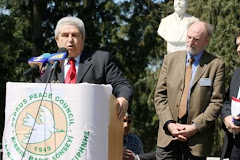
Cyprus election results.

PartiesVotes%+/–Seats+/–
Democratic Rally(Conservative-Christian)138,68234.28%+3.76%20+2
Progressive Party of Working People(Communist party)132,17132.67%+1.36%19+1
Democratic Party (Social Democratic)63,76315.76%−2.22%9−2
Movement for Social Democracy (Social Democratic)36,1138.93%−0.03%5±0
European Party (Centrist)15,7113.88%−1.91%2−1
Ecological and Environmental Movement (Greens)8,9602.21%+0.25%1±0

Had this terrible explosion not happened the Communist Party (AKEL) would have won the election:

http://articles.latimes.com/2011/jul/12/woa-fg-cyprus-rld/lexplosion-20110712


Cyprus munitions explosion kills 12

The munitions, seized in 2009 from an Iranian shipment to Syria, apparently exploded when a wildfire reached a military base. The explosion leads to the resignations of Cyprus' defense minister and the commander of the Greek Cypriot National Guard.

July 12, 2011|By Roula Hajjar, Los Angeles Times

Monday, March 25, 2013

The reactionary nature of Keynesian economics.

I had a lengthy discussion with a very liberal Minnesota State Senator this morning about my stating that there is nothing progressive about Keynesian economics. His position is that any government initiative which creates jobs should be considered progressive.

It is impossible to ague that the creation of any number of jobs with so many millions of people unemployed is not good. But, because the creation of any jobs may be good does not make Keynesian economics progressive.

No matter how hard anyone tries, there is no getting around the fact that Keynesian economics is all about using public capital and social capital (many people use the term "public funds" which is an okay definition but there is a difference between public capital and social capital which combined we can consider "public funds") during times of economic recession and depression in order to stimulate just enough spending get the capitalist consumer market going in order to increase production in the private sphere.

Keynesians prefer to spend public and social capital putting people to work on public projects managed by privately owned corporations but will agree to limited public works projects as a last resort--- hence what they do in the public sphere is always too little, too late even though the money workers employed on these public works projects ends up in the coffers of the extremely wealthy.

Keynesians view production as being the prerogative--- the exclusive right--- of private sector of the economy. They can make all the exaggerated claims they want about helping "small business" but anyone who looks can see they are really about helping only the largest Wall Street monopolies and multi-national corporations.

Does anyone really believe the Congressional Progressive Caucus would be able to create 7 million new jobs through subsidizing small business? The government doesn't even hire small businesses to pick up the garbage or fill small pot-holes in the roads and when public infrastructure like water and sewer is privatized, how often do you see the work turned over to small businesses?

The first insight we have that Keynesian economics is not progressive is that it's primary concern is the stimulation of the capitalist consumer market. The second is that the Keynesians take the position production is the exclusive right of private industry.

Progressives take the position that production should take place for social well-being so everyone can have the basic needs met.

Most people in this country, or any other country, spend what income they have on meeting their basic human needs so it is not any kind of far out left thinking to assert this basic fact of life--- and economics.

Progressives take the position that production in a public sector should occur--- especially when private production fails. A progressive position would be one in which it is advocated to bring all these closed mines, mills and factories back into production under public ownership using public capital and social capital--- just imagine what we could do with the trillions of dollars from the Social Security Trust Fund in order to start up production to meet social and human needs. Keynesians want no part of public ownership of the mines, mills and factories or power generating, communications, transportation or retail industry (distribution of goods produced through cooperatives).

Anyone with an ounce of common sense can see that for the Keynesians the economy can "bounce back" to what is considered a "recovery" with the "new norm" for unemployment remaining for years at 7% to 8.5%--- the president of the Minneapolis Federal Reserve Board stated this.

The Keynesians in fact believe, but won't publicly state, that this obscene level of unemployment is good because it depresses all wages. In fact, they will couch their approval by talking about how they use various levers to manage the economy so we don't get hyper inflation from spending on militarism and wars--- huge "public works projects" though the Keynesians don't like to admit how much they love militarism and wars--- hence the Congressional Progressive Caucus makes no bones they are for huge military expenditures while claiming they are for making "modest reductions" while using tax-dollars in a most frugal way only to "modernize" the war machine--- but, you notice when they speak of "modernization" they avoid all talk of what they really mean--- making the killing machine more efficient and effective... thus they deliver drone warfare, etc. as they evade ever talking about the imperialist nature of these wars.

I pointed out to the Senator that he had done nothing to keep the St. Paul Ford Plant in production under public ownership even though he repeatedly voted to spend public funds (social capital) to subsidize Ford's operation and then he compounded his "errors" when he enabled the Ford hydro-electric generating dam--- compliments of local, state and federal tax-dollars--- to be sold by the Ford Motor Company to a Canadian multi-national at a profit so obscene no one will state the amount and then the public gets screwed again because the electricity is sold to a monopoly to rip-off consumers when this hydro-electric generating plant could have been brought under public ownership and operated to bring free electricity to our public schools, to power street lights and other public buildings saving the very tax-payers who built this hydro-electric generating plant millions upon millions of dollars just like it saved the Ford Motor Company for some 85 years.

Would anyone call allowing Ford to sell a plant it never owned "progressive?" These Keynesians want to evade all talk about specifics because every time there is a discussion they end up exposing themselves for the reactionaries they are while pretending they are progressives.

The Keynesians like to pass themselves off as progressive job creators but they don't like to talk about the two-thousand jobs they flushed down the sewers into the Mississippi River when they allowed Ford Motor Company to close the St. Paul Ford Twin Cities Assembly Plant and they don't want to talk in public about how much the public is losing as water going through the Ford Dam generates 18 megawatts of electricity at a loss to tax-payers and the public for which the public once again subsidizes the electricity these Keynesians don't give a second thought to.

Keynesian economics is not only reactionary, it fosters the most crooked and corrupt kind of government seeing as how Brookfield Asset Management really spread around the campaign contributions to secure this secretive deal with the Ford Dam.

It makes me sick to hear these Keynesians try to hide their reactionary economics under the guise of being progressive.

And then when they find they can't defend their reactionary economics they claim we are too stupid to understand the complexities of economics.

Thursday, March 21, 2013

The Sequester Hits the Reservation by cutting funding to the already severely underfunded Indian Health Service

Always money for wars; but, never enough money for people...


While the New York Times blames the Republicans for the austerity driven sequester, the fact of the matter is, the sequester is a creation of Barack Obama and the Democrats who intentionally tossed the Republicans this raw meat knowing they would grab it.


Why haven't we seen tribal politicians stand up denouncing these racist cuts?

Why haven't we heard the Democrats speaking out against this continued genocide?

Why haven't we heard the foundation-funded outfits raising hell about this injustice?

Where are the churches which for centuries have been the instigators and purveyors of racist genocide who now claim they have changed their racist ways but keep their mouths shut?

Why hasn't the Democratic super majority in Minnesota passed a resolution condemning this racist injustice?

But, why hasn't the Indian Health Service raised its own voice in defense of cuts preventing its own Agency--- headed up by a Democrat--- from carrying out its mandate?

And why hasn't the head of the Department of Health and Human Services been raising awareness of these racist cuts?

And once again we see where there are no grassroots organizations responding to any of this; why not? Probably for the same reason we don't see anyone taking on the injustice of allowing smoking to continue to the detriment of workers' health in the Indian Gaming Industry... How much does allowing smoking in the Indian Gaming Industry cost the Indian Health Service as it sickens and kills workers?

http://www.nytimes.com/2013/03/21/opinion/the-sequester-hits-the-indian-health-service.html?_r=1&

Editorial

The Sequester Hits the Reservation

By 
The Congressional Republicans who brought us the mindless budget cuts known as the sequester have shown remarkable indifference to life-sustaining government services, American jobs and other programs. So what do they make of the country’s commitments to American Indians, its longstanding obligations to tribal governments under the Constitution and treaties dating back centuries?
Opinion Twitter Logo.
Very little, it seems. The sequester will impose cuts of 5 percent across the Indian Health Service, the modestly financed agency within the United States Department of Health and Human Services that provides basic health care to two million American Indians and native Alaskans. It is underfinanced for its mission and cannot tolerate more deprivation.

Here lies a little-noticed example of moral abdication. The biggest federal health and safety-net programs — Social Security, Medicaid, the Children’s Health Insurance Program, the Supplemental Nutrition Assistance Program, Supplemental Security Income, and veterans’ compensation and health benefits — are all exempt from sequestration. But the Indian Health Service is not.

The agency was supposed to be spared the worst of the automatic cuts; at least that is what its officials believed. Under a 1985 law that served as the model for the current sequester, annual cuts to appropriations for the Indian Health Service could not exceed 2 percent.

Even a cut of that amount is very bad news for the main health care provider for some of the poorest and sickest Americans, living in some of the most remote and medically underserved parts of the country. Like care for veterans, Indian health was supposed to be one area in which duty and compassion trumped cheapness.
The agency’s officials were braced for that level of cuts, but they were mistaken. The Office of Management and Budget interpreted the sequestration law to mean that the 2 percent cap did not apply to most of the Indian Health Service financing.

The agency’s director, Yvette Roubideaux, had to warn tribal leaders last September to plan for a much bigger, $220 million cut, which it expects will lead to 3,000 fewer inpatient admissions and 804,000 fewer outpatient visits each year.

The Indian Health Service operates 320 health centers, 45 hospitals, 115 health stations and 4 school health centers across the country. The vast majority of these are on reservations, where poverty, disease, substance abuse, suicide and other public health challenges are severe.

The government has been increasing its support for the service in the last decade; at a hearing on Tuesday of the House Appropriations Subcommittee on Interior, Environment and Related Agencies, the chairman, Mike Simpson, an Idaho Republican, noted that between 2000 and 2012, financing rose to $4.4 billion from $2.4 billion.

This has allowed some improvement and stability in services. But Dr. Roubideaux told Mr. Simpson that the agency’s catastrophic health emergency fund, which reimburses providers for trauma care and major surgeries, would still run out of money before the end of the year.
The federal government cannot use its budget nihilism to avoid its moral and legal obligations.
A version of this editorial appeared in print on March 21, 2013, on page A26 of the New York edition with the headline: The Sequester Hits the Reservation.


-- 
Alan L. Maki
Director of Organizing,
Midwest Casino Workers Organizing Council
 
58891 County Road 13
Warroad, Minnesota 56763

Phone: 218-386-2432
Cell: 651-587-5541

Primary E-mail: amaki000@centurytel.net