Monday, April 23, 2007
The "DFL Business Caucus" dominates the Minnesota DFL
The “Business Caucus” of the Minnesota Democratic Farmer-Labor Party wants to silence progressive thought. The well-heeled “Summit Hill Crowd” and the St. Paul Chamber of Commerce along with the Catholic Archdiocese of St. Paul-Minneapolis have teamed up and been hard at work trying to stifle all discussion on single-payer, universal health care in the same manner that they have tried to derail the struggle to end this dirty war in Iraq, to revoke the permit to mine peat in the Big Bog, to keep the Ford Plant open, to halt predatory lending, and on the issue of global warming… in each and every one of these areas very serious problems relating to human needs and our living environment are at stake.
Yes, the "DFL Business Caucus" dominates the Minnesota Democratic Farmer-Labor Party... But, there is no "B" in the name. "B" for business... make that double B for big-business.
There is a common thread that links these groups of the most reactionary elements in our state. That link is the drive for maximum corporate profits and these groups all have a vested interest in seeing to it that a real open and democratic discussion does not take place… to this end these powerful wealthy, corporate interests have engaged the services of one Merritt Clapp-Smith to carry forward the corporate anti-people, anti-environment agenda.
We have seen how Merritt Clapp-Smith has been made a cheerleader for the “Summit Hill Crowd” and she is closely associated with all of these very conservative and reactionary business interests… as a board member of the Minnesota Center for Environmental Advocacy which is nothing more than a front for the forestry, mining, and power generating industries who drag this organization out every time they want to create another environmental mess. Check it out:
http://www.mncenter.org/photos/mcea_board_of_directors/index.html
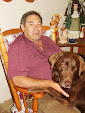
That is Merrit Clapp-Smith, board member in the orange shirt… this organization set out to disrupt our struggle to save the Big Bog--- our primary freshwater aquifer up here in northern Minnesota… Merritt Clapp-Smith is a past president of the Summit Hill Neighborhood Association and presently is a member of that board… it becomes very interesting to see how these business interests operate… Merritt Clapp-Smith, working with the Catholic Archdiocese of St. Paul-Minneapolis chose a Catholic School community center in which it would be easier to control and manipulate the “public work” of the Ford Site Planning Committee rather than use the public facilities of the UAW-Ford-MnScu Training Center.
I have asked both St. Paul Councilman Harris and Merritt Clapp-Smith to provide us with some of their family histories, both have refused. There is ample reason to believe that both Merritt Clapp-Smith and Councilman Harris have a conflict of interest in the work of the Ford Site Planning Committee.
It is very interesting to note how Merritt Clapp-Smith fosters and advances the work of this extremely wealthy ruling clique composed of the “Summit Hill Crowd,” the St. Paul Chamber of Commerce, and the “DFL Business Caucus.” It is this same grouping that has been in the center of being against everything that working people need in each of the issues I have noted. Make no mistake, on the issue of single-payer, universal health care this grouping has worked in the Minnesota Legislature to derail single-payer, universal health care movement in the exact same way that they have blocked the attempt to save the Ford Plant and the jobs of over two-thousand union workers.
Now, if this doesn’t send a clear signal to all of us working on these various issues that we need to come together in order to counter this powerful grouping of the well-heeled and wealthy I don’t know what ever will… but consider the fact that it is this very same conservative and reactionary bunch that denied Bishop Thomas Gumbleton the right to speak yesterday morning at St. Joan of Arc Catholic Church… and it was this group’s favorite Bishop, Harry Flynn, who did their dirty work just as Merritt Clapp-Smith has been doing.
Finally we are getting a glimpse of how this undemocratic, corrupt little group works together in order to make the decisions over the quality of the air we breathe and the water we drink and the jobs we have.
It is no wonder why Red Lake Gaming Enterprises has approached this little group with the idea of using its last gaming license to build a huge new casino along the St. Paul Mississippi River bank and why the Ford Motor Company wants to maintain ownership of this 15 acre parcel of prime real estate.
I think we need to ask how much DFL Chair Brian Melendez and DFL Executive Director Andrew O’Leary know about all of this… and we need to know why a DFL Senate Committee composed of eleven DFL members and only seven Republicans could not carry forward the legislation to protect the Ford Plant from the wrecking ball last Thursday in committee.
I would note that it is the very same DFL legislators, who are in fact the majority of the DFL caucus, whom have looked the other way in indifference as over twenty thousand Minnesotans go to work every day in smoke-filled casinos at poverty wages without any rights under state or federal labor laws… something that autoworkers may want to keep in mind as they apply for all those casino jobs that will be replacing their present employment with the Ford Motor Company.
Perhaps there is “an inconvenient truth” in all of this; that the well-heeled and the wealthy have created the game and made all the rules so they can profit at our expense exploiting our labor.
This is all very interesting indeed seeing how Merritt Clapp-Smith sits on the Board of the Minnesota Center for Environmental Advocacy, the same organization that tried to stick a monkey wrench into the struggle to save the Big Bog from another crooked and corrupt deal involving Red Lake Gaming Enterprises trading off its opposition to peat mining for favorable consideration of a casino operation in International Falls… a dirty deal orchestrated by one of the Minnesota Center for Environmental Advocacy’s favorite DFL Congressmen… James Oberstar, who just happens to be a favorite Congressman of Harry Flynn and the St. Paul Chamber of Commerce.
And the Saint Paul Police Department and the FBI want to know what I am doing three hundred and fifty miles from home sticking my nose into what is going on with the Ford Plant.
Oh, and on a final note: It took me over a year to obtain the letter signed by Red Lake Nation Chairman Butch Brun dropping opposition to peat mining in the Big Bog in return for the right of Red Lake Gaming Enterprises to build a new casino in International Falls… it will be relatively easy for me to obtain the birth certificates of Councilman Harris and Merritt Clapp-Smith to begin to explain their long term associations with the business and financial community in St. Paul… but if it took me a year to wrest this letter signed by Chairman Brun of the Red Lake Nation that was on file with the United States Army Corps of Engineers, the Minnesota DNR, the Koochiching County Board, the Red Lake Tribal Council, and in the files of United States Congressman James Oberstar… how long is it going to take me to research and obtain the records associated with the Ford Site Planning Committee and the present underhanded work of Merritt Clapp-Smith and the Ford Motor Company, this “DFL Business Caucus,” and the St. Paul Chamber of Commerce?
Keep in mind… Ford Motor Company intends to bring out the wrecking balls in about a year.
I think there are members of the DFL Caucus in the Minnesota Legislature who know a lot more than what they are saying about how the Minnesota DFL is being manipulated and controlled by these business interests. It is time they save us all a lot of time and step forward and tell us what is going on.
It is time for the UAW’s Gettelfinger to put the full resources of the United Auto Workers Union into this struggle to save the St. Paul Ford Twin Cities Assembly Plant and not sell autoworkers’ jobs down the river as he has done at Bradford-White; and it is time for the rail unions to do the same thing… not only with research, but to insist that the politicians who have been the recipients of campaign contributions of autoworkers and the rail unions now do their part in this struggle to save the Ford Plant which is closely related to all of these other struggles. Let there be no more “Dirty Thursdays” as Senator Cohen develops a new legislative approach towards saving the Ford Plant. It is time for Senator David Tomasonni, and Representatives Tony Sertich, Tom Rukavina, and Tom Anzelc to step boldly into this struggle and insist that there be unity in both the DFL controlled Senate and House.
We all know that the only way this Ford Plant is going to be saved is through public ownership of this plant… we are not talking about “mothballing” a plant structure, and the equipment inside of this plant… we are talking about keeping at least two thousand workers employed in an operating industrial production… this should be the focus of Senator Cohen’s future legislation and the UAW’s Gettelfinger should make this clear to Senator Cohen, Sertich, Rukavina, and Anzlc who will have to carry the ball for working people on this struggle… they have been dropping and fumbling the ball, now it is time for them to shape up before Ford and the Ford Site Planning Committee bring in the wrecking ball.
A lot can be done in one year, all is far from futile; the Ford Plant can be saved; but, if we are going to be successful we have a lot of work to do. Powerful influences of big money have to be overcome.
We prevented Red Lake Gaming Enterprises from building a new casino in International Falls with a door-to-door informational campaign, we have established casino worker organizing committees throughout Minnesota, Wisconsin, Michigan, and Iowa, we have held off a Canadian corporation’s attempt to mine peat in the Big Bog, we got seventy percent of the delegates at the last DFL State Convention to go on record supporting single-payer, universal health care; we successfully beat back attempts in several home foreclosure cases without any help from the DFL in spite of all their talk about predatory lending… we can beat back the drive to demolish the Ford Plant if we take off the gloves and confront these powerful economic interests by bringing the Ford workers, the people of the Twin Cities, and all Minnesotans into this struggle.
If anyone doubts that the struggle for an end to this dirty war in Iraq is not closely related to the struggle to save the Ford Plant through public ownership, take a drive or a walk through the community surrounding the Ford Plant… the only sign supporting this dirty war in Iraq in the entire community was placed at the entrance gate to the Ford Plant by company management… the rest of the surrounding community is filled with signs to stop the war.
The UAW should consider putting as much into making this a full scale community organizing effort as what they put into supporting DFL politicians... this spring, let's see some yard signs sprouting up like dandelions insisting the Ford Plant stay open under public ownership with people going door-to-door talking to their neighbors in much the same way the UAW uses its resources to get out the vote on Election Day. Petitions, leaflets, rallies, and demonstrations... let's see organize labor marching through the communities like they marched around the DFL State Convention floor in support of Mike Hatch and Amy Klobuchar.
We can no longer afford to heed the narrow vision of those who want us to view all of these issues ranging from single-payer, universal health care to the Ford Plant closing to the rights of casino workers as somehow unrelated… the “Summit Hill Crowd” understands that all of these issues are interconnected, even if we do not… anyone care to ask Merritt Clapp-Smith or Councilman Harris their views on the war in Iraq?
Senator Metzen’s Committee met to consider Senator Cohen’s proposed legislation, SF 607 from 3:15 to 4:34 on Thursday, April 19, 2007 with fourteen of eighteen members of the Committee present and by the time the vote was taken for which the person responsible for taking the minutes conveniently left out how the remaining members voted from the minutes… the vote was recorded as seven opposed and three for. We must remember DFL Senator Metzen is the Chair of this committee made up of eleven members from the DFL and seven Republicans. How then, can a Party which claims to represent labor not pass this legislation [Note: at the bottom I have attached the “minutes” of the meeting such as they are as I received them from Lisa Sarnes; I have placed “minutes” in quotation marks because based upon what one reads one has to ask if Lisa Sarnes is competent to be the clerk of such an important Committee; or, was a political decision made to have the “minutes” kept in this fashion]?
Below is a link to the voice recording of that Senate Committee meeting which I received from Ms. Sarnes:
Dear Mr Maki,
Here is the information you requested-
To listen to the audio, copy and paste this in your browser. After scrolling past the blue boxes you will see that the very first meeting listed is the Business, Industry and Jobs Committee and that is the date you are looking for. I have also attached the minutes and the agenda.
http://www.senate.leg.state.mn.us/media/media_list.php?ls=85&archive_year=2007&category=committee&type=audio#header
Lisa Sarne
Legislative Assistant
Senator James Metzen
Capitol 322
651-296-4370
How dare Democratic Senator Metzen not require that his own legislative assistant (LA), Lisa Sarne, who is responsible for taking the minutes of this meeting not record how each and every member of this Committee voted and who was absent at the time of the vote on this very important piece of legislation.
What does this tell us about the collusion of business interests and the DFL to deprive working class Minnesotans of their right to participate in the democratic process?
Perhaps Harry Flynn could enlighten us as to the meaning of the term “blasphemy;” because how else would you describe this conduct on the part of elected and public officials who preach to the rest of the world that we live in the world’s greatest democracy when these public officials can’t even maintain the proper minutes of a Committee meeting that was called for only one purpose… to vote on SF 607 and which lasted only one hour and nineteen minutes? Any secretary of a high school student council can, and does, keep better minutes.
There needs to be accountability.
The UAW leadership of Mr. Gettelfinger from Solidarity House first put forth the idea that “We need to elect Mike Hatch the Governor of Minnesota and the UAW’s delegates to the state DFL convention got up and danced around the convention floor for Hatch like a bunch of teenage cheerleaders at a high school football game at half-time; and, according to Gettelfinger by putting all of our eggs in the Hatch basket we will be all set and things will work out with the Ford Plant… our members will be taken care of.”
Well, Gettelfinger chose a loser in Hatch; and the UAW is poised to lose two thousand members in the Twin Cities.
Then we heard from Solidarity House we will resolve this in the state legislature… oh, how the UAW political action people heaped praise on the DFL caucus members who chaired the committee meetings in the House and Senate on this proposed legislation.
What has this groveling of the Gettelfinger bunch achieved to date? Not one thing of substance for Ford workers who will now have difficulty saving their homes from foreclosure as the parasitic and predatory lenders of the St. Paul Chamber of Commerce and the DFL “Business Caucus” circle like vultures over road-kill.
Is anyone getting a clear picture here of how all of these issues are interrelated?
Who will pay their health care bills? For too long the Reuther bunch of which Gettelfinger is a member has put forward the losing proposition that the UAW will solve all of its problems by developing a cozy relationship with the employers; and, the politicians hand picked by these employers... the results of the Reuther bunch have been coming home to roost in plant closings, job losses, autoworkers suffering the consequences of the health care mess like the rest of us.
Now there is Gettelfinger’s great brain-fart: Interest Based Bargaining (IBB). I have photographs of all the campaign signs the UAW supported in the last election from the State DFL Convention… not one of these politicians, with the exception of Senator David Tomassoni, do we know showed up to support SF 607; not one.
A one hour hearing starts out with fourteen of eighteen members present with DFL’er Roger Skoe missing in action and probably out to dinner with his Republican colleagues and this committee ends up with ten members voting; seven to three in opposition to Senator Tomassoni’s motion to support! This is what passes for democracy? Where is the accountability in any of this.
The Republicans who knew their DFL colleagues didn't have the courage to support this legislation were so confident the DFL was opposed they were no-shows, not only for the vote but the hearing itself.
Look, the Republicans had nothing to do with defeating this most important piece of labor legislation that UAW members were counting on. The business controlled DFL legislators did the dirty work of their own volition.
Are the DFL members of this committee now going to have the political and moral courage to step forward to tell us why they left the committee hearing prior to the vote or voted against HF 607? Or, do we have to pry it out of them?
Rumor has it United States Congressman Keith Ellison apparently is awaiting a call from Walter Mondale to get his instructions on what to do about the Ford Plant closing. Mondale sure is taking his time to phone Ellison.
We have been hearing from the DFL leadership that they were unable to accomplish anything of importance for working people in the last legislative session because the Republicans had been in control… now, the Democrats are in complete control of the House and Senate here in Minnesota and they can not even get a very significant piece of legislation approved by one tiny little committee which they overwhelmingly and completely dominate.
We have faced the same thing on health care; and all of these other issues right on down the line. In place of Republicans we get DFL’ers like Leroy Stumpf, Frank Moe, Brita Sailor, and David Olin… big deal.
I went to a little party at the home of Bob Bergland for Ford Bell… David Olin was there. I said, “Oh, are you supporting Ford Bell for United States Senate?”… Olin walked me over into a corner where no one could hear and whispered very sofly, “Of course, or I wouldn’t be here.” I asked him, “Are you going to publicly endorse Ford Bell for the United States Senate against Amy Klobuchar?” He looked around to make sure no one was listening and whispered even softer into my ear, “Shhh, no one has to know I was here this evening, right?” This is the kind of two faced double dealing politicians that comprise the majority of the DFL caucus in both the Senate and the House… here in Minnesota, and in the United States Congress. How can working people accomplish anything backing these kinds of opportunist, back-stabbing, sleaze-balls?
Several days before the election Olin boasted to the media that he was more conservative than his reactionary Republican opponent… I would be willing to bet that Representative David Olin has formed a fast, lasting and deep friendship with Harry Flynn and the “Summit Hill” gang. And Olin was chosen to run by State Senator Leroy Stumpf whose claim to fame is that he has never voted against a piece of legislation that business is for; coincidentally… Roger Skoe and Leroy Stumpf are great chums; and Skoe doesn’t show up for the hearing on SF 607; coincidental? I don't think so.
That the Minnesota DFL is playing games as two thousand jobs in the auto industry go down the river so several thousand poverty wage jobs in a casino can be created is the epitome of what one would call a “sell out” and “betrayal” of working people considering the fact that the very same Democratic Party is also responsible for casino workers having no rights in Minnesota… and Wisconsin, and Michigan, and Iowa… and all across this country.
Yesterday these powerful economic interests silenced the progressive voice of Bishop Thomas Gumbleton… it is now up to us to carry Bishop Gumbleton’s message for peace and social justice out into the communities across Minnesota.
For three days Legislative Assistants have been scurrying about the State Capitol frantically seeking advice on “How should we respond to these questions Maki is asking now?”
I think rather than worrying about how these legislative assistants have been sent scurrying by their bosses trying to figure out how to prevent me from gaining access to information… someone should whip the DFL caucus members into line.
Tell Harry Flynn, Merritt Clapp-Smith, the Summit Hill crowd, the DFL Business Caucus, and the St. Paul Chamber of Commerce to go to hell.
It is a sad day in Minnesota when working people get shafted like this… casino workers understand because we have been getting shafted like this by the DFL and the Democratic Party for a very long time.
Alan L. Maki
Director of Organizing
Red Lake Casino, Hotel, and Restaurant Employees’ Union Organizing Committee
And
Member of the Minnesota Democratic Farmer-Labor Party State Central Committee
Agenda and minutes of the:
Business, Industry and Jobs Committee
Senator Jim Metzen, Chair
Thursday, April 19, 2007
3:00 p.m. – Room 15 State Capitol
AGENDA
1. S.F. 607-Cohen: Motor vehicle manufacturing plant maintenance requirement.
Proponents: Bob Kailleen, United Auto Workers
Don Gerdesmeier, Joint Council 32 DRIVE
Phillip Qualy, United Transportation Union
Opponents: Mary Culler, Director of Government Affairs, Ford Motor Company
Cecile Bedor, City of St. Paul Director of Planning & Economic Dvlp.
Mark Moeller or Sandra Westerman, St. Paul Chamber of Commerce
BUSINESS, INDUSTRY AND JOBS COMMITTEE
SENATOR JAMES METZEN, CHAIR
Senator James Metzen, Chairman of the Business, Industry and Jobs Committee, called the meeting to order at 3:15 p.m. on Thursday, April 19, 2007 in room 15 of the State Capitol.
The clerk noted the roll. The following members were present:
Metzen, Chair
Saltzman, Vice-Chair
Bakk
Bonoff
Carlson
Day
Gimse
Koch
Latz
Michel
Murphy
Scheid
Sparks
Tomassoni
The following members were absent:
Gerlach
Neuville
Rosen
Skoe
Meeting began with a quorum.
1. S.F. 607-Cohen: Motor vehicle manufacturing plant maintenance requirement.
The following people gave testimony in favor of S.F. 607:
Bob Kailleen, United Auto Workers
Don Gerdesmeier, Joint Council 32 DRIVE
Phillip Qualy, United Transportation Union
Questions and comments from the committee followed.
The following people gave testimony in opposition to S.F. 607:
Mary Culler, Director of Government Affairs, Ford Motor Company
Cecile Bedor, City of St. Paul Director of Planning & Economic Development
Mark Moeller, St. Paul Chamber of Commerce
Questions and Comments from the committee followed.
Senator Cohen and Phillip Qualy gave closing remarks in favor of S.F. 607
Senator Tomassoni moved that the bill do pass and be re-referred to the Committee on Rules and Administration.
The Chair was in doubt and called for a division.
The motion did not prevail.
The meeting adjourned at 4:34 p.m.
_________________________________
James Metzen, Chair
Business, Industry and Jobs Committee
_________________________________
Lisa Sarne
Committee Clerk
Yes, the "DFL Business Caucus" dominates the Minnesota Democratic Farmer-Labor Party... But, there is no "B" in the name. "B" for business... make that double B for big-business.
There is a common thread that links these groups of the most reactionary elements in our state. That link is the drive for maximum corporate profits and these groups all have a vested interest in seeing to it that a real open and democratic discussion does not take place… to this end these powerful wealthy, corporate interests have engaged the services of one Merritt Clapp-Smith to carry forward the corporate anti-people, anti-environment agenda.
We have seen how Merritt Clapp-Smith has been made a cheerleader for the “Summit Hill Crowd” and she is closely associated with all of these very conservative and reactionary business interests… as a board member of the Minnesota Center for Environmental Advocacy which is nothing more than a front for the forestry, mining, and power generating industries who drag this organization out every time they want to create another environmental mess. Check it out:
http://www.mncenter.org/photos/mcea_board_of_directors/index.html
That is Merrit Clapp-Smith, board member in the orange shirt… this organization set out to disrupt our struggle to save the Big Bog--- our primary freshwater aquifer up here in northern Minnesota… Merritt Clapp-Smith is a past president of the Summit Hill Neighborhood Association and presently is a member of that board… it becomes very interesting to see how these business interests operate… Merritt Clapp-Smith, working with the Catholic Archdiocese of St. Paul-Minneapolis chose a Catholic School community center in which it would be easier to control and manipulate the “public work” of the Ford Site Planning Committee rather than use the public facilities of the UAW-Ford-MnScu Training Center.
I have asked both St. Paul Councilman Harris and Merritt Clapp-Smith to provide us with some of their family histories, both have refused. There is ample reason to believe that both Merritt Clapp-Smith and Councilman Harris have a conflict of interest in the work of the Ford Site Planning Committee.
It is very interesting to note how Merritt Clapp-Smith fosters and advances the work of this extremely wealthy ruling clique composed of the “Summit Hill Crowd,” the St. Paul Chamber of Commerce, and the “DFL Business Caucus.” It is this same grouping that has been in the center of being against everything that working people need in each of the issues I have noted. Make no mistake, on the issue of single-payer, universal health care this grouping has worked in the Minnesota Legislature to derail single-payer, universal health care movement in the exact same way that they have blocked the attempt to save the Ford Plant and the jobs of over two-thousand union workers.
Now, if this doesn’t send a clear signal to all of us working on these various issues that we need to come together in order to counter this powerful grouping of the well-heeled and wealthy I don’t know what ever will… but consider the fact that it is this very same conservative and reactionary bunch that denied Bishop Thomas Gumbleton the right to speak yesterday morning at St. Joan of Arc Catholic Church… and it was this group’s favorite Bishop, Harry Flynn, who did their dirty work just as Merritt Clapp-Smith has been doing.
Finally we are getting a glimpse of how this undemocratic, corrupt little group works together in order to make the decisions over the quality of the air we breathe and the water we drink and the jobs we have.
It is no wonder why Red Lake Gaming Enterprises has approached this little group with the idea of using its last gaming license to build a huge new casino along the St. Paul Mississippi River bank and why the Ford Motor Company wants to maintain ownership of this 15 acre parcel of prime real estate.
I think we need to ask how much DFL Chair Brian Melendez and DFL Executive Director Andrew O’Leary know about all of this… and we need to know why a DFL Senate Committee composed of eleven DFL members and only seven Republicans could not carry forward the legislation to protect the Ford Plant from the wrecking ball last Thursday in committee.
I would note that it is the very same DFL legislators, who are in fact the majority of the DFL caucus, whom have looked the other way in indifference as over twenty thousand Minnesotans go to work every day in smoke-filled casinos at poverty wages without any rights under state or federal labor laws… something that autoworkers may want to keep in mind as they apply for all those casino jobs that will be replacing their present employment with the Ford Motor Company.
Perhaps there is “an inconvenient truth” in all of this; that the well-heeled and the wealthy have created the game and made all the rules so they can profit at our expense exploiting our labor.
This is all very interesting indeed seeing how Merritt Clapp-Smith sits on the Board of the Minnesota Center for Environmental Advocacy, the same organization that tried to stick a monkey wrench into the struggle to save the Big Bog from another crooked and corrupt deal involving Red Lake Gaming Enterprises trading off its opposition to peat mining for favorable consideration of a casino operation in International Falls… a dirty deal orchestrated by one of the Minnesota Center for Environmental Advocacy’s favorite DFL Congressmen… James Oberstar, who just happens to be a favorite Congressman of Harry Flynn and the St. Paul Chamber of Commerce.
And the Saint Paul Police Department and the FBI want to know what I am doing three hundred and fifty miles from home sticking my nose into what is going on with the Ford Plant.
Oh, and on a final note: It took me over a year to obtain the letter signed by Red Lake Nation Chairman Butch Brun dropping opposition to peat mining in the Big Bog in return for the right of Red Lake Gaming Enterprises to build a new casino in International Falls… it will be relatively easy for me to obtain the birth certificates of Councilman Harris and Merritt Clapp-Smith to begin to explain their long term associations with the business and financial community in St. Paul… but if it took me a year to wrest this letter signed by Chairman Brun of the Red Lake Nation that was on file with the United States Army Corps of Engineers, the Minnesota DNR, the Koochiching County Board, the Red Lake Tribal Council, and in the files of United States Congressman James Oberstar… how long is it going to take me to research and obtain the records associated with the Ford Site Planning Committee and the present underhanded work of Merritt Clapp-Smith and the Ford Motor Company, this “DFL Business Caucus,” and the St. Paul Chamber of Commerce?
Keep in mind… Ford Motor Company intends to bring out the wrecking balls in about a year.
I think there are members of the DFL Caucus in the Minnesota Legislature who know a lot more than what they are saying about how the Minnesota DFL is being manipulated and controlled by these business interests. It is time they save us all a lot of time and step forward and tell us what is going on.
It is time for the UAW’s Gettelfinger to put the full resources of the United Auto Workers Union into this struggle to save the St. Paul Ford Twin Cities Assembly Plant and not sell autoworkers’ jobs down the river as he has done at Bradford-White; and it is time for the rail unions to do the same thing… not only with research, but to insist that the politicians who have been the recipients of campaign contributions of autoworkers and the rail unions now do their part in this struggle to save the Ford Plant which is closely related to all of these other struggles. Let there be no more “Dirty Thursdays” as Senator Cohen develops a new legislative approach towards saving the Ford Plant. It is time for Senator David Tomasonni, and Representatives Tony Sertich, Tom Rukavina, and Tom Anzelc to step boldly into this struggle and insist that there be unity in both the DFL controlled Senate and House.
We all know that the only way this Ford Plant is going to be saved is through public ownership of this plant… we are not talking about “mothballing” a plant structure, and the equipment inside of this plant… we are talking about keeping at least two thousand workers employed in an operating industrial production… this should be the focus of Senator Cohen’s future legislation and the UAW’s Gettelfinger should make this clear to Senator Cohen, Sertich, Rukavina, and Anzlc who will have to carry the ball for working people on this struggle… they have been dropping and fumbling the ball, now it is time for them to shape up before Ford and the Ford Site Planning Committee bring in the wrecking ball.
A lot can be done in one year, all is far from futile; the Ford Plant can be saved; but, if we are going to be successful we have a lot of work to do. Powerful influences of big money have to be overcome.
We prevented Red Lake Gaming Enterprises from building a new casino in International Falls with a door-to-door informational campaign, we have established casino worker organizing committees throughout Minnesota, Wisconsin, Michigan, and Iowa, we have held off a Canadian corporation’s attempt to mine peat in the Big Bog, we got seventy percent of the delegates at the last DFL State Convention to go on record supporting single-payer, universal health care; we successfully beat back attempts in several home foreclosure cases without any help from the DFL in spite of all their talk about predatory lending… we can beat back the drive to demolish the Ford Plant if we take off the gloves and confront these powerful economic interests by bringing the Ford workers, the people of the Twin Cities, and all Minnesotans into this struggle.
If anyone doubts that the struggle for an end to this dirty war in Iraq is not closely related to the struggle to save the Ford Plant through public ownership, take a drive or a walk through the community surrounding the Ford Plant… the only sign supporting this dirty war in Iraq in the entire community was placed at the entrance gate to the Ford Plant by company management… the rest of the surrounding community is filled with signs to stop the war.
The UAW should consider putting as much into making this a full scale community organizing effort as what they put into supporting DFL politicians... this spring, let's see some yard signs sprouting up like dandelions insisting the Ford Plant stay open under public ownership with people going door-to-door talking to their neighbors in much the same way the UAW uses its resources to get out the vote on Election Day. Petitions, leaflets, rallies, and demonstrations... let's see organize labor marching through the communities like they marched around the DFL State Convention floor in support of Mike Hatch and Amy Klobuchar.
We can no longer afford to heed the narrow vision of those who want us to view all of these issues ranging from single-payer, universal health care to the Ford Plant closing to the rights of casino workers as somehow unrelated… the “Summit Hill Crowd” understands that all of these issues are interconnected, even if we do not… anyone care to ask Merritt Clapp-Smith or Councilman Harris their views on the war in Iraq?
Senator Metzen’s Committee met to consider Senator Cohen’s proposed legislation, SF 607 from 3:15 to 4:34 on Thursday, April 19, 2007 with fourteen of eighteen members of the Committee present and by the time the vote was taken for which the person responsible for taking the minutes conveniently left out how the remaining members voted from the minutes… the vote was recorded as seven opposed and three for. We must remember DFL Senator Metzen is the Chair of this committee made up of eleven members from the DFL and seven Republicans. How then, can a Party which claims to represent labor not pass this legislation [Note: at the bottom I have attached the “minutes” of the meeting such as they are as I received them from Lisa Sarnes; I have placed “minutes” in quotation marks because based upon what one reads one has to ask if Lisa Sarnes is competent to be the clerk of such an important Committee; or, was a political decision made to have the “minutes” kept in this fashion]?
Below is a link to the voice recording of that Senate Committee meeting which I received from Ms. Sarnes:
Dear Mr Maki,
Here is the information you requested-
To listen to the audio, copy and paste this in your browser. After scrolling past the blue boxes you will see that the very first meeting listed is the Business, Industry and Jobs Committee and that is the date you are looking for. I have also attached the minutes and the agenda.
http://www.senate.leg.state.mn.us/media/media_list.php?ls=85&archive_year=2007&category=committee&type=audio#header
Lisa Sarne
Legislative Assistant
Senator James Metzen
Capitol 322
651-296-4370
How dare Democratic Senator Metzen not require that his own legislative assistant (LA), Lisa Sarne, who is responsible for taking the minutes of this meeting not record how each and every member of this Committee voted and who was absent at the time of the vote on this very important piece of legislation.
What does this tell us about the collusion of business interests and the DFL to deprive working class Minnesotans of their right to participate in the democratic process?
Perhaps Harry Flynn could enlighten us as to the meaning of the term “blasphemy;” because how else would you describe this conduct on the part of elected and public officials who preach to the rest of the world that we live in the world’s greatest democracy when these public officials can’t even maintain the proper minutes of a Committee meeting that was called for only one purpose… to vote on SF 607 and which lasted only one hour and nineteen minutes? Any secretary of a high school student council can, and does, keep better minutes.
There needs to be accountability.
The UAW leadership of Mr. Gettelfinger from Solidarity House first put forth the idea that “We need to elect Mike Hatch the Governor of Minnesota and the UAW’s delegates to the state DFL convention got up and danced around the convention floor for Hatch like a bunch of teenage cheerleaders at a high school football game at half-time; and, according to Gettelfinger by putting all of our eggs in the Hatch basket we will be all set and things will work out with the Ford Plant… our members will be taken care of.”
Well, Gettelfinger chose a loser in Hatch; and the UAW is poised to lose two thousand members in the Twin Cities.
Then we heard from Solidarity House we will resolve this in the state legislature… oh, how the UAW political action people heaped praise on the DFL caucus members who chaired the committee meetings in the House and Senate on this proposed legislation.
What has this groveling of the Gettelfinger bunch achieved to date? Not one thing of substance for Ford workers who will now have difficulty saving their homes from foreclosure as the parasitic and predatory lenders of the St. Paul Chamber of Commerce and the DFL “Business Caucus” circle like vultures over road-kill.
Is anyone getting a clear picture here of how all of these issues are interrelated?
Who will pay their health care bills? For too long the Reuther bunch of which Gettelfinger is a member has put forward the losing proposition that the UAW will solve all of its problems by developing a cozy relationship with the employers; and, the politicians hand picked by these employers... the results of the Reuther bunch have been coming home to roost in plant closings, job losses, autoworkers suffering the consequences of the health care mess like the rest of us.
Now there is Gettelfinger’s great brain-fart: Interest Based Bargaining (IBB). I have photographs of all the campaign signs the UAW supported in the last election from the State DFL Convention… not one of these politicians, with the exception of Senator David Tomassoni, do we know showed up to support SF 607; not one.
A one hour hearing starts out with fourteen of eighteen members present with DFL’er Roger Skoe missing in action and probably out to dinner with his Republican colleagues and this committee ends up with ten members voting; seven to three in opposition to Senator Tomassoni’s motion to support! This is what passes for democracy? Where is the accountability in any of this.
The Republicans who knew their DFL colleagues didn't have the courage to support this legislation were so confident the DFL was opposed they were no-shows, not only for the vote but the hearing itself.
Look, the Republicans had nothing to do with defeating this most important piece of labor legislation that UAW members were counting on. The business controlled DFL legislators did the dirty work of their own volition.
Are the DFL members of this committee now going to have the political and moral courage to step forward to tell us why they left the committee hearing prior to the vote or voted against HF 607? Or, do we have to pry it out of them?
Rumor has it United States Congressman Keith Ellison apparently is awaiting a call from Walter Mondale to get his instructions on what to do about the Ford Plant closing. Mondale sure is taking his time to phone Ellison.
We have been hearing from the DFL leadership that they were unable to accomplish anything of importance for working people in the last legislative session because the Republicans had been in control… now, the Democrats are in complete control of the House and Senate here in Minnesota and they can not even get a very significant piece of legislation approved by one tiny little committee which they overwhelmingly and completely dominate.
We have faced the same thing on health care; and all of these other issues right on down the line. In place of Republicans we get DFL’ers like Leroy Stumpf, Frank Moe, Brita Sailor, and David Olin… big deal.
I went to a little party at the home of Bob Bergland for Ford Bell… David Olin was there. I said, “Oh, are you supporting Ford Bell for United States Senate?”… Olin walked me over into a corner where no one could hear and whispered very sofly, “Of course, or I wouldn’t be here.” I asked him, “Are you going to publicly endorse Ford Bell for the United States Senate against Amy Klobuchar?” He looked around to make sure no one was listening and whispered even softer into my ear, “Shhh, no one has to know I was here this evening, right?” This is the kind of two faced double dealing politicians that comprise the majority of the DFL caucus in both the Senate and the House… here in Minnesota, and in the United States Congress. How can working people accomplish anything backing these kinds of opportunist, back-stabbing, sleaze-balls?
Several days before the election Olin boasted to the media that he was more conservative than his reactionary Republican opponent… I would be willing to bet that Representative David Olin has formed a fast, lasting and deep friendship with Harry Flynn and the “Summit Hill” gang. And Olin was chosen to run by State Senator Leroy Stumpf whose claim to fame is that he has never voted against a piece of legislation that business is for; coincidentally… Roger Skoe and Leroy Stumpf are great chums; and Skoe doesn’t show up for the hearing on SF 607; coincidental? I don't think so.
That the Minnesota DFL is playing games as two thousand jobs in the auto industry go down the river so several thousand poverty wage jobs in a casino can be created is the epitome of what one would call a “sell out” and “betrayal” of working people considering the fact that the very same Democratic Party is also responsible for casino workers having no rights in Minnesota… and Wisconsin, and Michigan, and Iowa… and all across this country.
Yesterday these powerful economic interests silenced the progressive voice of Bishop Thomas Gumbleton… it is now up to us to carry Bishop Gumbleton’s message for peace and social justice out into the communities across Minnesota.
For three days Legislative Assistants have been scurrying about the State Capitol frantically seeking advice on “How should we respond to these questions Maki is asking now?”
I think rather than worrying about how these legislative assistants have been sent scurrying by their bosses trying to figure out how to prevent me from gaining access to information… someone should whip the DFL caucus members into line.
Tell Harry Flynn, Merritt Clapp-Smith, the Summit Hill crowd, the DFL Business Caucus, and the St. Paul Chamber of Commerce to go to hell.
It is a sad day in Minnesota when working people get shafted like this… casino workers understand because we have been getting shafted like this by the DFL and the Democratic Party for a very long time.
Alan L. Maki
Director of Organizing
Red Lake Casino, Hotel, and Restaurant Employees’ Union Organizing Committee
And
Member of the Minnesota Democratic Farmer-Labor Party State Central Committee
Agenda and minutes of the:
Business, Industry and Jobs Committee
Senator Jim Metzen, Chair
Thursday, April 19, 2007
3:00 p.m. – Room 15 State Capitol
AGENDA
1. S.F. 607-Cohen: Motor vehicle manufacturing plant maintenance requirement.
Proponents: Bob Kailleen, United Auto Workers
Don Gerdesmeier, Joint Council 32 DRIVE
Phillip Qualy, United Transportation Union
Opponents: Mary Culler, Director of Government Affairs, Ford Motor Company
Cecile Bedor, City of St. Paul Director of Planning & Economic Dvlp.
Mark Moeller or Sandra Westerman, St. Paul Chamber of Commerce
BUSINESS, INDUSTRY AND JOBS COMMITTEE
SENATOR JAMES METZEN, CHAIR
Senator James Metzen, Chairman of the Business, Industry and Jobs Committee, called the meeting to order at 3:15 p.m. on Thursday, April 19, 2007 in room 15 of the State Capitol.
The clerk noted the roll. The following members were present:
Metzen, Chair
Saltzman, Vice-Chair
Bakk
Bonoff
Carlson
Day
Gimse
Koch
Latz
Michel
Murphy
Scheid
Sparks
Tomassoni
The following members were absent:
Gerlach
Neuville
Rosen
Skoe
Meeting began with a quorum.
1. S.F. 607-Cohen: Motor vehicle manufacturing plant maintenance requirement.
The following people gave testimony in favor of S.F. 607:
Bob Kailleen, United Auto Workers
Don Gerdesmeier, Joint Council 32 DRIVE
Phillip Qualy, United Transportation Union
Questions and comments from the committee followed.
The following people gave testimony in opposition to S.F. 607:
Mary Culler, Director of Government Affairs, Ford Motor Company
Cecile Bedor, City of St. Paul Director of Planning & Economic Development
Mark Moeller, St. Paul Chamber of Commerce
Questions and Comments from the committee followed.
Senator Cohen and Phillip Qualy gave closing remarks in favor of S.F. 607
Senator Tomassoni moved that the bill do pass and be re-referred to the Committee on Rules and Administration.
The Chair was in doubt and called for a division.
The motion did not prevail.
The meeting adjourned at 4:34 p.m.
_________________________________
James Metzen, Chair
Business, Industry and Jobs Committee
_________________________________
Lisa Sarne
Committee Clerk
Sunday, April 22, 2007
Bishop Thomas Gumbleton denied the right to speak at St. Joan of Arc Catholic Church in St. Paul Diocese in Minnesota
I spoke with the person answering the phone this morning at St. Joan of Arc Catholic Church, who refused to provide her name, but said that Pastor Tim De Bruycker had extended the invitation to Bishop Thomas Gumbleton of Detroit to speak this morning at their Church; and that the "invitation was rescinded" by the St. Paul Diocese; the Bishop of the Diocese is the very conservative and very reactionary Harry Flynn.
The St. Paul Catholic Diocese is known for its reactionary and conservative views as is its head, Bishop Harry Flynn.
The person who answered the phone at St. Joan of Arc Catholic Church told me that she felt the word "prohibited" which has been used by Charles Underwood in his "Peace calendar" was perhaps "too strong a word to use," but, that I could use any word I felt appropriate because in the end Bishop Gumbleton was not permitted the right to speak.
Bishop Gumbleton is one of the foremost champions of peace and social justice in the United States; and a foremost proponent of the rights of equality for the Palestinian people and has criticized the United States policy in Iraq from the day the war began and has been in the forefront of the nuclear weapons disarmament movement in the United states for decades. Bishop Gumbleton best exemplifies those who have the courage to speak out insisting that "swords be turned into plowshares." He is a cleric of unremarkable courage and conviction who has helped to house the homeless and feed the hungry. He has stood and spoken the truth to corporate power.
Those attending mass at St. Joan of Arc Catholic Church today were simply told that Bishop Gumbleton would not be present to address them this morning. No explanation was given.
This failure to provide an explanation has fueled speculation that Bishop Harry Flynn bowed to the pressures of the very wealthy, well-heeled, right-wing, anti-Palestinian lobby which supports the warmongering policies of the Israeli government of the corrupt Democratic Party machine of the "Summit Hill Club" and the St. Paul Chamber of Commerce which has a firm, tight grip on the Minnesota DFL, and has maneuvered and manipulated using every conceivable dirty trick in the book to prevent a full and open discussion concerning finding a just solution to the situation in the Middle East.
It is this same corrupt and anti-democratic grouping of "The Summit Hill Club" and the St. Paul Chamber of Commerce, that calls itself the "DFL Business Caucus" which has prevented me from participating as a duly elected member of the State Central Committee of the Minnesota Democratic Farmer-Labor Party after I took Walter Mondale to task and urged the DFL State Central Committee to take a stand in opposition to the recent Israeli carnage in Lebanon.
This "Business Caucus" took the lead in derailing the struggle for single-payer, universal health care.
It is this same "Business Caucus" that has refused to allow a thorough debate within the DFL concerning the war in Iraq.
It is this same "Business Caucus" that successfully stymied and blocked legislation in the Minnesota State Senate this past week to save the St. Paul Ford Twin Cities Assembly Plant.
It is this "Business Caucus" made up of members of the St. Paul Chamber of Commerce and the "Summit Hill Club" of which Merritt Clapp-Smith is on the Board of Directors and is the past President which now intends to demolish the Ford Plant destroying over 2,000 union jobs in the process; and, in its place put in a riverfront casino and upscale housing which has pressured the Arch Diocese of St. Paul to prohibit the humanist Bishop Thomas Gumbleton from speaking his mind at St. Joan of Arc Catholic Church.
It is this same anti-democratic and corrupt group of "business leaders" that is intent on returning the Minnesota Democratic Farmer-Labor Party to its origins noted for its racist support for the campaign of genocide to drive Native Americans from their homes and their lands, stole their resources, urged the mass hanging in Mankato, Minnesota--- and then continued to support slavery as they organized the most vicious mobs of "citizen committees" to beat-up union organizers; they then collaborated with the Republicans to run the most despicable, red-baiting, anti-Semitic campaign to oust from office Minnesota's most honest and popular Governor--- Elmer Benson.
It is this same group of corrupt DFL politicians that prevented Elmer Benson from continuing to have a voice in the newly formed Minnesota Democratic Farmer-Labor Party [the merger of the Democratic Party and the Minnesota Farmer-Labor Party] that has today denied Bishop Thomas Gumbleton the right to speak about peace and social justice and the rights of the Palestinian people along with supporting a just solution to the terrible problems and continuing violence in the Middle East.
If Bishop Thomas Gumbleton can be silenced by this band of two-bit, half-assed fascists there isn't a single person in America who enjoys freedom of speech and conscience anymore.
I would encourage everyone to speak out and condemn the anti-democratic actions of the "Summit Hill Club" and the St. Paul Chamber of Commerce along with the "DFL Business Caucus" and the Catholic Arch Diocese of St. Paul led by the conservative Harry Flynn who bowed to the pressure of this corrupt and undemocratic little group.
This is an outrage of the greatest magnitude.
THE WALL MUST FALL.
The St. Paul Catholic Diocese is known for its reactionary and conservative views as is its head, Bishop Harry Flynn.
The person who answered the phone at St. Joan of Arc Catholic Church told me that she felt the word "prohibited" which has been used by Charles Underwood in his "Peace calendar" was perhaps "too strong a word to use," but, that I could use any word I felt appropriate because in the end Bishop Gumbleton was not permitted the right to speak.
Bishop Gumbleton is one of the foremost champions of peace and social justice in the United States; and a foremost proponent of the rights of equality for the Palestinian people and has criticized the United States policy in Iraq from the day the war began and has been in the forefront of the nuclear weapons disarmament movement in the United states for decades. Bishop Gumbleton best exemplifies those who have the courage to speak out insisting that "swords be turned into plowshares." He is a cleric of unremarkable courage and conviction who has helped to house the homeless and feed the hungry. He has stood and spoken the truth to corporate power.
Those attending mass at St. Joan of Arc Catholic Church today were simply told that Bishop Gumbleton would not be present to address them this morning. No explanation was given.
This failure to provide an explanation has fueled speculation that Bishop Harry Flynn bowed to the pressures of the very wealthy, well-heeled, right-wing, anti-Palestinian lobby which supports the warmongering policies of the Israeli government of the corrupt Democratic Party machine of the "Summit Hill Club" and the St. Paul Chamber of Commerce which has a firm, tight grip on the Minnesota DFL, and has maneuvered and manipulated using every conceivable dirty trick in the book to prevent a full and open discussion concerning finding a just solution to the situation in the Middle East.
It is this same corrupt and anti-democratic grouping of "The Summit Hill Club" and the St. Paul Chamber of Commerce, that calls itself the "DFL Business Caucus" which has prevented me from participating as a duly elected member of the State Central Committee of the Minnesota Democratic Farmer-Labor Party after I took Walter Mondale to task and urged the DFL State Central Committee to take a stand in opposition to the recent Israeli carnage in Lebanon.
This "Business Caucus" took the lead in derailing the struggle for single-payer, universal health care.
It is this same "Business Caucus" that has refused to allow a thorough debate within the DFL concerning the war in Iraq.
It is this same "Business Caucus" that successfully stymied and blocked legislation in the Minnesota State Senate this past week to save the St. Paul Ford Twin Cities Assembly Plant.
It is this "Business Caucus" made up of members of the St. Paul Chamber of Commerce and the "Summit Hill Club" of which Merritt Clapp-Smith is on the Board of Directors and is the past President which now intends to demolish the Ford Plant destroying over 2,000 union jobs in the process; and, in its place put in a riverfront casino and upscale housing which has pressured the Arch Diocese of St. Paul to prohibit the humanist Bishop Thomas Gumbleton from speaking his mind at St. Joan of Arc Catholic Church.
It is this same anti-democratic and corrupt group of "business leaders" that is intent on returning the Minnesota Democratic Farmer-Labor Party to its origins noted for its racist support for the campaign of genocide to drive Native Americans from their homes and their lands, stole their resources, urged the mass hanging in Mankato, Minnesota--- and then continued to support slavery as they organized the most vicious mobs of "citizen committees" to beat-up union organizers; they then collaborated with the Republicans to run the most despicable, red-baiting, anti-Semitic campaign to oust from office Minnesota's most honest and popular Governor--- Elmer Benson.
It is this same group of corrupt DFL politicians that prevented Elmer Benson from continuing to have a voice in the newly formed Minnesota Democratic Farmer-Labor Party [the merger of the Democratic Party and the Minnesota Farmer-Labor Party] that has today denied Bishop Thomas Gumbleton the right to speak about peace and social justice and the rights of the Palestinian people along with supporting a just solution to the terrible problems and continuing violence in the Middle East.
If Bishop Thomas Gumbleton can be silenced by this band of two-bit, half-assed fascists there isn't a single person in America who enjoys freedom of speech and conscience anymore.
I would encourage everyone to speak out and condemn the anti-democratic actions of the "Summit Hill Club" and the St. Paul Chamber of Commerce along with the "DFL Business Caucus" and the Catholic Arch Diocese of St. Paul led by the conservative Harry Flynn who bowed to the pressure of this corrupt and undemocratic little group.
This is an outrage of the greatest magnitude.
THE WALL MUST FALL.
Saturday, April 21, 2007
President Bush got the welcome a warmonger deserves in Grand Rapids, Michigan
This coverage from the daily Republican rag and big business mouthpieces tells us a lot about what is going on in this country... both the Grand Rapids Press and WOTV continue to shamefully support this oilman's war.
The peace movement mobilizes thousands of people on the spur of the moment, and the Republican Party can't even bring out but a pitiful handful of warmongers that included bankers, the Huntings and the Pews, the Prince family which owns the Blackwater Agency, and Rich and Betsy DeVos along with General Motors' management, along with corporate executives that were brought in from Chicago, Detroit, and New York, along with a crowd of congressional staff of over one hundred from Washington D.C.
The crowd that was in attendance to greet President Bush included six board members of the local John Birch Society as well as members of the World Affairs Council together with Meijer and Bissel Corporation executives.
Only forty-four students from East Grand Rapids High School were allowed to attend because the Republicans were afraid of their own children in this Republican stronghold of East Grand Rapids, Michigan, the home of former Republican Congressman and our only un-elected President appointed by that crook Richard Nixon, Gerald R. Ford.
Bush, the Republicans, and the Secret Service chose this high school where the sons and daughters of the wealthy--- the bankers, corporate attorneys, and automotive executives go to school... no doubt Lee Iococa who often attends West Michigan Republican shindigs didn't receive an invitation either after Laura Bush read excerpts of his latest book to the President.
Peter Secchia was on hand as was Mike Lloyd the FBI informant turned Editor of the Grand Rapids Press who provided the FBI with much of the information in the dossier on Susan Logie. The group in attendance to hear Bush's words of wisdom were the wealthy and well-heeled while the rest of the people were kept far away.
The Secret Service and FBI even barred the school's teachers from attending Bush's speech because they were worried Bush would receive some loud "boos."
Previously Cheney was sent to deliver a speech to the Party faithful at conservative Calvin College which Cheney intentionally chose because he thought he was safe from protests... and he found out that neither he nor the Republican warmongers were welcome there.
One can't help but wonder what the people who are running this country are thinking when they are pursuing policies of war and destruction that are so unpopular that neither the President nor his Vice-President are welcome in these Republican strongholds.
One thing neither of these media reports mention is that former Republican Grand Rapids Mayor John Logie just months ago, while invited to speak from the pulpit on a Sunday morning at one of the largest churches in Grand Rapids, called for the impeachment of George Bush and Dick Cheney for lying to the American people about this dirty war in Iraq. Logie was the longest serving mayor of Grand Rapids. Perhaps Logie is just angry that the Secret Service and the FBI have compiled a massive dossier, including wire taps and photo surveillance on the family home, because of the peace activities of his wife, Susan.
Protests against president are peaceful
Saturday, April 21, 2007
By Jim Harger
The Grand Rapids Press
EAST GRAND RAPIDS -- AnneMarie Bessette didn't come to shop when she took her 15-year-old daughter, Coralie, to Gaslight Village.
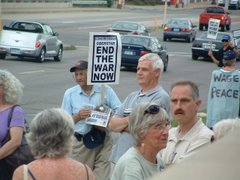
Mother and daughter were there to join nearly 1,000 protesters who roamed the business district Friday, waving signs and shouting anti-war chants while President Bush delivered a speech half a block away at East Grand Rapids High School.
"I'm trying to educate my children and help them understand international affairs," Bessette said. "I'm trying to help them understand what's happening in our country, and especially the war in Iraq."
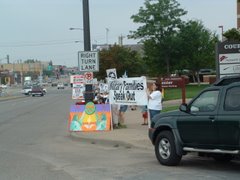
It was one of two separate protests held during Bush's brief visit to the Grand Rapids area. A smaller group of about 60 voiced their opposition to Bush and the war in Iraq at South Division Avenue and Fulton Street.
Prior to Bush's arrival at the high school, most of the protesters lined the east side of Lakeside Drive SE in the belief the president's motorcade would pass them. When the motorcade arrived from the other direction at 1 p.m., they streamed west along Wealthy Street SE and posted themselves at the intersection of Bagley Avenue SE.
Gaslight Village took on a carnival atmosphere as protesters drummed out anti-war chants and slogans.
Irene Bach, 83, basked in the sun and watched from a lawn chair that she and her husband, Sol, brought from their home on Breton Road.
"I guess I'm opposed to war, period," she said. "I'm very much for peace."
During the protest in downtown Grand Rapids, Amy Hamb, 38, of Rockford, stared at a 250-foot banner that carried the names and dates of death of more than 3,000 Americans killed during the war.
"Those are the dead?" whispered Hamb as she stood at a nearby bus stop. "I didn't realize. You hear about one or two West Michigan deaths, but those are the number dead from this war. I never got that," she said.
Plenty of cars beeped in recognition of the signs instructing "Honk if you want peace."
The handmade messages even included a nod to former President Reagan's words about the Berlin Wall: "Mr. President, tear down this war."
Donna Harris left her downtown residence to see the crowd gathering on the corner. She walked past the signs and moved in closer to examine the banner listing the names of the U.S. war dead. A furrow creased her brow.
"Oh my God, there are 43-year-old women on here. This really makes you face our dead," Harris said. "When I was younger, you used to be able to tell the president something and he would listen. That is not happening," said the 64-year-old woman, who described herself as an artist.
©2007 Grand Rapids Press
© 2007 Michigan Live. All Rights Reserved.
********
Bush in EGR: 'progress toward liberty'
Updated: April 20, 2007 04:28 PM CDT
EAST GRAND RAPIDS -- Less than 30 minutes after landing at Ford International Airport, President George W. Bush delivered a major policy speech about the Global War on Terror at East Grand Rapids High School.
The president was introduced by Dixie Anderson of the World Affairs Council, and the audience of about 500 included Reps. Vern Ehlers, Pete Hoekstra, Secretary of State Terri Lynn Land and longtime supporter Peter Secchia, plus 44 students from East Grand Rapids High School.
In prepared remarks lasting nearly 40 minutes, the president talked about the surge of both US troops and violence over the past few months.
President Bush said that sectarian murders have dropped by half in Baghdad since the U.S.-Iraqi military buildup began in February, rejecting a Democratic leader's claim that the war is lost.
"These operations are having an important effect on this young democracy," Bush said in a speech on terrorism, his second in two days. "They're showing Iraqi citizens across the country that there will be no sanctuary for killers anywhere in a free Iraq."
Bush said he continues to believe that Iraqi Prime Minister Nouri al-Maliki is committed to peace and reconciliation. At the same time, he said the U.S. military commitment in Iraq is not-open ended.
"Iraqis must not give in to al-Qaida if they want a peaceful society," he said.
Bush spoke at a high school to about 500 students and members of the World Affairs Council of Western Michigan. He urged Americans not to be swayed by the violence inflicted by suicide bombers. He said Wednesday's carnage, in which four large bombs exploded in mostly Shiite areas of Baghdad and killed 230 people, had all the "hallmarks of an al-Qaida attack."
It was the deadliest day in the city since the mid-February start of the U.S.-Iraqi campaign to reduce violence in the capital and Anbar Province, a stronghold for Sunni insurgents.
"Anbar province is still not safe," Bush said.
Pushing back against Democrats, Bush said that not all the troops that he ordered in January in a military buildup have arrived. It's too early to assume defeat, he said.
Senate Majority Leader Harry Reid, D-Nev., says the war in Iraq is "lost" and can only be won through political and economic diplomatic means. He said the surge is not accomplishing anything. Republicans have pounced on Reid for his comments, accusing him of turning his back on the troops and hurting military morale in Iraq.
Bush declined to take the gloves off.
"I respect the Democratic leadership," he said. "We have fundamental disagreements about whether or not helping this young democracy is, you know -- the consequences of failure or success, let's put it this way."
In past addresses, Bush has worked to paint a rose-colored picture of progress in Iraq. This time, he showed maps and photographs of destruction and acknowledged that tough challenges remain.
In recent days, Defense Secretary Robert Gates pressed al-Maliki to do more, and do it faster, to end sectarian strife. Navy Adm. William Fallon, chief of the U.S. Central Command, said Baghdad security has improved a bit but he, too, said Iraqis need to find a way to bring minority Sunnis, who ruled during Saddam Hussein's regime, fully into the government led by majority Shiites.
President Bush then was "happy to answer questions on any subject," and did so for nearly 30 minutes. The first question was how he dealt with Democratic control of the purse strings in Congress. The president answered he believed the troops would get the money they needed.
He expanded the answer to include how the sectarian violence began, how that impacted his decisions, and how it's taking time to train Iraqi troops to do what needs to be done.
The next question concerned his relationship with British Prime Minister Tony Blair, and the UK's plan to withdraw troops from certain regions of Iraq. "Tony Blair knows what I know," Bush said. "We are in a global war on terror. We are sometimes in different theaters, but we're fighting the global war."
Iran was the next topic of discussion, and how to deal with "their belligerent behavior." The president said the Iranians have defied the world community to "what I believe is to develop a nuclear weapon."
He said the country cannot give in to nuclear blackmail. Our objective, he said, "is to rally the world" to Iran's actions and garner support against their plans.
"Iran is a proud country with great traditions, but their government is" making bad choices.
A woman asked about the Iraq Study Group and the Baker-Hamilton recommendations. The president said he agreed with many of their recommendations, but he was bound "by conditions on the ground" in his reactions and decisions on conduct of the war. He said, plainly, he disagreed with some of their diplomatic recommendations, saying it would be counter-productive for face-to-face meetings with the Syrians until they change some of their behaviors.
In a reference to Nancy Pelosi's recent visit to Syria, the president said Syrian president Bashir Assad uses those visits to tell the world he's important. But, the president said, Assad has not lived up to any agreement with the international community.
"I don't know," Bush said when asked about al-Maliki's understanding of American patience. "We must make decisions based on principles and not on the latest opinion polls," he said to applause. "I believe in the universality of liberty...I firmly believe in the power of freedom."
A question about the US support of Saudi Arabia and other autocratic governments may be fomenting anger against the US. "It's not like I believe Jeffersonian democracy will be blooming in the desert," he said. "I do have a good relationship with King Abdullah and it gives me the chance to share my thoughts with him privately."
"There is progress being made," he added, "toward more liberty." Bush cited future elections in Egypt as being more open. "It takes a while. And the fundamental question is, will we be involved in the Middle East" in ways that affect their societies and the world at large.
"I will tell you," President Bush said, "I worry about us becoming isolationist and protectionist."
"We are all interconnected in this world."
The president wrapped up his session at 2:25 p.m.
After the speech, Bush made an unscheduled stop at the Gerald R. Ford Presidential Museum, where the former president was buried in January. He laid a bouquet of white roses on a stone wall that marks Ford's grave and paused there for a few moments.
*******
GRAND RAPIDS -- Officials at East Grand Rapids High School have been working all week to get ready for Friday's presidential visit, but a big difference you might notice now are the road closures.
Bagley Avenue will be closed from 9 a.m. Friday until 4 p.m. Lake Drive between Breton and Lovett will be shut down from 12:45 until 2:30, and Wealthy Street in Gaslight Village will be closed as the president arrives and departs from the school.
The president is expected to speak just after 1:00 Friday afternoon. The White House says he'll deliver a major policy speech on the war on terror. Although the school says the appearance is not a political statement, it's causing some issues among the students at East.
It's a scenario that plays out in just about every city and town the President visits: supporters versus protesters. Grand Rapids is no different. Both sides are planning to make their voices heard.
East Grand Rapids student Tim Vanderploeg is making sure he looks his best for the big day Friday. The high school senior was one of 44 lucky students picked in a random drawing to attend the President's speech.
Thursday, Vanderploeg, a staunch Bush supporter, said the excitement was almost overwhelming. "It's going to be hard to sleep knowing I'm going to see the leader of the free world tomorrow."
But not all students share his enthusiasm or support for the President. "There's been a little bit of tension," he admitted.
Katie Lorenz is also a senior at East. "The school right now is very tense, everyone is on edge," she said. "People are arguing in the hallways."
She and a group of students plan to join one of several protests at nearby John Collins Park. "We're planning to march as far as we can to the high school."
Lorenz is willing to leave school to take a stand for her cause. "It doesn't matter if you're Republican or Democrat, all we want is peace."
Former CIA advisor turned activist Ray McGovern will be part of what's anticipated to be the largest protest at the park. "We all feel a moral obligation to speak out," said McGovern.
Local Republicans anticipated a reaction to Bush's visit. "We respect their right to protest," said Kent County Republican Committee member Sam Moore.
The Committee said they will not hold a counter-demonstration-they believe the power of the presidency will speak for itself.
"I would anticipate he's going to renew his call that he will veto any legislation that sets a time table for withdrawal in Iraq," said Moore. "He wants the commanders on the ground to decide that, and that's the way it should be."
The note administrators sent home with students mentions conduct of the students as well. "We trust that the students of East Grand Rapids will conduct themselves in a manner that is responsible and respectful."
24 Hour News 8 will have more details about the President's visit Friday.
The peace movement mobilizes thousands of people on the spur of the moment, and the Republican Party can't even bring out but a pitiful handful of warmongers that included bankers, the Huntings and the Pews, the Prince family which owns the Blackwater Agency, and Rich and Betsy DeVos along with General Motors' management, along with corporate executives that were brought in from Chicago, Detroit, and New York, along with a crowd of congressional staff of over one hundred from Washington D.C.
The crowd that was in attendance to greet President Bush included six board members of the local John Birch Society as well as members of the World Affairs Council together with Meijer and Bissel Corporation executives.
Only forty-four students from East Grand Rapids High School were allowed to attend because the Republicans were afraid of their own children in this Republican stronghold of East Grand Rapids, Michigan, the home of former Republican Congressman and our only un-elected President appointed by that crook Richard Nixon, Gerald R. Ford.
Bush, the Republicans, and the Secret Service chose this high school where the sons and daughters of the wealthy--- the bankers, corporate attorneys, and automotive executives go to school... no doubt Lee Iococa who often attends West Michigan Republican shindigs didn't receive an invitation either after Laura Bush read excerpts of his latest book to the President.
Peter Secchia was on hand as was Mike Lloyd the FBI informant turned Editor of the Grand Rapids Press who provided the FBI with much of the information in the dossier on Susan Logie. The group in attendance to hear Bush's words of wisdom were the wealthy and well-heeled while the rest of the people were kept far away.
The Secret Service and FBI even barred the school's teachers from attending Bush's speech because they were worried Bush would receive some loud "boos."
Previously Cheney was sent to deliver a speech to the Party faithful at conservative Calvin College which Cheney intentionally chose because he thought he was safe from protests... and he found out that neither he nor the Republican warmongers were welcome there.
One can't help but wonder what the people who are running this country are thinking when they are pursuing policies of war and destruction that are so unpopular that neither the President nor his Vice-President are welcome in these Republican strongholds.
One thing neither of these media reports mention is that former Republican Grand Rapids Mayor John Logie just months ago, while invited to speak from the pulpit on a Sunday morning at one of the largest churches in Grand Rapids, called for the impeachment of George Bush and Dick Cheney for lying to the American people about this dirty war in Iraq. Logie was the longest serving mayor of Grand Rapids. Perhaps Logie is just angry that the Secret Service and the FBI have compiled a massive dossier, including wire taps and photo surveillance on the family home, because of the peace activities of his wife, Susan.
Protests against president are peaceful
Saturday, April 21, 2007
By Jim Harger
The Grand Rapids Press
EAST GRAND RAPIDS -- AnneMarie Bessette didn't come to shop when she took her 15-year-old daughter, Coralie, to Gaslight Village.
Mother and daughter were there to join nearly 1,000 protesters who roamed the business district Friday, waving signs and shouting anti-war chants while President Bush delivered a speech half a block away at East Grand Rapids High School.
"I'm trying to educate my children and help them understand international affairs," Bessette said. "I'm trying to help them understand what's happening in our country, and especially the war in Iraq."
It was one of two separate protests held during Bush's brief visit to the Grand Rapids area. A smaller group of about 60 voiced their opposition to Bush and the war in Iraq at South Division Avenue and Fulton Street.
Prior to Bush's arrival at the high school, most of the protesters lined the east side of Lakeside Drive SE in the belief the president's motorcade would pass them. When the motorcade arrived from the other direction at 1 p.m., they streamed west along Wealthy Street SE and posted themselves at the intersection of Bagley Avenue SE.
Gaslight Village took on a carnival atmosphere as protesters drummed out anti-war chants and slogans.
Irene Bach, 83, basked in the sun and watched from a lawn chair that she and her husband, Sol, brought from their home on Breton Road.
"I guess I'm opposed to war, period," she said. "I'm very much for peace."
During the protest in downtown Grand Rapids, Amy Hamb, 38, of Rockford, stared at a 250-foot banner that carried the names and dates of death of more than 3,000 Americans killed during the war.
"Those are the dead?" whispered Hamb as she stood at a nearby bus stop. "I didn't realize. You hear about one or two West Michigan deaths, but those are the number dead from this war. I never got that," she said.
Plenty of cars beeped in recognition of the signs instructing "Honk if you want peace."
The handmade messages even included a nod to former President Reagan's words about the Berlin Wall: "Mr. President, tear down this war."
Donna Harris left her downtown residence to see the crowd gathering on the corner. She walked past the signs and moved in closer to examine the banner listing the names of the U.S. war dead. A furrow creased her brow.
"Oh my God, there are 43-year-old women on here. This really makes you face our dead," Harris said. "When I was younger, you used to be able to tell the president something and he would listen. That is not happening," said the 64-year-old woman, who described herself as an artist.
©2007 Grand Rapids Press
© 2007 Michigan Live. All Rights Reserved.
********
Bush in EGR: 'progress toward liberty'
Updated: April 20, 2007 04:28 PM CDT
EAST GRAND RAPIDS -- Less than 30 minutes after landing at Ford International Airport, President George W. Bush delivered a major policy speech about the Global War on Terror at East Grand Rapids High School.
The president was introduced by Dixie Anderson of the World Affairs Council, and the audience of about 500 included Reps. Vern Ehlers, Pete Hoekstra, Secretary of State Terri Lynn Land and longtime supporter Peter Secchia, plus 44 students from East Grand Rapids High School.
In prepared remarks lasting nearly 40 minutes, the president talked about the surge of both US troops and violence over the past few months.
President Bush said that sectarian murders have dropped by half in Baghdad since the U.S.-Iraqi military buildup began in February, rejecting a Democratic leader's claim that the war is lost.
"These operations are having an important effect on this young democracy," Bush said in a speech on terrorism, his second in two days. "They're showing Iraqi citizens across the country that there will be no sanctuary for killers anywhere in a free Iraq."
Bush said he continues to believe that Iraqi Prime Minister Nouri al-Maliki is committed to peace and reconciliation. At the same time, he said the U.S. military commitment in Iraq is not-open ended.
"Iraqis must not give in to al-Qaida if they want a peaceful society," he said.
Bush spoke at a high school to about 500 students and members of the World Affairs Council of Western Michigan. He urged Americans not to be swayed by the violence inflicted by suicide bombers. He said Wednesday's carnage, in which four large bombs exploded in mostly Shiite areas of Baghdad and killed 230 people, had all the "hallmarks of an al-Qaida attack."
It was the deadliest day in the city since the mid-February start of the U.S.-Iraqi campaign to reduce violence in the capital and Anbar Province, a stronghold for Sunni insurgents.
"Anbar province is still not safe," Bush said.
Pushing back against Democrats, Bush said that not all the troops that he ordered in January in a military buildup have arrived. It's too early to assume defeat, he said.
Senate Majority Leader Harry Reid, D-Nev., says the war in Iraq is "lost" and can only be won through political and economic diplomatic means. He said the surge is not accomplishing anything. Republicans have pounced on Reid for his comments, accusing him of turning his back on the troops and hurting military morale in Iraq.
Bush declined to take the gloves off.
"I respect the Democratic leadership," he said. "We have fundamental disagreements about whether or not helping this young democracy is, you know -- the consequences of failure or success, let's put it this way."
In past addresses, Bush has worked to paint a rose-colored picture of progress in Iraq. This time, he showed maps and photographs of destruction and acknowledged that tough challenges remain.
In recent days, Defense Secretary Robert Gates pressed al-Maliki to do more, and do it faster, to end sectarian strife. Navy Adm. William Fallon, chief of the U.S. Central Command, said Baghdad security has improved a bit but he, too, said Iraqis need to find a way to bring minority Sunnis, who ruled during Saddam Hussein's regime, fully into the government led by majority Shiites.
President Bush then was "happy to answer questions on any subject," and did so for nearly 30 minutes. The first question was how he dealt with Democratic control of the purse strings in Congress. The president answered he believed the troops would get the money they needed.
He expanded the answer to include how the sectarian violence began, how that impacted his decisions, and how it's taking time to train Iraqi troops to do what needs to be done.
The next question concerned his relationship with British Prime Minister Tony Blair, and the UK's plan to withdraw troops from certain regions of Iraq. "Tony Blair knows what I know," Bush said. "We are in a global war on terror. We are sometimes in different theaters, but we're fighting the global war."
Iran was the next topic of discussion, and how to deal with "their belligerent behavior." The president said the Iranians have defied the world community to "what I believe is to develop a nuclear weapon."
He said the country cannot give in to nuclear blackmail. Our objective, he said, "is to rally the world" to Iran's actions and garner support against their plans.
"Iran is a proud country with great traditions, but their government is" making bad choices.
A woman asked about the Iraq Study Group and the Baker-Hamilton recommendations. The president said he agreed with many of their recommendations, but he was bound "by conditions on the ground" in his reactions and decisions on conduct of the war. He said, plainly, he disagreed with some of their diplomatic recommendations, saying it would be counter-productive for face-to-face meetings with the Syrians until they change some of their behaviors.
In a reference to Nancy Pelosi's recent visit to Syria, the president said Syrian president Bashir Assad uses those visits to tell the world he's important. But, the president said, Assad has not lived up to any agreement with the international community.
"I don't know," Bush said when asked about al-Maliki's understanding of American patience. "We must make decisions based on principles and not on the latest opinion polls," he said to applause. "I believe in the universality of liberty...I firmly believe in the power of freedom."
A question about the US support of Saudi Arabia and other autocratic governments may be fomenting anger against the US. "It's not like I believe Jeffersonian democracy will be blooming in the desert," he said. "I do have a good relationship with King Abdullah and it gives me the chance to share my thoughts with him privately."
"There is progress being made," he added, "toward more liberty." Bush cited future elections in Egypt as being more open. "It takes a while. And the fundamental question is, will we be involved in the Middle East" in ways that affect their societies and the world at large.
"I will tell you," President Bush said, "I worry about us becoming isolationist and protectionist."
"We are all interconnected in this world."
The president wrapped up his session at 2:25 p.m.
After the speech, Bush made an unscheduled stop at the Gerald R. Ford Presidential Museum, where the former president was buried in January. He laid a bouquet of white roses on a stone wall that marks Ford's grave and paused there for a few moments.
*******
GRAND RAPIDS -- Officials at East Grand Rapids High School have been working all week to get ready for Friday's presidential visit, but a big difference you might notice now are the road closures.
Bagley Avenue will be closed from 9 a.m. Friday until 4 p.m. Lake Drive between Breton and Lovett will be shut down from 12:45 until 2:30, and Wealthy Street in Gaslight Village will be closed as the president arrives and departs from the school.
The president is expected to speak just after 1:00 Friday afternoon. The White House says he'll deliver a major policy speech on the war on terror. Although the school says the appearance is not a political statement, it's causing some issues among the students at East.
It's a scenario that plays out in just about every city and town the President visits: supporters versus protesters. Grand Rapids is no different. Both sides are planning to make their voices heard.
East Grand Rapids student Tim Vanderploeg is making sure he looks his best for the big day Friday. The high school senior was one of 44 lucky students picked in a random drawing to attend the President's speech.
Thursday, Vanderploeg, a staunch Bush supporter, said the excitement was almost overwhelming. "It's going to be hard to sleep knowing I'm going to see the leader of the free world tomorrow."
But not all students share his enthusiasm or support for the President. "There's been a little bit of tension," he admitted.
Katie Lorenz is also a senior at East. "The school right now is very tense, everyone is on edge," she said. "People are arguing in the hallways."
She and a group of students plan to join one of several protests at nearby John Collins Park. "We're planning to march as far as we can to the high school."
Lorenz is willing to leave school to take a stand for her cause. "It doesn't matter if you're Republican or Democrat, all we want is peace."
Former CIA advisor turned activist Ray McGovern will be part of what's anticipated to be the largest protest at the park. "We all feel a moral obligation to speak out," said McGovern.
Local Republicans anticipated a reaction to Bush's visit. "We respect their right to protest," said Kent County Republican Committee member Sam Moore.
The Committee said they will not hold a counter-demonstration-they believe the power of the presidency will speak for itself.
"I would anticipate he's going to renew his call that he will veto any legislation that sets a time table for withdrawal in Iraq," said Moore. "He wants the commanders on the ground to decide that, and that's the way it should be."
The note administrators sent home with students mentions conduct of the students as well. "We trust that the students of East Grand Rapids will conduct themselves in a manner that is responsible and respectful."
24 Hour News 8 will have more details about the President's visit Friday.
Monday, April 16, 2007
The "Summit Hill" Crowd
I will be focusing on this issue on my blog over the next several months.
I think the time is now for hearings to determine if there isn’t some conflict of interest in what is going on with the Ford Plant and the Ford Site Planning Committee. Maybe some newspaper will have the courage to assign a few reporters to investigate what the Ford Motor Company is exchanging two thousand or more good paying jobs with excellent benefits for.
I think we need to know if the Ford Motor Company hasn’t made the decision to demolish this Plant because they have a more profitable scenario in mind. Keep in mind, Ford seems very unusually interested in the future of this property for a company that wants to abandon the property. Isn’t it kind of strange that no one has asked Ford if they intend to maintain a future financial interest as this property is "developed?"
I found many people in St. Paul struggling to keep their heads above water in paying mortgages ranging from $1,300.00 to over $4,000.00 dollars a month… and the Ford Site Planning Committee is planning for upscale housing for the well-heeled. Please see the last article from “The Nation”… in the same way, many homeowners in St. Paul are being foreclosed on right now because there is no way for them to meet their mortgage obligations; and neither the Mayor nor any city council members have stepped forward to assist these people. The DFL legislators have done absolutely nothing to halt predatory, parasitic lending, either.
I think we are getting a very good idea of the type of “planning” the Ford Site Planning Committee has in mind for this site…
Here is what I think “The Summit Hill Crowd” is looking at:
I think we will see a marina and high priced condos and town houses along the river and a new huge casino… luxury hotels and high-priced shops with artists and artisans.
I think we will see Ford remain as a partner in all of this much like what we see that Whirlpool Corporation has done in Benton Harbor, Michigan; as it shut down production in this community and moved production south and overseas. The properties and the economic scenarios are very similar.
We will see several thousand “service jobs” created that pay between $7.00 and $8.50 an hour with virtually no benefits; with tax-payers subsidizing these poverty wages with food stamps and welfare payments; and other workers throughout the area will suffer with this massive downward pressure on wages… we will see poverty in the Twin Cities soar out of sight and homelessness climb as soup kitchens scramble to keep up with their “new business.”
We will see the Minnesota Environmental Advocacy Council, a front for every polluting corporation in Minnesota, support all of this in the name of “open green spaces;” in the form of a few ballparks and a few small parks with some swings along with walking and biking trails.
I think we will see the City of St. Paul turn over its River Front property to these vultures known as venture capitalists and real estate speculators.
We will see the St. Paul Police Department crack down on child panhandlers; and, around election time crack down on prostitution.
Has anyone thought to ask if there might be some kind of conflict of interest among the public officials involved in all of this? Perhaps someone involved from the Mayor’s office or on the Ford Site Planning Committee has connections to gaming and real estate interests who will profit from all of this?
The “Summit Hill” crowd has big, big, plans for the Ford Property.
I can’t help but wonder how many members of the DFL state legislative caucus know what is going down here but won’t say. This may turn out to be one of the worst perversions of the democratic process in Minnesota history… not to mention the state's biggest boon-doggle.
I think we need to know why the UAW’s Gettelfinger has not dared to show his face in the Twin Cities to address this mess.
We may have to consider some kind of independent political action to address all of this. I think the time has come for the mass distribution of a special edition of a newspaper specifically focused on the future of the Ford Plant. Maybe even some kind of ballot initiative on public ownership of this plant.
Again, like the peat mining in the Big Bog, Minntac’s intent to contaminate the streams, rivers, and lakes of northern Minnesota and Lake Superior, and on the issues of single-payer, universal health care and the war in Iraq, the DFL State Central Committee and even the DFL Progressive Caucus refuses to address the issues involved in the Ford Plant closing and demolition. The continued silence is getting old. The Green Party has done no better. This is not being discussed on any of these list serves--- Shove’s Progressive Calendar has had little mention, while Charles Underwood’s “Peace Calendar” has not published anything in spite of a large sign promoting the war in Iraq at the Ford plant gate on Ford Parkway. I think we have a right to ask the question: What gives here?
I think we have to consider the influence that grants from “philanthropic foundations” in Minnesota have had in influencing the organizations that we have come to expect that would stand up and fight for what is right; my opinion is, that silence has been purchased.
Here are some web sites you might want to check out if you think the scenario I am putting forward is far-fetched:
http://www.epa.gov/swerosps/bf/06arc/harborshores.htm
http://www.chicagofed.org/publications/msa/msa12_01.pdf
http://www.abonmarche.com/devcomplete.html
http://www.michigan.gov/deq/0,1607,7-135-3308_3323-163914--,00.html
http://www.cornerstonechamber.com/about/pressroom.taf?do=read&newsid=12 (note the very last item in this press release by the Chamber of Commerce)
Check out how opponents to this kind of development are being treated in Benton Harbor, Michigan:
Published Apr 12, 2007 10:05 PM
The Rev. Edward Pinkney won’t be alone in Benton Harbor, Mich., when he faces the racist power structure that is trying to silence him and his organization, BANCO (Black Autonomy Network of Community Organizations). On March 21, the Rev. Edward Pinkney was convicted by an all-white jury on charges that supporters explain were highly motivated by political struggles taking place in Berrien County, Mich.
Detroit supporters are already organizing bus transportation to fill the courtroom when he is sentenced on May 14.
Rev. Pinkney was accused of five counts of election improprieties during the successful 2005 recall election of Glen Yarbrough, Benton Harbor city commissioner and supporter of the Harbor Shores Development.
In the first trial, a jury with two African-American participants could not reach agreement. Charges included merely having another person’s absentee ballot in his possession. Pinkney admitted giving stamps and labels to people who could not afford to buy stamps to send in their absentee ballots.
A well-known community leader, Rev. Pinkney relentlessly exposes the racist court and economic system oppressing the mostly African-American people of Benton Harbor. The details of his trial and the jury selection prove once again what he has said all along about the unjust and racist treatment of the Benton Harbor people, especially the exclusion of Black jurors.
Wayne Bentley, a Kent County jury commissioner from Grand Rapids, reviewed three years of jury questionnaires from Berrien County where Rev. Pinkney’s trial took place. He found five ways that poor people—who in this racist society are disproportionately people of color—are currently being systematically under-represented on juries in that county.
But what about that Harbor Shores Development?
Harbor Shores is planned to be an upscale housing, retail development, a Jack Nicklaus golf course and more, on land currently owned by the initiator of the $500 million project—the transnational Whirlpool Corporation—and public land on the Lake Michigan shoreline owned by the city of Benton Harbor.
While the project, undoubtedly a big tax write off for Whirlpool, is portrayed as an “anti-poverty program” for the people of Benton Harbor, the city would only receive $1 million for the land and the people of Benton Harbor would receive “training” while being used as the excuse to get tax moneys from the state of Michigan to clean up former industrial sites for the developers.
In much the same way that U.S. “foreign aid” never really helps people in oppressed countries, capitalist “developments” don’t do much for poor communities here, especially Black and Latino communities.
Rev. Pinkney told the truth and tried to stop the capitalist bonanza called Harbor Shores. Could his truth about this racist enterprise have been his “crime”?
******
Could such treatment be in the future of those opposing the plans of the Ford Site Planning Committee… on Election Day the St. Paul Police Department blocked off a section of Ford Parkway up the hill from the Ford Plant with hundreds of people looking on as a dangerous “terrorist suspect” was detained for the “crime” of taking photos without consulting the proper authorities or obtaining permission. The dangerous “terrorist suspect” that the St. Paul Police Department detained for over an hour while blocking the street was me.
Watch my blog for photos:
http://thepodunkblog.blogspot.com/
Any concerned person has to ask: What the hell is going on in this country?
Really, do two thousand working people have to give up their jobs so Ford can stuff its corporate coffers even more?
Minnesota legislators were very eager to offer the Ford Motor Company all kinds of handouts in order to keep the production in the Twin Cities, however, have politicians and Ford Motor Company reached an even more lucrative deal for Ford that we haven’t been told about? I think this question needs to be asked.
*****
The New Suburban Poverty
By Eyal Press
The Nation
23 April 2007 Issue
Rockingham County, North Carolina, has never been known for its opulence, but until recently most residents would not have hesitated to describe it as comfortably middle class. For several decades the county, a rectangular block of land in the north central part of the state, owed its prosperity to textile mills and tobacco plants, industries that weren't always friendly to unions but that nevertheless furnished the local workforce with jobs that paid enough to raise a family and buy a nice house somewhere.
Among those to do so was Johnny Price, a 44-year-old African-American who lives in a ranch house with green shutters on a street called Sparrow in a leafy residential subdivision on the outskirts of the town of Eden. Two towering oak trees dominate Price's front lawn. In his driveway sits a navy blue station wagon. By the standards of some newly built suburbs, the setup is modest, but for Price, the youngest of ten children whose father died when he was 6 and whose mother worked as a domestic servant, it's a testament to the rewards of hard work and perseverance, values he's tried to instill in his teenage son and daughter, who have lived with him since he and his wife divorced. Lately this has gotten more challenging. A year ago Price lost the job he'd held for nineteen years in company-wide layoffs at Unified, a textile manufacturer. He's now struggling to make do on $1,168 in monthly unemployment benefits and, like many people in Rockingham County, which has been ravaged by plant closings in recent years, wondering how long he'll be able to continue paying his mortgage.
Stories of downward mobility in America's suburbs have not exactly cluttered the headlines over the past decade. Gated communities of dream homes, mansions ringed by man-made lakes and glass-cube office parks: These are the images typically evoked by the posh, supersized subdivisions built during the 1990s technology boom. Low-wage jobs, houses under foreclosure, families unable to afford food and medical care are not. But venture beyond the city limits of any major metropolitan area today, and you will encounter these things, in forms less concentrated - and therefore less visible - than in the more blighted pockets of our cities perhaps, but with growing frequency all the same. In the three counties surrounding Greensboro, North Carolina, the city half an hour south of where Johnny Price lives, the poverty rate has surged in recent years. It now stands at 14.4 percent, only slightly below the level in New Orleans.
Greensboro, it turns out, is not alone. Last December the Brookings Institution published a report showing that from Las Vegas to Boise to Houston, suburban poverty has been growing over the past seven years, in some places slowly, in others by as much as 33 percent. "The enduring social and fiscal challenges for cities that stem from high poverty are increasingly shared by their suburbs," the report concludes. It's a problem some may assume is confined to the ragged fringes of so-called "inner ring" suburbs that directly border cities, places where the housing stock is older and from which many wealthier residents long ago departed. But this isn't the case. "Overall ... first suburbs did not bear the brunt of increasing suburban poverty in the early 2000s," notes the Brookings report, which found that economic distress has spread to "second-tier suburbs and 'exurbs'" as well.
The result is a historic milestone that has gone strangely ignored: For the first time ever, more poor Americans live in the suburbs than in all our cities combined.
One reason this shift may not have sunk into public consciousness is that for as long as suburbs have existed, Americans have tended to envision them as pristine sanctuaries where people go to escape brushing shoulders with the poor. The most familiar historical example - much lamented by a generation of progressives who came to associate the migration to suburbs with racial backlash and urban decline - is the mass exodus of middle-class white ethnics from the nation's central cities, which accelerated in the wake of the riots and social unrest of the 1960s. In more recent years, it's often assumed, the forces fueling the growth of suburbs have only made things worse - the social landscape more segregated, the sprawl more extreme, the gap increasingly vast between people who rarely set foot in cities and those who rarely leave them.
In fact, however, the gentrification of many urban neighborhoods, from Brooklyn to San Francisco to Washington, has forced many working-class residents out. In a reversal of the classic migration story, many of these displaced residents have fled to the suburbs, lured in part by the growing pool of mostly low-wage jobs there - cleaning homes, mowing lawns, staffing restaurants, strip malls and office plazas. Alan Berube, co-author of the Brookings Institution study, says the "decentralization of low-wage employment" is one of the main factors driving suburban poverty rates up.
In some counties, a lot of those jobs are falling to immigrants, who are increasingly heading straight to the suburbs rather than to cities in search of employment. In his 2004 book On Paradise Drive, David Brooks presents a sunny portrait of the gorgeous mosaic that the influx of foreigners into formerly lily-white subdivisions has wrought. "Now you'll see little Taiwanese girls in the figure-skating clinics, Ukrainian boys learning to pitch," he writes.
What you'll also see are people like the day laborers who gather every morning in the parking lots of the Home Depots in Nassau County, Long Island, where the median family income is $87,558 and the overall poverty rate is fairly low, but where the demand for food stamps has increased by 40 percent since 2003. Although the median hourly wage for the roofing and construction jobs that day laborers land is $10 an hour, many don't see a penny of this: A study last year by researchers at UCLA found that nearly half experience wage theft. A worker from Mexico I spoke with on a frigid day in February said he was owed $400 for some plumbing he'd done recently. Like most of the other men around him, he wore a hooded sweatshirt rather than a coat and cupped his fingers around his mouth to warm his bare hands, proper winter apparel evidently being an unaffordable luxury. Because the work is seasonal and sporadic, few day laborers earn more than $15,000 a year. More than half of those injured on the job don't receive the medical care they need.
Other immigrants on Long Island ply trades whose wages and hours call to mind certain features of urban sweatshops, save that the exploitation, like so much else in suburbia, is more hidden and dispersed. "We did a survey of domestic workers here and found that people were working seventy-hour weeks and getting, on average, $4.03 an hour," said Nadia Marin-Molina, director of an immigrants' rights organization called the Workplace Project, in Nassau County. Not long ago, three workers dropped by her office from a nearby restaurant to report they'd been getting $20 for twelve-hour shifts, well below the minimum wage even after factoring in tips. At a deli in the town center of Garden City, an affluent enclave of sprawling homes and fancy shops just down the road from the Workplace Project's modest headquarters, several others were fired simply for demanding to be paid on the books. Last year, the Workplace Project helped immigrants in Nassau County recuperate $143,849 in back wages, some from contractors who paid them with checks that bounced, others from companies like Popeyes and D'Angelo Pizzeria that didn't compensate them for overtime.
That landing a service job hardly guarantees earning an adequate income would not come as news to former factory workers in North Carolina. Johnny Price is currently enrolled in courses at Rockingham Community College, funded under the Trade Adjustment Act, in the hope of becoming an accountant. He told me there's no way he could keep up with his $700 mortgage payments and support his kids working as a clerk in a place like Wal-Mart, a major employer with two new stores in the area.
Price used to make $15 an hour, with health benefits and vacation days. What he's hoping to avoid is the fate of people like Jodi Wilmouth, whom I met at the Rockingham County Red Cross, which opened a food pantry several years ago in a low-slung brick building in Eden. Wilmouth earns $6.25 an hour as a cashier at a local department store called Belk, which she said is not enough to cover her basic expenses. On the day she dropped by, President Bush was visiting a Caterpillar plant in Peoria, Illinois. He later said that in today's economy "workers are making more money."
Ada Wells, who works at the food pantry, offered a different view. "What we have are the working poor," said Wells, another former textile employee. "When I left my factory in 1999, the lowest-paid workers made $9 an hour, with insurance and vacation days. Now we have people who can't pay their electricity bills on the wages they earn."
There are certain comparative advantages to being poor in a place other than inner-city Cleveland or Detroit. Whatever else he may fear, Price doesn't have to worry about his children growing up on a street strewn with crack vials and gang graffiti - the one he lives on has manicured lawns and driveways with basketball hoops. The peculiar toxicity of urban poverty, many scholars believe, rests in its intense concentration, the welter of enmeshed problems that fuel crime, spiraling dropout rates and an air of hopelessness that leeches into every aspect of neighborhood life.
But the suburbs also have their disadvantages, among them the fact that getting anywhere generally requires a car. There's no public transportation system in most outlying suburban areas, which is why the people who show up at the food pantry at the Red Cross in Rockingham County often carpool to get there, cramming one person each from four or five families into a single vehicle to save gas. Then, too, the newness of suburban poverty means in many towns there's a dearth of social service agencies to offer help. Nearly 7,000 people showed up at the food pantry last year, a sevenfold increase from 2000. "It's overwhelming," said Janna Nowell, the facility's director. The day before I visited, the pantry ran out of food, a problem that's become familiar in many suburban locales. "There's a growing spatial gap between the providers and the people in need," says Alan Berube. "Public hospitals, nutrition assistance programs - most of these things are still overwhelmingly urban. You see small-scale operations in suburbs getting inundated. They just can't deal with the demand."
An even more vexing challenge is finding an affordable place to live, since most of the low-income, subsidized housing in America was built in cities. Where do indigent people in the suburbs go? In North Carolina, among the few options are places like the slate-gray trailer that 62-year-old Barbara Hall now calls home. She used to live in a four-bedroom ranch house with her husband and kids. That was before she got divorced and lost her job. "It's humiliating," says Hall, who has long silver hair, clear blue eyes and a chronic bad back that requires her to take medication she can't currently afford.
There are, of course, more fortunate people in the suburbs whose houses have doubled and tripled in size in recent years - tech workers in the booming area surrounding North Carolina's research triangle, for example. But since 1998, housing foreclosures in North Carolina have nearly tripled.
The trend extends beyond the South - there were 1.2 million foreclosures across the country in 2006, a 42 percent increase from the previous year - and is among the indications that the number of people under economic duress in many suburbs far exceeds the percentage that is officially poor.
Compared with Barbara Hall, who is unemployed and surviving on disability checks, Rosa Melara, who lives in Montgomery County, Maryland, a suburban area adjacent to Washington, is doing well. Melara works in a nail salon and earned $28,000 last year. She also lives in a county with more low-income housing than most suburbs, thanks to inclusionary zoning policies that for decades have required affordable units to be built in large-scale developments. Yet Melara rents a converted garage without heating because most of the apartments and houses in Montgomery County are still well beyond her means. About half the parishioners in the church she attends in suburban Bethesda are facing similar problems, she told me.
I met Melara at another church in neighboring Howard County, also in the Washington-Baltimore corridor and for several years among the wealthiest counties in the United States. Last year a task force on affordable housing appointed by County Executive James Robey warned that "an undeniable gap" exists between the need for low-income housing and its availability in the area, and not only for the poor. Seventy percent of the jobs in the county, including those of entry-level teachers in its celebrated public school system, cops who patrol the streets and firemen who respond to emergencies, pay less than $50,000 a year. Meanwhile, the average single-family house sold for nearly ten times that amount, $485,500, and rents have crept ever higher. The result is that a growing share of the population - public servants, couples starting families, retirees, recent college graduates - can't find affordable places to live, according to the task force: "These are the children and parents of County residents," its report stated, "County teachers and police officers, the waiters and waitresses who serve meals, the Mall workers, the hospital workers, the people who contribute to the quality of life in Howard County in countless ways."
The dilemma is far worse, of course, for the truly indigent, not least because a lot of suburbanites who might be willing to hire them as nannies or to be served by them at restaurants don't necessarily want them as neighbors. In June 2005 authorities in the town of Brookhaven, in Suffolk County, Long Island, launched a series of raids to shut down overcrowded homes in which immigrants lacking other affordable options were renting rooms. County Executive Steve Levy, a Democrat, declared that the evictions were necessary to "preserve suburbia as we know it." At 196 Berkshire Drive, a powder-blue clapboard house that was raided, immigrants protested by setting up tents in the backyard and sleeping outside. Others who were evicted wound up sleeping in the woods on plastic sheets, their belongings stowed under bushes. In a special report on housing on Long Island, Newsday likened the packed, often filthy quarters where many immigrants live - a dozen boarders crammed into a basement flooded with sewage, adults sleeping in the closets of houses on tree-lined streets in nice neighborhoods - to "turn-of-the-century tenements."
Other counties have introduced anti-soliciting laws to drive away day laborers like the ones I met outside the Home Depot in neighboring Nassau County, another sign that being poor in the suburbs comes with the added burden of being made to feel you don't belong. Several of the workers I met told me they've been called "parasites." Some day laborers have had rocks thrown at them. At one point, the Mexican man I spoke with motioned toward a red car that circled by, driven, he said, by a security guard from Staples who patrols the area to make sure he and his fellow laborers stay on the edge of the parking lot, so customers won't be disturbed. In September 2000 two immigrants were picked up by what they thought were contractors, taken to an abandoned warehouse and nearly killed. (They survived by dashing onto the Long Island Expressway.)
Such incidents may be viewed as a product of racism or of something else: a sense of anxiety about the future that extends far beyond the ranks of the poor. "I do think middle-class people here feel squeezed, and if leaders don't offer solutions, they'll look for people to blame," says Workplace Project's Marin-Molina. As in Howard County, evidence of this insecurity is not hard to come by. In 2004 more than 40 percent of Long Island homeowners spent more than one-third of their income (the conventional definition of a "cost burden") on housing, a report published last year by Adelphi University found. In recent years the typical starting job in the region has paid $24,000, far short of the $60,780 the Economic Policy Institute has estimated a family of four would need to cover basic living expenses.
Unravel the thread linking suburbs to prosperity and something else begins to come undone: the story Republicans have told about how people living there, particularly those in the fastest-growing, furthest-outlying communities, are their natural constituents. "Democrats stink in the exurbs" is how conservative columnist Brooks put it some years ago, pointing to the strip-mall zones around Orlando, strong Jeb Bush territory, and to Mesa, Arizona, a booming area east of Phoenix. In these rapidly expanding communities, places where the parking lots of megachurches fill up every Sunday with SUVs, liberals just don't have a clue what matters to people, Brooks implied. In the 2004 election, it appeared he was right: Republicans swept such areas, carrying a startling ninety-seven of the 100 fastest-growing counties in the country. In Democratic circles, panic ensued.
It turned out the panic was premature. In last year's midterm elections the GOP's advantage in the exurbs narrowed considerably. Democrats won 60 percent of the vote in inner suburbs, 55 percent in the next ring and a majority of the overall suburban vote. They would not control either the House or Senate today were it not for these gains.
In part, the shift reflects widespread disillusionment with the war in Iraq. But it may also be a sign that Republicans have become the clueless ones when it comes to decoding the concerns of suburbanites. The GOP's presumed edge with these voters rested on the assumption that new suburban growth centers were filling up with prosperous middle-class professionals who care most about low taxes and being left alone to raise their kids. A lot of suburbs now appear to be filling up with a different social type: stressed-out parents worried about healthcare, college tuition and paying their mortgage. Political scientist Jacob Hacker has referred to such people as "office-park populists," folks who "aren't necessarily buying smash-the-system rants against free trade and immigration ... [but] are skeptical of corporate promises and concerned about their security."
Addressing the concerns of such people is, of course, not necessarily synonymous with tackling the predicament of the suburban poor. (As the raids on immigrants in Nassau County show, suburban populism can cut two ways.) Nor is the party affiliation of low-income suburbanites necessarily so easy to predict. In North Carolina I met numerous people who fumed about the scandalously low minimum wage or about NAFTA - and then told me they were Republicans. Others complained about the exorbitant cost of healthcare - and about how the government is giving it away free to undocumented Mexicans. But still others nodded when asked about John Edwards's assertion that there are two Americas today. "We do have two Americas," said Ada Wells of Rockingham County, "and they don't understand each other." Many suburbanites I spoke with seemed interested in issues - affordable housing, a higher minimum wage, universal health insurance - that progressive Democrats have long argued should be at the center of the party's agenda, and that both Hacker's "office-park populists" and the people who clean those offices for a living have a stake in. Granted, the affluent software engineers flocking to emerging suburbs might still care more about lower taxes. But more than half the people in emerging suburbs don't have a four-year college degree. The African-American population in such places surged by 50 percent in the 1990s. "If you look at emerging suburbs, they're becoming rapidly more diverse," says the Democratic pollster Ruy Teixeira. "And they're full of people who don't make a lot of money."
Beyond altering voting patterns, the dispersal of poverty to the suburbs has the potential to upend a larger idea: that the interests of suburbanites and city dwellers are diametrically opposed. This has been the guiding - if often unspoken - premise driving regional development for decades, one that has played no small part in fueling residential segregation and sprawl. But if cities and suburbs increasingly face many of the same problems, wouldn't it make sense for them to work together?
One proponent of this view is David Rusk, former mayor of Albuquerque and a longtime advocate of more equitable regional development. "In order to deal with the problems of poverty and economic decline reaching across cities into many suburbs, you have to get states to lay down some strong directives with regard to balanced regional housing development and some form of regional tax-base sharing," he says. To illustrate why, Rusk cites the case of southern New Jersey, in particular the area surrounding Camden. "This is an area of roughly 1.75 million people, and the ten fastest-growing municipalities, in terms of job creation, are all third-ring suburbs," he says. "They saw the creation of about 42,000 jobs in the 1990s, but the construction of only 1,200 low-income housing units. Meanwhile, the ten areas that were the biggest employment losers saw 25,000 jobs disappear, but 16,000 price-controlled housing units built. It's a mirror opposite of what's needed - where the job supply is growing, there's no affordable workforce housing. Where it's vanishing, it's all piled in."
Rusk has coined a motto that a growing number of advocacy groups and regional leaders are coming to embrace: "If you're good enough to work here, you're good enough to live here." It is with this principle in mind that New Jersey reformers are rallying behind the idea of repealing an unsavory practice known as a Regional Contribution Agreement, or RCA, an innocuous-sounding term for the Machiavellian deals that enable one municipality - typically an affluent, high-growth suburb - to circumvent its obligation to build low-income housing within its boundaries by paying another municipality - typically a poor city desperate for money - to construct the units instead. The not-so-subtle purpose is to enable suburbs to prevent the "wrong" kind of people from moving in. New Jersey Governor Jon Corzine has said he thinks RCAs are detrimental, but he has yet to endorse legislation introduced in the State Senate that would abolish them.
Even if Corzine comes around, it's perhaps naïve to imagine that such practices will altogether cease: The suburbs were created, after all, precisely to erect spatial barriers between rich and poor. This is surely part of the reason new ones keep springing up in ever more remote areas, away from the crime and squalor (read: poor brown and black folk) in urban locales. But it is also a fact that less affluent people are slowly but surely finding their way into suburbs anyway. Jonathan Lange, an organizer with the Industrial Areas Foundation, works in two of the wealthiest areas in the country: Maryland's Howard and Montgomery counties. The poverty in both places is "discreet, hard to get your hands on and extremely difficult to organize," he says. Nevertheless, it's there. Not long ago, a pastor Lange knows discovered that there are scores of homeless kids at Oakland Mills, a Howard County high school. Some of the kids sleep in cars, others in cheap motels, the pastor was told, an experience unimaginable to many of their classmates, perhaps, but increasingly emblematic of the suburban population these days.
Alan L. Maki
58891 County Road 13
Warroad, Minnesota 56763
Phone: 218-386-2432
Cell phone: 651-587-5541
E-mail: amaki000@centurytel.net
Check out my blog:
http://thepodunkblog.blogspot.com/
I think the time is now for hearings to determine if there isn’t some conflict of interest in what is going on with the Ford Plant and the Ford Site Planning Committee. Maybe some newspaper will have the courage to assign a few reporters to investigate what the Ford Motor Company is exchanging two thousand or more good paying jobs with excellent benefits for.
I think we need to know if the Ford Motor Company hasn’t made the decision to demolish this Plant because they have a more profitable scenario in mind. Keep in mind, Ford seems very unusually interested in the future of this property for a company that wants to abandon the property. Isn’t it kind of strange that no one has asked Ford if they intend to maintain a future financial interest as this property is "developed?"
I found many people in St. Paul struggling to keep their heads above water in paying mortgages ranging from $1,300.00 to over $4,000.00 dollars a month… and the Ford Site Planning Committee is planning for upscale housing for the well-heeled. Please see the last article from “The Nation”… in the same way, many homeowners in St. Paul are being foreclosed on right now because there is no way for them to meet their mortgage obligations; and neither the Mayor nor any city council members have stepped forward to assist these people. The DFL legislators have done absolutely nothing to halt predatory, parasitic lending, either.
I think we are getting a very good idea of the type of “planning” the Ford Site Planning Committee has in mind for this site…
Here is what I think “The Summit Hill Crowd” is looking at:
I think we will see a marina and high priced condos and town houses along the river and a new huge casino… luxury hotels and high-priced shops with artists and artisans.
I think we will see Ford remain as a partner in all of this much like what we see that Whirlpool Corporation has done in Benton Harbor, Michigan; as it shut down production in this community and moved production south and overseas. The properties and the economic scenarios are very similar.
We will see several thousand “service jobs” created that pay between $7.00 and $8.50 an hour with virtually no benefits; with tax-payers subsidizing these poverty wages with food stamps and welfare payments; and other workers throughout the area will suffer with this massive downward pressure on wages… we will see poverty in the Twin Cities soar out of sight and homelessness climb as soup kitchens scramble to keep up with their “new business.”
We will see the Minnesota Environmental Advocacy Council, a front for every polluting corporation in Minnesota, support all of this in the name of “open green spaces;” in the form of a few ballparks and a few small parks with some swings along with walking and biking trails.
I think we will see the City of St. Paul turn over its River Front property to these vultures known as venture capitalists and real estate speculators.
We will see the St. Paul Police Department crack down on child panhandlers; and, around election time crack down on prostitution.
Has anyone thought to ask if there might be some kind of conflict of interest among the public officials involved in all of this? Perhaps someone involved from the Mayor’s office or on the Ford Site Planning Committee has connections to gaming and real estate interests who will profit from all of this?
The “Summit Hill” crowd has big, big, plans for the Ford Property.
I can’t help but wonder how many members of the DFL state legislative caucus know what is going down here but won’t say. This may turn out to be one of the worst perversions of the democratic process in Minnesota history… not to mention the state's biggest boon-doggle.
I think we need to know why the UAW’s Gettelfinger has not dared to show his face in the Twin Cities to address this mess.
We may have to consider some kind of independent political action to address all of this. I think the time has come for the mass distribution of a special edition of a newspaper specifically focused on the future of the Ford Plant. Maybe even some kind of ballot initiative on public ownership of this plant.
Again, like the peat mining in the Big Bog, Minntac’s intent to contaminate the streams, rivers, and lakes of northern Minnesota and Lake Superior, and on the issues of single-payer, universal health care and the war in Iraq, the DFL State Central Committee and even the DFL Progressive Caucus refuses to address the issues involved in the Ford Plant closing and demolition. The continued silence is getting old. The Green Party has done no better. This is not being discussed on any of these list serves--- Shove’s Progressive Calendar has had little mention, while Charles Underwood’s “Peace Calendar” has not published anything in spite of a large sign promoting the war in Iraq at the Ford plant gate on Ford Parkway. I think we have a right to ask the question: What gives here?
I think we have to consider the influence that grants from “philanthropic foundations” in Minnesota have had in influencing the organizations that we have come to expect that would stand up and fight for what is right; my opinion is, that silence has been purchased.
Here are some web sites you might want to check out if you think the scenario I am putting forward is far-fetched:
http://www.epa.gov/swerosps/bf/06arc/harborshores.htm
http://www.chicagofed.org/publications/msa/msa12_01.pdf
http://www.abonmarche.com/devcomplete.html
http://www.michigan.gov/deq/0,1607,7-135-3308_3323-163914--,00.html
http://www.cornerstonechamber.com/about/pressroom.taf?do=read&newsid=12 (note the very last item in this press release by the Chamber of Commerce)
Check out how opponents to this kind of development are being treated in Benton Harbor, Michigan:
Published Apr 12, 2007 10:05 PM
The Rev. Edward Pinkney won’t be alone in Benton Harbor, Mich., when he faces the racist power structure that is trying to silence him and his organization, BANCO (Black Autonomy Network of Community Organizations). On March 21, the Rev. Edward Pinkney was convicted by an all-white jury on charges that supporters explain were highly motivated by political struggles taking place in Berrien County, Mich.
Detroit supporters are already organizing bus transportation to fill the courtroom when he is sentenced on May 14.
Rev. Pinkney was accused of five counts of election improprieties during the successful 2005 recall election of Glen Yarbrough, Benton Harbor city commissioner and supporter of the Harbor Shores Development.
In the first trial, a jury with two African-American participants could not reach agreement. Charges included merely having another person’s absentee ballot in his possession. Pinkney admitted giving stamps and labels to people who could not afford to buy stamps to send in their absentee ballots.
A well-known community leader, Rev. Pinkney relentlessly exposes the racist court and economic system oppressing the mostly African-American people of Benton Harbor. The details of his trial and the jury selection prove once again what he has said all along about the unjust and racist treatment of the Benton Harbor people, especially the exclusion of Black jurors.
Wayne Bentley, a Kent County jury commissioner from Grand Rapids, reviewed three years of jury questionnaires from Berrien County where Rev. Pinkney’s trial took place. He found five ways that poor people—who in this racist society are disproportionately people of color—are currently being systematically under-represented on juries in that county.
But what about that Harbor Shores Development?
Harbor Shores is planned to be an upscale housing, retail development, a Jack Nicklaus golf course and more, on land currently owned by the initiator of the $500 million project—the transnational Whirlpool Corporation—and public land on the Lake Michigan shoreline owned by the city of Benton Harbor.
While the project, undoubtedly a big tax write off for Whirlpool, is portrayed as an “anti-poverty program” for the people of Benton Harbor, the city would only receive $1 million for the land and the people of Benton Harbor would receive “training” while being used as the excuse to get tax moneys from the state of Michigan to clean up former industrial sites for the developers.
In much the same way that U.S. “foreign aid” never really helps people in oppressed countries, capitalist “developments” don’t do much for poor communities here, especially Black and Latino communities.
Rev. Pinkney told the truth and tried to stop the capitalist bonanza called Harbor Shores. Could his truth about this racist enterprise have been his “crime”?
******
Could such treatment be in the future of those opposing the plans of the Ford Site Planning Committee… on Election Day the St. Paul Police Department blocked off a section of Ford Parkway up the hill from the Ford Plant with hundreds of people looking on as a dangerous “terrorist suspect” was detained for the “crime” of taking photos without consulting the proper authorities or obtaining permission. The dangerous “terrorist suspect” that the St. Paul Police Department detained for over an hour while blocking the street was me.
Watch my blog for photos:
http://thepodunkblog.blogspot.com/
Any concerned person has to ask: What the hell is going on in this country?
Really, do two thousand working people have to give up their jobs so Ford can stuff its corporate coffers even more?
Minnesota legislators were very eager to offer the Ford Motor Company all kinds of handouts in order to keep the production in the Twin Cities, however, have politicians and Ford Motor Company reached an even more lucrative deal for Ford that we haven’t been told about? I think this question needs to be asked.
*****
The New Suburban Poverty
By Eyal Press
The Nation
23 April 2007 Issue
Rockingham County, North Carolina, has never been known for its opulence, but until recently most residents would not have hesitated to describe it as comfortably middle class. For several decades the county, a rectangular block of land in the north central part of the state, owed its prosperity to textile mills and tobacco plants, industries that weren't always friendly to unions but that nevertheless furnished the local workforce with jobs that paid enough to raise a family and buy a nice house somewhere.
Among those to do so was Johnny Price, a 44-year-old African-American who lives in a ranch house with green shutters on a street called Sparrow in a leafy residential subdivision on the outskirts of the town of Eden. Two towering oak trees dominate Price's front lawn. In his driveway sits a navy blue station wagon. By the standards of some newly built suburbs, the setup is modest, but for Price, the youngest of ten children whose father died when he was 6 and whose mother worked as a domestic servant, it's a testament to the rewards of hard work and perseverance, values he's tried to instill in his teenage son and daughter, who have lived with him since he and his wife divorced. Lately this has gotten more challenging. A year ago Price lost the job he'd held for nineteen years in company-wide layoffs at Unified, a textile manufacturer. He's now struggling to make do on $1,168 in monthly unemployment benefits and, like many people in Rockingham County, which has been ravaged by plant closings in recent years, wondering how long he'll be able to continue paying his mortgage.
Stories of downward mobility in America's suburbs have not exactly cluttered the headlines over the past decade. Gated communities of dream homes, mansions ringed by man-made lakes and glass-cube office parks: These are the images typically evoked by the posh, supersized subdivisions built during the 1990s technology boom. Low-wage jobs, houses under foreclosure, families unable to afford food and medical care are not. But venture beyond the city limits of any major metropolitan area today, and you will encounter these things, in forms less concentrated - and therefore less visible - than in the more blighted pockets of our cities perhaps, but with growing frequency all the same. In the three counties surrounding Greensboro, North Carolina, the city half an hour south of where Johnny Price lives, the poverty rate has surged in recent years. It now stands at 14.4 percent, only slightly below the level in New Orleans.
Greensboro, it turns out, is not alone. Last December the Brookings Institution published a report showing that from Las Vegas to Boise to Houston, suburban poverty has been growing over the past seven years, in some places slowly, in others by as much as 33 percent. "The enduring social and fiscal challenges for cities that stem from high poverty are increasingly shared by their suburbs," the report concludes. It's a problem some may assume is confined to the ragged fringes of so-called "inner ring" suburbs that directly border cities, places where the housing stock is older and from which many wealthier residents long ago departed. But this isn't the case. "Overall ... first suburbs did not bear the brunt of increasing suburban poverty in the early 2000s," notes the Brookings report, which found that economic distress has spread to "second-tier suburbs and 'exurbs'" as well.
The result is a historic milestone that has gone strangely ignored: For the first time ever, more poor Americans live in the suburbs than in all our cities combined.
One reason this shift may not have sunk into public consciousness is that for as long as suburbs have existed, Americans have tended to envision them as pristine sanctuaries where people go to escape brushing shoulders with the poor. The most familiar historical example - much lamented by a generation of progressives who came to associate the migration to suburbs with racial backlash and urban decline - is the mass exodus of middle-class white ethnics from the nation's central cities, which accelerated in the wake of the riots and social unrest of the 1960s. In more recent years, it's often assumed, the forces fueling the growth of suburbs have only made things worse - the social landscape more segregated, the sprawl more extreme, the gap increasingly vast between people who rarely set foot in cities and those who rarely leave them.
In fact, however, the gentrification of many urban neighborhoods, from Brooklyn to San Francisco to Washington, has forced many working-class residents out. In a reversal of the classic migration story, many of these displaced residents have fled to the suburbs, lured in part by the growing pool of mostly low-wage jobs there - cleaning homes, mowing lawns, staffing restaurants, strip malls and office plazas. Alan Berube, co-author of the Brookings Institution study, says the "decentralization of low-wage employment" is one of the main factors driving suburban poverty rates up.
In some counties, a lot of those jobs are falling to immigrants, who are increasingly heading straight to the suburbs rather than to cities in search of employment. In his 2004 book On Paradise Drive, David Brooks presents a sunny portrait of the gorgeous mosaic that the influx of foreigners into formerly lily-white subdivisions has wrought. "Now you'll see little Taiwanese girls in the figure-skating clinics, Ukrainian boys learning to pitch," he writes.
What you'll also see are people like the day laborers who gather every morning in the parking lots of the Home Depots in Nassau County, Long Island, where the median family income is $87,558 and the overall poverty rate is fairly low, but where the demand for food stamps has increased by 40 percent since 2003. Although the median hourly wage for the roofing and construction jobs that day laborers land is $10 an hour, many don't see a penny of this: A study last year by researchers at UCLA found that nearly half experience wage theft. A worker from Mexico I spoke with on a frigid day in February said he was owed $400 for some plumbing he'd done recently. Like most of the other men around him, he wore a hooded sweatshirt rather than a coat and cupped his fingers around his mouth to warm his bare hands, proper winter apparel evidently being an unaffordable luxury. Because the work is seasonal and sporadic, few day laborers earn more than $15,000 a year. More than half of those injured on the job don't receive the medical care they need.
Other immigrants on Long Island ply trades whose wages and hours call to mind certain features of urban sweatshops, save that the exploitation, like so much else in suburbia, is more hidden and dispersed. "We did a survey of domestic workers here and found that people were working seventy-hour weeks and getting, on average, $4.03 an hour," said Nadia Marin-Molina, director of an immigrants' rights organization called the Workplace Project, in Nassau County. Not long ago, three workers dropped by her office from a nearby restaurant to report they'd been getting $20 for twelve-hour shifts, well below the minimum wage even after factoring in tips. At a deli in the town center of Garden City, an affluent enclave of sprawling homes and fancy shops just down the road from the Workplace Project's modest headquarters, several others were fired simply for demanding to be paid on the books. Last year, the Workplace Project helped immigrants in Nassau County recuperate $143,849 in back wages, some from contractors who paid them with checks that bounced, others from companies like Popeyes and D'Angelo Pizzeria that didn't compensate them for overtime.
That landing a service job hardly guarantees earning an adequate income would not come as news to former factory workers in North Carolina. Johnny Price is currently enrolled in courses at Rockingham Community College, funded under the Trade Adjustment Act, in the hope of becoming an accountant. He told me there's no way he could keep up with his $700 mortgage payments and support his kids working as a clerk in a place like Wal-Mart, a major employer with two new stores in the area.
Price used to make $15 an hour, with health benefits and vacation days. What he's hoping to avoid is the fate of people like Jodi Wilmouth, whom I met at the Rockingham County Red Cross, which opened a food pantry several years ago in a low-slung brick building in Eden. Wilmouth earns $6.25 an hour as a cashier at a local department store called Belk, which she said is not enough to cover her basic expenses. On the day she dropped by, President Bush was visiting a Caterpillar plant in Peoria, Illinois. He later said that in today's economy "workers are making more money."
Ada Wells, who works at the food pantry, offered a different view. "What we have are the working poor," said Wells, another former textile employee. "When I left my factory in 1999, the lowest-paid workers made $9 an hour, with insurance and vacation days. Now we have people who can't pay their electricity bills on the wages they earn."
There are certain comparative advantages to being poor in a place other than inner-city Cleveland or Detroit. Whatever else he may fear, Price doesn't have to worry about his children growing up on a street strewn with crack vials and gang graffiti - the one he lives on has manicured lawns and driveways with basketball hoops. The peculiar toxicity of urban poverty, many scholars believe, rests in its intense concentration, the welter of enmeshed problems that fuel crime, spiraling dropout rates and an air of hopelessness that leeches into every aspect of neighborhood life.
But the suburbs also have their disadvantages, among them the fact that getting anywhere generally requires a car. There's no public transportation system in most outlying suburban areas, which is why the people who show up at the food pantry at the Red Cross in Rockingham County often carpool to get there, cramming one person each from four or five families into a single vehicle to save gas. Then, too, the newness of suburban poverty means in many towns there's a dearth of social service agencies to offer help. Nearly 7,000 people showed up at the food pantry last year, a sevenfold increase from 2000. "It's overwhelming," said Janna Nowell, the facility's director. The day before I visited, the pantry ran out of food, a problem that's become familiar in many suburban locales. "There's a growing spatial gap between the providers and the people in need," says Alan Berube. "Public hospitals, nutrition assistance programs - most of these things are still overwhelmingly urban. You see small-scale operations in suburbs getting inundated. They just can't deal with the demand."
An even more vexing challenge is finding an affordable place to live, since most of the low-income, subsidized housing in America was built in cities. Where do indigent people in the suburbs go? In North Carolina, among the few options are places like the slate-gray trailer that 62-year-old Barbara Hall now calls home. She used to live in a four-bedroom ranch house with her husband and kids. That was before she got divorced and lost her job. "It's humiliating," says Hall, who has long silver hair, clear blue eyes and a chronic bad back that requires her to take medication she can't currently afford.
There are, of course, more fortunate people in the suburbs whose houses have doubled and tripled in size in recent years - tech workers in the booming area surrounding North Carolina's research triangle, for example. But since 1998, housing foreclosures in North Carolina have nearly tripled.
The trend extends beyond the South - there were 1.2 million foreclosures across the country in 2006, a 42 percent increase from the previous year - and is among the indications that the number of people under economic duress in many suburbs far exceeds the percentage that is officially poor.
Compared with Barbara Hall, who is unemployed and surviving on disability checks, Rosa Melara, who lives in Montgomery County, Maryland, a suburban area adjacent to Washington, is doing well. Melara works in a nail salon and earned $28,000 last year. She also lives in a county with more low-income housing than most suburbs, thanks to inclusionary zoning policies that for decades have required affordable units to be built in large-scale developments. Yet Melara rents a converted garage without heating because most of the apartments and houses in Montgomery County are still well beyond her means. About half the parishioners in the church she attends in suburban Bethesda are facing similar problems, she told me.
I met Melara at another church in neighboring Howard County, also in the Washington-Baltimore corridor and for several years among the wealthiest counties in the United States. Last year a task force on affordable housing appointed by County Executive James Robey warned that "an undeniable gap" exists between the need for low-income housing and its availability in the area, and not only for the poor. Seventy percent of the jobs in the county, including those of entry-level teachers in its celebrated public school system, cops who patrol the streets and firemen who respond to emergencies, pay less than $50,000 a year. Meanwhile, the average single-family house sold for nearly ten times that amount, $485,500, and rents have crept ever higher. The result is that a growing share of the population - public servants, couples starting families, retirees, recent college graduates - can't find affordable places to live, according to the task force: "These are the children and parents of County residents," its report stated, "County teachers and police officers, the waiters and waitresses who serve meals, the Mall workers, the hospital workers, the people who contribute to the quality of life in Howard County in countless ways."
The dilemma is far worse, of course, for the truly indigent, not least because a lot of suburbanites who might be willing to hire them as nannies or to be served by them at restaurants don't necessarily want them as neighbors. In June 2005 authorities in the town of Brookhaven, in Suffolk County, Long Island, launched a series of raids to shut down overcrowded homes in which immigrants lacking other affordable options were renting rooms. County Executive Steve Levy, a Democrat, declared that the evictions were necessary to "preserve suburbia as we know it." At 196 Berkshire Drive, a powder-blue clapboard house that was raided, immigrants protested by setting up tents in the backyard and sleeping outside. Others who were evicted wound up sleeping in the woods on plastic sheets, their belongings stowed under bushes. In a special report on housing on Long Island, Newsday likened the packed, often filthy quarters where many immigrants live - a dozen boarders crammed into a basement flooded with sewage, adults sleeping in the closets of houses on tree-lined streets in nice neighborhoods - to "turn-of-the-century tenements."
Other counties have introduced anti-soliciting laws to drive away day laborers like the ones I met outside the Home Depot in neighboring Nassau County, another sign that being poor in the suburbs comes with the added burden of being made to feel you don't belong. Several of the workers I met told me they've been called "parasites." Some day laborers have had rocks thrown at them. At one point, the Mexican man I spoke with motioned toward a red car that circled by, driven, he said, by a security guard from Staples who patrols the area to make sure he and his fellow laborers stay on the edge of the parking lot, so customers won't be disturbed. In September 2000 two immigrants were picked up by what they thought were contractors, taken to an abandoned warehouse and nearly killed. (They survived by dashing onto the Long Island Expressway.)
Such incidents may be viewed as a product of racism or of something else: a sense of anxiety about the future that extends far beyond the ranks of the poor. "I do think middle-class people here feel squeezed, and if leaders don't offer solutions, they'll look for people to blame," says Workplace Project's Marin-Molina. As in Howard County, evidence of this insecurity is not hard to come by. In 2004 more than 40 percent of Long Island homeowners spent more than one-third of their income (the conventional definition of a "cost burden") on housing, a report published last year by Adelphi University found. In recent years the typical starting job in the region has paid $24,000, far short of the $60,780 the Economic Policy Institute has estimated a family of four would need to cover basic living expenses.
Unravel the thread linking suburbs to prosperity and something else begins to come undone: the story Republicans have told about how people living there, particularly those in the fastest-growing, furthest-outlying communities, are their natural constituents. "Democrats stink in the exurbs" is how conservative columnist Brooks put it some years ago, pointing to the strip-mall zones around Orlando, strong Jeb Bush territory, and to Mesa, Arizona, a booming area east of Phoenix. In these rapidly expanding communities, places where the parking lots of megachurches fill up every Sunday with SUVs, liberals just don't have a clue what matters to people, Brooks implied. In the 2004 election, it appeared he was right: Republicans swept such areas, carrying a startling ninety-seven of the 100 fastest-growing counties in the country. In Democratic circles, panic ensued.
It turned out the panic was premature. In last year's midterm elections the GOP's advantage in the exurbs narrowed considerably. Democrats won 60 percent of the vote in inner suburbs, 55 percent in the next ring and a majority of the overall suburban vote. They would not control either the House or Senate today were it not for these gains.
In part, the shift reflects widespread disillusionment with the war in Iraq. But it may also be a sign that Republicans have become the clueless ones when it comes to decoding the concerns of suburbanites. The GOP's presumed edge with these voters rested on the assumption that new suburban growth centers were filling up with prosperous middle-class professionals who care most about low taxes and being left alone to raise their kids. A lot of suburbs now appear to be filling up with a different social type: stressed-out parents worried about healthcare, college tuition and paying their mortgage. Political scientist Jacob Hacker has referred to such people as "office-park populists," folks who "aren't necessarily buying smash-the-system rants against free trade and immigration ... [but] are skeptical of corporate promises and concerned about their security."
Addressing the concerns of such people is, of course, not necessarily synonymous with tackling the predicament of the suburban poor. (As the raids on immigrants in Nassau County show, suburban populism can cut two ways.) Nor is the party affiliation of low-income suburbanites necessarily so easy to predict. In North Carolina I met numerous people who fumed about the scandalously low minimum wage or about NAFTA - and then told me they were Republicans. Others complained about the exorbitant cost of healthcare - and about how the government is giving it away free to undocumented Mexicans. But still others nodded when asked about John Edwards's assertion that there are two Americas today. "We do have two Americas," said Ada Wells of Rockingham County, "and they don't understand each other." Many suburbanites I spoke with seemed interested in issues - affordable housing, a higher minimum wage, universal health insurance - that progressive Democrats have long argued should be at the center of the party's agenda, and that both Hacker's "office-park populists" and the people who clean those offices for a living have a stake in. Granted, the affluent software engineers flocking to emerging suburbs might still care more about lower taxes. But more than half the people in emerging suburbs don't have a four-year college degree. The African-American population in such places surged by 50 percent in the 1990s. "If you look at emerging suburbs, they're becoming rapidly more diverse," says the Democratic pollster Ruy Teixeira. "And they're full of people who don't make a lot of money."
Beyond altering voting patterns, the dispersal of poverty to the suburbs has the potential to upend a larger idea: that the interests of suburbanites and city dwellers are diametrically opposed. This has been the guiding - if often unspoken - premise driving regional development for decades, one that has played no small part in fueling residential segregation and sprawl. But if cities and suburbs increasingly face many of the same problems, wouldn't it make sense for them to work together?
One proponent of this view is David Rusk, former mayor of Albuquerque and a longtime advocate of more equitable regional development. "In order to deal with the problems of poverty and economic decline reaching across cities into many suburbs, you have to get states to lay down some strong directives with regard to balanced regional housing development and some form of regional tax-base sharing," he says. To illustrate why, Rusk cites the case of southern New Jersey, in particular the area surrounding Camden. "This is an area of roughly 1.75 million people, and the ten fastest-growing municipalities, in terms of job creation, are all third-ring suburbs," he says. "They saw the creation of about 42,000 jobs in the 1990s, but the construction of only 1,200 low-income housing units. Meanwhile, the ten areas that were the biggest employment losers saw 25,000 jobs disappear, but 16,000 price-controlled housing units built. It's a mirror opposite of what's needed - where the job supply is growing, there's no affordable workforce housing. Where it's vanishing, it's all piled in."
Rusk has coined a motto that a growing number of advocacy groups and regional leaders are coming to embrace: "If you're good enough to work here, you're good enough to live here." It is with this principle in mind that New Jersey reformers are rallying behind the idea of repealing an unsavory practice known as a Regional Contribution Agreement, or RCA, an innocuous-sounding term for the Machiavellian deals that enable one municipality - typically an affluent, high-growth suburb - to circumvent its obligation to build low-income housing within its boundaries by paying another municipality - typically a poor city desperate for money - to construct the units instead. The not-so-subtle purpose is to enable suburbs to prevent the "wrong" kind of people from moving in. New Jersey Governor Jon Corzine has said he thinks RCAs are detrimental, but he has yet to endorse legislation introduced in the State Senate that would abolish them.
Even if Corzine comes around, it's perhaps naïve to imagine that such practices will altogether cease: The suburbs were created, after all, precisely to erect spatial barriers between rich and poor. This is surely part of the reason new ones keep springing up in ever more remote areas, away from the crime and squalor (read: poor brown and black folk) in urban locales. But it is also a fact that less affluent people are slowly but surely finding their way into suburbs anyway. Jonathan Lange, an organizer with the Industrial Areas Foundation, works in two of the wealthiest areas in the country: Maryland's Howard and Montgomery counties. The poverty in both places is "discreet, hard to get your hands on and extremely difficult to organize," he says. Nevertheless, it's there. Not long ago, a pastor Lange knows discovered that there are scores of homeless kids at Oakland Mills, a Howard County high school. Some of the kids sleep in cars, others in cheap motels, the pastor was told, an experience unimaginable to many of their classmates, perhaps, but increasingly emblematic of the suburban population these days.
Alan L. Maki
58891 County Road 13
Warroad, Minnesota 56763
Phone: 218-386-2432
Cell phone: 651-587-5541
E-mail: amaki000@centurytel.net
Check out my blog:
http://thepodunkblog.blogspot.com/
Wednesday, April 11, 2007
The Grand Rapids Press, Peter Secchia, & Casinos
Peter Secchia, the wealthy Republican Party big-shot, recently wrote an op-ed piece about casinos in the Grand Rapids Press--- a self-professed pro-war, anti-union, racist Republican Party rag. Actually, as it turns out, Secchia did not even write the op-ed piece himself... his friend Conrad Black--- with help from his wife--- penned the op-ed piece.
The op-ed piece was written to try to explain why Peter Secchia has withdrawn his support for opposition to plans by an international casino venture to construct a new casino in Southwest Michigan using the "sovereign" status of the Gun Lake Band to add another property to its already very profitable portfolio.
In the tens of thousands of words that have been published in the Grand Rapids Press about this new casino venture the only subject relating to casinos that has never been written about once is the plight of those workers who will be employed in this new casino venture.
However, irregardless of who actually wrote the op-ed piece, Secchia argues that Grand Rapids, Michigan now needs its own casino in order to raise funds to support just about every public service from the schools and public libraries to the public swimming pools and for fixing the pot-holes in the roads.
The Grand Rapids Press is every bit as interesting as Secchia himself as it is the only newspaper in the United States that can boast of having an editor that worked two part-time jobs at one time... one job as a reporter, the other as an informant for the FBI's "Red Squads." That both Secchia and the Editor of the Grand Rapids Press would continue to ignore the plight of casino workers is nothing new. What is a bit strange is that unions like the UAW would remain silent as a labor-backed governor supports an agreement with another casino operator with plans to build a new casino in Southwest Michigan employing more than 1,800 workers who will go to their poverty wage jobs in a smoke-filled casino without any rights under state or federal labor laws under the most Draconian conditions enforced by a mean and ruthless management team that hides this injustice behind the cover of "sovereignty."
Actually, I am surprised that neither Secchia or the Grand Rapids Press have taken advantage of these "benefits" provided under the guise of "sovereignty" for their own businesses.
I don't know of any other sovereign nations which are allowed to abuse the most elemental, basic and fundamental human rights of working people without strong and vigorous objections.
Ron Gettelfinger and the members of the UAW along with other unions may want to keep in mind that having tens of thousands of workers employed in these casinos under such atrocious and Draconian conditions across Michigan, Wisconsin, Minnesota, and Iowa serves the same purpose as any union buster's mace and billy club.
Come to think of it, if Secchia, Rich DeVos, Fred Meijers, the Big Three, and the pharmaceutical, chemical, mining, power generating, and forestry companies were adequately taxed to the hilt as they should be, there wouldn't be any problem at all providing an adequate level of public services for all Michigan communities... I guess Secchia's friend Conrad Black once again left out a pertinent point in something emanating from his corrupt little fingers that taint everything he touches... including Secchia's op-ed piece in the Grand Rapids Press.
Actually, there is another thing besides the deplorable conditions that will be awaiting casino workers that has never been mentioned in any of the articles in the Grand Rapids Press... this is the fact that the Grand Rapids Press stands to gain tens of thousands of dollars from advertising revenues promoting this casino.
It is no wonder that Peter Secchia dropped his opposition to the Gun Lake Band's intent to front for Las Vegas mobsters looking to get their clutches on the pay-checks of West Michigan workers through a new casino in Southwest Michigan after attending a Michigan State University football game with the Grand Rapids Press' Op-Ed Page Editor in Chief, Joe Crawford, the son of an auto corporation executive. Had the two families--- Secchia and his wife, and Crawford and his wife--- not been involved in a ghastly rear end collision of the type the media just loves that totaled the car they were so cozy in which made the nightly news, we would never have known of any of this. It is also no coincidence that Secchia and his editor friend were seated with one of the biggest sports bookies from Las Vegas at the Michigan State University football game in East Lansing, Michigan; a bookie who uses casino operations throughout the Midwest to conduct his illegal gambling ring as police agencies including the local police, the state police, and the FBI wring their hands claiming that "sovereignty" prevents their intervention. Secchia and Crawford enjoyed their seats at the game courtesy of this bookie.
As we all know... anytime there is so much money to be made by everyone from mobsters to newspapers, poverty wages and the plight of working people will always be ignored; after all, it is in paying these poverty wages to workers who have no right to organize that fortunes have always been made... the casino industry is not an exception to any other industry; labor creates all wealth, but at every turn only receives a pittance of its creation... this is all just par for the course... I am sure Peter Secchia and his well-heeled country club chums understand this all too well even if Michigan's labor-backed Democratic Party Governor and her legislative colleagues don't... or, maybe they--- like the well-heeled country club crowd--- smell some campaign contributions coming their way?
The op-ed piece was written to try to explain why Peter Secchia has withdrawn his support for opposition to plans by an international casino venture to construct a new casino in Southwest Michigan using the "sovereign" status of the Gun Lake Band to add another property to its already very profitable portfolio.
In the tens of thousands of words that have been published in the Grand Rapids Press about this new casino venture the only subject relating to casinos that has never been written about once is the plight of those workers who will be employed in this new casino venture.
However, irregardless of who actually wrote the op-ed piece, Secchia argues that Grand Rapids, Michigan now needs its own casino in order to raise funds to support just about every public service from the schools and public libraries to the public swimming pools and for fixing the pot-holes in the roads.
The Grand Rapids Press is every bit as interesting as Secchia himself as it is the only newspaper in the United States that can boast of having an editor that worked two part-time jobs at one time... one job as a reporter, the other as an informant for the FBI's "Red Squads." That both Secchia and the Editor of the Grand Rapids Press would continue to ignore the plight of casino workers is nothing new. What is a bit strange is that unions like the UAW would remain silent as a labor-backed governor supports an agreement with another casino operator with plans to build a new casino in Southwest Michigan employing more than 1,800 workers who will go to their poverty wage jobs in a smoke-filled casino without any rights under state or federal labor laws under the most Draconian conditions enforced by a mean and ruthless management team that hides this injustice behind the cover of "sovereignty."
Actually, I am surprised that neither Secchia or the Grand Rapids Press have taken advantage of these "benefits" provided under the guise of "sovereignty" for their own businesses.
I don't know of any other sovereign nations which are allowed to abuse the most elemental, basic and fundamental human rights of working people without strong and vigorous objections.
Ron Gettelfinger and the members of the UAW along with other unions may want to keep in mind that having tens of thousands of workers employed in these casinos under such atrocious and Draconian conditions across Michigan, Wisconsin, Minnesota, and Iowa serves the same purpose as any union buster's mace and billy club.
Come to think of it, if Secchia, Rich DeVos, Fred Meijers, the Big Three, and the pharmaceutical, chemical, mining, power generating, and forestry companies were adequately taxed to the hilt as they should be, there wouldn't be any problem at all providing an adequate level of public services for all Michigan communities... I guess Secchia's friend Conrad Black once again left out a pertinent point in something emanating from his corrupt little fingers that taint everything he touches... including Secchia's op-ed piece in the Grand Rapids Press.
Actually, there is another thing besides the deplorable conditions that will be awaiting casino workers that has never been mentioned in any of the articles in the Grand Rapids Press... this is the fact that the Grand Rapids Press stands to gain tens of thousands of dollars from advertising revenues promoting this casino.
It is no wonder that Peter Secchia dropped his opposition to the Gun Lake Band's intent to front for Las Vegas mobsters looking to get their clutches on the pay-checks of West Michigan workers through a new casino in Southwest Michigan after attending a Michigan State University football game with the Grand Rapids Press' Op-Ed Page Editor in Chief, Joe Crawford, the son of an auto corporation executive. Had the two families--- Secchia and his wife, and Crawford and his wife--- not been involved in a ghastly rear end collision of the type the media just loves that totaled the car they were so cozy in which made the nightly news, we would never have known of any of this. It is also no coincidence that Secchia and his editor friend were seated with one of the biggest sports bookies from Las Vegas at the Michigan State University football game in East Lansing, Michigan; a bookie who uses casino operations throughout the Midwest to conduct his illegal gambling ring as police agencies including the local police, the state police, and the FBI wring their hands claiming that "sovereignty" prevents their intervention. Secchia and Crawford enjoyed their seats at the game courtesy of this bookie.
As we all know... anytime there is so much money to be made by everyone from mobsters to newspapers, poverty wages and the plight of working people will always be ignored; after all, it is in paying these poverty wages to workers who have no right to organize that fortunes have always been made... the casino industry is not an exception to any other industry; labor creates all wealth, but at every turn only receives a pittance of its creation... this is all just par for the course... I am sure Peter Secchia and his well-heeled country club chums understand this all too well even if Michigan's labor-backed Democratic Party Governor and her legislative colleagues don't... or, maybe they--- like the well-heeled country club crowd--- smell some campaign contributions coming their way?
Tuesday, April 10, 2007
United Auto Workers Union (UAW) and "Interest Based Bargaining" (IBB)
Working people are having a hard time understanding why, when they voted so overwhelmingly for peace and social justice on November 7, the Democratic Party has not made any legislative progress--- as promised. The failure of the Democrats to deliver has been at the local, state, and federal levels. Not by coincidence union members are wondering why their unions are not taking up struggles to defend their interests during the collective bargaining process and with employers engaged in another round of plant closings after years of concessions have been endured in order to save American jobs in the auto and manufacturing industries... obviously, "concessionary bargaining" did not provide the claimed results; neither will "IBB" which is no more than an extension of the present rotten political process into the collective bargaining arena.
I had the opportunity to discuss this with a group of UAW members who are employed at Bradford-White in Middleville, Michigan a couple weeks ago where a union leadership supported by the national president of the union, Ron Gettlefinger, shoved what is probably the very worst union contract in American history down the throats of the membership in the name of "saving jobs" and "middle-class" status for the union members. The local president, Terry Delp, was quoted as saying, "We are ready to become the poster child of the IBB process." "IBB" stands for "Interest Based Bargaining;" a "bargaining process" that in essence creates a "company union" where management and union officers including union stewards receive their "training" side-by-side with management and supervisors.
For years now, beginning with Walter Reuther, the UAW has been going downhill in accepting concession after concession from managements while employing the same losing tactics in the political arena; tactics which have not improved living standards for the working class nor protected the jobs of members. All this has been done while couched in militant sounding rhetoric as the leadership fails to bring the membership into struggle with the corporations and their political stooges in state and federal governments.
How has this deplorable situation come to be? First it started with Reuther and his gang joining the Big Three automakers in smashing the militant rank-and-file membership in the UAW. Reuther created disunity in the labor movement as he advanced the idea that he would win health care through the collective bargaining process for the membership rather than through a political struggle that would make health care available to all as was being advocated by most of the CIO unions. Universal, national health care was the rallying point for organized labor coming out of World War II and was the focus of the left in the labor movement. Walter's brother, Victor, shortly before his death, acknowledged that the Reuther brothers had done the dirty work for the corporations, the FBI and the CIA in the U.S. and in international labor movement under the guise of appearing to be "progressive." The chickens have now come home to roost on the health care issue; just as they have on concessions, job losses, and plant closings. Reuther bought into the capitalist system--- lock, stock, and barrel; and, every UAW administration since has bought into this losing proposition with the Gettlefinger administration bowing to their corporate masters more than any others before them.
On the one hand we now hear UAW President Gettlefinger talking big about organizing the unorganized; while on the other hand promoting "Interest Based Bargaining" in the workplace and failing to hold corporations and elected officials accountable for destroying the living standards of American workers as the Big Three take the profits they have gained from the exploitation of American workers and now invest these profits overseas as they exploit workers where wages are even cheaper and government services next to nil. Of course, Mr. Gettlefinger does not acknowledge this inherent problem with capitalism because to do so would mean that employees and employers do not share a common interest in just about anything... in fact, I can't think of an area where employers and employees have anything in common.
Workers won't participate in organizing drives in order to participate in the "IBB" process that leaves them with a "contract" at the mercy of management.
The United Auto Workers have been engaged in a collective bargaining process that put forth the notion that employers and employees had a common interest in bargaining long before this "class collaborationist" Interest Based Bargaining was given its present name. Workers and management never have had any common interests.
In taking the UAW in this reactionary direction the leadership--- from Reuther to Gettlefinger--- gave up the very rights to which working people are entitled: the right to public ownership of industries, a socialist concept that Gettlefinger and company, pun intended, are afraid of. Yet, public ownership is the only alternative available to working people in the face of plant closures like what is taking place at the St. Paul, Minnesota Ford Twin Cities Assembly Plant... there quite simply is no other solution to keeping these plants open.
What good does it do to engage in collective bargaining where workers give up a good share of their standard of living in return for "labor and environmental sustainability" which are long-term objectives that obviously don't mean anything if the plant closes?
Now the UAW leadership says it is for "universal health care" but is still playing games with "single-payer, universal health care" just like Andy Stern of the SEIU, the AFL-CIO leadership, and Change To Win. Just as those politicians who the UAW has supported with membership dues in getting them elected has been given a pass on single-payer, universal health care, so to does the UAW leadership give the politicians a free pass on plant closings by not holding politicians accountable to put forward Public Ownership, at least in part, as a joint venture with private capital as the only solution to a plant closing. Let us be very frank... those mill, mine, and plant closings that have been halted through partnerships with the Chinese government are in fact Public Ownership ventures with this socialist government.
Public Ownership of industries has worked well for Chinese workers and it will work well for American workers. But, in order to pursue Public Ownership and begin saving American jobs and the U.S. auto industry this will require a well organized left-wing rank-and-file action movement in the UAW and other unions. UAW members will have to take the lead in fighting back against the present intensified corporate drive to destroy the standard of living of American workers.
If any worker wants to know where the present "class collaborationist" leadership that thinks of collective bargaining as "Interest Based Bargaining" and where this process will lead to, I would suggest that UAW members look at the "labor-management" relationship (actually it is a management dictatorship) that has been allowed to develop by organized labor and their politicians in the casino industry where casino workers are employed at poverty wages without any rights in the workplace under state or federal labor laws. Already, the building trades unions are sending their members to work in constructing these casinos with the general contractors enforcing health and safety standards rather than state and federal inspectors.
Let us make no mistake about this relationship that exists in the casino industry. Neither Mr. Gettlefinger nor any of the politicians he bankrolls with membership dues has raised any objection to such Draconian working conditions as state legislators have approved casino operation after operation going into business. In fact, Mr. Gettlefinger's favorite governor--- Michigan Governor Jennifer Granholm--- has just approved another casino operation for... guess where?... the Middleville, Michigan area! Not a whimper from this international union president about the lack of rights for 1,800 workers who will be employed in this casino. No doubt some former Bradford-White, Delphi, Ford, and General Motors employees will end up working in this casino as these unemployed autoworkers now make up a large share of casino employees across Michigan... all of whom have no rights nor a voice at work in their places of employment. No doubt, Ford workers from the Twin Cities Assembly Plant will be finding employment under similar circumstances here in Minnesota.
Right now, many auto workers and those who have lost their jobs in the forestry and mining industries go to jobs in these casinos under thee most Draconian working conditions in these smoke-filled casinos across Minnesota, Wisconsin, Michigan, Iowa, and Indiana... so much for "labor and sustainability" when it comes to a collective bargaining process where labor is eager, willing, and ready to go along to get along with "Interest Based Bargaining"... all in the interest of the employer. Perhaps Mr. Gettlefinger would like to discuss health conditions in these smoke-filled casinos that his members will find themselves in. So much for bargaining when it come to environmental conditions in the workplace.
No one should find it strange that both Mr. Gettlefinger and the Democratic Party politicians at the local, state, and national levels in his stable refuse to use the term "working class," but rather, choose to use the term "middle class."
Walter Reuther helped Hubert Humphrey and company, again, pun intended, to destroy the real Minnesota Farmer-Labor Party which had no fear of taking up the question of public ownership of major industries including banking, power generating, auto, forestry, and steel. Just as the rank and file movements were destroyed, so too were the political movements created by these rank and file movements destroyed. This is why working people are so powerless today. The Reutherites can talk all they want about the need to defend in the political arena what is won at the bargaining table... in fact, these are nothing more than mere words without any substance much like President Gettlefinfinger trying to shift to the subject or organizing the unorganized as an excuse for not having to come to grips with massive employment terminations and plant closings... the typical crap by which one evades addressing a problem... by focusing attention on another problem in order to avoid one's lack of leadership and direction where it is really needed; the UAW has a miserable record when it comes to organizing the unorganized these past 60 years.
Empowerment of working people requires working people to organize rank and file movements around issues in the workplace and in their communities... issues that come to mind are peace, public ownership, single-payer, universal health care... real collective bargaining with employers and their politicians from a position of strong rank and file movements... on the shop floor, and in local communities.
Working people are paying a terrible price for sitting in silence as Ron Gettlefinger sits with his finger up his ass as Ford and the Big Three close plants and set themselves up for their largest profit orgy in history at the expense of the working class.
Instead of discussing "Interest Based Bargaining" UAW members would be better off talking about whether or not public ownership might be the way to go.
The President of the UAW Local at Bradford-White responded to a spoiled ballot during the vote to endorse "IBB." The spoiled ballot had written across it, "All members of the bargaining committee should hold their heads in shame and resign." The President had the unmitigated gall to suggest that the person who wrote this across his or her ballot should run for President of the local. One-third of the membership, to its credit, voted against this atrocious "IBB" inspired contract which the Local president says will end the "adversarial relationship" between labor and management. Not so ironically, the Local president and members of the bargaining committee invoke the name of Walter Reuther to the IBB process.
If working people are looking for anything to change in the workplace or the political arena without the participation of active rank and file organizations I would encourage these people to think again because the rank and file workers who organized the unions didn't have concepts like "IBB" in their minds at the time; and, contrary to popular belief and false labor history, it wasn't the Reuther brothers who organized the UAW... they simply were opportunists who stepped into the battle just in time to gain control of the union apparatus others had built up... they and their bunch have been tearing the union movement to shreds ever since with those who pay their salaries getting the shaft... It is time to stop making excuses for these opportunists who have more in common with the bosses than with the workers paying their big salaries.
I would like to hear from UAW President Ron Gettlefinger and the Local Leadership of Bradford-White what they see as a solution to plant closings... if not public ownership; then what? If not single-payer, universal health care; then what?
Every time I walk into a casino and see a UAW member wearing a jacket emblazoned with the UAW logo sitting at a slot machine without one iota of concern for the workers employed in these casinos under such Draconian conditions my heart sinks… knowing, that had the UAW stayed the course as advocated by those rank and file activists like Phil Raymond, Wyndham Mortimer, Bob Travis, Bud Simons, and Bill McKie the UAW would be a much different union today, much healthier and more vibrant, and the membership would be active and immersed in the day to day politics and the life of local communities in a way that justice would prevail.
Perhaps someone will pass this blog posting on to President Gettlefinger so he can find out about the real pioneers who built the UAW and the rank and file action they stood for.
I had the opportunity to discuss this with a group of UAW members who are employed at Bradford-White in Middleville, Michigan a couple weeks ago where a union leadership supported by the national president of the union, Ron Gettlefinger, shoved what is probably the very worst union contract in American history down the throats of the membership in the name of "saving jobs" and "middle-class" status for the union members. The local president, Terry Delp, was quoted as saying, "We are ready to become the poster child of the IBB process." "IBB" stands for "Interest Based Bargaining;" a "bargaining process" that in essence creates a "company union" where management and union officers including union stewards receive their "training" side-by-side with management and supervisors.
For years now, beginning with Walter Reuther, the UAW has been going downhill in accepting concession after concession from managements while employing the same losing tactics in the political arena; tactics which have not improved living standards for the working class nor protected the jobs of members. All this has been done while couched in militant sounding rhetoric as the leadership fails to bring the membership into struggle with the corporations and their political stooges in state and federal governments.
How has this deplorable situation come to be? First it started with Reuther and his gang joining the Big Three automakers in smashing the militant rank-and-file membership in the UAW. Reuther created disunity in the labor movement as he advanced the idea that he would win health care through the collective bargaining process for the membership rather than through a political struggle that would make health care available to all as was being advocated by most of the CIO unions. Universal, national health care was the rallying point for organized labor coming out of World War II and was the focus of the left in the labor movement. Walter's brother, Victor, shortly before his death, acknowledged that the Reuther brothers had done the dirty work for the corporations, the FBI and the CIA in the U.S. and in international labor movement under the guise of appearing to be "progressive." The chickens have now come home to roost on the health care issue; just as they have on concessions, job losses, and plant closings. Reuther bought into the capitalist system--- lock, stock, and barrel; and, every UAW administration since has bought into this losing proposition with the Gettlefinger administration bowing to their corporate masters more than any others before them.
On the one hand we now hear UAW President Gettlefinger talking big about organizing the unorganized; while on the other hand promoting "Interest Based Bargaining" in the workplace and failing to hold corporations and elected officials accountable for destroying the living standards of American workers as the Big Three take the profits they have gained from the exploitation of American workers and now invest these profits overseas as they exploit workers where wages are even cheaper and government services next to nil. Of course, Mr. Gettlefinger does not acknowledge this inherent problem with capitalism because to do so would mean that employees and employers do not share a common interest in just about anything... in fact, I can't think of an area where employers and employees have anything in common.
Workers won't participate in organizing drives in order to participate in the "IBB" process that leaves them with a "contract" at the mercy of management.
The United Auto Workers have been engaged in a collective bargaining process that put forth the notion that employers and employees had a common interest in bargaining long before this "class collaborationist" Interest Based Bargaining was given its present name. Workers and management never have had any common interests.
In taking the UAW in this reactionary direction the leadership--- from Reuther to Gettlefinger--- gave up the very rights to which working people are entitled: the right to public ownership of industries, a socialist concept that Gettlefinger and company, pun intended, are afraid of. Yet, public ownership is the only alternative available to working people in the face of plant closures like what is taking place at the St. Paul, Minnesota Ford Twin Cities Assembly Plant... there quite simply is no other solution to keeping these plants open.
What good does it do to engage in collective bargaining where workers give up a good share of their standard of living in return for "labor and environmental sustainability" which are long-term objectives that obviously don't mean anything if the plant closes?
Now the UAW leadership says it is for "universal health care" but is still playing games with "single-payer, universal health care" just like Andy Stern of the SEIU, the AFL-CIO leadership, and Change To Win. Just as those politicians who the UAW has supported with membership dues in getting them elected has been given a pass on single-payer, universal health care, so to does the UAW leadership give the politicians a free pass on plant closings by not holding politicians accountable to put forward Public Ownership, at least in part, as a joint venture with private capital as the only solution to a plant closing. Let us be very frank... those mill, mine, and plant closings that have been halted through partnerships with the Chinese government are in fact Public Ownership ventures with this socialist government.
Public Ownership of industries has worked well for Chinese workers and it will work well for American workers. But, in order to pursue Public Ownership and begin saving American jobs and the U.S. auto industry this will require a well organized left-wing rank-and-file action movement in the UAW and other unions. UAW members will have to take the lead in fighting back against the present intensified corporate drive to destroy the standard of living of American workers.
If any worker wants to know where the present "class collaborationist" leadership that thinks of collective bargaining as "Interest Based Bargaining" and where this process will lead to, I would suggest that UAW members look at the "labor-management" relationship (actually it is a management dictatorship) that has been allowed to develop by organized labor and their politicians in the casino industry where casino workers are employed at poverty wages without any rights in the workplace under state or federal labor laws. Already, the building trades unions are sending their members to work in constructing these casinos with the general contractors enforcing health and safety standards rather than state and federal inspectors.
Let us make no mistake about this relationship that exists in the casino industry. Neither Mr. Gettlefinger nor any of the politicians he bankrolls with membership dues has raised any objection to such Draconian working conditions as state legislators have approved casino operation after operation going into business. In fact, Mr. Gettlefinger's favorite governor--- Michigan Governor Jennifer Granholm--- has just approved another casino operation for... guess where?... the Middleville, Michigan area! Not a whimper from this international union president about the lack of rights for 1,800 workers who will be employed in this casino. No doubt some former Bradford-White, Delphi, Ford, and General Motors employees will end up working in this casino as these unemployed autoworkers now make up a large share of casino employees across Michigan... all of whom have no rights nor a voice at work in their places of employment. No doubt, Ford workers from the Twin Cities Assembly Plant will be finding employment under similar circumstances here in Minnesota.
Right now, many auto workers and those who have lost their jobs in the forestry and mining industries go to jobs in these casinos under thee most Draconian working conditions in these smoke-filled casinos across Minnesota, Wisconsin, Michigan, Iowa, and Indiana... so much for "labor and sustainability" when it comes to a collective bargaining process where labor is eager, willing, and ready to go along to get along with "Interest Based Bargaining"... all in the interest of the employer. Perhaps Mr. Gettlefinger would like to discuss health conditions in these smoke-filled casinos that his members will find themselves in. So much for bargaining when it come to environmental conditions in the workplace.

No one should find it strange that both Mr. Gettlefinger and the Democratic Party politicians at the local, state, and national levels in his stable refuse to use the term "working class," but rather, choose to use the term "middle class."
Walter Reuther helped Hubert Humphrey and company, again, pun intended, to destroy the real Minnesota Farmer-Labor Party which had no fear of taking up the question of public ownership of major industries including banking, power generating, auto, forestry, and steel. Just as the rank and file movements were destroyed, so too were the political movements created by these rank and file movements destroyed. This is why working people are so powerless today. The Reutherites can talk all they want about the need to defend in the political arena what is won at the bargaining table... in fact, these are nothing more than mere words without any substance much like President Gettlefinfinger trying to shift to the subject or organizing the unorganized as an excuse for not having to come to grips with massive employment terminations and plant closings... the typical crap by which one evades addressing a problem... by focusing attention on another problem in order to avoid one's lack of leadership and direction where it is really needed; the UAW has a miserable record when it comes to organizing the unorganized these past 60 years.
Empowerment of working people requires working people to organize rank and file movements around issues in the workplace and in their communities... issues that come to mind are peace, public ownership, single-payer, universal health care... real collective bargaining with employers and their politicians from a position of strong rank and file movements... on the shop floor, and in local communities.
Working people are paying a terrible price for sitting in silence as Ron Gettlefinger sits with his finger up his ass as Ford and the Big Three close plants and set themselves up for their largest profit orgy in history at the expense of the working class.
Instead of discussing "Interest Based Bargaining" UAW members would be better off talking about whether or not public ownership might be the way to go.
The President of the UAW Local at Bradford-White responded to a spoiled ballot during the vote to endorse "IBB." The spoiled ballot had written across it, "All members of the bargaining committee should hold their heads in shame and resign." The President had the unmitigated gall to suggest that the person who wrote this across his or her ballot should run for President of the local. One-third of the membership, to its credit, voted against this atrocious "IBB" inspired contract which the Local president says will end the "adversarial relationship" between labor and management. Not so ironically, the Local president and members of the bargaining committee invoke the name of Walter Reuther to the IBB process.
If working people are looking for anything to change in the workplace or the political arena without the participation of active rank and file organizations I would encourage these people to think again because the rank and file workers who organized the unions didn't have concepts like "IBB" in their minds at the time; and, contrary to popular belief and false labor history, it wasn't the Reuther brothers who organized the UAW... they simply were opportunists who stepped into the battle just in time to gain control of the union apparatus others had built up... they and their bunch have been tearing the union movement to shreds ever since with those who pay their salaries getting the shaft... It is time to stop making excuses for these opportunists who have more in common with the bosses than with the workers paying their big salaries.
I would like to hear from UAW President Ron Gettlefinger and the Local Leadership of Bradford-White what they see as a solution to plant closings... if not public ownership; then what? If not single-payer, universal health care; then what?
Every time I walk into a casino and see a UAW member wearing a jacket emblazoned with the UAW logo sitting at a slot machine without one iota of concern for the workers employed in these casinos under such Draconian conditions my heart sinks… knowing, that had the UAW stayed the course as advocated by those rank and file activists like Phil Raymond, Wyndham Mortimer, Bob Travis, Bud Simons, and Bill McKie the UAW would be a much different union today, much healthier and more vibrant, and the membership would be active and immersed in the day to day politics and the life of local communities in a way that justice would prevail.
Perhaps someone will pass this blog posting on to President Gettlefinger so he can find out about the real pioneers who built the UAW and the rank and file action they stood for.
Subscribe to:
Posts (Atom)