Friday, March 7, 2014
Who purged "cost-of-living" from our working-class vocabulary?
"Cost-of-living" has been purged from our working-class vocabulary right along with the purging of Communists from the labor movement; coincidental?
To make way for concession bargaining and to prevent any meaningful discussion of wages.
We see this in the discussion taking place around the Minimum Wage and contract negotiations.
There is only one thing that wages can legitimately be compared to: "cost-of-living."
What can you purchase with your wages?
Your "standard-of-living" is determined by what you can purchase with your wages combined with access to universal social programs.
Something to think about:
When Communists were purged from the labor unions the millionaire labor leaders stopped talking about the relationship between wages and cost-of-living and concession bargaining began.
In addition, very simple yet truthful ideas are being left out of the national conversation spreading to the public square concerning poverty, income inequality and the Minimum Wage:
Workers paid poverty wages are going to be poor.
Workers without jobs are going to be poor.
We had better come up with real, specific solutions to both of these problems:
Paying workers real living wages in relation to cost-of-living.
Providing workers with real living wage jobs.
Question:
What is preventing every job from being a decent, living wage job?
Isn't this a legitimate question?
To make way for concession bargaining and to prevent any meaningful discussion of wages.
We see this in the discussion taking place around the Minimum Wage and contract negotiations.
There is only one thing that wages can legitimately be compared to: "cost-of-living."
What can you purchase with your wages?
Your "standard-of-living" is determined by what you can purchase with your wages combined with access to universal social programs.
Something to think about:
When Communists were purged from the labor unions the millionaire labor leaders stopped talking about the relationship between wages and cost-of-living and concession bargaining began.
In addition, very simple yet truthful ideas are being left out of the national conversation spreading to the public square concerning poverty, income inequality and the Minimum Wage:
Workers paid poverty wages are going to be poor.
Workers without jobs are going to be poor.
We had better come up with real, specific solutions to both of these problems:
Paying workers real living wages in relation to cost-of-living.
Providing workers with real living wage jobs.
Question:
What is preventing every job from being a decent, living wage job?
Isn't this a legitimate question?
Wednesday, March 5, 2014
My comment on the thoughts published by Mike Cavlan in the Twin Cities Daily Planet.
First is Mike Cavlan's excellent thought-provoking commentary followed by my own commentary.
The Minnesota Department of Natural Resources, U.S. Army Corps of Engineers and U.S. Forest Service hosted a public meeting Tuesday, January 28th at the RiverCenter In St Paul on an environmental review of what's proposed to be the first copper-nickel mine in the state.
I along with with over 2000 other people attended. Of those 2000 people about half were opposed to the Polymet Mine being proposed in northern Minnesota. The other half were either dressed up in "working class" mining attire replenished with hard hats along with a variety of "suits." More on that later.
During the public testimony there was an impassioned discussion and
debate. Those of us opposed to it gave our testimony when allowed. Some
of us noticed something peculiar develop with those "hard hat" "working
class guys" when they were chosen to speak. Almost to man they gave up
their microphone time to a "suit." In fact I watched in horror as some
of these "hard hat guys" gave up the microphone to representatives of
the Chamber of Commerce and management of the Polymet Mining interests.
At this point I feel compelled to give you my own personal and family
Trade Union history. I have been a proud member of the ITGWU (Irish
Transport and General Workers) the irish version of the Teamsters,
IVG&ATA (Irish Vintners Grocers & Allied Trades Association
(Irish version of the UFCW) the MNA (Both Michigan and Minnesota Nurses
Association. My father was a shop stewart for the Teamsters in
California and my uncle Brian was shop stewart for the ITGWU. I was born
into Trade Union politics. In Ireland the Trade Unions stand up and
fight for working people, all working people. It appears that here in
the United states they seem to stand only for themselves, their own
narrow interests and for corporation interests. To use the Occupy Wall
Street vernacular, the 1% instead of the 99%.
During the public discussion another "hard hat' gave up the microphone to another suit. This man spoke disparagingly to those of us opposed. He held up a paper bag and told us that "collect your cell phones, computers and car keys." The simple arrogance of this statement got to me. I stood up in the crowd and gave him the finger. I had no idea who he was.
Turns out it was Tommy Rukavina. Rukavina's been a milkman, a garbageman and miner. But he's also spent almost a quarter century in the state House of Representatives. He is currently a staffer for the Rick Nolan for Congress campaign. According to Rukavina "I've been around labor unions all my life and I have labor beliefs,"I've been around relatives that have been involved in their union and never had a problem with speaking up in defense of their fellow workers, so that's why I speak up for the underdog."
So initially my reaction was that I publicly apologize for giving Tommy Rukavina by giving him the finger. I had not known it was him speaking. If I had have known I would have given him both barrels. Both hands extending the one finger salute. However having talked to Trade Union people that I admire and trust I changed my mind. Instead let's have an honest discussion on the Trade Unions in this country.
From where I sit people like Tommy Rukavina go to the heart and soul of what is wrong with the Trade Union movement in this country, in my own humble but honest opinion. Trade Union "leadership" do not protect the interests of all working people. They do not stand up and fight the corporate interests raving our nation. No instead they "cooperate" with the corporate owners. I call that collaborating with the enemy which is treason.
Earlier I had mentioned a "hard hat guy" giving up the microphone for a "suit" speaking for the Chamber of Commerce. The Chamber Of Commerce have always worked against the interests of ordinary working people. Yet this "Union guy" gave up the microphone to them. Now if you do not believe that he did so under the direct orders of his "Union" "leadership' then I have a bridge for sale, going cheap in Brooklyn. No real Trade Unionist would ever give up the microphone to a representative of the Chamber Of Commerce.
Tommy Rukavina represents that collaborationist mentality that has infected Trade Unions in the United States. So Tommy, here you go. I take back my both barrels of the one finger salute. However my perspective that this collaborationist mentality is what is destroying the Trade Union movement in this country I most certainly do not take back.
Polymet is not going to help the people of northern Minnesota. This Canadian conglomerate will come in, ravage the area, contaminate the ground water for 500 years and then leave. There has never been a sulfide mining process that has done otherwise. Never. The facts speak for themselves.
Instead the people of northern Minnesota will suffer and this mine will probably give some of the children of the region a variety of cancers and other ailments. For the promise of some jobs. None of which are even guaranteed to be union jobs. The health of the children will be put at risk and these corporate powers have never show willingness to protect them. instead they have a history of turning and running leaving their mess behind. Including PolyMet. It is also evident that this mine will indeed contaminate the Boundary Waters which is a Minnesota jewel.
Those of us opposed to this understand that northern Minnesota needs jobs. We just see this mine as a disaster waiting to happen and that it will negatively affect the people of Minnesota as a whole and northern Minnesota in particular. Real sustainable jobs are possible.
Just not with PolyMet or other internationalist corporate powers like them.
As the old trade Union song goes Tommy Rukavina and others like you. What side are you on boys, what side are you on? Take a look at your own Minnesota history with the Farmer Labor Association. These heroes of the past can guide you back to where you belong.
My comment:
I generally agree with Tom Rukavina... 99.999% of the time. On this issue of sulfide-mining I, too, along with Michael Cavlan, am in complete disagreement.
These so-called "hearings" are a fiasco--- window dressing for allowing the mining companies to do as they please in the name of "jobs, jobs, jobs" when the real issue is "profits, profits, profits."
I don't understand why anyone with labor's interest in mind would support permitting any other mining projects--- especially when nothing has been done to halt the decades of these mining companies swindling Iron Rangers out of their pensions while leaving behind polluted pits and massive poverty after they abscond with the profits.
United States Steel's huge MinnTac operation, the largest of its kind in the world has provided us with the "jewel" they call the "Clearwater Reservoir"--- what they call their gigantic tailing pond stretching for three miles and two miles wide--- leeching billions of gallons of the most dangerous contaminants and pollution into the Dark River and St. Louis River watersheds reaching into the depths of Lake Superior and even as far north as Hudson's Bay!
"Jobs, jobs, jobs"--- from 80,000 jobs in mining on the Iron Range to 12,000 jobs today.
Machines and technology have been allowed to replace workers.
While workers in the mining industry have been laid off; many of the remaining workers are forced to work ten and twelve hour days--- five, six and even seven days a week.
Want job creation in the mining industry?
Try a shorter work week with forty hours pay. Longer vacations. Earlier retirements with pension funds protected. Polymet will maybe create a few hundred jobs--- in the existing taconite industry, these kinds of reforms combined would create thousands of new union jobs.
Will Polymet be a union operation? Since the USW maintains a sweatheart agreement with Cleveland Cliffs to enable a gigantic non-union taconite operation at Silver Bay, judging from its current relationship of the way they are supporting this hideous Polymet project, it is doubtful the USW will ever try to organize Polymet. Jobs where workers unprotected without union contract have no rights; just what we need more of in Minnesota; like 44,000 casino workers employed in loud, noisy, smoke-filled casinos at poverty wages and without any protections under state or federal labor laws isn't bad enough.
I was glad to see and hear where rank-and-file union members of the United Steelworkers Union have organized a rank-and-file caucus, the Hard Rock Miners--- demanding that their pension funds be honored.
I would expect the entire Minnesota Democratic Farmer-Labor Party's Iron Range contingent to stand up in opposing any further mining permits--- at least until all of the pension funds of present and former miners have been honored. This is the very least these DFL politicians and party hacks can do.
These "public hearings" are meant to foment anger and sow confusion and discord among the very people who should be united in making sure more mining companies are not allowed to shit on working people, the communities workers have to live in and the healthy ecosystems required for survival.
If not for the out of control Military-Industrial Complex requiring these non-ferrous minerals and metals, this mining would not even be under consideration. Why else would Congressman Rick Nolan have co-sponsored this legislation with Republicans protecting this mining Polymet as a "national security" project?
There are hundreds of projects that the government could undertake to provide Iron Rangers with jobs--- good jobs paying decent wages. Anyone can come up with a list of what needs to be done to improve the lives and livelihoods of people living in Appalachia North.
There are tens of thousands of existing jobs on the Iron Range that could be turned into good, decent, living wage jobs if only the Minnesota Democratic Farmer-Labor Party with its super-majority would wield its power and pass Minimum Wage legislation making the Minimum Wage a real living wage based on cost-of-living, indexed to real inflation with regularly scheduled raises to improve the standard-of-living of working people--- of course, one has to ask why the unions affiliated with Change To Win and the Minnesota AFL-CIO have made nothing but half-hearted attempts to organize all of these workers? Isn't a good union contract better than any government anti-poverty program?
We should be telling the Minnesota DNR to take these hearings and shove them straight up their ass; what we need is a series of roundtable discussions bringing workers together to talk about all of this in a civil way; do we have a democracy that will tolerate this?
Many years ago, both socialist Farmer-Labor governors, Floyd Olson and Elmer Benson proposed that if mining was going to continue with our communities and jobs protected and the profits from mining going to make life better for people, mining was going to have to be brought under public ownership.
Were their concerns legitimate?
Apparently so given what the situation is today on the Iron Range--- yet, why isn't this idea of public ownership of the mining industry being brought forward and discussed here and now?
Wouldn't it make more sense to put all proposed mining projects on hold until public ownership has been discussed rather than allowing these mining companies to come in--- exploit workers, swindle them out of their pensions as they rape the land leaving nothing behind but massive poverty and a dirty mess for tax-payers to clean up?
Why I gave Tommy Rukavina the finger
March 04, 2014
The Minnesota Department of Natural Resources, U.S. Army Corps of Engineers and U.S. Forest Service hosted a public meeting Tuesday, January 28th at the RiverCenter In St Paul on an environmental review of what's proposed to be the first copper-nickel mine in the state.
I along with with over 2000 other people attended. Of those 2000 people about half were opposed to the Polymet Mine being proposed in northern Minnesota. The other half were either dressed up in "working class" mining attire replenished with hard hats along with a variety of "suits." More on that later.
During the public discussion another "hard hat' gave up the microphone to another suit. This man spoke disparagingly to those of us opposed. He held up a paper bag and told us that "collect your cell phones, computers and car keys." The simple arrogance of this statement got to me. I stood up in the crowd and gave him the finger. I had no idea who he was.
Turns out it was Tommy Rukavina. Rukavina's been a milkman, a garbageman and miner. But he's also spent almost a quarter century in the state House of Representatives. He is currently a staffer for the Rick Nolan for Congress campaign. According to Rukavina "I've been around labor unions all my life and I have labor beliefs,"I've been around relatives that have been involved in their union and never had a problem with speaking up in defense of their fellow workers, so that's why I speak up for the underdog."
So initially my reaction was that I publicly apologize for giving Tommy Rukavina by giving him the finger. I had not known it was him speaking. If I had have known I would have given him both barrels. Both hands extending the one finger salute. However having talked to Trade Union people that I admire and trust I changed my mind. Instead let's have an honest discussion on the Trade Unions in this country.
From where I sit people like Tommy Rukavina go to the heart and soul of what is wrong with the Trade Union movement in this country, in my own humble but honest opinion. Trade Union "leadership" do not protect the interests of all working people. They do not stand up and fight the corporate interests raving our nation. No instead they "cooperate" with the corporate owners. I call that collaborating with the enemy which is treason.
Earlier I had mentioned a "hard hat guy" giving up the microphone for a "suit" speaking for the Chamber of Commerce. The Chamber Of Commerce have always worked against the interests of ordinary working people. Yet this "Union guy" gave up the microphone to them. Now if you do not believe that he did so under the direct orders of his "Union" "leadership' then I have a bridge for sale, going cheap in Brooklyn. No real Trade Unionist would ever give up the microphone to a representative of the Chamber Of Commerce.
Tommy Rukavina represents that collaborationist mentality that has infected Trade Unions in the United States. So Tommy, here you go. I take back my both barrels of the one finger salute. However my perspective that this collaborationist mentality is what is destroying the Trade Union movement in this country I most certainly do not take back.
Polymet is not going to help the people of northern Minnesota. This Canadian conglomerate will come in, ravage the area, contaminate the ground water for 500 years and then leave. There has never been a sulfide mining process that has done otherwise. Never. The facts speak for themselves.
Instead the people of northern Minnesota will suffer and this mine will probably give some of the children of the region a variety of cancers and other ailments. For the promise of some jobs. None of which are even guaranteed to be union jobs. The health of the children will be put at risk and these corporate powers have never show willingness to protect them. instead they have a history of turning and running leaving their mess behind. Including PolyMet. It is also evident that this mine will indeed contaminate the Boundary Waters which is a Minnesota jewel.
Those of us opposed to this understand that northern Minnesota needs jobs. We just see this mine as a disaster waiting to happen and that it will negatively affect the people of Minnesota as a whole and northern Minnesota in particular. Real sustainable jobs are possible.
Just not with PolyMet or other internationalist corporate powers like them.
As the old trade Union song goes Tommy Rukavina and others like you. What side are you on boys, what side are you on? Take a look at your own Minnesota history with the Farmer Labor Association. These heroes of the past can guide you back to where you belong.
My comment:
I generally agree with Tom Rukavina... 99.999% of the time. On this issue of sulfide-mining I, too, along with Michael Cavlan, am in complete disagreement.
These so-called "hearings" are a fiasco--- window dressing for allowing the mining companies to do as they please in the name of "jobs, jobs, jobs" when the real issue is "profits, profits, profits."
I don't understand why anyone with labor's interest in mind would support permitting any other mining projects--- especially when nothing has been done to halt the decades of these mining companies swindling Iron Rangers out of their pensions while leaving behind polluted pits and massive poverty after they abscond with the profits.
United States Steel's huge MinnTac operation, the largest of its kind in the world has provided us with the "jewel" they call the "Clearwater Reservoir"--- what they call their gigantic tailing pond stretching for three miles and two miles wide--- leeching billions of gallons of the most dangerous contaminants and pollution into the Dark River and St. Louis River watersheds reaching into the depths of Lake Superior and even as far north as Hudson's Bay!
"Jobs, jobs, jobs"--- from 80,000 jobs in mining on the Iron Range to 12,000 jobs today.
Machines and technology have been allowed to replace workers.
While workers in the mining industry have been laid off; many of the remaining workers are forced to work ten and twelve hour days--- five, six and even seven days a week.
Want job creation in the mining industry?
Try a shorter work week with forty hours pay. Longer vacations. Earlier retirements with pension funds protected. Polymet will maybe create a few hundred jobs--- in the existing taconite industry, these kinds of reforms combined would create thousands of new union jobs.
Will Polymet be a union operation? Since the USW maintains a sweatheart agreement with Cleveland Cliffs to enable a gigantic non-union taconite operation at Silver Bay, judging from its current relationship of the way they are supporting this hideous Polymet project, it is doubtful the USW will ever try to organize Polymet. Jobs where workers unprotected without union contract have no rights; just what we need more of in Minnesota; like 44,000 casino workers employed in loud, noisy, smoke-filled casinos at poverty wages and without any protections under state or federal labor laws isn't bad enough.
I was glad to see and hear where rank-and-file union members of the United Steelworkers Union have organized a rank-and-file caucus, the Hard Rock Miners--- demanding that their pension funds be honored.
I would expect the entire Minnesota Democratic Farmer-Labor Party's Iron Range contingent to stand up in opposing any further mining permits--- at least until all of the pension funds of present and former miners have been honored. This is the very least these DFL politicians and party hacks can do.
These "public hearings" are meant to foment anger and sow confusion and discord among the very people who should be united in making sure more mining companies are not allowed to shit on working people, the communities workers have to live in and the healthy ecosystems required for survival.
If not for the out of control Military-Industrial Complex requiring these non-ferrous minerals and metals, this mining would not even be under consideration. Why else would Congressman Rick Nolan have co-sponsored this legislation with Republicans protecting this mining Polymet as a "national security" project?
There are hundreds of projects that the government could undertake to provide Iron Rangers with jobs--- good jobs paying decent wages. Anyone can come up with a list of what needs to be done to improve the lives and livelihoods of people living in Appalachia North.
There are tens of thousands of existing jobs on the Iron Range that could be turned into good, decent, living wage jobs if only the Minnesota Democratic Farmer-Labor Party with its super-majority would wield its power and pass Minimum Wage legislation making the Minimum Wage a real living wage based on cost-of-living, indexed to real inflation with regularly scheduled raises to improve the standard-of-living of working people--- of course, one has to ask why the unions affiliated with Change To Win and the Minnesota AFL-CIO have made nothing but half-hearted attempts to organize all of these workers? Isn't a good union contract better than any government anti-poverty program?
We should be telling the Minnesota DNR to take these hearings and shove them straight up their ass; what we need is a series of roundtable discussions bringing workers together to talk about all of this in a civil way; do we have a democracy that will tolerate this?
Many years ago, both socialist Farmer-Labor governors, Floyd Olson and Elmer Benson proposed that if mining was going to continue with our communities and jobs protected and the profits from mining going to make life better for people, mining was going to have to be brought under public ownership.
Were their concerns legitimate?
Apparently so given what the situation is today on the Iron Range--- yet, why isn't this idea of public ownership of the mining industry being brought forward and discussed here and now?
Wouldn't it make more sense to put all proposed mining projects on hold until public ownership has been discussed rather than allowing these mining companies to come in--- exploit workers, swindle them out of their pensions as they rape the land leaving nothing behind but massive poverty and a dirty mess for tax-payers to clean up?
Tuesday, March 4, 2014
Red Lake Gaming Enterprises hires Rat contractors and Scabs to build another casino to exploit labor and rape Mother Nature.
Red Lake Gaming Enterprises hires rat contractors and scabs to build a new multi-million dollar casino in Warroad, Minnesota at the mouth of the Warroad River where it empties into Lake-of-the Woods, a huge international body of water (Minnesota-Manitoba-Ontario), destroying hundreds of acres of pristine wetlands--- in the process destroying breeding areas for pelicans, ducks, northern pike and walleye; a primary eagle breeding and feeding area.
The casino will be another loud, noisy, smoke-filled casino where workers are paid poverty wages and employed without any rights under state or federal labor laws.
Wealthy white mobsters will own the slot machines and table games skimming off most of the profits. As the people of the Red Lake Nation are left mired in debt causing poverty and poverty wages getting heart and lung diseases and cancers from second-hand smoke also causing severe complications for diabetics.
Corrupt tribal officials like Red Lake Nation Chair, Floyd Jourdain, profit from prostitution and dope peddling as was pointed out in the New York Times. Corrupt FBI and police turn a blind eye, in return for bribes, while the Democrats reap huge campaign contributions totaling tens of millions of dollars every election cycle in return for enabling all of this to begin with.
Television, radio and the newspapers reap huge advertising revenues from the casino industry and they refuse to report on the plight of casino workers or the destruction of the ecosystems.
The gift shop will illegally sell merchandise advertised as "genuine Native crafts" that are manufactured in the sweatshops of the Philippines, Bangladesh, India, Mexico, Puerto Rico and China.
The sacred circle of life can be broken when profits are the objective.
Of course, all of this exploitation of labor and the rape of Mother Nature is hidden behind skillfully managed images and portrayal of "Native American Indian culture, history and heritage" with scenes of Indians singing and dancing at Pow Wows in colorful regalia as children go to school in rags and hungry.
I was asked: Aren't there Tribal elections?
My response:
Tribal elections and politics are every bit as corrupt as the rest of the elections in this country--- perhaps even worse since it is outright mobsters running the entire show. Try to run for office on an Indian Reservation where tribal politics is controlled by the bribes from violent, wealthy white mobsters and see how far you get. The head of the Minnesota Indian Gaming Association is a thoroughly racist wealthy white man who lives in a multi-million dollar mansion in Beltrami County, John McCarthy.
McCarthy also owns Tony Doom Enterprises which produces campaign paraphernalia, from business cards, pencils, leaflets/brochures, pens and yard signs for politicians along with selling them office furniture.
So, with one hand McCarthy is doling out these campaign contributions--- bribes to maintain the injustices of the status quo--- while with the other hand he is taking back these campaign contribution selling campaign paraphernalia.
Quite the racket I would say. Not exactly conducive to promoting democracy.
Monday, March 3, 2014
Two exceptionally good articles in my opinion: "The Long, Slow Surrender of American Liberals" and "Losing Our Way."
I thought I would post them together because they both seem to compliment one another even though the last one doesn't mention the first though I think Adolf Reed should have mentioned Bob Herbert's excellent article as someone who was exposing what was going on with the Obama Administration fairly early on.
A call to build an anti-monopoly alliance and working class based progressive political party capable of challenging Wall Street for political and economic power is missed in both articles. Both are required.
Reed kind of ends the left's historic involvement kind of early, in my opinion. He should have taken us through the struggles to get the "Full Employment act of 1945" enacted--- labor and its left were very strong in this struggle.
Another thing; Reed doesn't mention by name either the Socialist Party or the Communist Party as the primary left organizations of this period from 1932 to 1946. Reed, like so many others, fails to point this out. This is very important. The left has always done best while the Socialists and Communists have worked together or at least were traveling along parallel paths. Working together worked out very well and very successfully with both of their involvements in the socialist Minnesota Farmer-Labor Party. No one seems to want to mention this very important fact.
I don't think Reed goes quite far enough in characterizing how many liberals, progressives and leftists were brought into creating a false image of Obama which he did not deserve and was not true. Many are still, to this very day, trying to characterize Obama as a liberal with a progressive agenda--- an outright lie. Reed is correct; Obama has a neo-liberal Wall Street agenda.
In discussing how the struggle for equality--- has been to a large extent abandoned--- Reed doesn't make clear the attempt of these same dishonest liberals, progressives and leftists to turn the discussion from fighting for equality to demanding "equity." The foundation-funded outfits, the think-tanks for the Democrats, have done this. "Equality" and "Equity" mean two different things. It's darn near impossible to gain equity while mass inequality persists.
The role of the Democratic Party hack and linguist, George Lakoff, in shaping the and defining the Democratic agenda has never been exposed--- not in Reed's piece below nor by anyone else. How are Lakoff's thoroughly reactionary writings and advice in the name of being "progressive" to the Democrats based largely on refining the dishonest and corrupt red-baiting politics Hubert H. Humphrey going unchallenged? This needs to be thoroughly discussed which means studying Lakoff's writings.
Again, I think some of these honest intellectuals are going to have to come to grips with the fact that most successful working class advances have come when the Socialist and Communist parties have been at their strongest points leading the working class. There can't be any beating around the bush on this point.
First Norman Thomas led his extremely influential, powerful, mass Socialist Party astray; then, a decade later, Earl Browder led the powerful Communist Party astray. Both after having contributed immensely towards building their respective parties.
We have different left parties simply because people coming from different walks of life having lived through different circumstances view the world and the role of our movements differently... but, the working together of the Socialists and Communists in Minnesota has proven unity in action can be achieved--- but; and this is an important BUT, but only when the grassroots and rank-and-file from both parties demand this.
We really need some kind of forums and round-table discussions bringing together liberals, progressives and leftists.
On many important issues from peace to full employment and the Minimum Wage becoming a real living wage along with real health care reform and the need for public child care centers we should be able to come to a meeting of the minds and find common ground uniting us in struggle in a way that brings our multi-national, female-male, young and old working class into action.
The circulation and organized discussion of these two articles could lead to very powerful action.
Alan L. Maki
Welcome to America in the second decade of the 21st century. An army of long-term unemployed workers is spread across the land, the human fallout from the Great Recession and long years of misguided economic policies. Optimism is in short supply. The few jobs now being created too often pay a pittance, not nearly enough to pry open the doors to a middle-class standard of living.
Arthur Miller, echoing the poet Archibald MacLeish, liked to say that the essence of America was its promises. That was a long time ago. Limitless greed, unrestrained corporate power and a ferocious addiction to foreign oil have led us to an era of perpetual war and economic decline. Young people today are staring at a future in which they will be less well off than their elders, a reversal of fortune that should send a shudder through everyone.
The U.S. has not just misplaced its priorities. When the most powerful country ever to inhabit the earth finds it so easy to plunge into the horror of warfare but almost impossible to find adequate work for its people or to properly educate its young, it has lost its way entirely.
Nearly 14 million Americans are jobless and the outlook for many of them is grim. Since there is just one job available for every five individuals looking for work, four of the five are out of luck. Instead of a land of opportunity, the U.S. is increasingly becoming a place of limited expectations. A college professor in Washington told me this week that graduates from his program were finding jobs, but they were not making very much money, certainly not enough to think about raising a family.
There is plenty of economic activity in the U.S., and plenty of wealth. But like greedy children, the folks at the top are seizing virtually all the marbles. Income and wealth inequality in the U.S. have reached stages that would make the third world blush. As the Economic Policy Institute has reported, the richest 10 percent of Americans received an unconscionable 100 percent of the average income growth in the years 2000 to 2007, the most recent extended period of economic expansion.
Americans behave as if this is somehow normal or acceptable. It shouldn’t be, and didn’t used to be. Through much of the post-World War II era, income distribution was far more equitable, with the top 10 percent of families accounting for just a third of average income growth, and the bottom 90 percent receiving two-thirds. That seems like ancient history now.
The current maldistribution of wealth is also scandalous. In 2009, the richest 5 percent claimed 63.5 percent of the nation’s wealth. The overwhelming majority, the bottom 80 percent, collectively held just 12.8 percent.
This inequality, in which an enormous segment of the population struggles while the fortunate few ride the gravy train, is a world-class recipe for social unrest. Downward mobility is an ever-shortening fuse leading to profound consequences.
A stark example of the fundamental unfairness that is now so widespread was in The New York Times on Friday under the headline: “G.E.’s Strategies Let It Avoid Taxes Altogether.” Despite profits of $14.2 billion — $5.1 billion from its operations in the United States — General Electric did not have to pay any U.S. taxes last year.
As The Times’s David Kocieniewski reported, “Its extraordinary success is based on an aggressive strategy that mixes fierce lobbying for tax breaks and innovative accounting that enables it to concentrate its profits offshore.”
G.E. is the nation’s largest corporation. Its chief executive, Jeffrey Immelt, is the leader of President Obama’s Council on Jobs and Competitiveness. You can understand how ordinary workers might look at this cozy corporate-government arrangement and conclude that it is not fully committed to the best interests of working people.
Overwhelming imbalances in wealth and income inevitably result in enormous imbalances of political power. So the corporations and the very wealthy continue to do well. The employment crisis never gets addressed.
The wars never end. And nation-building never gets a foothold here at home.
New ideas and new leadership have seldom been more urgently needed.
A call to build an anti-monopoly alliance and working class based progressive political party capable of challenging Wall Street for political and economic power is missed in both articles. Both are required.
Reed kind of ends the left's historic involvement kind of early, in my opinion. He should have taken us through the struggles to get the "Full Employment act of 1945" enacted--- labor and its left were very strong in this struggle.
Another thing; Reed doesn't mention by name either the Socialist Party or the Communist Party as the primary left organizations of this period from 1932 to 1946. Reed, like so many others, fails to point this out. This is very important. The left has always done best while the Socialists and Communists have worked together or at least were traveling along parallel paths. Working together worked out very well and very successfully with both of their involvements in the socialist Minnesota Farmer-Labor Party. No one seems to want to mention this very important fact.
I don't think Reed goes quite far enough in characterizing how many liberals, progressives and leftists were brought into creating a false image of Obama which he did not deserve and was not true. Many are still, to this very day, trying to characterize Obama as a liberal with a progressive agenda--- an outright lie. Reed is correct; Obama has a neo-liberal Wall Street agenda.
In discussing how the struggle for equality--- has been to a large extent abandoned--- Reed doesn't make clear the attempt of these same dishonest liberals, progressives and leftists to turn the discussion from fighting for equality to demanding "equity." The foundation-funded outfits, the think-tanks for the Democrats, have done this. "Equality" and "Equity" mean two different things. It's darn near impossible to gain equity while mass inequality persists.
The role of the Democratic Party hack and linguist, George Lakoff, in shaping the and defining the Democratic agenda has never been exposed--- not in Reed's piece below nor by anyone else. How are Lakoff's thoroughly reactionary writings and advice in the name of being "progressive" to the Democrats based largely on refining the dishonest and corrupt red-baiting politics Hubert H. Humphrey going unchallenged? This needs to be thoroughly discussed which means studying Lakoff's writings.
Again, I think some of these honest intellectuals are going to have to come to grips with the fact that most successful working class advances have come when the Socialist and Communist parties have been at their strongest points leading the working class. There can't be any beating around the bush on this point.
First Norman Thomas led his extremely influential, powerful, mass Socialist Party astray; then, a decade later, Earl Browder led the powerful Communist Party astray. Both after having contributed immensely towards building their respective parties.
We have different left parties simply because people coming from different walks of life having lived through different circumstances view the world and the role of our movements differently... but, the working together of the Socialists and Communists in Minnesota has proven unity in action can be achieved--- but; and this is an important BUT, but only when the grassroots and rank-and-file from both parties demand this.
We really need some kind of forums and round-table discussions bringing together liberals, progressives and leftists.
On many important issues from peace to full employment and the Minimum Wage becoming a real living wage along with real health care reform and the need for public child care centers we should be able to come to a meeting of the minds and find common ground uniting us in struggle in a way that brings our multi-national, female-male, young and old working class into action.
The circulation and organized discussion of these two articles could lead to very powerful action.
Alan L. Maki
The Long, Slow Surrender of American Liberals
For
nearly all the twentieth century there was a dynamic left in the
United States grounded in the belief that unrestrained capitalism
generated unacceptable social costs. That left crested in influence
between 1935 and 1945, when it anchored a coalition centered in the
labor movement, most significantly within the Congress of Industrial
Organizations (CIO). It was a prominent voice in the Democratic Party
of the era, and at the federal level its high point may have come in
1944, when FDR propounded what he called “a second Bill of Rights.”
Among these rights, Roosevelt proclaimed, were the right to a “useful
and remunerative job,” “adequate medical care,” and “adequate
protection from the economic fears of old age, sickness, accident,
and unemployment.”
The
labor-left alliance remained a meaningful presence in American
politics through the 1960s. What have become known as the social
movements of the Sixties — civil rights activism, protests
against the Vietnam War, and a renewed women’s movement —
were vitally linked to that egalitarian left. Those movements drew
institutional resources, including organizing talents and committed
activists, from that older left and built on both the legislative and
the ideological victories it had won. But during the 1980s and early
1990s, fears of a relentless Republican juggernaut pressured those
left of center to take a defensive stance, focusing on the immediate
goal of electing Democrats to stem or slow the rightward tide. At the
same time, business interests, in concert with the Republican right
and supported by an emerging wing of neoliberal Democrats, set out to
roll back as many as possible of the social protections and
regulations the left had won. As this defensiveness overtook leftist
interest groups, institutions, and opinion leaders, it increasingly
came to define left-wing journalistic commentary and criticism. New
editorial voices — for example, The American Prospect —
emerged to articulate the views of an intellectual left that defined
itself as liberal rather than radical. To be sure, this shift was not
absolute. Such publications as New Labor Forum, New Politics,
Science & Society, Monthly Review, and others maintained
an oppositional stance, and the Great Recession has encouraged new
outlets such as Jacobin and Endnotes. But the American
left moved increasingly toward the middle.
Today,
the labor movement has been largely subdued, and social activists
have made their peace with neoliberalism and adjusted their horizons
accordingly. Within the women’s movement, goals have shifted from
practical objectives such as comparable worth and universal child
care in the 1980s to celebrating appointments of individual women to
public office and challenging the corporate glass ceiling. Dominant
figures in the antiwar movement have long since accepted the
framework of American military interventionism. The movement for
racial justice has shifted its focus from inequality to “disparity,”
while neatly evading any critique of the structures that produce
inequality.
The
sources of this narrowing of social vision are complex. But its most
conspicuous expression is subordination to the agenda of a Democratic
Party whose center has moved steadily rightward since Ronald Reagan’s
presidency. Although it is typically defended in a language of
political practicality and sophistication, this shift requires, as
the historian Russell Jacoby notes, giving up “a belief that the
future could fundamentally surpass the present,” which
traditionally has been an essential foundation of leftist thought and
practice. “Instead of championing a radical idea of a new society,”
Jacoby observes in The End of Utopia, “the left ineluctably
retreats to smaller ideas, seeking to expand the options within the
existing society.”
The
atrophy of political imagination shows up in approaches to strategy
as well. In the absence of goals that require long-term organizing —
e.g., single-payer health care, universally free public higher
education and public transportation, federal guarantees of housing
and income security — the election cycle has come to exhaust
the time horizon of political action. Objectives that cannot be met
within one or two election cycles seem fanciful, as do any that do
not comport with the Democratic agenda. Even those who consider
themselves to the Democrats’ left are infected with electoralitis.
Each election now becomes a moment of life-or-death urgency that
precludes dissent or even reflection. For liberals, there is only one
option in an election year, and that is to elect, at whatever cost,
whichever Democrat is running. This modus operandi has tethered what
remains of the left to a Democratic Party that has long since
renounced its commitment to any sort of redistributive vision and
imposes a willed amnesia on political debate. True, the last Democrat
was really unsatisfying, but this one is better; true, the
last Republican didn’t bring destruction on the universe, but this
one certainly will. And, of course, each of the “pivotal” Supreme
Court justices is four years older than he or she was the last time.
Why
does this tailing behind an increasingly right-of-center Democratic
Party persist in the absence of any apparent payoff? There has nearly
always been a qualifying excuse: Republicans control the White House;
they control Congress; they’re strong enough to block progressive
initiatives even if they don’t control either the executive or the
legislative branch. Thus have the faithful been able to take comfort
in the circular self-evidence of their conviction. Each undesirable
act by a Republican administration is eo ipso evidence that if
the Democratic candidate had won, things would have been much better.
When Democrats have been in office, the imagined omnipresent threat
from the Republican bugbear remains a fatal constraint on action and
a pretext for suppressing criticism from the left.
Exaggerating
the differences between Democratic and Republican candidates,
moreover, encourages the retrospective sanitizing of previous
Democratic candidates and administrations. If only Al Gore had been
inaugurated after the 2000 election, the story goes, we might well
not have had the September 11 attacks and certainly would not
have had the Iraq War — as if it were unimaginable that the
Republican reaction to the attacks could have goaded him into
precisely such an act. And considering his bellicose stand on Iraq
during the 2000 campaign, he well might not have needed goading.
The
stale proclamations of urgency are piled on top of the standard
jeremiads about the Supreme Court and Roe v. Wade. The
“filibuster-proof Senate majority” was the gimmick that spruced
up the 2008 election cycle, conveniently suggesting strategic
preparation for large policy initiatives while deferring discussion
of what precisely those initiatives might be. It was an ideal
diversion that gave wonks, would-be wonks, and people who just watch
too much cable-television news something to chatter about and a
rhetorical basis for feeling “informed.” It was, however, built
on the bogus premise that Democrat = liberal.
Most
telling, though, is the reinvention of the Clinton Administration as
a halcyon time of progressive success. Bill Clinton’s record
demonstrates, if anything, the extent of Reaganism’s victory in
defining the terms of political debate and the limits of political
practice. A recap of some of his administration’s greatest hits
should suffice to break through the social amnesia.
Clinton ran partly on a pledge of “ending welfare as we know it”; in office he both presided over the termination of the federal government’s sixty-year commitment to provide income support for the poor and effectively ended direct federal provision of low-income housing. In both cases his approach was to transfer federal subsidies — when not simply eliminating them — from impoverished people to employers of low-wage labor, real estate developers, and landlords. He signed into law repressive crime bills that increased the number of federal capital offenses, flooded the prisons, and upheld unjustified and racially discriminatory sentencing disparities for crack and powder cocaine. He pushed NAFTA through over strenuous objections from labor and many congressional Democrats. He temporized on his campaign pledge to pursue labor-law reform that would tilt the playing field back toward workers, until the Republican takeover of Congress in 1995 gave him an excuse not to pursue it at all. He undertook the privatization of Sallie Mae, the Student Loan Marketing Association, thereby fueling the student-debt crisis.
Notwithstanding
his administration’s Orwellian folderol about “reinventing
government,” his commitment to deficit reduction led to, among
other things, extending privatization of the federal meat-inspection
program, which shifted responsibility to the meat industry — a
reinvention that must have pleased his former Arkansas patron, Tyson
Foods, and arguably has left its legacy in the sporadic outbreaks and
recalls that suggest deeper, endemic problems of food safety in the
United States. His approach to health-care reform, like Barack
Obama’s, was built around placating the insurance and
pharmaceutical industries, and its failure only intensified the
blitzkrieg of for-profit medicine.
In
foreign policy, he was no less inclined than Reagan or George
H. W. Bush to engage in military interventionism. Indeed,
counting his portion of the Somali operation, he conducted nearly as
many discrete military interventions as his two predecessors
combined, and in four fewer years. Moreover, the Clinton
Administration initiated the “extraordinary rendition” policy,
under which the United States claims the right to apprehend
individuals without charges or public accounting so that they can be
imprisoned anywhere in the world (and which the Obama Administration
has explicitly refused to repudiate). Clinton also increased American
use of “privatized military services” — that is,
mercenaries.
The
nostalgic mist that obscures this record is perfumed by evocations of
the Clinton prosperity. Much of that era’s apparent prosperity,
however, was hollow — the effects of first the tech bubble and
then the housing bubble. His administration was implicated in both,
not least by his signing the repeal of the 1933 Glass–Steagall Act,
which had established a firewall between commercial and investment
banking in response to the speculative excesses that sparked the
Great Depression. And, as is the wont of bubbles, first one and then
the other burst, ushering in the worst economic crisis since the
depression that had led to the passage of Glass–Steagall in the
first place. To be sure, the Clinton Administration was not solely or
even principally responsible for those speculative bubbles and their
collapse. The Republican administrations that preceded and succeeded
him were equally inclined to do the bidding of the looters and sneak
thieves of the financial sector. Nevertheless, Clinton and the Wall
Street cronies who ran his fiscal and economic policy — Robert
Rubin, Lawrence Summers, Alan Greenspan — are no less
implicated than the Republicans in having brought about the economic
crisis that has lingered since 2008.
It
is difficult to imagine that a Republican administration could have
been much more successful in advancing Reaganism’s agenda. Indeed,
Clinton made his predilections clear from the outset.
“We’re Eisenhower Republicans here,” he declared, albeit exasperatedly, shortly after his 1992 victory. “We stand for lower deficits, free trade, and the bond market. Isn’t that great?”
Taking
into account the left’s disappearance into Democratic neoliberalism
helps explain how and why so many self-proclaimed leftists or
progressives — individuals, institutions, organizations, and
erstwhile avatars of leftist opinion such as The Nation —
came to be swept up in the extravagant rhetoric and expectations that
have surrounded the campaign, election, and presidency of Barack
Obama.
Obama
and his campaign did not dupe or simply co-opt unsuspecting radicals.
On the contrary, Obama has been clear all along that he is not a
leftist. Throughout his career he has studiously distanced himself
from radical politics. In his books and speeches he has frequently
drawn on stereotypical images of leftist dogmatism or folly. When not
engaging in rhetorically pretentious, jingoist oratory about the
superiority of American political and economic institutions, he has
often chided the left in gratuitous asides that seem intended mainly
to reassure conservative sensibilities of his judiciousness —
rather as Booker T. Washington used black chicken-stealing
stereotypes to establish his bona fides with segregationist
audiences. This inclination to toss off casual references to the
left’s “excesses” or socialism’s “failure” has been a
defining element of Brand Obama and suggests that he is a new kind of
pragmatic progressive who is likely to bridge — or rise
above — left and right and appeal across ideological
divisions. Assertions that Obama possesses this singular ability
contributed to the view that he was electable and, once elected,
capable of forging a new, visionary, postpartisan consensus.
This
feature of Brand Obama even suffused the enthusiasm of those who
identify as leftists, many of whom at this point would like to roll
up their past proclamations behind them. Here was a nominal
progressive who actually could win the presidency, clearing the
electoral hurdle that Jesse Jackson, Ralph Nader, and other protest
candidates could not. Yet few acknowledged the extent to which
Obama’s broad appeal hinged on his disavowals of left “excesses.”
What kind of “progressive” pursues a political strategy of
distancing himself from the left by rehearsing hackneyed conservative
stereotypes? Even granting the never-quite-demonstrated assertion
that Obama is, in his heart of hearts, committed to a progressive
agenda (a trope familiar from the Clinton Administration, we might
recall), how would a coalition built on reassuring conservatives not
seriously constrain his administration?
The
generalities with which Obama laid out his vision made it easy to
avoid such questions. His books are not substantive articulations of
a social program but performances in which his biographical narrative
and identity stands in for a vaguely transformational politics.
Sometimes this projection has been not so subtle. In an interview
with the journalist James Traub a year before the election, Obama
averred: “I think that if you can tell people, ‘We have a
president in the White House who still has a grandmother living in a
hut on the shores of Lake Victoria and has a sister who’s half
Indonesian, married to a Chinese-Canadian,’ then they’re going to
think that he may have a better sense of what’s going on in our
lives and in our country. And they’d be right.”
Unsurprisingly,
therefore, there is little with which to disagree in those books.
They meant to produce precisely that effect. Matt Taibbi
characterized Obama’s political persona in early 2007 as an
ingeniously crafted human cipher, a man without race, ideology,
geographic allegiances, or, indeed, sharp edges of any kind. You
can’t run against him on issues because you can’t even find him
on the ideological spectrum. Obama’s “Man for all seasons” act
is so perfect in its particulars that just about anyone can
find a bit of himself somewhere in the candidate’s background,
whether in his genes or his upbringing. . . . [H]is
strategy seems to be to appear as a sort of ideological Universalist,
one who spends a great deal of rhetorical energy showing that he
recognizes the validity of all points of view, and conversely
emphasizes that when he does take hard positions on issues, he often
does so reluctantly.
Taibbi
described Obama’s political vision as “an amalgam of Kennedy,
Reagan, Clinton and the New Deal; he is aiming for the middle of the
middle of the middle.” Taibbi is by no means alone in this view;
others have been more sharply critical in drawing out its
implications, even during the heady moment of the 2008 campaign.
Nearer
the liberal mainstream, Paul Krugman repeatedly demonstrated that
many of candidate Obama’s positions and political inclinations were
not only inconsistent with the hyperbolic rhetoric that surrounded
the campaign but were moreover not even especially liberal. When in a
June 2008 issue of The Nation Naomi Klein expressed
concern about Obama’s profession of love for the free market and
his selection of very conventionally neoliberal economic advisers,
Krugman responded rather waspishly, “Look, Obama didn’t pose as a
Nation-type progressive, then turn on his allies after the
race was won. Throughout the campaign he was slightly less
progressive than Hillary Clinton on domestic issues — and more
than slightly on health care. If people like Ms. Klein are
shocked, shocked that he isn’t the candidate of their fantasies,
they have nobody but themselves to blame.” As early as 2006, Ken
Silverstein noted in these pages that the rising star’s extensive
corporate and financial-sector connections suggested that his
progressive supporters should rein in their hopes. Larissa
MacFarquhar, in a 2007 New Yorker profile, also gave reason
for restraint to those projecting “transformative” expectations
onto Obama. “In his view of history,” she reports, “in his
respect for tradition, in his skepticism that the world can be
changed any way but very, very slowly, Obama is deeply
conservative. . . . Asked whether he has changed his
mind about anything in the past twenty years, he says ‘I’m
probably more humble now about the speed with which government
programs can solve every problem.’ ”
These
and other critics, skeptics, and voices of caution were largely
drowned out in the din of the faithful’s righteous fervor. Some in
the flock who purported to represent the campaign’s left flank,
such as the former SDS stalwart Carl Davidson and the professional
white antiracist Tim Wise, denounced Obama’s critics as
out-of-touch, pie-in-the-sky radicals who were missing the train of
history because they preferred instead to wallow in marginalization.
This response is a generic mantra of political opportunists. Some who
called for climbing on the bandwagon insisted that Obama was a secret
progressive who would reveal his true politics once elected. Others
relied on the familiar claim that actively supporting the campaign —
as distinct from choosing to vote for him as yet another lesser
evil — would put progressives in a position to exert leftward
pressure on his administration.
Again
and again, perfectly sentient adults cited the clinching arguments
made on the candidate’s behalf by their children. We were urged to
marvel at and take our cues from the already indulged
upper-middle-class Children of the Corn and their faddish, utterly
uninformed exuberance. And it was easy to understand why so many of
them found Obama to be absolutely new under the sun. To them he was.
A twenty-five-year-old on November 4, 2008, was a nine-year-old
when Bill Clinton was first elected, ten when he pushed NAFTA through
Congress, thirteen when he signed welfare “reform,” and sixteen
when he signed the Financial Services Modernization Act of 1999,
which repealed Glass–Steagall.
Obama’s
miraculous ability to inspire and engage the young replaced specific
content in his patter of Hope and Change. In the same way that he and
his supporters presented his life story as the embodiment of a
politics otherwise not clearly defined, the projection of inspired
youth substituted a narrative of identity — and a vague and
ephemeral one at that — for argument. Those in Obama’s
thrall viewed his politics as qualitatively different from Bill
Clinton’s, even though the political niche Obama had crafted for
himself only deepened Clintonism. Of course, perception of Obama’s
difference from the Clintons and other Democratic contenders past and
present was bound up in his becoming the first black president, the
symbolic significance of which far outweighed the candidate’s
actual politics. Thus, for instance, the philosopher Slavoj Žižek,
usually not a faddish enthusiast, proclaimed just after the 2008
presidential election that
Obama’s
victory is not just another shift in the eternal parliamentary
struggle for a majority, with all the pragmatic calculations and
manipulations that involves. It is a sign of something more. . . .
Whatever our doubts, for that moment [of his election] each of us was
free and participating in the universal freedom of humanity. . . .
Obama’s victory is a sign of history in the triple Kantian sense of
signum rememorativum, demonstrativum, prognosticum. A sign in
which the memory of the long past of slavery and the struggle for its
abolition reverberates; an event which now demonstrates a change; a
hope for future achievements.
Nevertheless,
Obama could not have sold his signature “bipartisan”
transcendence so successfully to those who identify as leftists if
Clinton had not already moved the boundaries of liberalism far enough
rightward. Obama’s posture of judiciousness depends partly on the
ritual validation of bromides about “big government,” which he
typically evokes through resonant phrases rather than through
affirmative argument that might ring too dissonantly with his leftist
constituents. He can finesse the tension with allusions because
Clinton, in his supposed “New Covenant” from a “New Democrat,”
had already severed the link between Democratic liberalism and
vigorous, principled commitment to the public sector.
Obama
also relies on nasty, victim-blaming stereotypes about black poor
people to convey tough-minded honesty about race and poverty.
Clinton’s division of the poor into those who “play by the rules”
and those who presumably do not, his recasting of the destruction of
publicly provided low-income housing and the forced displacement of
poor people as “Moving to Opportunity” and “HOPE,” and most
of all his debacle of “welfare reform” already had helped liberal
Democrats to view behavior modification of a defective population as
the fundamental objective of antipoverty policy. Indeed, even ersatz
leftists such as Glenn Greenwald, then of Salon.com, and The
Nation’s Katrina vanden Heuvel defended and rationalized
Obama’s willingness to disparage black poor people. Greenwald
applauded the candidate for making what he somehow imagined to be the
“unorthodox” and “not politically safe” move of showing
himself courageous enough to beat up on this politically powerless
group. For her part, vanden Heuvel rationalized such moves as
his odious “Popeyes chicken” speech as reflective of a
“generational division” among black Americans, with Obama
representing a younger generation that values “personal
responsibility.”* Perhaps, but it’s noteworthy that
Obama didn’t give the Popeyes speech to groups of investment
bankers.
*
In a 2008 speech to
a mostly African-American audience in the city of Beaumont, Texas,
Obama scolded his
listeners about feeding junk food to children: “Y’all have
Popeyes out in Beaumont? I know some of y’all you got that cold
Popeyes out for breakfast. I know. That’s why y’all
laughing. . . . You can’t do
that. Children have to have proper nutrition. That affects also how
they study, how they learn in school.
Obama’s
reflexive disposition to cater first to his right generally has been
taken in stride as political necessity or even applauded as sagacious
pragmatism. Defenses of Obama’s endorsements of the likes of John
Barrow, a conservative Democrat from Georgia, and the Republican
turncoat senator Arlen Specter of Pennsylvania over more liberal
Democrats rest on the assumption that Democrats can win only by
operating within a framework of political debate set by the right and
attempting to produce electoral majorities by triangulating
constituencies. At least since Bill Clinton’s 1992 campaign,
“serious” Democratic candidates have insisted that, because
appealing to the right’s agenda is necessary to win, the
responsible left must forgo demands for specific policies or programs
as quid pro quo for their support. As its reaction to left criticism
of his approach to health-care reform illustrated, the Obama
Administration defines as “responsible” those who support it
without criticism; those who do not are by definition the “far
left” and therefore dismissible. To complete the dizzying
ideological orbit, this limitation has been sold as evidence of the
importance of subordinating all other concrete political objectives
to the project of electing more Democrats, on the premise that
the more of them we elect, the greater the likelihood that a majority
will be amenable to embracing a leftist program.
Anticipation
of jobs and “access” — the crack cocaine (or, more
realistically, powder cocaine) of the interest-group world —
helps to make this scam more alluring, especially among those who
have nurtured their aspirations in elite universities or the
policy-wonk left or both. Such aspirants can be among the most
adamant in denouncing leftist criticism of the Democrat of the moment
as irresponsible and politically immature.
But
if the left is tied to a Democratic strategy that, at least since the
Clinton Administration, tries to win elections by absorbing much of
the right’s social vision and agenda, before long the notion of a
political left will have no meaning. For all intents and purposes,
that is what has occurred. If the right sets the terms of debate for
the Democrats, and the Democrats set the terms of debate for the
left, then what can it mean to be on the political left? The terms
“left” and “progressive” — and in practical usage the
latter is only a milquetoast version of the former — now
signify a cultural sensibility rather than a reasoned critique of the
existing social order. Because only the right proceeds from a clear,
practical utopian vision, “left” has come to mean little more
than “not right.”
The
left has no particular place it wants to go. And, to rehash an old
quip, if you have no destination, any direction can seem as good as
any other. The left careens from this oppressed group or crisis
moment to that one, from one magical or morally pristine constituency
or source of political agency (youth/students; undocumented
immigrants; the Iraqi labor movement; the Zapatistas; the urban
“precariat”; green whatever; the black/Latino/LGBT “community”;
the grassroots, the netroots, and the blogosphere; this season’s
worthless Democrat; Occupy; a “Trotskyist” software engineer
elected to the Seattle City Council) to another. It lacks focus and
stability; its métier is bearing witness, demonstrating solidarity,
and the event or the gesture. Its reflex is to “send messages” to
those in power, to make statements, and to stand with or for the
oppressed.
This
dilettantish politics is partly the heritage of a generation of
defeat and marginalization, of decades without any possibility of
challenging power or influencing policy. So the left operates with no
learning curve and is therefore always vulnerable to the new
enthusiasm. It long ago lost the ability to move forward under its
own steam. Far from being avant-garde, the self-styled left in the
United States seems content to draw its inspiration, hopefulness, and
confidence from outside its own ranks, and lives only on the outer
fringes of American politics, as congeries of individuals in the
interstices of more mainstream institutions.
With
the two parties converging in policy, the areas of fundamental
disagreement that separate them become too arcane and too remote from
most people’s experience to inspire any commitment, much less
popular action. Strategies and allegiances become mercurial and
opportunistic, and politics becomes ever more candidate-centered and
driven by worshipful exuberance about individuals or, more
accurately, the idealized and evanescent personae — the
political holograms — their packagers project.
As
the “human cipher” Taibbi described, Obama is the pure product of
this hollowed-out politics. He is a triumph of image and identity
over content; indeed, he is the triumph of identity as
content. Taibbi misreads how race figures into Brand Obama. Obama is
not “without” race; he embodies it as an abstraction, a feel-good
evocation severed from history and social relations. Race is what
Obama projects in place of an ideology. His racial classification
combines with a narrative of self-presentation, including his past as
a “community organizer,” to convey a sensation of a
politics, much as advertising presents a product as the material
expression of inchoate desire. This became the basis for a faith in
his virtue that largely insulated him from sharp criticism from the
left through the first five years of his presidency. Proclamation
that Obama’s election was, in Žižek’s terms, a “sign in which
the memory of the long past of slavery and the struggle for its
abolition reverberates” was also a call to suspend critical
judgment, to ascribe to the event a significance above whatever Obama
stood for or would do.
In
fact, Obama was able to win the presidency only because the changes
his election supposedly signified had already taken place. His
election, after all, did not depend on disqualifying large chunks of
the white electorate. As things stand, his commitments to an
imperialist foreign policy and Wall Street have only more tightly
sealed the American left’s coffin by nailing it shut from the
inside. Katrina vanden Heuvel pleads for the president to accept
criticism from a “principled left” that has demonstrated its
loyalty through unprincipled acquiescence to his administration’s
initiatives; in a 2010 letter, the president of the AFL-CIO railed
against the Deficit Commission as a front for attacking Social
Security while tactfully not mentioning that Obama appointed the
commission or ever linking him to any of the economic policies that
labor continues to protest; and there is even less of an antiwar
movement than there was under Bush, as Obama has expanded American
aggression and slaughter into Pakistan, Yemen, Somalia, and who knows
where else.
Barack
Obama has always been no more than an unexceptional neoliberal
Democrat with an exceptional knack for self-presentation persuasive
to those who want to believe, and with solid connections and
considerable good will from the corporate and financial sectors. From
his successful wooing of University of Chicago and Hyde Park liberals
at the beginning of his political career, his appeal has always been
about the persona he projects — the extent to which he
encourages people to feel good about their politics, the political
future, and themselves through feeling good about him — than
about any concrete vision or political program he has advanced. And
that persona has always been bound up in and continues to play off
complex and contradictory representations of race in American
politics.
Particularly
among those who stress the primary force of racism in American life,
Obama’s election called forth in the same breath competing
impulses — exultation in the triumphal moment and a caveat
that the triumph is not as definitive as it seems. Proponents of an
antiracist politics almost ritualistically express anxiety that
Obama’s presidency threatens to issue in premature proclamation of
the transcendence of racial inequality, injustice, or conflict. It is
and will be possible to find as many expressions of that view as one
might wish, just as lunatic and more or less openly racist “birther”
and Tea Party tendencies have become part of the political landscape.
An equal longer-term danger, however, is the likelihood that we will
find ourselves with no critical politics other than a desiccated
leftism capable only of counting, parsing, hand-wringing,
administering, and making up “Just So” stories about
dispossession and exploitation recast in the evocative but
politically sterile language of disparity and diversity. This is
neoliberalism’s version of a left. Radicalism now means only a very
strong commitment to antidiscrimination, a point from which
Democratic liberalism has not retreated. Rather, it’s the path
Democrats have taken in retreating from a commitment to economic
justice.
Confusion
and critical paralysis prompted by the racial imagery of Obama’s
election prevented even sophisticated intellectuals like Žižek from
concluding that Obama was only another Clintonite Democrat —
no more, no less. It is how Obama could be sold, even within the
left, as a hybrid of Martin Luther King Jr. and Neo from The
Matrix. The triumph of identity politics, condensed around the
banal image of the civil rights insurgency and its legacy as a
unitary “black liberation movement,” is what has enabled Obama
successfully to present himself as the literal embodiment of an
otherwise vaporous progressive politics. In this sense his election
is most fundamentally an expression of the limits of the left in the
United States — its decline, demoralization, and collapse.
The
crucial tasks for a committed left in the United States now are to
admit that no politically effective force exists and to begin trying
to create one. This is a long-term effort, and one that requires
grounding in a vibrant labor movement. Labor may be weak or in
decline, but that means aiding in its rebuilding is the most serious
task for the American left. Pretending some other option exists is
worse than useless. There are no magical interventions, shortcuts, or
technical fixes. We need to reject the fantasy that some spark will
ignite the People to move as a mass. We must create a constituency
for a left program — and that cannot occur via MSNBC or blog
posts or the New
York Times.
It requires painstaking organization and building relationships with
people outside the Beltway and comfortable leftist groves. Finally,
admitting our absolute impotence can be politically liberating;
acknowledging that as a left we have no influence on who gets
nominated or elected, or what they do in office, should reduce the
frenzied self-delusion that rivets attention to the quadrennial,
biennial, and now seemingly permanent horse races. It is long past
time for us to begin again to approach leftist critique and strategy
by determining what our social and governmental priorities should be
and focusing our attention on building the kind of popular movement
capable of realizing that vision. Obama and his top aides punctuated
that fact by making brutally apparent during the 2008 campaign that
no criticism from the left would have a place in this regime of Hope
and Change. The message could not be clearer.
Op-Ed Columnist
Losing Our Way
By BOB HERBERT
Published: March 25, 2011
So here we are pouring shiploads of cash into yet another war, this time in Libya, while simultaneously demolishing school budgets, closing libraries, laying off teachers and police officers, and generally letting the bottom fall out of the quality of life here at home.
Damon Winter/The New York Times
Bob HerbertWelcome to America in the second decade of the 21st century. An army of long-term unemployed workers is spread across the land, the human fallout from the Great Recession and long years of misguided economic policies. Optimism is in short supply. The few jobs now being created too often pay a pittance, not nearly enough to pry open the doors to a middle-class standard of living.
Arthur Miller, echoing the poet Archibald MacLeish, liked to say that the essence of America was its promises. That was a long time ago. Limitless greed, unrestrained corporate power and a ferocious addiction to foreign oil have led us to an era of perpetual war and economic decline. Young people today are staring at a future in which they will be less well off than their elders, a reversal of fortune that should send a shudder through everyone.
The U.S. has not just misplaced its priorities. When the most powerful country ever to inhabit the earth finds it so easy to plunge into the horror of warfare but almost impossible to find adequate work for its people or to properly educate its young, it has lost its way entirely.
Nearly 14 million Americans are jobless and the outlook for many of them is grim. Since there is just one job available for every five individuals looking for work, four of the five are out of luck. Instead of a land of opportunity, the U.S. is increasingly becoming a place of limited expectations. A college professor in Washington told me this week that graduates from his program were finding jobs, but they were not making very much money, certainly not enough to think about raising a family.
There is plenty of economic activity in the U.S., and plenty of wealth. But like greedy children, the folks at the top are seizing virtually all the marbles. Income and wealth inequality in the U.S. have reached stages that would make the third world blush. As the Economic Policy Institute has reported, the richest 10 percent of Americans received an unconscionable 100 percent of the average income growth in the years 2000 to 2007, the most recent extended period of economic expansion.
Americans behave as if this is somehow normal or acceptable. It shouldn’t be, and didn’t used to be. Through much of the post-World War II era, income distribution was far more equitable, with the top 10 percent of families accounting for just a third of average income growth, and the bottom 90 percent receiving two-thirds. That seems like ancient history now.
The current maldistribution of wealth is also scandalous. In 2009, the richest 5 percent claimed 63.5 percent of the nation’s wealth. The overwhelming majority, the bottom 80 percent, collectively held just 12.8 percent.
This inequality, in which an enormous segment of the population struggles while the fortunate few ride the gravy train, is a world-class recipe for social unrest. Downward mobility is an ever-shortening fuse leading to profound consequences.
A stark example of the fundamental unfairness that is now so widespread was in The New York Times on Friday under the headline: “G.E.’s Strategies Let It Avoid Taxes Altogether.” Despite profits of $14.2 billion — $5.1 billion from its operations in the United States — General Electric did not have to pay any U.S. taxes last year.
As The Times’s David Kocieniewski reported, “Its extraordinary success is based on an aggressive strategy that mixes fierce lobbying for tax breaks and innovative accounting that enables it to concentrate its profits offshore.”
G.E. is the nation’s largest corporation. Its chief executive, Jeffrey Immelt, is the leader of President Obama’s Council on Jobs and Competitiveness. You can understand how ordinary workers might look at this cozy corporate-government arrangement and conclude that it is not fully committed to the best interests of working people.
Overwhelming imbalances in wealth and income inevitably result in enormous imbalances of political power. So the corporations and the very wealthy continue to do well. The employment crisis never gets addressed.
The wars never end. And nation-building never gets a foothold here at home.
New ideas and new leadership have seldom been more urgently needed.
•
This is my last column for The New York Times after an
exhilarating, nearly 18-year run. I’m off to write a book and
expand my efforts on behalf of working people, the poor and others
who are struggling in our society. My thanks to all the readers who
have been so kind to me over the years. I can be reached going
forward at bobherbert88@gmail.com.
A version of this op-ed appeared in print on March 26, 2011, on page A23 of the New York edition.
Lee Lorch passes.
It was with great sadness that I read of the death of Lee Lorch in the New York Times.
Lee Lorch was a heroic civil rights activist, good friend of the Cuban Revolution and stalwart Marxist.
I first met Lee Lorch in Toronto when he became involved in helping our family fight deportation from Canada...
The civil rights agitator mathematician was forced into exile by racism and McCarthyism-MM
Lee Lorch, Desegregation Activist Who Led Stuyvesant Town Effort, Dies at 98
By DAVID MARGOLICK
New York Times, March 1,2014
http://www.nytimes.com/2014/03/02/nyregion/lee-lorch-desegregation-activist-who-led-stuyvesant-town-effort-dies-at-98.html?hp
Lee Lorch, 95, a leader of an effort 60 years ago to desegregate Stuyvesant Town, at his home in Toronto.
Lee Lorch, a soft-spoken mathematician whose leadership in the campaign to desegregate Stuyvesant Town, the gargantuan housing development on the Lower East Side of Manhattan, helped make housing discrimination illegal nationwide, died Friday at a hospital in Toronto. He was 98.
He died of natural causes, according to his daughter Alice Lorch Bartels.
By helping to organize tenants in a newly built housing complex — and then inviting a black family to live in his own vacant apartment — Mr. Lorch played a crucial role in forcing the Metropolitan Life Insurance Company, which owned the development, to abandon its whites-only admissions policy. His campaign anticipated the sit-ins and other civil rights protests to come.
But Mr. Lorch’s lifelong agitation for racial equality, not just in New York but later in Tennessee and Arkansas, led him into a life of professional turmoil and, ultimately, exile from the US in Canada.
In the spring of 1946, Mr. Lorch — a graduate of Townsend Harris High School in Brooklyn, Cornell University and the University of Cincinnati, where he earned a doctorate in mathematics — returned from wartime service in the Pacific with the Army Air Corps to teach math at City College. Like millions of veterans, he could not find a place to live. After a two-year search, having lived much of the time in a Quonset hut overlooking Jamaica Bay in Brooklyn, he, along with his wife and young daughter, moved into Stuyvesant Town. So did 25,000 other people.
As he later put it, he had all the credentials: “a steady job, college teacher and all that. And not black.”
In 1943, Frederick H. Ecker, the president of Metropolitan Life at the time, told The New York Post: “Negroes and whites don’t mix.” If black residents were allowed in the development, he added, “it would be to the detriment of the city, too, because it would depress all surrounding property.”
A lawsuit against Metropolitan brought in 1947 by three black veterans, and co-sponsored by the American Civil Liberties Union, the American Jewish Congress and the National Association for the Advancement of Colored People, had failed in the state courts, and no local laws prohibited such discrimination; the city had not only supplied the land, and tax breaks, to the insurance company, but let it select tenants as it saw fit.
With 100,000 people vying for the 8,759 apartments on the 72-acre tract, no boycott could possibly work. Any successful protest had to come from inside: Polls showed that two-thirds of those admitted favored integration. Mr. Lorch’s wartime experiences — like seeing black soldiers forced to do the dirty work on his troop transport overseas — had intensified his resolve.
Mr. Lorch became vice chairman of a group of 12 tenants calling themselves the Town and Village Tenants Committee to End Discrimination in Stuyvesant Town.
“When you got into Stuyvesant Town, there was a serious moral dilemma,” he recalled in a 2010 interview with William Kelly of the Stuyvesant Town-Peter Cooper Village Video Project. “In the concentration camps of Nazi Germany, people had seen the end results of racism.”
Some 1,800 tenants eventually joined the group. “Stuyvesant Town is a grand old town; but you can’t get in if your skin is brown,” went one of their chants, Charles V. Bagli of The New York Times wrote in a book about Stuyvesant Town’s history. A group of 3,500 residents petitioned Mayor William O’Dwyer to help eliminate the “No Negroes Allowed” policy, and supported anti-discrimination legislation before the City Council.
But Metropolitan Life held firm. And in early 1949, Mr. Lorch paid the price. Despite the backing of a majority of colleagues in his department, the appointments committee at City College blocked his promotion, effectively forcing him to leave
Mr. Lorch was “unquestionably a fine scholar and a promising teacher,” an alumni committee later concluded, but some colleagues “regarded him, rightly or wrongly, as an irritant and a potential troublemaker.” Mr. Lorch himself charged that the college “protects bigots and fires those who fight bigotry.”
The New York branch of the N.A.A.C.P. and other groups protested the decision to the Board of Higher Education to no avail. In September 1949, Mr. Lorch found a teaching job at Pennsylvania State University, but his reputation preceded him: Upon arriving at the campus, he was taken directly to the university’s acting president.
“He wanted me to explain this stuff about Stuyvesant Town — that they’d been getting phone calls from wealthy alumni essentially wanting to know why I had been hired and how quickly I could be fired,” he recalled in the 2010 interview.
But Mr. Lorch had held on to his Stuyvesant Town apartment, at 651 East 14th St., and he and his wife soon gave a black family, Hardine and Raphael Hendrix and their young son, their apartment for the entire academic year.
Quickly, Metropolitan Life refused to accept the Lorches’ $76 rent check, and began devising ways to get them out. At Penn State, Mr. Lorch was denied reappointment. Accommodating the Hendrixes, a college official told him, was “extreme, illegal and immoral, and damaging to the public relations of the college.”
The decision brought protests from Penn State students, Albert Einstein, the American Association of University Professors and the American Mathematical Society, as well as from The Times and The Daily Worker, the paper of the Communist Party U.S.A.
The Worker argued that Mr. Lorch, who was often linked to the Communist Party, was “an all too rare sort of bird among academic circles these days. He actually believes in the U.S. Constitution which guarantees the Negro people equality! And he not only believes in it, but stands up and fights for what he believes. Amazing!”
In June 1950, the United States Supreme Court declined to review the insurance company’s exclusionary policy. Succumbing to political and economic pressure, Metropolitan Life admitted three black families that year.
But it also moved to evict Mr. Lorch and 34 other protesting tenants. They dug in.
“We had decided — and this was the general feeling on the committee — we weren’t going to go quietly, that we would resist, they’d have to throw us out by force,” Mr. Lorch recalled.
Meantime, in September 1950, he accepted a new academic post, becoming one of two white professors at Fisk University, the historically black institution in Nashville, Tenn. His wife, Grace, a longtime activist herself — she had led the Boston School Committee in its effort to stop women from being fired as teachers the moment they married, as she had been — returned to Stuyvesant Town, where the Teamsters union supplied protection for protesting tenants.
In January 1952, as tenants barricaded themselves in their apartment and picketed outside City Hall and Metropolitan Life’s own headquarters, the company compromised: Mr. Lorch and two other organizers would move out, but the Hendrixes got to stay.
Seven years later, only 47 blacks lived in Stuyvesant Town. But the frustration the campaign helped unleash culminated in the Fair Housing Act of 1968, which prohibited discrimination in the sale, rental, or financing of housing.
At Fisk, Mr. Lorch taught three of the first blacks ever to earn doctorates in mathematics. But there, too, his activism, like attempting to enroll his daughter in an all-black school and refusing to answer questions before the House Un-American Activities Committee about his Communist ties, got him in trouble. In 1955, he was again let go. Only tiny Philander Smith College, an all-black institution in Little Rock, Ark., would hire him, and only when it could find no one else.
“Because he believed in the principles of decency and justice, and the equality of men under God, Lee Lorch and his family have been hounded through four states from the North to the South like refugees in displaced camps,” one of the nation’s most important black journalists, Ethel Payne of The Chicago Defender, wrote in May 1956. “And in the process of punishing Lee Lorch for his views, three proud institutions of learning have been made to grovel in the dust and bow the knee to bigotry.”
It was Grace Lorch who made the headlines the following year, for comforting Elizabeth Eckford of the Little Rock Nine after Ms. Eckford’s walk through a group of angry hecklers outside Little Rock Central High School, a moment captured in a famous photograph. Mr. Lorch, who had become an official with the Arkansas chapter of the N.A.A.C.P., was working behind the scenes, accompanying the black students to school, then tutoring them as they awaited admission.
Once more whites abused the Lorches for their activities, evicting them from their apartment, harassing their young daughter, burning a cross on their lawn and placing dynamite in their garage. And black leaders, mindful of Mr. Lorch’s Communist associations, kept their distance.
“Thurgood Marshall has been busy poisoning as many people as he can against us,” Mr. Lorch complained in October 1957, referring to the lawyer leading the N.A.A.C.P.’s desegregation campaign in the courts and, later, a justice of the United States Supreme Court. The group’s field secretary, Clarence Laws, wrote Mr. Lorch: “The best contribution you could make to the cause of full citizenship for Negroes in Arkansas at this time would be to terminate, in writing, your affiliation with the Little Rock Branch, N.A.A.C.P.”
When, at the end of the school year, Philander Smith declined to renew Mr. Lorch’s appointment, it was official: No American college would have him. So in 1959, he moved his family to Canada — first to the University of Alberta, and then, in 1968, to York University, from which he retired in 1985.
Lee Lorch was born on Sept. 20, 1915 at his home on 149th Street and Broadway in Manhattan to Adolph Lorch and Florence Mayer Lorch. His wife, the former Grace Lonergan, died in 1974. Mr. Lorch is survived by his daughter, Ms. Bartels; two granddaughters, Natasha and Jessica; and a sister, Judith Brooks.
Mr. Lorch was often honored by his fellow mathematicians. In 1990, he received an honorary degree from the City University of New York.
In his 2010 interview with Mr. Kelly, Mr. Lorch insisted that it was his wife and daughter, and not he, who had paid the greatest price for his principles. Asked if he would do anything any differently, he paused. “More and better of the same,” he replied.
Lee Lorch was a heroic civil rights activist, good friend of the Cuban Revolution and stalwart Marxist.
I first met Lee Lorch in Toronto when he became involved in helping our family fight deportation from Canada...
The civil rights agitator mathematician was forced into exile by racism and McCarthyism-MM
Lee Lorch, Desegregation Activist Who Led Stuyvesant Town Effort, Dies at 98
By DAVID MARGOLICK
New York Times, March 1,2014
http://www.nytimes.com/2014/03/02/nyregion/lee-lorch-desegregation-activist-who-led-stuyvesant-town-effort-dies-at-98.html?hp
Lee Lorch, 95, a leader of an effort 60 years ago to desegregate Stuyvesant Town, at his home in Toronto.
Lee Lorch, a soft-spoken mathematician whose leadership in the campaign to desegregate Stuyvesant Town, the gargantuan housing development on the Lower East Side of Manhattan, helped make housing discrimination illegal nationwide, died Friday at a hospital in Toronto. He was 98.
He died of natural causes, according to his daughter Alice Lorch Bartels.
By helping to organize tenants in a newly built housing complex — and then inviting a black family to live in his own vacant apartment — Mr. Lorch played a crucial role in forcing the Metropolitan Life Insurance Company, which owned the development, to abandon its whites-only admissions policy. His campaign anticipated the sit-ins and other civil rights protests to come.
But Mr. Lorch’s lifelong agitation for racial equality, not just in New York but later in Tennessee and Arkansas, led him into a life of professional turmoil and, ultimately, exile from the US in Canada.
In the spring of 1946, Mr. Lorch — a graduate of Townsend Harris High School in Brooklyn, Cornell University and the University of Cincinnati, where he earned a doctorate in mathematics — returned from wartime service in the Pacific with the Army Air Corps to teach math at City College. Like millions of veterans, he could not find a place to live. After a two-year search, having lived much of the time in a Quonset hut overlooking Jamaica Bay in Brooklyn, he, along with his wife and young daughter, moved into Stuyvesant Town. So did 25,000 other people.
As he later put it, he had all the credentials: “a steady job, college teacher and all that. And not black.”
In 1943, Frederick H. Ecker, the president of Metropolitan Life at the time, told The New York Post: “Negroes and whites don’t mix.” If black residents were allowed in the development, he added, “it would be to the detriment of the city, too, because it would depress all surrounding property.”
A lawsuit against Metropolitan brought in 1947 by three black veterans, and co-sponsored by the American Civil Liberties Union, the American Jewish Congress and the National Association for the Advancement of Colored People, had failed in the state courts, and no local laws prohibited such discrimination; the city had not only supplied the land, and tax breaks, to the insurance company, but let it select tenants as it saw fit.
With 100,000 people vying for the 8,759 apartments on the 72-acre tract, no boycott could possibly work. Any successful protest had to come from inside: Polls showed that two-thirds of those admitted favored integration. Mr. Lorch’s wartime experiences — like seeing black soldiers forced to do the dirty work on his troop transport overseas — had intensified his resolve.
Mr. Lorch became vice chairman of a group of 12 tenants calling themselves the Town and Village Tenants Committee to End Discrimination in Stuyvesant Town.

“When you got into Stuyvesant Town, there was a serious moral dilemma,” he recalled in a 2010 interview with William Kelly of the Stuyvesant Town-Peter Cooper Village Video Project. “In the concentration camps of Nazi Germany, people had seen the end results of racism.”
Some 1,800 tenants eventually joined the group. “Stuyvesant Town is a grand old town; but you can’t get in if your skin is brown,” went one of their chants, Charles V. Bagli of The New York Times wrote in a book about Stuyvesant Town’s history. A group of 3,500 residents petitioned Mayor William O’Dwyer to help eliminate the “No Negroes Allowed” policy, and supported anti-discrimination legislation before the City Council.
But Metropolitan Life held firm. And in early 1949, Mr. Lorch paid the price. Despite the backing of a majority of colleagues in his department, the appointments committee at City College blocked his promotion, effectively forcing him to leave
Mr. Lorch was “unquestionably a fine scholar and a promising teacher,” an alumni committee later concluded, but some colleagues “regarded him, rightly or wrongly, as an irritant and a potential troublemaker.” Mr. Lorch himself charged that the college “protects bigots and fires those who fight bigotry.”
The New York branch of the N.A.A.C.P. and other groups protested the decision to the Board of Higher Education to no avail. In September 1949, Mr. Lorch found a teaching job at Pennsylvania State University, but his reputation preceded him: Upon arriving at the campus, he was taken directly to the university’s acting president.
“He wanted me to explain this stuff about Stuyvesant Town — that they’d been getting phone calls from wealthy alumni essentially wanting to know why I had been hired and how quickly I could be fired,” he recalled in the 2010 interview.
But Mr. Lorch had held on to his Stuyvesant Town apartment, at 651 East 14th St., and he and his wife soon gave a black family, Hardine and Raphael Hendrix and their young son, their apartment for the entire academic year.
Quickly, Metropolitan Life refused to accept the Lorches’ $76 rent check, and began devising ways to get them out. At Penn State, Mr. Lorch was denied reappointment. Accommodating the Hendrixes, a college official told him, was “extreme, illegal and immoral, and damaging to the public relations of the college.”
The decision brought protests from Penn State students, Albert Einstein, the American Association of University Professors and the American Mathematical Society, as well as from The Times and The Daily Worker, the paper of the Communist Party U.S.A.
The Worker argued that Mr. Lorch, who was often linked to the Communist Party, was “an all too rare sort of bird among academic circles these days. He actually believes in the U.S. Constitution which guarantees the Negro people equality! And he not only believes in it, but stands up and fights for what he believes. Amazing!”
In June 1950, the United States Supreme Court declined to review the insurance company’s exclusionary policy. Succumbing to political and economic pressure, Metropolitan Life admitted three black families that year.
But it also moved to evict Mr. Lorch and 34 other protesting tenants. They dug in.
“We had decided — and this was the general feeling on the committee — we weren’t going to go quietly, that we would resist, they’d have to throw us out by force,” Mr. Lorch recalled.
Meantime, in September 1950, he accepted a new academic post, becoming one of two white professors at Fisk University, the historically black institution in Nashville, Tenn. His wife, Grace, a longtime activist herself — she had led the Boston School Committee in its effort to stop women from being fired as teachers the moment they married, as she had been — returned to Stuyvesant Town, where the Teamsters union supplied protection for protesting tenants.
In January 1952, as tenants barricaded themselves in their apartment and picketed outside City Hall and Metropolitan Life’s own headquarters, the company compromised: Mr. Lorch and two other organizers would move out, but the Hendrixes got to stay.
Seven years later, only 47 blacks lived in Stuyvesant Town. But the frustration the campaign helped unleash culminated in the Fair Housing Act of 1968, which prohibited discrimination in the sale, rental, or financing of housing.
At Fisk, Mr. Lorch taught three of the first blacks ever to earn doctorates in mathematics. But there, too, his activism, like attempting to enroll his daughter in an all-black school and refusing to answer questions before the House Un-American Activities Committee about his Communist ties, got him in trouble. In 1955, he was again let go. Only tiny Philander Smith College, an all-black institution in Little Rock, Ark., would hire him, and only when it could find no one else.
“Because he believed in the principles of decency and justice, and the equality of men under God, Lee Lorch and his family have been hounded through four states from the North to the South like refugees in displaced camps,” one of the nation’s most important black journalists, Ethel Payne of The Chicago Defender, wrote in May 1956. “And in the process of punishing Lee Lorch for his views, three proud institutions of learning have been made to grovel in the dust and bow the knee to bigotry.”
It was Grace Lorch who made the headlines the following year, for comforting Elizabeth Eckford of the Little Rock Nine after Ms. Eckford’s walk through a group of angry hecklers outside Little Rock Central High School, a moment captured in a famous photograph. Mr. Lorch, who had become an official with the Arkansas chapter of the N.A.A.C.P., was working behind the scenes, accompanying the black students to school, then tutoring them as they awaited admission.
Once more whites abused the Lorches for their activities, evicting them from their apartment, harassing their young daughter, burning a cross on their lawn and placing dynamite in their garage. And black leaders, mindful of Mr. Lorch’s Communist associations, kept their distance.
“Thurgood Marshall has been busy poisoning as many people as he can against us,” Mr. Lorch complained in October 1957, referring to the lawyer leading the N.A.A.C.P.’s desegregation campaign in the courts and, later, a justice of the United States Supreme Court. The group’s field secretary, Clarence Laws, wrote Mr. Lorch: “The best contribution you could make to the cause of full citizenship for Negroes in Arkansas at this time would be to terminate, in writing, your affiliation with the Little Rock Branch, N.A.A.C.P.”
When, at the end of the school year, Philander Smith declined to renew Mr. Lorch’s appointment, it was official: No American college would have him. So in 1959, he moved his family to Canada — first to the University of Alberta, and then, in 1968, to York University, from which he retired in 1985.
Lee Lorch was born on Sept. 20, 1915 at his home on 149th Street and Broadway in Manhattan to Adolph Lorch and Florence Mayer Lorch. His wife, the former Grace Lonergan, died in 1974. Mr. Lorch is survived by his daughter, Ms. Bartels; two granddaughters, Natasha and Jessica; and a sister, Judith Brooks.
Mr. Lorch was often honored by his fellow mathematicians. In 1990, he received an honorary degree from the City University of New York.
In his 2010 interview with Mr. Kelly, Mr. Lorch insisted that it was his wife and daughter, and not he, who had paid the greatest price for his principles. Asked if he would do anything any differently, he paused. “More and better of the same,” he replied.
Saturday, March 1, 2014
Testimony of Green Party activist Liane Gale before the Minnesota Select Committee on Living Wage Jobs.
I gave testimony yesterday at the H.F. 92 (Minimum Wage Increase) Conference Committee:

"I would like to remind those members of the committee, who belong to the DFL that the DFL platform supports a minimum wage that keeps pace with inflation and provides full time workers with an income above the poverty level. To be not poor, people need to earn enough money to afford them the necessities for a dignified life. This is certainly not possible with the current state minimum wage, it is not possible with the $7.75 senate version and it is also not possible with the $9.50 house version. These are all poverty wages. Again, even $9.50/hr would not put an end to poverty wages here in MN.
As Rep. Winkler mentioned yesterday, 40% of MN jobs pay $14 or less. Let’s be honest. These are all poverty wages and they all contribute to rising inequality, a major issue in the U.S. For example, you may be familiar with the statistics that 95% of income gains in the last five years went to the top 1%. Inequality continues to increase and the modest minimum wage increases that are being discussed here and elsewhere will not reverse this trend.
I am currently taking an online class “Sustainable Development” taught by Jeffrey Sachs, a world-renowned professor of economics, a leader in sustainable development and Director of the Earth Institute at Columbia University. He considers” social inclusion” as a pillar of sustainability. Inequality is not sustainable.
I am asking the question “who allows the economy to exploit people and the planet? Isn’t it time we put the economy in service of the people, while at the same time dealing respectfully with the planet? Isn’t it time we put people before profit? I am also asking the representatives here: Where does your primary responsibility lie? Is it with the people, or is it with corporations?
The DFL has a rare super-majority. Governor Dayton is on the record with his support of living wages. Minnesota has long been considered a progressive bellweather. You have a unique opportunity here to do something significant for working men and women. It is what everybody morally deserves – the prospect of a dignified life. Be courageous. Lead our state – and our nation – in securing the right of every worker to earn a decent living. It would be entirely in your power to enact the Minnesota Living Wage Act of 2014."

"I would like to remind those members of the committee, who belong to the DFL that the DFL platform supports a minimum wage that keeps pace with inflation and provides full time workers with an income above the poverty level. To be not poor, people need to earn enough money to afford them the necessities for a dignified life. This is certainly not possible with the current state minimum wage, it is not possible with the $7.75 senate version and it is also not possible with the $9.50 house version. These are all poverty wages. Again, even $9.50/hr would not put an end to poverty wages here in MN.
As Rep. Winkler mentioned yesterday, 40% of MN jobs pay $14 or less. Let’s be honest. These are all poverty wages and they all contribute to rising inequality, a major issue in the U.S. For example, you may be familiar with the statistics that 95% of income gains in the last five years went to the top 1%. Inequality continues to increase and the modest minimum wage increases that are being discussed here and elsewhere will not reverse this trend.
I am currently taking an online class “Sustainable Development” taught by Jeffrey Sachs, a world-renowned professor of economics, a leader in sustainable development and Director of the Earth Institute at Columbia University. He considers” social inclusion” as a pillar of sustainability. Inequality is not sustainable.
I am asking the question “who allows the economy to exploit people and the planet? Isn’t it time we put the economy in service of the people, while at the same time dealing respectfully with the planet? Isn’t it time we put people before profit? I am also asking the representatives here: Where does your primary responsibility lie? Is it with the people, or is it with corporations?
The DFL has a rare super-majority. Governor Dayton is on the record with his support of living wages. Minnesota has long been considered a progressive bellweather. You have a unique opportunity here to do something significant for working men and women. It is what everybody morally deserves – the prospect of a dignified life. Be courageous. Lead our state – and our nation – in securing the right of every worker to earn a decent living. It would be entirely in your power to enact the Minnesota Living Wage Act of 2014."
For a living Minimum Wage.
Many articles are being written about the Minimum Wage. Most of these articles are nothing but nonsense as far as working people are concerned--- or should be concerned.
Most of the articles in the mainstream media only have one purpose: to confuse and disorient working people.
But even articles in the alternative media often fail to get it right.
I think some of the articles makes a lot of good points but have some very faulty conclusions in my opinion.
The number one problem is these articles mainly compare the Minimum Wage to everything except the actual "cost-of-living" and this is the one and only thing that really counts.
Also, I don't agree that 60% of the industrial wages is what we should be aiming for.
First of all because industrial wages are falling mainly because of concession contracts--- even in Canada, but worse here in the U.S. where labor is much weaker.
Second; because everyone has the right to real living wage jobs no matter what those jobs are.
Third; most industrial workers can't get by without using at least several credit cards usually always nearly maxed out.
Working class debt is not even part of the discussion at this point--- because you can purchase what you need to live on credit does this mean you are receiving a real living wage? Of course not.
Studies show most working class families are only a paycheck or two or three away from poverty and often bankruptcy and losing their homes and cars.
At least Canadians don't experience medical bankruptcies but even excluding this, most working class families in the United States and Canada are living at, or very near, poverty--- when actual cost-of-living factors are considered.
The U.S. Department of Labor's Bureau of Labor Statistics is the most thorough and credible government agency in the world when it comes to tracking actual "cost-of-living" factors which the U.S. Congress has required them to call the "Consumer Price Index" which includes eight categories with each of those eight categories having 200 or so sub-categories.
You won't find most U.S. or Canadian politicians, nor even labor leaders, talking about "cost-of-living;" and, in my opinion, this is why we haven't been able to win a Minimum Wage that is a real living wage.
I think this concept is very important:
We shouldn't be talking about a living wage as if it is not connected to the Minimum Wage.
We need to be very clear: We want the Minimum Wage to be a real living wage. If anyone disagrees with this let them have the moral, political and intellectual courage to argue otherwise.
The whole idea is to win, through struggle, a Minimum Wage that is a real living wage and the ONLY way to accomplish this is to legislatively tie the Minimum Wage to all "cost-of-living" factors, then determine the LEGITIMATE inflation rate and recalculate for inflation quarterly with periodic increases in the Minimum Wage just for the sole purpose of improving the Standard of Living of working people.
The fact of the matter is, the working class has one inflation rate and the wealthy quite another. Inflation doesn't matter to anyone if you have the money to purchase whatever you want. Have you ever heard a wealthy person complain about the price of hamburger or a gallon of milk or a loaf of bread or the price of gas or electricity or the cost of heating their home?
I challenge anyone to tell me there is any other way to arrive at a just Minimum Wage other than tying it to "cost-of-living."
In fact, the greatest advances in union organizing have been achieved when the unions focused on wages in relation to "cost-of-living."
Employers cringe when they hear wages compared to "cost-of-living." And they should because when workers fight for wages in line with "cost-of-living" business profits are going to be diminished--- should we care about their profits? Hell no! Because workers create the wealth.
Most of the articles in the mainstream media only have one purpose: to confuse and disorient working people.
But even articles in the alternative media often fail to get it right.
I think some of the articles makes a lot of good points but have some very faulty conclusions in my opinion.
The number one problem is these articles mainly compare the Minimum Wage to everything except the actual "cost-of-living" and this is the one and only thing that really counts.
Also, I don't agree that 60% of the industrial wages is what we should be aiming for.
First of all because industrial wages are falling mainly because of concession contracts--- even in Canada, but worse here in the U.S. where labor is much weaker.
Second; because everyone has the right to real living wage jobs no matter what those jobs are.
Third; most industrial workers can't get by without using at least several credit cards usually always nearly maxed out.
Working class debt is not even part of the discussion at this point--- because you can purchase what you need to live on credit does this mean you are receiving a real living wage? Of course not.
Studies show most working class families are only a paycheck or two or three away from poverty and often bankruptcy and losing their homes and cars.
At least Canadians don't experience medical bankruptcies but even excluding this, most working class families in the United States and Canada are living at, or very near, poverty--- when actual cost-of-living factors are considered.
The U.S. Department of Labor's Bureau of Labor Statistics is the most thorough and credible government agency in the world when it comes to tracking actual "cost-of-living" factors which the U.S. Congress has required them to call the "Consumer Price Index" which includes eight categories with each of those eight categories having 200 or so sub-categories.
You won't find most U.S. or Canadian politicians, nor even labor leaders, talking about "cost-of-living;" and, in my opinion, this is why we haven't been able to win a Minimum Wage that is a real living wage.
I think this concept is very important:
We shouldn't be talking about a living wage as if it is not connected to the Minimum Wage.
We need to be very clear: We want the Minimum Wage to be a real living wage. If anyone disagrees with this let them have the moral, political and intellectual courage to argue otherwise.
The whole idea is to win, through struggle, a Minimum Wage that is a real living wage and the ONLY way to accomplish this is to legislatively tie the Minimum Wage to all "cost-of-living" factors, then determine the LEGITIMATE inflation rate and recalculate for inflation quarterly with periodic increases in the Minimum Wage just for the sole purpose of improving the Standard of Living of working people.
The fact of the matter is, the working class has one inflation rate and the wealthy quite another. Inflation doesn't matter to anyone if you have the money to purchase whatever you want. Have you ever heard a wealthy person complain about the price of hamburger or a gallon of milk or a loaf of bread or the price of gas or electricity or the cost of heating their home?
I challenge anyone to tell me there is any other way to arrive at a just Minimum Wage other than tying it to "cost-of-living."
In fact, the greatest advances in union organizing have been achieved when the unions focused on wages in relation to "cost-of-living."
Employers cringe when they hear wages compared to "cost-of-living." And they should because when workers fight for wages in line with "cost-of-living" business profits are going to be diminished--- should we care about their profits? Hell no! Because workers create the wealth.
Friday, February 28, 2014
Don't like what I write? Don't read it.
People
have written me suggesting I stop using words like "imperialism," "Dumb
Donkey," "Democratic Party hack," "foundation funded outfit," "company
mole," "greedy bastards," "warmonger," "millionaire labor leader,"
"racist white mobsters," "goddamn," "the Israeli killing machine," and
so on and so forth.
I never really know how to respond to these "concerns."
My position, quite frankly, and what I tell those complaining, is that they aren't being forced to read anything I write and if they disagree with what I write to simply respond instead of taking these cheap shots.
Usually, I think, although I can't explain the motives of others, is that this is being used as a way to try to try silence and censor me because there is disagreement with my ideas--- and instead of expressing their disagreement with me, it is just simpler for them to try to pressure me not to state my views.
I bring this up because Ken Martin, the Chair of the Minnesota Democratic Farmer-Labor Party, recently told a group of people they should "monitor" my FaceBook posts and my blog posts and file complaints with my Internet Service Provider, Blogger.com and FaceBook anytime they found anything that might be considered "offensive" and in violation of their established standards.
What a morally, ethically and intellectually bankrupt way to participate in the political process.
Why doesn't this piece of donkey dung just come out and post his own responses to me? Goddamn chicken shit... Bakkk, Bak, Bak, Bak, Bak, Baaakkkk.
I never really know how to respond to these "concerns."
My position, quite frankly, and what I tell those complaining, is that they aren't being forced to read anything I write and if they disagree with what I write to simply respond instead of taking these cheap shots.
Usually, I think, although I can't explain the motives of others, is that this is being used as a way to try to try silence and censor me because there is disagreement with my ideas--- and instead of expressing their disagreement with me, it is just simpler for them to try to pressure me not to state my views.
I bring this up because Ken Martin, the Chair of the Minnesota Democratic Farmer-Labor Party, recently told a group of people they should "monitor" my FaceBook posts and my blog posts and file complaints with my Internet Service Provider, Blogger.com and FaceBook anytime they found anything that might be considered "offensive" and in violation of their established standards.
What a morally, ethically and intellectually bankrupt way to participate in the political process.
Why doesn't this piece of donkey dung just come out and post his own responses to me? Goddamn chicken shit... Bakkk, Bak, Bak, Bak, Bak, Baaakkkk.
Calls for U.S. Military Intervention in Syria Re-surfacing
Once again, R2P — responsibility to protect — is being used as a pretext for attacking Syria.
By Coleen Rowley, .

Homs. Image Wikimedia Commons
Cross-posted from the March newsletter of Veterans for Peace, Chapter 27.
The propaganda that continues to flourish for war on Syria shows many Americans fail to understand the problems posed by ”US Empire-building” believing it to be an altruistic force, toppling other governments and starting wars for the good of all mankind. Two recent articles in the New York Times (NYT): “Use Force To Save Starving Syrians” and “U.S. Scolds Russia as It Weighs Options on Syrian War“ are typical of the concerted efforts underway to ramp up US military intervention despite overwhelming opposition voiced by Congress and the American public thwarting Obama’s plan to bomb Syria announced in late August last year.
The “U.S. Weighs Options” news piece is easier to expose since it employs an obviously twisted and one-sided reporting lens that puts the primary blame on Russia for the violent conflict in Syria. It was apparently fed to Michael R. Gordon and his NYT colleagues by anonymous Administration officials as well as the Washington Institute for Near East Policy, the neo-con think tank nefariously founded by the Israeli American Public Affairs Committee (AIPAC) to deceptively appear to be independent of its parent, the foreign-based lobby group. (AIPAC has been revealed by scholars as the most powerful force in recent decades on US foreign policy, repeatedly pushing the U.S. into wars for Israel.) It should be recalled that Gordon himself is the same NYT reporter who gave a big assist back in 2002 to Judith Miller, notoriously collaborating with Scooter Libby and other neoconservatives to gin up war on Iraq by writing false front page stories about Saddam’s WMD. Unfortunately Gordon never was held accountable (in contrast to Miller who was eventually forced out of the NYT and also did jail time, for covering for Libby’s other illegal leaks). It’s therefore not surprising that Gordon and others continue to carry water and blatantly skew the facts for AIPAC and the neocons.
The other push for increased military intervention in Syria, however, could be categorized as “neo-lib.” The “Use Force…” op-ed by long-time advocates of “Right to Protect (R2P)” and Syrian regime change, Danny Postel and Nader Hashemi, current heads of the University of Denver’s Korbel School of International Studies, is even more insidious. As their colleague, Professor Rob Prince, explains in his insightful counterpoint, “Military Humanitarian Intervention: the Shock Doctrine Applied to Syria:”
In calling for military intervention in Syria — something not even the U.S. military itself is particularly enthusiastic about — Hashemi and Postel cozy up, as they have before on Iran in 2009 and Libya in 2011, with the likes of AIPAC, along with this country’s band of intrepid and misdirected neoconservatives. These are the same elements that pushed this country into invading Iraq and continue to push the Obama Administration to intervene militarily in Syria.Close examination of the facts–rather than shock doctrine emotion–is indeed required because R2P is based on a form of ends-justify-the means, concocted utilitarianism, i.e. Orwellian-type propositions that killing can save lives, that war can bring human rights, democracy and peace. It’s not different from the prevalent argument that torture can be justified as saving lives or “we must bomb the village to save it,” designed to prey on people’s emotions instead of facilitating critical thinking based on actual facts or research.
These two writers urging U.S. military force admit “political interests” typically lie behind R2P interventions. But they fail to recognize how their own long-standing political interest in toppling the current Syrian government undercuts their own claimed morality mantel. It also casts doubt on their suggestion that such force and aerial bombardment would be used evenhandedly against both Syrian regime forces and/or rebel militias, upon whichever side blocks the delivery of food and humanitarian supplies. Any “humanitarian” proposal emanating from Obama and Kerry who similarly announced “Assad must go” from early on would naturally face equal skepticism. Russia and China certainly remember how they were deliberately misled in UN Security Council discussions to not veto what then U.S. Ambassador Susan Rice sold as a limited “no fly zone” humanitarian mission to protect Libyans in Benghazi but which morphed within days of that vote into thousands of NATO bombing sorties over six months to take out Qaddafi and force regime change upon Libya. In the case of Libya, a right to “protect” turned out to mean the right to destroy. That probably explains why Postel-Hashemi do not point to Libya as their precedent for R2P success but, rather bizarrely, to Somalia and “Black Hawk Down.”
It’s long been observed that “truth is the first casualty of war.” So fact checking is needed when these R2P-regime change proponents point to the “humanitarian nightmare in Syria — replete with refugee flows, sarin gas, barrel bombs, and “industrial-scale” killings and torture, (which have) horrified the world.” Facts are inherently scarce in the fog of war enveloping Syrian atrocities. Eventually truth will emerge. But for starters, very little solid evidence exists as to who was responsible for the sarin attack on Ghouta on August 21. Despite John Kerry’s initially bold claims that the U.S. possessed “undeniable” evidence that Assad’s forces were responsible “beyond any reasonable doubt,” Seymour Hersh and other investigative journalists have reported that US intelligence was never conclusive. Evidence does exist of a few hundred Syrians dying in the August chemical attack but the (overly precise) figure the U.S. cited of 1429 victims is now widely viewed as exaggerated since it stemmed from a sloppy, rushed counting of shrouded images in various videos by US intelligence agencies.
The U.N. too has already backtracked on several of its original key findings about this sarin attack. Whatever bits of intelligence the U.S. does possess remain classified and secret to this day so it’s hard to assess but, at very least, the trajectory “vector analysis”–referred to by our United Nations Ambassador Samantha Powers and relied upon by the NYT and Human Rights Watch (HRW)–has been significantly discredited. The NYT had to print a retraction of its initial map showing trajectories of sarin-loaded missiles traveling 9 kilometers after it was determined the range of the actual missiles used was no more than 2.5 kilometers.
The NYT’s and HRW’s concocted maps were further undercut by the fact that no sarin was found at the site of the supposed missile landing in Moadamiya, south of Damascus. The only rocket tested and found to be carrying Sarin was the one that landed in Zalmalka/Ein Tarma, east of Damascus. (HRW’s errors and, even worse, their failure to admit these errors when they knew their map was being relied upon to justify US bombing of Syria, also calls their agenda into question. HRW’s hypocrisy using human rights as a pretext for military intervention and its directors’ conflicts of interests is documented elsewhere.)
In late January, 2014, two weapons experts challenged the ballistic data, concluding ”that under no circumstances can Syria be held accountable for the massacre” (see Flawed US intelligence on Ghouta massacre based on MIT report: “Possible Implications of Faulty US Technical Intelligence in the Damascus Nerve Agent Attack of August 21, 2013″)
War crimes should of course always be brought to light and prosecuted. But the recent “smoking gun” report accusing Assad and conveniently made public just when the Geneva II peace negotiations were getting underway is suspicious on many levels. Reportedly commissioned and funded by Qatar, a country arming and funding Syria’s rebels, the report lacks independent, unbiased sources and omits evidence of war crimes being committed by rebel factions in Syria. (Also see “Is Syrian peace conference laying the foundation for war?“)
It’s no secret that the U.S. has a long history of toppling governments that it doesn’t like, even democratically elected ones. And Syria is not the only place right now where the official goal is regime change! The coup orchestration department is working overtime these days with reports of U.S. attempts to topple governments in Venezuela and the Ukraine. (U.S. meddling in the latter, despite the complexity of the situation—see here and here, was recently confirmed through interceptions of Assistant Secretary of State Victoria Nuland, formerly Dick Cheney’s principal deputy foreign policy advisor and married to neocon Robert Kagan, co-founder of the Project for the New American Century.)
The use (abuse) of human rights law as justification for orchestrating such “regime changes” in Syria and around the world exemplifies a dangerous form of hypocrisy as it serves to deprive these international principles of legitimacy.
As retired CIA analyst Paul Pillar recently wrote, it is a mistake to see “the United States as an omnipotent global savior or policeman. We ought to bear this principle in mind in contemplating policy about problems anywhere on the globe. It certainly should be borne in mind with the Middle East, where there is a still fairly recent history of forceful U.S. action doing more harm than good…”
In May of 2002, Coleen Rowley
brought some of the FBI’s pre 9/11 lapses to light and testified to the
Senate Judiciary Committee about some of the endemic problems facing the
FBI and the intelligence community. Rowley’s memo to FBI Director
Robert Mueller in connection with the Joint Intelligence Committee’s
Inquiry led to a two-year long Department of Justice Inspector General
investigation. She was one of three whistleblowers chosen as persons of
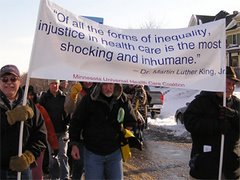
the year by TIME magazine. She currently works with the Veterans for Peace chapter in Minneapolis, Minnesota.
Subscribe to:
Posts (Atom)