- affordable universal health care;
- an end to the wars;
- a significant reduction in the military budget and an end to the military-industrial-
congressional complex; - investigation of illegal conduct, including war crimes, by executive officials during the current and prior administrations;
- investigation of the events on 9/11 to answer significant questions that have been raised;
- prosecution for illegal conduct leading to the economic melt-down;
- disincentives for U.S. companies to send jobs overseas;
- employee and environmental safeguards in trade agreements;
- implementation of major domestic jobs and infrastructure programs;
- an end to the Bush tax cuts for the wealthy;
- campaign finance reform to end the corrupting influence of money in politics;
- treat substance abuse within a public health framework rather than as a criminal matter;
- repeal the PATRIOT Act;
- compassionate and rational immigration reform;
- marriage equality;
- an end to subsidies for oil and gas companies;
- a ban on a Canada-to-Mexico tar sands pipeline;
- air quality protection, including stricter ozone limits; and
- aggressive action and leadership on the climate crisis and the environment?”
Tuesday, November 1, 2011
Have you had enough? New Party on the horizon
Rocky Anderson
418 Douglas Street
Salt Lake City, UTAH 84102
E-mail: rockyandersonrocky@yahoo.com
Press Release - October 21, 2011
Have you had enough?
New Party on the horizon
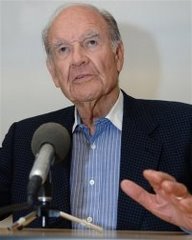
The former Mayor of Salt Lake City and Executive Director of High Road for Human Rights, Rocky Anderson, calls for the formation of a new political party and a sustained movement committed to the public interest.
Two months ago, Anderson “divorced himself” from what he referred to as “the spineless, gutless Democratic Party.” Responding to an email from the Democratic Congressional Campaign Committee, which showed as the subject, “Standing strong,” Anderson wrote: “How dare you send an email with the subject line ‘Standing strong.’ You didn’t do it on Iraq, you didn’t do it on torture, you didn’t do it on signing statements, you haven’t done it onAfghanistan, you haven’t done it on defense spending, you haven’t done it on real health care reform, you haven’t done it on the debt ceiling fiasco.”
(Rolly: Rocky Anderson says adieu to the Democratic Party,” The Salt Lake Tribune, August 12, 2011.)
Anderson continued: “I’m done with the Democratic Party… I think the answer is a new political party that actually will advocate for and promote the interests of the public rather than the narrow interests of the wealthy who bought and paid for not only Congress but the White House… The Constitution has been eviscerated while Democrats have stood by with nary a whimper. It is a gutless, unprincipled party, bought and paid for by the same interests that buy and pay for the Republican Party.”
(Romboy, “Former S.L. mayor Rocky Anderson divorces himself from ‘gutless’ Democratic Party,” Deseret News, August 13, 2011.)
This country needs a new, powerful party that can win elections, according to Anderson. “The pensions and other savings accounts of the middle class in this country have been decimated. The only way out is another party. I would call it, frankly, a second party that actually represents the interests of the American people. There isn’t a real opposition force in Washington, D.C., any more, and we the people have the capacity to change that -- and we must if our republic is going to survive. I consider myself an Independent, but I would be very pleased to work with others to form not just a political party to run another campaign, but to launch a sustained movement for major change in this country.”
(“Rocky: Not a Democrat,” (Interview with Rocky Anderson by Lexie Levitt), City Weekly,September 26, 2011.)
Anderson said that people are fed up with the Democratic and Republican parties, Congress, and the Obama administration to the point of being ready to support a new party that rejects the corporatism and militarism of the two “Wall Street lap-dog” major parties.
The polls support Anderson’s view that the people of the United States are desirous of a new party, and bold, new leadership, like never before. Patrick Caddell and Douglas Shoen have written:
“The United States is in the midst of what we would both call a pre-Revolutionary moment, and there is widespread support for fundamental change in the system. An increasing number of Americans are now searching beyond the two parties for bold and effective leadership.”
(Caddell and Schoen, “Expect a Third-Party Candidate in 2012,” The Wall Street Journal, August 25, 2011.)
"Have you had enough?" asks Anderson. “Would you support the formation of a new party that will commit to:
Rocky Anderson has been in the process of contacting some of America’s leading social, environmental and political activists with the goal of creating a powerful, broad-based political alternative to the increasingly unpopular Republican and Democratic Parties. He intends that the new party will have candidates in local, state, and federal races throughout the nation.
Anderson plans on hosting a meeting soon between leaders in various sectors of the country in order to draft a new platform and a long-term strategy capable of attracting a majority of voters, including millions of dissatisfied Democrats and Republicans who, until now, had nowhere else to go.
Anderson has stated his intention to do what is possible to get on the ballots in all 50 states and to campaign for candidates aggressively in all states. "The Democratic and Republican Parties have acted as if voters have no other real options. The people of this country will demonstrate that we, indeed, have another option - a party that will work in the public interest, rather than for the defense contractors, the health insurance companies, and the rapacious financial institutions that have caused such economic havoc in our nation and the world."
Anderson anticipates a broad-based coalition, similar to the one built by the New Democratic Party of Canada (NDP), which won impressive political gains in the Canadian federal elections last May. The NDP is the political party that brought universal health care to the Canadian people.
Press info: Mackenzie Scott - Tel. 801-520-0491
Rocky Anderson - Tel. 801-557-9007
E-mail: rockyandersonrocky@yahoo.com
Saturday, October 29, 2011
A response to Michael Zweig
A discussion with social democrat Michael Zweig, friend to those who lead organized labor
This article written by Michael Zweig was published in the Huffington Post and Michael Zweig e-mailed me the article seeking my comment. My comments are in italics bold... I would also like to point out, based upon my limited interaction with Michael Zweig, that he strives to stifle discussion rather than encourage debate.
Alan L. Maki
Director of Organizing,
Midwest Casino Workers Organizing Council
OWS Has Lessons to Learn From Past Movements
Posted: 10/28/11 07:19 PM ET
http://www.huffingtonpost.com/ michael-zweig/ows-has-lessons- to-learn-_b_1064743.html
Michael Zweig
Professor of Economics, Stony Brook University
The Occupy Wall Street action in lower Manhattan has unleashed the energies of hundreds of thousands of people across the country and changed the national conversation. The heart of its appeal lies in the formulation: "We are the 99%." For the first time in years, the finger of responsibility for our country's troubles is pointing up at the 1%, rather than down at the ordinary people who do the work of business and government.
This is true; but, the question needs to be asked: Why haven't Michael Zweig and the union "leaders" he runs with like Leo Gerard and Richard Trumka taken up these struggles before? Obviously they have the resources and "lead" organized labor. Why did Michael Zweig and his friends who lead labor support, and continue to support, Wall Street's chosen one--- Barack Obama? Why haven't Zweig and his friends who "lead" organized labor asked those workers who pay the dues which pay their big fat salaries: How is Barack Obama's Wall Street war economy working for you? To Zweig's credit he has made some feeble attempts to question the war in Afghanistan which his friends who lead organized labor have finally come to call for an end of so we can focus on creating jobs in our own country although both Zweig and his friends who "lead" organized labor have failed to condemn, denounce and encourage a fight-back against Obama's Wall Street imperialist agenda of wars abroad financed with austerity measures here at home which is where responsibility for all of our problems clearly lies.
In challenging the 1%, OWS has taken the moral high ground at a time when our country seems to have lost its moral compass. The growing movement holds corporate elites and their political representatives responsible for the moral failings exposed by the great and growing inequalities between the 1% and the 99%, and the widespread suffering of mass unemployment and home foreclosures in the midst of highly concentrated personal wealth and political power. OWS challenges the deep immorality and total unacceptability of the economic and political arrangements that generate and secure this inequality.
Again, all true; but, there is no discussion of the even greater inequalities being imposed on people of color, women and the handicapped nor is there any suggestion that Affirmative Action (Executive Order #11246) needs to be enforced to "level the playing field" for all working people. It is fine and good that Zweig points out the immoral inequalities between the rich and the poor even though he fails to make clear from where these inequalities stem in the first place with a capitalist system that is in its twilight stage of barbaric, cannibalistic imperialism where Wall Street coupon clippers exploit labor and rape Mother Nature here at home and all over the world which gives rise to wars for occupation that Wall Street tries to impose the cost for on working people where racism and inequalities are intentionally intensified to keep the working class divided.
This challenge is reminiscent of the moral foundations of the mid-20th century civil rights, women's liberation, and peace movements, as well as the great labor battles of the 1930s and 1940s that brought unions and shared prosperity broadly to the working class. Despite the complex difficulties these movements faced, they carried the day on the basis of their clear moral vision.
First of all, there has never been this "shared prosperity" that Zweig alludes to. The labor struggles of the 1930's and 1940's primary accomplishment was challenging the power of monopoly at the point of production while achieving a better standard of living for many workers--- but, at no time was the wealth created by the working class ever "shared" with workers by Wall Street; in fact, the Wall Street coupon clippers were the only ones to "prosper." For most workering class families, there has been a constant struggle just to survive. I don't know what kind of world Michael Zweig lives in but the working people and working class families I have ever known from the 1950's until present have always been engaged in a struggle to survive and for most of these working people fortunate to have had a decent job for at most two-decades, the struggle to survive was one of paycheck-to-paycheck and for most of the working class the struggle to survive has been from week-to-week if not day-to-day. Where Zweig gets this "shared prosperity" bullshit from beats me.I would note that the labor, civil rights and peace movements had very clear objectives. Occupy Wall Street still doesn't and Michael Zweig seems to be content with this as are his friends who lead organized labor.
There was a "moral vision" but that moral vision included goals and objectives together with the need to educate, organize and unite people in struggle.
In fact, the OWS protest parallels earlier movements in several ways. I was a minor figure in the founding of Students for a Democratic Society in 1962 but knew many of the leaders and participated actively in its development, plunging first into civil rights, then into opposition to the Vietnam War and support for women's liberation. As with OWS, in SDS and the overall civil rights, gay and lesbian rights, women's and labor movements, leaders were articulate and politically astute as well as morally grounded. Then, as now, the movement aspired to "participatory democracy" through broad engagement in decision-making and subsequent action. Then, as now, the movement thrived on imaginative tactics that engaged a wide audience. Then, as now, the crusade often grew spontaneously and without coordination as people around the country took up the issues and built the movement in their own ways.
Michael Zweig places far to much emphasis on these movements having been "spontaneous." I too worked in all these movements, including in SDS. And it all took a heck of a lot of organizing--- there was no reliance on spontaneity.
OWS carries forward another feature of early SDS -- close connections with labor. The Port Huron Statement, the founding document of the student movement of the 1960s, was hammered out in June 1962 at a camp outside Port Huron, Michigan, used as a retreat by the United Auto Workers. The connection with labor remained strong in the early civil rights movement but became strained at the 1964 Democratic national convention when the UAW and other unions, in deference to President Lyndon Johnson's political agenda, blocked the seating of the Mississippi Freedom Democratic Party delegation. SDS went from mild support of Johnson in the 1964 election -- "Part of the Way with LBJ" -- to outright hostility, and nearly total estrangement from labor, as the Vietnam War escalated.
Today, Michael Zweig and his friends who lead organized labor are sticking with Barack Obama who is far worse than Lyndon Johnson. At least with Lyndon Johnson he was smart enough and somewhgat compassionate enough but with the common sense that Franklin D. Roosevelt had to "bend towards justice" with his support for Civil Rights and an array of progressive social programs.
Today, national labor leaders have spoken in defense of OWS, and many New York City locals are providing material support. We do not know how long this friendly alliance will last as the movement seeks to grow in the turmoil of the presidential campaigns.
Why are Zweig and his friends who lead organized labor still supporting Obama since we learned that it was wrong for organized labor not to have supported George McGovern? This continued support for Obama by Zweig and his friends who lead organized labor is dividing the peoples' movements; including organized labor and the working class.
We can, however, draw lessons from the earlier mass undertakings that are relevant today. By holding to its principle of non-violence, OWS will secure its moral high ground. The current movement, still in its infancy, has not developed a key feature of earlier ones, central to their success: disruption of the institutions they challenge with words, as with strikes or sit-ins. If Occupy grows into a movement that seriously challenges the 1% for power, it will inevitably face ferocious opposition, as did all its predecessors.
Agreed; the opposition will become furious and ferocious if organized labor joins with Occupy Wall Street and occupies closing plants to save them; engages in a general strike; and withdraws from the Democratic Party in support of founding a progressive working class based people's party along the lines of the socialist oriented New Democratic Party in Canada or the old socialist Minnesota Farmer-Labor Party.
We look back on the successes of the civil rights, anti-war, labor, and women's struggles with pride. But to prevail, many participants suffered arrests, blacklisting, and other forms of intimidation, including killings, as they continued on the path to victory. Still, as the appearance of over a thousand New York City allies at Zuccotti Park at 6 a.m. on October 14 showed, police repression can be forestalled when the 99% make clear they will not accept or tolerate it, but will instead join in and support a movement that is in their own interests.
Michael Zweig would like us to believe that history can be sanitized. The fact is, that while President Lyndon Johnson was signing Executive Order #11246 (Affirmative Action) every major city in this country was, literally, burning. We are fast approaching the "tipping point" in this country with arrogant politicians like Obama bringing forward phony "jobs" and "student loan" legislation playing us all for fools and suckers. As Martin Luther King Jr. pointed out to Robert Kennedy when Kennedy tried to draw King into condemning the rioting; King told Robert Kennedy: "Riots result when governments don't listen to the legitimate grievances of the people by coming forward with real solutions to their problems."Instead of focusing on Occupy Wall Street being non-violent, Michael Zweig and his friends who lead organized labor might want to point out to Barack Obama what Martin Luther Jr. King pointed out to Robert Kennedy. Michael Zweig and his friends who lead organized labor might want to begin seriously pondering how they are going to organize a General Strike to serve notice on Barack Obama and his Wall Street friends just what working people want:
Peace so we can put people to work creating the kind of universal social programs people want and need like a National Public Health Care System and a National Public Child Care System. Struggling for this kind of agenda that is an alternative to Wall Street's agenda is what will assure the unity Zweig claims he desires:
A people’s program for real change...
* Peace--- end the wars in Iraq, Afghanistan and Libya and shutdown the 800 U.S. military bases on foreign soil protecting Wall Street’s interests.
* A National Public Health Care System - ten million new jobs; free health care for all.
* A National Public Child Care System - three to five million new jobs; free child care for all working families.
* Works Progress Administration - three million new jobs; repair, restore and build new infrastructure.
* Civilian Conservation Corps - two million new jobs protecting and restoring to health our ecosystems.
Alan L. Maki
Director of Organizing,
Midwest Casino Workers Organizing Council
OWS Has Lessons to Learn From Past Movements
Posted: 10/28/11 07:19 PM ET
http://www.huffingtonpost.com/
Michael Zweig
Professor of Economics, Stony Brook University
The Occupy Wall Street action in lower Manhattan has unleashed the energies of hundreds of thousands of people across the country and changed the national conversation. The heart of its appeal lies in the formulation: "We are the 99%." For the first time in years, the finger of responsibility for our country's troubles is pointing up at the 1%, rather than down at the ordinary people who do the work of business and government.
This is true; but, the question needs to be asked: Why haven't Michael Zweig and the union "leaders" he runs with like Leo Gerard and Richard Trumka taken up these struggles before? Obviously they have the resources and "lead" organized labor. Why did Michael Zweig and his friends who lead labor support, and continue to support, Wall Street's chosen one--- Barack Obama? Why haven't Zweig and his friends who "lead" organized labor asked those workers who pay the dues which pay their big fat salaries: How is Barack Obama's Wall Street war economy working for you? To Zweig's credit he has made some feeble attempts to question the war in Afghanistan which his friends who lead organized labor have finally come to call for an end of so we can focus on creating jobs in our own country although both Zweig and his friends who "lead" organized labor have failed to condemn, denounce and encourage a fight-back against Obama's Wall Street imperialist agenda of wars abroad financed with austerity measures here at home which is where responsibility for all of our problems clearly lies.
In challenging the 1%, OWS has taken the moral high ground at a time when our country seems to have lost its moral compass. The growing movement holds corporate elites and their political representatives responsible for the moral failings exposed by the great and growing inequalities between the 1% and the 99%, and the widespread suffering of mass unemployment and home foreclosures in the midst of highly concentrated personal wealth and political power. OWS challenges the deep immorality and total unacceptability of the economic and political arrangements that generate and secure this inequality.
Again, all true; but, there is no discussion of the even greater inequalities being imposed on people of color, women and the handicapped nor is there any suggestion that Affirmative Action (Executive Order #11246) needs to be enforced to "level the playing field" for all working people. It is fine and good that Zweig points out the immoral inequalities between the rich and the poor even though he fails to make clear from where these inequalities stem in the first place with a capitalist system that is in its twilight stage of barbaric, cannibalistic imperialism where Wall Street coupon clippers exploit labor and rape Mother Nature here at home and all over the world which gives rise to wars for occupation that Wall Street tries to impose the cost for on working people where racism and inequalities are intentionally intensified to keep the working class divided.
This challenge is reminiscent of the moral foundations of the mid-20th century civil rights, women's liberation, and peace movements, as well as the great labor battles of the 1930s and 1940s that brought unions and shared prosperity broadly to the working class. Despite the complex difficulties these movements faced, they carried the day on the basis of their clear moral vision.
First of all, there has never been this "shared prosperity" that Zweig alludes to. The labor struggles of the 1930's and 1940's primary accomplishment was challenging the power of monopoly at the point of production while achieving a better standard of living for many workers--- but, at no time was the wealth created by the working class ever "shared" with workers by Wall Street; in fact, the Wall Street coupon clippers were the only ones to "prosper." For most workering class families, there has been a constant struggle just to survive. I don't know what kind of world Michael Zweig lives in but the working people and working class families I have ever known from the 1950's until present have always been engaged in a struggle to survive and for most of these working people fortunate to have had a decent job for at most two-decades, the struggle to survive was one of paycheck-to-paycheck and for most of the working class the struggle to survive has been from week-to-week if not day-to-day. Where Zweig gets this "shared prosperity" bullshit from beats me.I would note that the labor, civil rights and peace movements had very clear objectives. Occupy Wall Street still doesn't and Michael Zweig seems to be content with this as are his friends who lead organized labor.
There was a "moral vision" but that moral vision included goals and objectives together with the need to educate, organize and unite people in struggle.
In fact, the OWS protest parallels earlier movements in several ways. I was a minor figure in the founding of Students for a Democratic Society in 1962 but knew many of the leaders and participated actively in its development, plunging first into civil rights, then into opposition to the Vietnam War and support for women's liberation. As with OWS, in SDS and the overall civil rights, gay and lesbian rights, women's and labor movements, leaders were articulate and politically astute as well as morally grounded. Then, as now, the movement aspired to "participatory democracy" through broad engagement in decision-making and subsequent action. Then, as now, the movement thrived on imaginative tactics that engaged a wide audience. Then, as now, the crusade often grew spontaneously and without coordination as people around the country took up the issues and built the movement in their own ways.
Michael Zweig places far to much emphasis on these movements having been "spontaneous." I too worked in all these movements, including in SDS. And it all took a heck of a lot of organizing--- there was no reliance on spontaneity.
OWS carries forward another feature of early SDS -- close connections with labor. The Port Huron Statement, the founding document of the student movement of the 1960s, was hammered out in June 1962 at a camp outside Port Huron, Michigan, used as a retreat by the United Auto Workers. The connection with labor remained strong in the early civil rights movement but became strained at the 1964 Democratic national convention when the UAW and other unions, in deference to President Lyndon Johnson's political agenda, blocked the seating of the Mississippi Freedom Democratic Party delegation. SDS went from mild support of Johnson in the 1964 election -- "Part of the Way with LBJ" -- to outright hostility, and nearly total estrangement from labor, as the Vietnam War escalated.
Today, Michael Zweig and his friends who lead organized labor are sticking with Barack Obama who is far worse than Lyndon Johnson. At least with Lyndon Johnson he was smart enough and somewhgat compassionate enough but with the common sense that Franklin D. Roosevelt had to "bend towards justice" with his support for Civil Rights and an array of progressive social programs.
Today, national labor leaders have spoken in defense of OWS, and many New York City locals are providing material support. We do not know how long this friendly alliance will last as the movement seeks to grow in the turmoil of the presidential campaigns.
Why are Zweig and his friends who lead organized labor still supporting Obama since we learned that it was wrong for organized labor not to have supported George McGovern? This continued support for Obama by Zweig and his friends who lead organized labor is dividing the peoples' movements; including organized labor and the working class.
We can, however, draw lessons from the earlier mass undertakings that are relevant today. By holding to its principle of non-violence, OWS will secure its moral high ground. The current movement, still in its infancy, has not developed a key feature of earlier ones, central to their success: disruption of the institutions they challenge with words, as with strikes or sit-ins. If Occupy grows into a movement that seriously challenges the 1% for power, it will inevitably face ferocious opposition, as did all its predecessors.
Agreed; the opposition will become furious and ferocious if organized labor joins with Occupy Wall Street and occupies closing plants to save them; engages in a general strike; and withdraws from the Democratic Party in support of founding a progressive working class based people's party along the lines of the socialist oriented New Democratic Party in Canada or the old socialist Minnesota Farmer-Labor Party.
We look back on the successes of the civil rights, anti-war, labor, and women's struggles with pride. But to prevail, many participants suffered arrests, blacklisting, and other forms of intimidation, including killings, as they continued on the path to victory. Still, as the appearance of over a thousand New York City allies at Zuccotti Park at 6 a.m. on October 14 showed, police repression can be forestalled when the 99% make clear they will not accept or tolerate it, but will instead join in and support a movement that is in their own interests.
Michael Zweig would like us to believe that history can be sanitized. The fact is, that while President Lyndon Johnson was signing Executive Order #11246 (Affirmative Action) every major city in this country was, literally, burning. We are fast approaching the "tipping point" in this country with arrogant politicians like Obama bringing forward phony "jobs" and "student loan" legislation playing us all for fools and suckers. As Martin Luther King Jr. pointed out to Robert Kennedy when Kennedy tried to draw King into condemning the rioting; King told Robert Kennedy: "Riots result when governments don't listen to the legitimate grievances of the people by coming forward with real solutions to their problems."Instead of focusing on Occupy Wall Street being non-violent, Michael Zweig and his friends who lead organized labor might want to point out to Barack Obama what Martin Luther Jr. King pointed out to Robert Kennedy. Michael Zweig and his friends who lead organized labor might want to begin seriously pondering how they are going to organize a General Strike to serve notice on Barack Obama and his Wall Street friends just what working people want:
Peace so we can put people to work creating the kind of universal social programs people want and need like a National Public Health Care System and a National Public Child Care System. Struggling for this kind of agenda that is an alternative to Wall Street's agenda is what will assure the unity Zweig claims he desires:
A people’s program for real change...
* Peace--- end the wars in Iraq, Afghanistan and Libya and shutdown the 800 U.S. military bases on foreign soil protecting Wall Street’s interests.
* A National Public Health Care System - ten million new jobs; free health care for all.
* A National Public Child Care System - three to five million new jobs; free child care for all working families.
* Works Progress Administration - three million new jobs; repair, restore and build new infrastructure.
* Civilian Conservation Corps - two million new jobs protecting and restoring to health our ecosystems.
* Public Ownership of the 58,000 mines, mills and factories closed by Wall Street – twenty-five million good paying, decent union jobs.
* Tax the hell out of the rich and cut the military budget by ending the wars to pay for it all which will create full employment.
* Enforce Affirmative Action; end discrimination.
* Raise the minimum wage to a real living wage.
* What tax-payers subsidize in the way of businesses, tax-payers should own and reap the profits from.
* Moratorium on home foreclosures and evictions.
* Defend democracy by defending workers' rights including the right to collective bargaining for improving the lives and livelihoods of working people.
* Roll-back and freeze the price of food, electricity, gas and heating fuels; not wages, benefits or pensions.
* Defend and expand Social Security.
* Wall Street is our enemy.
Let's talk about the politics and economics of livelihood for a real change.
The time has come for working people to break free from Wall Street’s “two-party trap.” We need a working class-based progressive people’s party.
Peace + tax the rich = millions of new jobs at real living wages putting people to work solving our social problems which will solve our economic problems… Redistribute the wealth. Put people before Wall Street profits.
How is Barack Obama's Wall Street war economy working for you?
- In invite Michael Zweig's response.
Michael Zweig is a professor of economics and director of the Center for Study of Working Class Life at Stony Brook University. The second edition of his book The Working Class Majority: America's Best Kept Secret will be published in December.
* Tax the hell out of the rich and cut the military budget by ending the wars to pay for it all which will create full employment.
* Enforce Affirmative Action; end discrimination.
* Raise the minimum wage to a real living wage.
* What tax-payers subsidize in the way of businesses, tax-payers should own and reap the profits from.
* Moratorium on home foreclosures and evictions.
* Defend democracy by defending workers' rights including the right to collective bargaining for improving the lives and livelihoods of working people.
* Roll-back and freeze the price of food, electricity, gas and heating fuels; not wages, benefits or pensions.
* Defend and expand Social Security.
* Wall Street is our enemy.
Let's talk about the politics and economics of livelihood for a real change.
The time has come for working people to break free from Wall Street’s “two-party trap.” We need a working class-based progressive people’s party.
Peace + tax the rich = millions of new jobs at real living wages putting people to work solving our social problems which will solve our economic problems… Redistribute the wealth. Put people before Wall Street profits.
How is Barack Obama's Wall Street war economy working for you?
- In invite Michael Zweig's response.
Michael Zweig is a professor of economics and director of the Center for Study of Working Class Life at Stony Brook University. The second edition of his book The Working Class Majority: America's Best Kept Secret will be published in December.
Alan L. Maki
Director of Organizing,
Midwest Casino Workers Organizing Council
58891 County Road 13
Warroad, Minnesota 56763
Phone: 218-386-2432
Cell: 651-587-5541
Primary E-mail: amaki000@centurytel.net
E-mail: alan.maki1951mn@gmail.com
Friday, October 28, 2011
Four Directions Walk to End Poverty
Four Directions Walk to End Poverty… make sure you watch the videos
There is a lot of important information here put together by the folks in Winnipeg, Manitoba struggling against poverty. Lots of good ideas for activists in cities all across Canada and the United States. Some really good work going on here… Alan
Date: Fri, 28 Oct 2011
From: Four Directions Walk
Subject: Four Directions Walk Cte meeting – Tues, Nov 1
Four Direction Walk to End Poverty in Manitoba
Dear Friends, Sisters and Brothers,
Thank you everyone who attended, walked and helped out with this year’s 4DW last Saturday! We’ll be having a meeting to see how things went and make plans:
Four Directions Walk Committee
Tues, Nov. 1, 4:30 pm
St. Matthews Maryland Church
641 Maryland
(Use the South door on McGee)
Everyone is welcome.
Numbers, media, etc.
This was our largest annual Walk to date; more than 100 people participated including 10 Walkers from the perimeter with another 20 joining along the way.
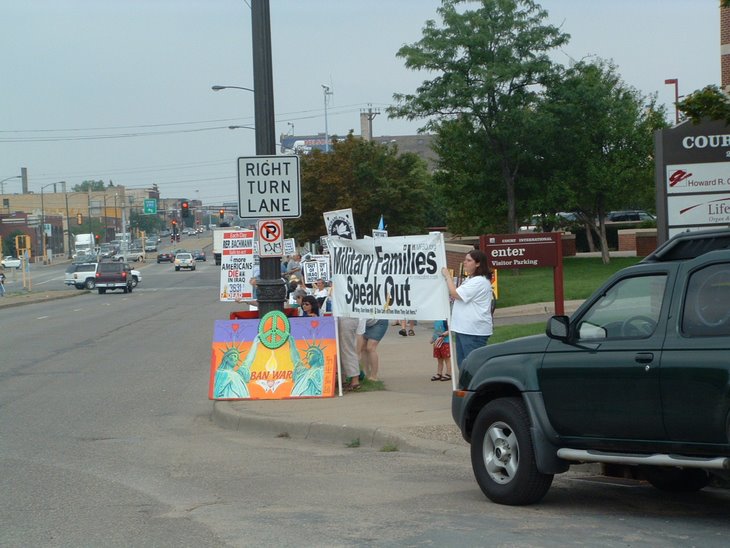
A larger number of groups participated, swelling the numbers including Occupy Winnipeg, Action 1:21, FemRev Winnipeg, Feed My Lambs (thank you for the food!) and The Urban, among others. We want to thank all the groups that helped out, some of which are not listed here!
For the first time, we both major newspapers in Winnipeg covered the Walk. The articles are appended, below. Cheryl-Anne Carr, a Walk Committee member, is quoted accurately:
“The problems have been studied long enough, the situations have been looked at long enough, the problem is that there are not enough jobs, and the pay is not high enough. The problem is the province wants to keep people poor so that theres a huge pool of labour that’s frightened and can be used to keep wages down, and prices high. There’s a shortage of housing, theres a shortage of education spaces.”
Paul Graham with the help of Ken Harasym has produced a 30 minute video of the Walk, which will be broadcast repeatedly on Shaw Cable’s community channel: http://paulsgraham.ca/2011/10/24/video-four-directions-walk-to-end-poverty/
Many thanks! This is a must-see!
There is another video on youtube, but I don’t know who produced it:
It looks like we’ll have to have another Walk next year, because we had zero response from the government. We invited all elected politicians to listen, not speak). Only Harvey Smith from Winnipeg City Council attended (J Gerbasi and J Browaty sent their regrets they could not attend).

Of Winnipeg’s MPs, 3 Conservatives sent regrets (Fletcher, Toet and Bateman). Of MLAs, only one Progressive Conservative sent regrets (R Eichler, chair of the caucus).
If you have qs, we are at 792-3371 or reply by email.
Yours For Ending Poverty in Manitoba,
Four Directions Walk Committee
* * * * * *
Anti-poverty rally held at Legislature
By,Winnipeg Sun, Saturday, October 22, 2011
(81 internet comments omitted)
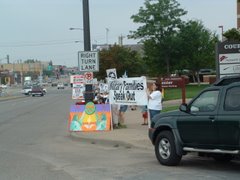
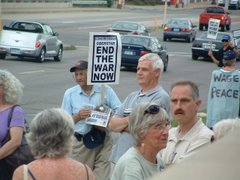
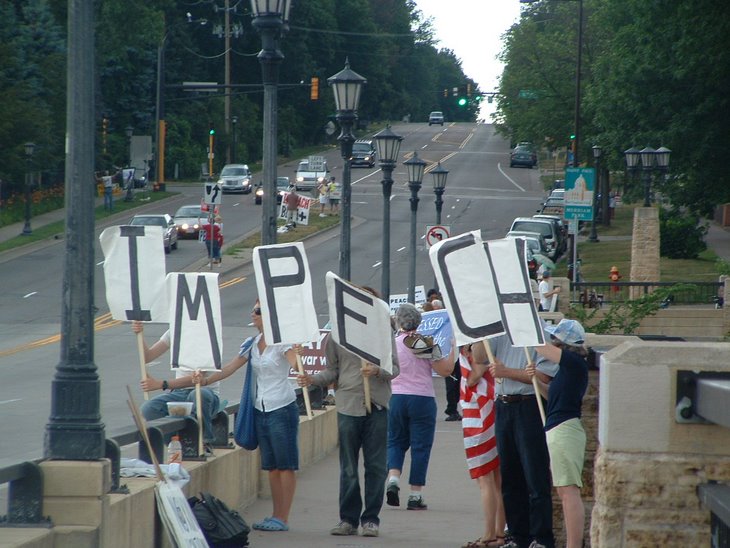
With flags waving and protest signs in the air, people marched from four directions of the city with one message eliminate poverty.
Protesters walked for hours before joining for a rally at the Manitoba Legislative Building Saturday afternoon.
“The problems have been studied long enough, the situations have been looked at long enough, the problem is that there are not enough jobs, and the pay is not high enough,” said Cheryl-Anne Carr, Four Directions Walk committee member.
“The problem is the province wants to keep people poor so that theres a huge pool of labour that’s frightened and can be used to keep wages down, and prices high. There’s a shortage of housing, theres a shortage of education spaces.”
The event marked the fourth annual Four Directions Walk to End Poverty. Clothing and food donations were being taken at the rally for the less fortunate.
Protester Terry Weaymouth said he hopes the protest will open people’s eyes to Winnipeg’s poverty problems.
“I think everybody’s affected by poverty, especially in my life,” he said. “I grew up in poverty and my friends have been affected by poverty. Its a big issue.”
Shon Villier held up a sign that read Solidarity in different languages.
“We don’t have to live in a society where people are hungry and living in the streets,” Villier said. “We have the resources to share, we have the money and it doesn’t have to be this way.”
Politics blamed for plight of poor
Marchers rally at legislature
By: Alexandra Paul, Winnipeg Free Press, Sunday, October 23, 2011
(72 internet comments omitted)
Under grey skies, about 50 people with banners and placards that called for an end to poverty rallied on the steps of the Manitoba legislature Saturday.
The fourth annual Four Directions Walk to End Poverty saw groups of a dozen or more gather at each of the four cardinal points of the Perimeter Highway and walk through the city to meet at the government seat.
“I came all the way from the Perimeter at Headingley,” said Neil Adams, a community worker from the North End. “I told people on the way here, who were honking their horns on Portage Avenue, to honk for better housing, better water and more wages.”
The annual event draws together a coalition of anti-poverty groups that believe it is a lack of political will that keeps welfare rates low and the working poor dependent on food banks.
“The problem is the government wants to keep people poor so they’ll have a pool of cheap labour,” organizer Cheryl Ann Carr said.
“We’ve talked to hundreds of people and put together a justice charter, and we can eliminate poverty in this province and we can do it quickly,” Carr said.
The charter is a six-point plan that calls for housing, expanded health care, jobs and annual incomes to be human rights. It also calls for an end to racism, sexism and all forms of discrimination. The sixth demand is for proportional government and pay cuts to match the average workers wage and benefits for all MLAs.
The Lutheran Urban Ministry collected sweaters, coats, shoes and boots to distribute at the rally.
Another group was handing out food next to a sign that read, Feed My Lambs.
Walkers began at St. Mary’s Road and the Perimeter in the south, Portage Avenue at the Perimeter in the west, Main Street at the Perimeter in the north and Pembina Highway at the Perimeter in the south.
“The major problem we face in this city and in this province is poverty… What it requires is for some level of government action to do something about it,” Coun. Harvey Smith (Daniel McIntyre) said.
He pointed to municipal housing programs in cities like Calgary that could be adopted in Winnipeg to cut the rate of homelessness.
Longtime poverty advocate Nick Ternette said he puts the blame for a lack of political will squarely on the shoulders of the provincial government.
“The NDP has paid no attention to poverty issues in an effective way. During the election campaign, I asked one cabinet minister (if he supported) a guaranteed annual income and he said No. A single person on social assistance gets $481 a month; thats $4 a day for food. It hasn’t increased in over a decade,” Ternette said.
Subscribe to:
Posts (Atom)