Thursday, December 11, 2008
The "Main Street Recovery Program"
Some thoughts on the "Main Street Recovery Program"
By Alan L. Maki - Dec 11th, 2008
This "Main Street Recovery Program" initiated by the Campaign for America's Future lacks many specifics and intentionally omits support for H.R. 676 and socialized health care; with the biggest drawback being that no resources have been made available by these organizations aimed at empowering working people in their communities and where they work... but, the general thrust here is something we all need to support and get behind.
Also lacking is any clear program relating to legislation for a real living minimum wage which is the real, fundamental and basic way to redistribute wealth in this country in order to solve the problems of working class poverty as we seek a more just socialist alternative to capitalism.
In fact, the capitalist system which is now obviously on the skids to oblivion is not even challenged in this statement.
It is not that I disregard the fundamental weaknesses in this statement as I endorse the "Main Street Recovery Program," but, rather, on the basis of its many strengths in bringing forward a new direction for our country.
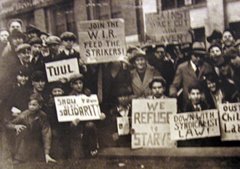
It would be naive to assume that even such a modest liberal program as that being floated here will take shape under the Obama Administration unless all those who supported, and than voted for Obama, along with the millions of liberals and progressives who supported other candidates or did not vote at all are brought into the decision-making process to correct the glaring weaknesses relating to specific solutions to specific problems with the full and complete empowerment of the people forcing action out from the government through mass pressure tactics as employed during the depression years under the leadership of the left--- most notably the Communist Party, left in general and the emerging network of trade union activists.
The Campaign for America's Future who put this together is known for its outstanding statements which remain on paper to only be filed away without any action.
We can change this through education, organization, unity and action... learning from the struggles of the Thirties and the present struggles like those heroic workers in Chicago at Republic Windows and Doors who have demonstrated the importance of working people taking bold, militant action in defense of their own livelihoods and for the rights of all working people.
In fact, we are facing are living in a depression growing worse by the day; not in a recession. Over a year ago the recession was well underway and in this time has come a full-blown depression from which "economic recovery" is not possible--- not for the working class. We are now well into a severe capitalist crisis caused by "over production" in a world where people are starving and require the basics of life which they are presently being deprived of here in the United States and across the globe.
It will be interesting to see just how much the Campaign for America's Future and the endorsers of this program are willing to bend to the real needs of the working class for real solutions to their problems; and, then, how much Obama will listen.
There is far too much emphasis here on middle class and middle income when the primary emphasis should be on creating a society with living wages and incomes for the entire working class.
There is something very wrong with a distinguished group of middle class intellectuals not taking to task the need to eliminate poverty in this country... the wealthiest country in the world.
We need to keep in mind as we live in the midst of this economic depression that wealth may be disappearing from sight and from our view, but this wealth exists all the same as it is only in the process of changing hands as the wealthiest come to control and dominate even more. This is very important for us to remember because it is this wealth that we need to be concerned about; along with the ownership and control of the mines, mills and factories where this wealth has been created.
The time has come to bring the failing auto, steel and power generating industries as well as banking under public ownership through nationalization so wealth becomes the property of society rather than of the few... another problem the "Main Street Recovery Program" fails to address... common sense dictates that tax-payers should own what the finance through bailouts... including owning and controlling the wealth created.
There is a fear here in this statement of touching the "sacred cow" of private ownership of the means of production.
Also overlooked in importance is the question of peace and the need to end these dirty imperialist wars for oil and regional domination so we can transfer funds from war-making which subsidizes the profits of a thoroughly rotten and corrupt military-financial-industrial complex to financing human needs--- from health care to education and a massive jobs program... we simply can't tolerate plunging our Nation into debt even further than it already is to finance an even modest program as suggested below.
But, when all is said and done, the "Main Street Recovery Program" is an excellent new beginning towards a real new New Deal... with some tweaking here and there we should be able to turn it into something a real new People's Front can mobilize support for built on the foundation left to us by the old Left which served the working class so well.
Perhaps the single most important omission in the "Main Street Recovery Program" is a real sense of urgency which is so typical of this liberal intellectual community.
Understandably, people losing their jobs, homes and having their utilities turned off in the middle of the winter have a greater sense of urgency and a greater desire to see problems resolved than middle class intellectuals... this sense of urgency is what adds the kind of militancy to struggles built around these kinds of ideas which brings such ideas to reality in the form of, not only government policy, but in pushing the government to establish programs... and this, after all, is the kind of change we all seek.
This is why it is so important that people be empowered at the grassroots and rank and file level... the only sure way we will win the real change we are seeking as the Wall Street crowd, which at this point has the primary influence over Obama and is prepared to fight tooth and nail to defend their profit system.
It would have brought credibility and strength to the "Main Street Recovery Program" to have had the endorsements of the Republic Door and Window workers who seized control of the plant in Chicago in defense of their rights as endorsers of this progressive agenda with their action being cited as one of the ways to force government to act.
In fact, these middle class intellectuals should have had the common sense to insist on obtaining initial endorsements from grassroots community activists and rank and file working class activists.
Overall, the initiative taken by the Campaign for America's Future in bringing forward the "Main Street Recovery Program" is to be lauded and supported.
Of course we need to be sure that any and all programs don't become just another profit orgy for Wall Street coupon clippers and the banks. The programs should all be publicly funded and administered.
In the past some of the endorsers of the "Main Street Recovery Program," like Carl Pope and Leo Gerard have abandoned people in the midst of struggles... others like John Sweeney have been all talk and no action; never allocating the kind of resources required to bring a progressive agenda to reality--- while still others from among the endorsers have fought attempts by the left and progressive forces to merge issues of peace with social and economic justice. Still others cling to a faith that capitalism can be turned into a "kinder, gentler" form of some kind of "people's capitalism," and still others are laboring under the illusion that some tinkering here and regulation there will resolve the present economic mess. Others like Robert Borosage who colluded with the Democrats to derail the peace movement are working in the same way to try to derail the grassroots and rank and file movements developing around single-payer universal health care as embodied in House Resolution 676.
Alan L. Maki
Director of Organizing,
Midwest Casino Workers Organizing Council
A MAIN STREET RECOVERY PROGRAM from the Campaign for America's Future; provided here for your consideration and for further dialogue, discussion and debate.
Executive Summary
Our economy now faces the most serious crisis since the Great Depression. The financial crisis that was triggered by the bursting of the housing bubble has now spread to the real economy, and we face a sharp downturn that is spreading across the globe. A serious recession now seems unavoidable in the United States, as well as Europe and Japan. The developing world is already struggling with financial turmoil and economic decline. For the first time since the 1930s, we face a real risk of deep worldwide economic contraction.
Restoring economic growth will require a bold, multifaceted plan. This must begin with a recovery program for Main Street – substantial fiscal expansion to revive the real economy.
With a deep and long global downturn now likely, any plan for reviving the economy
should be substantial, strategic, and sustained. It should also be coordinated with
simultaneous efforts across the world.
Reviving our nearly $15 trillion economy will require substantial fiscal expansion. With interest rates already low, monetary policy can provide little help. The decline in consumption brought by the collapse of housing and stock prices has already been dramatic.
Now states and localities must cut spending or raise taxes to balance budgets. Exports are declining as the world economy slows.
Three percent of GDP – about $450 billion each year for two years, a total of $900 billion – should define the floor, not the ceiling, of what needs to be done.
The plan must be strategic, focused on public investment in areas vital to strengthening America’s long-term competitiveness. Public investments are far more efficient at stimulating the economy than tax cuts for individuals or businesses. The money allocated will be spent and will produce jobs here. And public investment provides a long-term return in the higher productivity of transport on modern roads and rail, the higher productivity of better-trained workers, and the new technologies spawned from higher research and development funds.
Central to the plan should be investment in green technology, reducing our dependence on foreign oil, and addressing the rising threat of global warming. It must also target the states, funding vital health care and public programs so the recession is not worsened by local budget-cutting. This will also help to maintain the income of the people most likely to spend in the economy.
Finally, the recovery plan must be sustained. Two years of deficit-funded stimulus should help the economy recover. But it will take many years of fiscal expansion to move us from an economy driven by booms and busts of asset bubbles to one of sustained and balanced growth.
□ □ □
A MAIN STREET RECOVERY PROGRAM
We now face the worst economic crisis since the Great Depression. The collapse
of the housing bubble, followed by a credit freeze and stock market collapse, has erased over $10 trillion in paper value in the U.S. alone. The debacle in housing exposed, in the words of Noriel Roubini, a subprime global financial system that was recklessly overleveraged, laden with exotic securities of unknown value, and now facing staggering losses. Massive, and at times desperate, efforts by central banks across the world have served only to stave off collapse.
This financial contagion has now infected the real economy. A serious recession
now seems unavoidable in the United States as well as in Europe and Japan. And the
developing world, which we were told was “de-coupled” from the U.S. and Europe, is
facing enormous strains of its own. For the first time since the 1930s, we face a real risk of worldwide deflation and substantial economic contraction.
Restoring economic growth will require a strong and multifaceted plan. Reviving
the financial system itself will require far more than the hastily assembled and badly designed $700 billion bailout passed in September. We must
(1) remedy the costly defects in the current plans;
(2) put in place a systematic program of real mortgage relief
for homeowners, and
(3) enact comprehensive reform of financial markets.
It is not possible, however, to simply clean up this mess and return to business as
usual. Stabilizing the housing and financial markets and staving off a deep downturn
must be part of a broader, systemic effort to address the roots of this crisis.
For too long, our economy has been based on consumption sustained through
asset bubbles and easy credit, with the vast majority of new wealth accumulated only
by those at the very top. We must chart a strategy to move towards sustainable, longterm growth, with blessings that are widely shared. This will require increased
government investment in public education, in research and development of new
technology, and in the modern infrastructure that is vital to building a competitive
economy. It must also include raising the minimum wage and reviving the right of
employees to organize and bargain collectively, so that workers may once again capture a fair share of the productivity and wealth they help generate.
The new strategy must include access to comprehensive and affordable health
care for all Americans. It must include a system of taxation that produces the revenue necessary for supporting a vital public sector in a fairer and more progressive manner.
We will also need a new global initiative to reform currency and financial regulations, to place the financial system in its proper role as servant to the real economy. And this strategy must be accompanied by a global trade regime that reduces unsustainable trade imbalances and ensures that trade benefits workers in all participating countries.
In the coming weeks, we will address each of these issues. We begin below with
an analysis of the steps needed to counter the deepening recession and get the real
economy going again.
The Immediate Need: Reviving Main Street
The need for substantial fiscal expansion to revive the real economy is clear and
present, as a long and deep downturn now seems inescapable. The economy has been
losing private-sector jobs for 12 months. Unemployment is already at a five-year high
and continues to rise, and many employees are working fewer hours than they wish,
facing pay and benefit cuts, or dropping out of the workforce in discouragement.
After taking into consideration workers who take part-time jobs out of necessity and those who are otherwise marginally attached to the labor force, the effective unemployment rate at the end of November was an extraordinary 12.5 percent.
Consumers are cutting back, as their confidence has been shaken by staggering
losses in housing and stock-market values. Manufacturing has been relentlessly
shedding jobs over the last seven years and is now in a near-free fall. Construction has been decimated by the bursting of the housing bubble and the freezing of credit. Retail stores are girding for a grim holiday season. Exports, which had risen with the falling dollar, will now be slowed by the global economic downturn. States and localities that had increased public employment over the past year now face declining revenues and rising deficits which will force layoffs and cutbacks in needed services. Our economy is in trouble and needs action now.
While more monetary loosening is likely, its effects will be limited, as interest
rates are already at low levels. A major fiscal stimulus is essential. Though the $700 billion Wall Street bailout may have been necessary, it was not stimulative. In the end, banks will only lend at needed levels when there is a growing economy in which to lend. And while budget deficits have already risen, they pose no immediate danger as the global crisis has witnessed a flight of investment back to the dollar, allowing for relatively low-cost financing.
With a deep and long global downturn now likely, any plan for reviving the
economy should be substantial, strategic and sustained. It is also imperative that it be coordinated with similar efforts across the world. The U.S. cannot be expected to lift the global economy alone.
Reviving our nearly $15 trillion economy will require substantial fiscal
expansion. The consumption effects of the collapse of housing and stock prices have
already been dramatic, as reflected in the bottoming of consumer confidence. When
gross domestic product growth fell to negative levels at the end of 2000 and America
was hit by the shock of 9-11, the U.S. general government budget (federal, state and
local combined) went from reporting a surplus of approximately 1.3 percent of GDP to
running a deficit of about 4.9 percent GDP by the end of 2004 – the equivalent of over $900 billion in fiscal stimulus. Even that stimulus – which was bolstered by extremely low interest rates, a thriving financial system, a housing asset bubble, and a growing global economy – produced only a slow recovery and stagnant incomes. Today’s crisis is worse, and fiscal expansion must do much more of the heavy lifting. Although not directly comparable, China recently announced a stimulus plan focused entirely on the internal investment of 7 percent of their GDP each year for two years.
Three percent of GDP -- about $450 billion each year for two years, for a total
of $900 billion -- should define the floor, not the ceiling, of what needs to be done. The plan for reviving the economy must be strategic, focused on public
investment in areas vital to strengthening America’s long-term competitiveness, not
simply on giving consumers or businesses a temporary boost through tax rebates. As
we detail below, central elements of the plan should include investment in green
technology, reducing our dependence on foreign oil, and addressing the rising threat of global warming. We should also move to repair and modernize our intellectual and
physical infrastructure and to provide temporary financial assistance to workers most
in need. This approach will generate jobs immediately and contribute to greater
productivity and international competitiveness.
Public investments are far more efficient at stimulating the economy than tax
cuts for either individuals or businesses are. First, all investment spending will in fact be spent, whereas data suggests that only 20 percent of the recent tax rebates went into consumption; the remainder was saved or used to reduce consumer debt.
Second, more of the jobs generated through public investment will be created
here. In contrast, a good portion of the tax rebates were spent on goods manufactured
abroad, creating jobs in China and elsewhere. Infrastructure funding targets
construction workers, who have been hit hardest by the housing market’s collapse.
Infrastructure projects are tangible and visible, helping to generate needed confidence in recovery. Economic models, such as the one used by Mark Zandi of Moody’s Economy.com, show that in the first year, stimulus investments in the form of
infrastructure spending, aid to state governments, and extended unemployment
benefits or food stamps generate more GDP growth per dollar than do tax cuts or
rebates.
1 And public investment is just that: an investment. Money spent earns a return in
the form of higher productivity from workers who take advantage of broader and
cleaner transportation choices and faster broadband connections, and from students
whose ability to learn is improved by modernized schools or attendance at otherwise
unaffordable colleges.
Critics argue that public investment takes too long to begin, claiming that
recessions end before infrastructure money has been spent. This argument has little
relevance now, as we face a recession that is likely to be deep and long if we do not
provide a sustained response. Moreover, in recent recessions, labor markets recovered
far more slowly than other elements of the economy. In the recession of 2001, for
example, it took more than two years for employment rates to bottom out and four
years before they rose above pre-recession levels. In addition, there is a significant backlog of infrastructure projects that are ready to go and lack only the resources to move forward. Governor John Corzine of New Jersey testified that his state alone has $1.5 billion of projects ready to start in 90 days. A survey by the American Association of State Highway and Transportation Officials found over 3,000 projects totaling $17.9 billion that are ready to launch within 90 days of receiving funding. A compilation by the Economic Policy Institute found $20 billion worth of school projects that are ready to begin.
Any recovery plan must also be sustained. Ending the recession, however difficult, is
not sufficient. It will take many years of fiscal expansion through public investment to move us from an economy driven by the booms and busts of asset bubbles to one driven by sustained and balanced growth. During the initial two-year period of
increased deficit spending, we should be formulating a multiyear plan to change our
economic priorities. After the first two years, this program should be permanent,
productive and paid for. Long-term investments in public education and training, in
health care, in modernizing our infrastructure, in urban reconstruction, and in research and development should be sustained not by deficit spending but by changes in how we use our resources.
Returning to a more progressive tax code – by closing corporate loopholes such as the
egregious carried-interest tax break and by collecting the $300 billion a year that the IRS is owed but does not collect – could easily raise over $600 billion a year.
Core Elements of the Recovery Plan
At $450 billion a year for two years, a recovery plan should focus on the
following core elements:
Green Investment.
A first priority should be a green investment agenda designed to reduce our dependence on foreign oil and address the rising threat of global warming.
Green Recovery, a report by Robert Pollin of the University of Massachusetts’ Political Economy Research Institute, and the Center for American Progress, documents
opportunities for creating two million green jobs over two years by investing nearly
$100 billion in six green infrastructure areas: retrofitting buildings to improve energy efficiency, expanding mass transit and freight rail networks, constructing “smart” electric-grid systems, increasing capacity for generating power from wind and solar energy, and developing carbon capture technologies and next-generation biofuels.
2 This amount should be considered a minimum and could be expanded if appropriate plans can be rapidly developed. We designate $50 billion of this package for investment in green projects that will generate jobs and growth in the near term.
3 Infrastructure Modernization and Repair. A second priority is major investment in state of-the-art national infrastructure, including everything from roads and bridges to schools, airports, and sewers. These investments generate jobs while providing the foundation for greater productivity for our factories and offices, better health for all citizens and a better education for our children.
In an America that is literally falling apart, the need for this investment is
apparent. According to the American Society of Civil Engineers, over two-thirds of
America’s roads are in poor or mediocre condition, resulting in billions wasted on
automobile repairs and traffic delays.
4 More than one in four bridges are rated structurally deficient or obsolete and half of waterway locks are functionally obsolete.
5 The Department of Education found that 43 percent of schools are in a state of disrepair so severe that it “interferes with the delivery of instruction.”
6 The American Society of Civil Engineers estimates that getting the nation’s infrastructure in good working condition would require $1.6 trillion spent over five years, or more than $300 billion per year.
7 The Economic Policy Institute has compiled a range of infrastructure projects –
including building high-quality drinking water and wastewater systems, and
modernizing and repairing schools and roads – that total about $40 billion and are
“ready to go.” There is an estimated $32 billion backlog of repairs and rebuilding
needed to bring public housing into good condition. A $75 billion investment program
in the first year could easily be expanded to $150 billion, still less than the amount deemed justifiable by the Congressional Budget Office in the second.
8 Aid to States. The economic downturn has left state and municipal finances in dire
straits. Tax revenues are plummeting as demand for services is rising. The Center for
Budget and Policy Priorities reports that at least 41 states face shortfalls in their budgets this year or will face shortfalls next year. Twenty-nine states closed shortfalls totaling $48 billion in their fiscal year 2009 operating budgets largely by drawing on “rainy day funds.” In fiscal year 2010, CBPP estimates that a total deficit of $100 billion will have impact on virtually every state. In previous recessions, the financial pressures on states continued building at least two years after the onset of the recession.
9 In past recessions, states have responded to budget gaps by reducing children’s
health care services, cutting spending on child care and education, restricting Medicaid eligibility, cutting back or deferring construction projects, increasing taxes and publicuniversity tuition, and by slashing aid to localities, a move which often results in layoffs of police officers and firefighters. All of these actions add to the severity of the downturn, bringing lay offs of even more workers and further burdens to citizens.
We suggest spending $50 billion on state aid in the first year and increasing
spending to $75 billion in the second. The most effective measures would split funds
between flexible block grants for general revenue sharing (in order to prevent cuts in funding for education and other vital state programs), and a temporary increase in
federal matching funds for Medicaid (in order to address the increase in demand for
Medicaid and avoid cuts in health care that would lead to a sharp rise in the number of uninsured).
As the Zandi modeling shows, aid to states has a relatively high stimulus impact
per dollar spent, since the money is put to use immediately, and forestalls cutbacks and
tax increases that would reinforce the downturn.
10 The Kaiser Commission on Medicaid and the Uninsured also studied the role Medicaid plays in state and local economies and found that Medicaid spending generates economic activity, including jobs, income and state tax revenues, while reductions in state and federal Medicaid will lead to
declines in economic activity at the state level.
11 Investment in Public Education. Across the country, states are limiting or cutting back
aid to universities. America’s great public universities, which allowed millions to join
the middle class, no longer get most of their funding from state appropriations. This has
led to sharp increases in the costs borne by students and their families. Federal aid
programs have not kept up with these rising costs.
In 1979, the highest level of Pell Grants, which provide aid to the students most
in need, covered up to three quarters of the average cost of attending a four-year public
college. To return to that level of support, and to make college affordable for thousands
more students by expanding eligibility for Pell Grants, would cost $35 billion
annually.
12 This aid could be dispensed quickly through existing mechanisms and
would help to reduce downward pressure on labor markets by bringing potential
students into school. The importance of a college education will only grow in the years
ahead.
Many middle-class and low-income families rely on federally-subsidized student
loans to help pay for college education, and more are expected to seek federal loans as
their investments and income suffer during the economic downturn. Despite passage
and extension of the Ensuring Continued Access to Student Loans Act, federal student
aid programs—which include Stafford, Perkins, and PLUS loans—currently face a
budget shortfall of approximately $5 billion.
13 We recommend fully funding federal student aid programs, while expanding direct lending to secure the student loan market. Not only will this investment provide needed support to students and schools, it will generate a positive return as the loans are repaid.
14 Research and Development. Public investment in research and development – both
military and non-military – now represents less than one-half the share of GDP that it
did at its height in the 1960s.
15 Increased productivity and national income growth is inherently linked to R&D investment that stimulates innovation and facilitates transmission of new technologies. For this country to compete and thrive in a global economy, staying on the cutting edge of research and development is vital.
This expansion should be continued even after the economy recovers, and will be paid for by
rising revenues. There is no better investment in our future.
The Association of American Universities is currently gathering figures from the
national research centers to estimate the level of funding these agencies could easily
absorb in one to two years. We conservatively estimate an increase of $5 billion in the
first year and $10 billion in the second.
Health Care. In addition to meeting a very real need, this crisis provides an
opportunity to increase access to and lower the cost of health care. Providing federal
support to expand the State Children’s Health Insurance Program and increasing access
to Medicaid would help reduce state-budget shortfalls and strengthen the health-care
safety net at a time when more families will be forced to rely on it. There is also
potential to use stimulus investments to promote systemic changes that will spur
economic growth in the short-term and improve quality and cost-effectiveness of care in
the long-term. For instance, providing incentives for hospitals and physicians to adopt
electronic medical record systems could yield more than $80 billion in annual savings.
16 We recommend investing a total of approximately $15 billion in targeted health care
projects in the first year and $55 billion in the second, as a down-payment on
comprehensive health care reform.
Aid to Those in Need. Economic downturns hit the weakest and poorest families
hardest. The poorest families have the fewest resources on which to draw in the event
of a job loss or drop in income. Assistance given to them will be spent immediately on
food and medicine, and on rent and car loans.
17 Providing aid to those most in need is not only the morally right thing to do, it makes the most economic sense. Estimates by Moody’s Economy.com indicate that each dollar in tax cuts that include low-income households increases real GDP by $1.29, whereas tax reductions for capital gains and dividends yield less than 40 cents of real GDP growth on the dollar.
18 Providing jobless workers with assistance affording COBRA health insurance
premiums would help families avoid drawing down their savings to remain healthy.
Based on Congressional Budget Office modeling, offering a 75 percent subsidy to all
eligible workers is estimated to cost $11.75 billion over two years.
19 Modernizing the unemployment insurance system to meet the needs of the
contemporary workforce would cost approximately $7.5 billion.
20 Funds for this investment will be provided by an extension of the Federal Unemployment Tax Act (FUTA) surtax. A temporary 20 percent increase in the food stamp benefit would cost approximately $15 billion and would enable millions of low-income families to cope with rapid increases in food costs.
21 The Center for American Progress’ Task Force on Poverty estimates that the number of Americans living in poverty could be reduced by more than a quarter through an annual investment of $38 billion to increase the Earned Income and Child Tax Credits, raise the minimum wage, and expand access to child care.
22 Pre-K Now recommends the federal government invest about $1 billion a year in
incentive grants to states to extend their pre-kindergarten programs. The Center on
Budget and Policy Priorities believes states could spend an additional $1 billion in the first year and $1.5 billion in the 2nd year, in child care and an equivalent amount in Head Start for a total of $5 billion over 2 years for these two programs. In all, $80 billion would be devoted to the purpose of reducing poverty.
Tax Cuts. A total of $450 billion of spending in the first year is the minimum
necessary to provide a real stimulus. Public investment provides the most stimulus
effect, but a decade of starvation has left many public entities without the capacity to absorb all of the needed spending in the first year. Moreover, although the tax cut earlier this year did not adequately translate into consumer buying, the rapidly deteriorating job market since then suggests that millions of low- and middle-income Americans are struggling to meet their daily obligations, and therefore are more likely to spend the proceeds of any tax relief they get.
The Economists’ Policy Group on Women’s Issues calls for the expansion of
public support for paid home-care workers; tax credits for family members providing
for their own disabled, elderly, and infirm; and a significant increase in the child credit, making it fully refundable, to provide tax relief to those who need it most. We therefore propose $145 billion of tax relief in a refundable rebate targeted to low- and middleincome taxpayers in the first year, replaced by increased public investment in the second.
Conclusion
Properly designed, the recovery program can not only help the economy get
back on its feet, but also provide a down payment for a more productive and just
society. The deficits involved in the first two years – along with those incurred by the financial bailout – will be significant, but they will be far less costly than allowing this recession to descend into a depression—a direction in which we could very well be headed.
Total Proposed Stimulus Spending for Two Years
(in billions of dollars)
Year
One
Year
Two
Green Investment23 $50 $50
Infrastructure24 $75 $150
Aid to States25 $50 $75
Education26 $40 $40
Research and Development27 $5 $10
Health Care28 $15 $55
Unemployment Insurance
and COBRA Subsidy29 $15 $15
Food Stamps30 $15 $15
Poverty Reduction31 $40 $40
Middle-Class Tax Cut32 $145 -
Total Over Two Years $900 billion
The undersigned have endorsed the Main Street Recovery Program:
Robert Borosage, Co‐Director, Institute for Americaʹs Future
Leo Gerard, International President, United Steelworkers (USW)
Dean Baker, Economist, Center for Economic and Policy Research (CEPR)
Anna Burger, Chair, Change to Win
Jane DʹArista, Financial Markets Center
Jeff Faux, Economist & Founder, Economic Policy Institute (EPI)
James Galbraith, Economist
Heidi Hartmann, President, Institute for Women’s Policy Research
Robert Johnson, Economist
Robert Kuttner, Co‐Editor, The American Prospect, Senior Fellow, Demos
Julie A. Matthaei, Professor of Economics, Wellesley College
Gerald W. McEntee, International President, American Federation of State, County and
Municipal Employees (AFSCME)
Lawrence Mishel, President, Economic Policy Institute (EPI)
Susan Ozawa, Economic Studies Fellow, Institute for Americaʹs Future
Robert Pollin, Department of Economics and Political Economy Research Institute
(PERI), University of Massachusetts, Amherst
Carl Pope, Executive Director, Sierra Club
Andrew Stern, President, Service Employees International Union (SEIU)
John J. Sweeney, President, AFL‐CIO
Dennis Van Roekel, President, National Education Association (NEA)
Mike Wessell, Senior Advisor, Alliance for American Manufacturing
Clayola Brown, National President, A. Philip Randolph Institute
Randi Weingarten, President, American Federation of Teachers (AFT)
Maria Somma, National President, Asian Pacific American Labor Alliance (APLA)
Frank Hurt, International President, Bakery, Confectionery, Tobacco Workers, and
Grain Millers International Union (BCTGM)
Christopher Chafe, Executive Director, Change to Win
William Lucy, President, Coalition of Black Trade Unionists
Marsha Zakowski, National President, Coalition of Labor Union Women (CLUW)
Larry Cohen, President, Communications Workers of America (CWA)
Matthew D. Loeb, International President, International Alliance of Theatrical Stage
Employees (IATSE)
Gregory Junemann, President, International Federation of Professional & Technical
Engineers (IFPTE)
Milton Rosado, National President, Labor Council for Latin American Advancement
(LCLAA)
Gabriella D. Lemus, Executive Director, Labor Council for Latin American
Advancement (LCLAA)
Terence M. O’Sullivan, General President, Laborers’ International Union of North
America (LIUNA)
Michael Sacco, President, Seafarers International Union (SIU)
Michael Sullivan, General President, Sheet Metal Workers International
Association (SMW)
James C. Little, International President, Transport Worker Union of America (TWU)
Robert A. Scardelletti, International President, Transportation Communications
International Union (TCU)
Bruce Raynor, General President, UNITE HERE
Ron Gettelfinger, President, United Auto Workers (UAW)
Steve Kest, Executive Director, ACORN
Rebecca Haag, Executive Director, AIDS Action
Nan Aron, President, Alliance for Justice
Mary Beth Maxwell, Executive Director, American Rights at Work
Amy Isaacs, National Director, Americans for Democratic Action
Jim Campen, Executive Director, Americans for Fairness in Lending
Linda Brown, Executive Director, Arizona Advocacy Network
Bill Moyer, Executive Director, Backbone Campaign
Kevin B. Zeese, Executive Director, Campaign for Fresh Air & Clean Politics
Karen Dolan, Director, Cities for Progress
Lynda Delaforgue, Executive Director, Citizen Action of Illinois
Karen Scharff, Executive Director, Citizen Action of New York
Deborah Weinstein, Executive Director, Coalition on Human Needs
Don Mathis, President & CEO, Community Action Partnership
Tom Swan, Executive Director, CT Citizen Action Group
Miles Rapoport, President, Demos
Heidi Shierholz, Economist, Economic Policy Institute
Bill Newton, Executive Director, Florida Consumer Action Network
Larry Pellegrini, Executive Director, Georgia Rural Urban Summit
John Cavanaugh, Director, Institute for Policy Studies
Betty Ahrens, Executive Director, Iowa Citizen Action Network
Sarita Gupta, Executive Director, Jobs with Justice
Ben Manski, Executive Director, Liberty Tree Foundation for the Democratic
Revolution
Linda Teeter, Executive Director, Michigan Citizen Action
Jackie Kendall, Executive Director, Midwest Academy
Christine L. Owens, Executive Director, National Employment Law Project
Rea Carey, Executive Director, National Gay & Lesbian Task Force Foundation
Ali Noorani, Executive Director, National Immigration Forum
Kim A. Gandy, President, National Organization for Women (NOW)
George Goehl, Executive Director, National Peopleʹs Action
Jo Cromerford, Executive Director, National Priorities Project
Don Morrison, Executive Director, NDPeople.org
Phyllis Salowe‐Kaye, Executive Director, New Jersey Citizen Action
Sarah L. Johnson, Organizer, NH Citizens Alliance
Sarah Chaisson Warner, Civic Engagement Director, NH Citizens Alliance
Karen Malcolm, Executive Director, Ocean State Action
Gary D. Bass, PhD, Executive Director, OMB Watch
Andrew Gillum, Director, People For Foundation’s Young Elected Officials Network
Rev. Rolen Womack, Chair, People For Foundation’s African American Ministers
Leadership Council
Kathryn Kolbert, President, People for the American Way Foundation (PFAW)
Brad Martin, Political Director, Progressive Future
Sean Dobson, Executive Director, Progressive Maryland
Brian Rothenberg, Executive Director, ProgressOhio
Nate Lowentheil, Executive Director, Roosevelt Institution
Tom Peters, Executive Director, Tennessee Action Network
Steve Gutow, President & CEO, The Jewish Council for Public Affairs
Charlie Clements, President & CEO, Unitarian Universalist Service Committee (UUSC)
Lee Farris, Federal Tax Policy Coordinator, United for a Fair Economy
Carmen Berkley, President, United States Student Association
Jeff Blum, Executive Director, USAction
Will Pittz, Executive Director, Washington Community Action Network
Page Gardner, President, Women’s Voices. Women Vote Action Fund
Paula Brantner, Executive Director, Workplace Fairness
Gary Zuckett, Executive Director, WV Citizen Action Group
Tanweer Akram, Ph.D.
Randy Albelda, Professor of Economics and Senior Fellow, The Center for Social Policy
at University of Massachusetts ‐ Boston
Marcus Alexis, Professor Emeritus, Northwestern University
Sylvia A. Allegretto, Ph.D., Economist, Institute for Research on Labor & Employment,
University of California, Berkeley
Gar Alperovitz, University of Maryland
Marcellus Andrews, Barnard College, Columbia University
Patricia A. Atkinson, Professor of Economics, Portland State University
M. V. Lee Badgett, Director, Center for Public Policy & Administration, University of
Massachusetts
Ron Baiman, DePaul University
Nina Banks, Bucknell University
Dr. Michael H. Belzer, Associate Professor, Department of Economics, Wayne State
University
Gunseli Berik, University of Utah
Carole Biewener, Professor of Economics and of Womenʹs and Gender Studies,
Simmons College
Cihan Bilginsoy, University of Utah
Colin S. Cavell, Ph.D., University of Bahrain, Sakhir Campus
Oliver Cooke, Ph.D., Assistant Professor of Economics, Richard Stockton College of
New Jersey
David R. Cormier, Ph.D., Institute for Labor Studies and Research Extension Service,
West Virginia University
Brendan Cushing‐Daniels, Assistant Professor of Economics, Gettysburg College
James M. Cypher, Professor of Economics, California State University, Fresno
Anita Dancs, Assistant Professor of Economics, Western New England College
William Darity, Jr., Duke University
Gregory DeFreitas, Professor of Economics, Hofstra University
Ranjit S. Dighe, Associate Professor of Economics, SUNY College at Oswego
Robert Drago, Professor of Labor Studies and Women’s Studies, Penn State University
Niev Duffy, Ph.D., President, Eastern Economic Research
Gerald Epstein, Professor of Economics and Co‐Director, Political Economy Research
Institute (PERI), University of Massachusetts, Amherst
Susan F. Feiner, Professor of Economics, University of Southern Maine
Deborah M. Figart, Ph.D., Dean, School of Graduate and Continuing Studies and
Professor of Economics, The Richard Stockton College of NJ
Gerald Friedman, Professor of Economics, University of Massachusetts at Amherst
William Ganley, Ph.D., Professor of Economics & Finance, Buffalo State College
(SUNY)
Angel Garcia Banchs, Professor, New School University/Universidad Central de
Venezuela
Carole A. Green, University of South Florida
Karl D. Gregory, Ph.D., Professor Emeritus of Economics, Oakland University
Robert Guttmann, Professor and Chair of Economics, Hofstra University
Martin Hart‐Landsberg, Professor of Economics, Lewis and Clark College
Susan Helper, Professor of Economics, Case Western Reserve University
Conrad M. Herold, Associate Professor of Economics, Hofstra University
Adam S. Hersh, Ph.D. Candidate, Department of Economics, University of
Massachusetts, Amherst
Barbara E. Hopkins, Ph.D., Professor of Economics, Wright State University
Michael D. Intriligator, Ph.D., Professor of Economics, Political Science, and Public
Policy, University of California, Los Angeles
Sanford M. Jacoby, Professor of Economics, UCLA
Mark A. Johnson, Associate Professor of Economics, Chicago State University
A.J. Julius, Assistant Professor, UCLA
Andrew I. Kohen, Professor of Economics, James Madison University
Benjamin Kohl, Associate Professor and Undergraduate Chair, Temple University
Douglas Koritz, Ph.D., Department of Economics & Finance and Assistant Dean for
Intellectual Foundations, Buffalo State College
Rachel Kreier, Assistant Professor of Economics, Hofstra University
Peter Karl Kresl, Professor of Economics – Emeritus, Bucknell University
Supriya Lahiri, Ph.D., Professor, Department of Economics, University of
Massachusetts, Lowell
Margaret Levenstein, University of Michigan
Chuck Levenstein, Professor Emeritus of Work Environment, University of
Massachusetts Lowell
Victor D. Lippit, Professor of Economics, University of California, Riverside
Robert G. Lynch, Professor of Economics, Washington College
Catherine Lynde, Professor, University of Massachusetts, Boston
Arthur MacEwan, Professor Emeritus of Economics, University of Massachusetts,
Boston
Mark H. Maier, Glendale Community College
John Mannah, Ph.D., Candidate, New School for Social Research
Patrick L. Mason, Department of Economics and Political Economy Research Institute
(PERI), Florida State University
Thomas Masterson, Research Scholar, Levy Economics Institute of Bard College
Thomas F. Mayer, Professor of Sociology, University of Colorado at Boulder
Elaine McCrate, Professor of Economics & Womenʹs Studies, University of Vermont
Patrick A. McGuire, Professor of Economics, Hobart & William Smith Colleges
Hannah McKinney, Professor of Economics and Business, Kalamazoo College
Martin Melkonian, Department of Economics, Hofstra University
William Milberg, Associate Professor Dept. of Economics, New School for Social
Research
Tracy Mott, Associate Professor of Economics, University of Denver
Jamee K. Moudud, Ph.D., Economics Faculty and Chair, Social Science Group, Sarah
Lawrence College
Eric Nilsson, Professor, Economics Department, California State University, San
Bernardino
Laurie Nisonoff, Professor of Economics School of Social Science, Hampshire College
Aaron Pacitti, American University
Dimitri B. Papadimitriou, The Levy Economics Institute of Bard College
M. Stephen Pendleton, Associate Professor of Economics, Buffalo State College (SUNY)
Michael Perelman, California State University
Joseph Persky, Department of Economics, University of Illinois at Chicago
Karl Petrick, Assistant Professor of Economics, Western New England College
Mark A. Price, Ph.D., Labor Economist, Keystone Research Center
Paddy Quick, St. Francis College, Brooklyn
Miguel D. Ramirez, Professor of Economics, Trinity College
Cordelia Reimers, Professor Emeritus of Economics, Hunter College & The Graduate
Center, CUNY
Joseph Ricciardi, Professor of Economics, Babson College
Malcom Robinson, Ph.D., Professor of Economics, Thomas More College
Charlie Rock, Professor of Economics, Rollins College
James M. Rock, Professor Emeritus, University of Utah
Sergio Romero, Ph.D., Boise State University
Michael Rosen, Milwaukee Area Technical College
Hector Saez, Ph.D., Economist, Center for Sustaining Agriculture & Natural Resources,
Northwest Research and Extension Center
Helen Scharber, University of Massachusetts, Amherst
Dr. Ted P. Schmidt, Chair & Associate Professor, Department of Economics & Finance,
Buffalo State College
Juliet B. Schor, Boston College
Sanford F. Schram, Graduate School of Social Work and Social Research, Bryn Mawr
College
Joel Scott
Stephanie Seguino, Associate Dean, Professor of Economics, College of Arts and
Sciences, University of Vermont
Barry Shelley, Economist, University of Massachusetts, Amherst
Vince Snowberger, Economist (retired)
Mary Huff Stevenson, Professor of Economics, University of Massachusetts, Boston
James B. Stewart, Professor of Labor Studies and Employment Relations and
Management and Organization, Penn State University
Jeffrey Stewart, Doctor, University of Cincinnati
David Terkla, Professor, University of Massachusetts, Boston
Frank Thompson, Lecturer in Economics, University of Michigan
Chris Tilly, Director, Institute for Research Labor and Employment and Professor of
Urban Planning (IRLE)
John E. Tower, Professor Emeritus, School of Business Administration, Oakland
University
Leanne Ussher, Assistant Professor of Economics, Queens College, CUNY
Marjolein van der Veen, Economics Instructor, Bellevue Community College
Matias Vernengo, Professor of Economics, University of Utah
Paula B. Voos, Rutgers University
Norman J. Waitzman, Ph.D., Professor, Department of Economics, University of Utah
David F. Weiman, Alena Wels Hirschorn ʹ58 Professor of Economics, Barnard College,
Columbia University
Thomas Weisskopf, Professor of Economics, University of Michigan
Christian Weller, Professor of Public Policy, University of Massachusetts Boston
Linda Wilcox Young, Southern Oregon University
Max Fraad Wolff, Graduate Program in International Affairs, New School University
Martin H. Wolfson, University of Notre Dame
June M. Zaccone, Professor of Economics, Hofstra University
Ajit Zacharias, The Levy Economics Institute of Bard College
John J. Zink, Franklin and Marshall College
Ben Zipperer, University of Massachusetts, Amherst
By Alan L. Maki - Dec 11th, 2008
This "Main Street Recovery Program" initiated by the Campaign for America's Future lacks many specifics and intentionally omits support for H.R. 676 and socialized health care; with the biggest drawback being that no resources have been made available by these organizations aimed at empowering working people in their communities and where they work... but, the general thrust here is something we all need to support and get behind.
Also lacking is any clear program relating to legislation for a real living minimum wage which is the real, fundamental and basic way to redistribute wealth in this country in order to solve the problems of working class poverty as we seek a more just socialist alternative to capitalism.
In fact, the capitalist system which is now obviously on the skids to oblivion is not even challenged in this statement.
It is not that I disregard the fundamental weaknesses in this statement as I endorse the "Main Street Recovery Program," but, rather, on the basis of its many strengths in bringing forward a new direction for our country.
It would be naive to assume that even such a modest liberal program as that being floated here will take shape under the Obama Administration unless all those who supported, and than voted for Obama, along with the millions of liberals and progressives who supported other candidates or did not vote at all are brought into the decision-making process to correct the glaring weaknesses relating to specific solutions to specific problems with the full and complete empowerment of the people forcing action out from the government through mass pressure tactics as employed during the depression years under the leadership of the left--- most notably the Communist Party, left in general and the emerging network of trade union activists.
The Campaign for America's Future who put this together is known for its outstanding statements which remain on paper to only be filed away without any action.
We can change this through education, organization, unity and action... learning from the struggles of the Thirties and the present struggles like those heroic workers in Chicago at Republic Windows and Doors who have demonstrated the importance of working people taking bold, militant action in defense of their own livelihoods and for the rights of all working people.
In fact, we are facing are living in a depression growing worse by the day; not in a recession. Over a year ago the recession was well underway and in this time has come a full-blown depression from which "economic recovery" is not possible--- not for the working class. We are now well into a severe capitalist crisis caused by "over production" in a world where people are starving and require the basics of life which they are presently being deprived of here in the United States and across the globe.
It will be interesting to see just how much the Campaign for America's Future and the endorsers of this program are willing to bend to the real needs of the working class for real solutions to their problems; and, then, how much Obama will listen.
There is far too much emphasis here on middle class and middle income when the primary emphasis should be on creating a society with living wages and incomes for the entire working class.
There is something very wrong with a distinguished group of middle class intellectuals not taking to task the need to eliminate poverty in this country... the wealthiest country in the world.
We need to keep in mind as we live in the midst of this economic depression that wealth may be disappearing from sight and from our view, but this wealth exists all the same as it is only in the process of changing hands as the wealthiest come to control and dominate even more. This is very important for us to remember because it is this wealth that we need to be concerned about; along with the ownership and control of the mines, mills and factories where this wealth has been created.
The time has come to bring the failing auto, steel and power generating industries as well as banking under public ownership through nationalization so wealth becomes the property of society rather than of the few... another problem the "Main Street Recovery Program" fails to address... common sense dictates that tax-payers should own what the finance through bailouts... including owning and controlling the wealth created.
There is a fear here in this statement of touching the "sacred cow" of private ownership of the means of production.
Also overlooked in importance is the question of peace and the need to end these dirty imperialist wars for oil and regional domination so we can transfer funds from war-making which subsidizes the profits of a thoroughly rotten and corrupt military-financial-industrial complex to financing human needs--- from health care to education and a massive jobs program... we simply can't tolerate plunging our Nation into debt even further than it already is to finance an even modest program as suggested below.
But, when all is said and done, the "Main Street Recovery Program" is an excellent new beginning towards a real new New Deal... with some tweaking here and there we should be able to turn it into something a real new People's Front can mobilize support for built on the foundation left to us by the old Left which served the working class so well.
Perhaps the single most important omission in the "Main Street Recovery Program" is a real sense of urgency which is so typical of this liberal intellectual community.
Understandably, people losing their jobs, homes and having their utilities turned off in the middle of the winter have a greater sense of urgency and a greater desire to see problems resolved than middle class intellectuals... this sense of urgency is what adds the kind of militancy to struggles built around these kinds of ideas which brings such ideas to reality in the form of, not only government policy, but in pushing the government to establish programs... and this, after all, is the kind of change we all seek.
This is why it is so important that people be empowered at the grassroots and rank and file level... the only sure way we will win the real change we are seeking as the Wall Street crowd, which at this point has the primary influence over Obama and is prepared to fight tooth and nail to defend their profit system.
It would have brought credibility and strength to the "Main Street Recovery Program" to have had the endorsements of the Republic Door and Window workers who seized control of the plant in Chicago in defense of their rights as endorsers of this progressive agenda with their action being cited as one of the ways to force government to act.
In fact, these middle class intellectuals should have had the common sense to insist on obtaining initial endorsements from grassroots community activists and rank and file working class activists.
Overall, the initiative taken by the Campaign for America's Future in bringing forward the "Main Street Recovery Program" is to be lauded and supported.
Of course we need to be sure that any and all programs don't become just another profit orgy for Wall Street coupon clippers and the banks. The programs should all be publicly funded and administered.
In the past some of the endorsers of the "Main Street Recovery Program," like Carl Pope and Leo Gerard have abandoned people in the midst of struggles... others like John Sweeney have been all talk and no action; never allocating the kind of resources required to bring a progressive agenda to reality--- while still others from among the endorsers have fought attempts by the left and progressive forces to merge issues of peace with social and economic justice. Still others cling to a faith that capitalism can be turned into a "kinder, gentler" form of some kind of "people's capitalism," and still others are laboring under the illusion that some tinkering here and regulation there will resolve the present economic mess. Others like Robert Borosage who colluded with the Democrats to derail the peace movement are working in the same way to try to derail the grassroots and rank and file movements developing around single-payer universal health care as embodied in House Resolution 676.
Alan L. Maki
Director of Organizing,
Midwest Casino Workers Organizing Council
A MAIN STREET RECOVERY PROGRAM from the Campaign for America's Future; provided here for your consideration and for further dialogue, discussion and debate.
Executive Summary
Our economy now faces the most serious crisis since the Great Depression. The financial crisis that was triggered by the bursting of the housing bubble has now spread to the real economy, and we face a sharp downturn that is spreading across the globe. A serious recession now seems unavoidable in the United States, as well as Europe and Japan. The developing world is already struggling with financial turmoil and economic decline. For the first time since the 1930s, we face a real risk of deep worldwide economic contraction.
Restoring economic growth will require a bold, multifaceted plan. This must begin with a recovery program for Main Street – substantial fiscal expansion to revive the real economy.
With a deep and long global downturn now likely, any plan for reviving the economy
should be substantial, strategic, and sustained. It should also be coordinated with
simultaneous efforts across the world.
Reviving our nearly $15 trillion economy will require substantial fiscal expansion. With interest rates already low, monetary policy can provide little help. The decline in consumption brought by the collapse of housing and stock prices has already been dramatic.
Now states and localities must cut spending or raise taxes to balance budgets. Exports are declining as the world economy slows.
Three percent of GDP – about $450 billion each year for two years, a total of $900 billion – should define the floor, not the ceiling, of what needs to be done.
The plan must be strategic, focused on public investment in areas vital to strengthening America’s long-term competitiveness. Public investments are far more efficient at stimulating the economy than tax cuts for individuals or businesses. The money allocated will be spent and will produce jobs here. And public investment provides a long-term return in the higher productivity of transport on modern roads and rail, the higher productivity of better-trained workers, and the new technologies spawned from higher research and development funds.
Central to the plan should be investment in green technology, reducing our dependence on foreign oil, and addressing the rising threat of global warming. It must also target the states, funding vital health care and public programs so the recession is not worsened by local budget-cutting. This will also help to maintain the income of the people most likely to spend in the economy.
Finally, the recovery plan must be sustained. Two years of deficit-funded stimulus should help the economy recover. But it will take many years of fiscal expansion to move us from an economy driven by booms and busts of asset bubbles to one of sustained and balanced growth.
□ □ □
A MAIN STREET RECOVERY PROGRAM
We now face the worst economic crisis since the Great Depression. The collapse
of the housing bubble, followed by a credit freeze and stock market collapse, has erased over $10 trillion in paper value in the U.S. alone. The debacle in housing exposed, in the words of Noriel Roubini, a subprime global financial system that was recklessly overleveraged, laden with exotic securities of unknown value, and now facing staggering losses. Massive, and at times desperate, efforts by central banks across the world have served only to stave off collapse.
This financial contagion has now infected the real economy. A serious recession
now seems unavoidable in the United States as well as in Europe and Japan. And the
developing world, which we were told was “de-coupled” from the U.S. and Europe, is
facing enormous strains of its own. For the first time since the 1930s, we face a real risk of worldwide deflation and substantial economic contraction.
Restoring economic growth will require a strong and multifaceted plan. Reviving
the financial system itself will require far more than the hastily assembled and badly designed $700 billion bailout passed in September. We must
(1) remedy the costly defects in the current plans;
(2) put in place a systematic program of real mortgage relief
for homeowners, and
(3) enact comprehensive reform of financial markets.
It is not possible, however, to simply clean up this mess and return to business as
usual. Stabilizing the housing and financial markets and staving off a deep downturn
must be part of a broader, systemic effort to address the roots of this crisis.
For too long, our economy has been based on consumption sustained through
asset bubbles and easy credit, with the vast majority of new wealth accumulated only
by those at the very top. We must chart a strategy to move towards sustainable, longterm growth, with blessings that are widely shared. This will require increased
government investment in public education, in research and development of new
technology, and in the modern infrastructure that is vital to building a competitive
economy. It must also include raising the minimum wage and reviving the right of
employees to organize and bargain collectively, so that workers may once again capture a fair share of the productivity and wealth they help generate.
The new strategy must include access to comprehensive and affordable health
care for all Americans. It must include a system of taxation that produces the revenue necessary for supporting a vital public sector in a fairer and more progressive manner.
We will also need a new global initiative to reform currency and financial regulations, to place the financial system in its proper role as servant to the real economy. And this strategy must be accompanied by a global trade regime that reduces unsustainable trade imbalances and ensures that trade benefits workers in all participating countries.
In the coming weeks, we will address each of these issues. We begin below with
an analysis of the steps needed to counter the deepening recession and get the real
economy going again.
The Immediate Need: Reviving Main Street
The need for substantial fiscal expansion to revive the real economy is clear and
present, as a long and deep downturn now seems inescapable. The economy has been
losing private-sector jobs for 12 months. Unemployment is already at a five-year high
and continues to rise, and many employees are working fewer hours than they wish,
facing pay and benefit cuts, or dropping out of the workforce in discouragement.
After taking into consideration workers who take part-time jobs out of necessity and those who are otherwise marginally attached to the labor force, the effective unemployment rate at the end of November was an extraordinary 12.5 percent.
Consumers are cutting back, as their confidence has been shaken by staggering
losses in housing and stock-market values. Manufacturing has been relentlessly
shedding jobs over the last seven years and is now in a near-free fall. Construction has been decimated by the bursting of the housing bubble and the freezing of credit. Retail stores are girding for a grim holiday season. Exports, which had risen with the falling dollar, will now be slowed by the global economic downturn. States and localities that had increased public employment over the past year now face declining revenues and rising deficits which will force layoffs and cutbacks in needed services. Our economy is in trouble and needs action now.
While more monetary loosening is likely, its effects will be limited, as interest
rates are already at low levels. A major fiscal stimulus is essential. Though the $700 billion Wall Street bailout may have been necessary, it was not stimulative. In the end, banks will only lend at needed levels when there is a growing economy in which to lend. And while budget deficits have already risen, they pose no immediate danger as the global crisis has witnessed a flight of investment back to the dollar, allowing for relatively low-cost financing.
With a deep and long global downturn now likely, any plan for reviving the
economy should be substantial, strategic and sustained. It is also imperative that it be coordinated with similar efforts across the world. The U.S. cannot be expected to lift the global economy alone.
Reviving our nearly $15 trillion economy will require substantial fiscal
expansion. The consumption effects of the collapse of housing and stock prices have
already been dramatic, as reflected in the bottoming of consumer confidence. When
gross domestic product growth fell to negative levels at the end of 2000 and America
was hit by the shock of 9-11, the U.S. general government budget (federal, state and
local combined) went from reporting a surplus of approximately 1.3 percent of GDP to
running a deficit of about 4.9 percent GDP by the end of 2004 – the equivalent of over $900 billion in fiscal stimulus. Even that stimulus – which was bolstered by extremely low interest rates, a thriving financial system, a housing asset bubble, and a growing global economy – produced only a slow recovery and stagnant incomes. Today’s crisis is worse, and fiscal expansion must do much more of the heavy lifting. Although not directly comparable, China recently announced a stimulus plan focused entirely on the internal investment of 7 percent of their GDP each year for two years.
Three percent of GDP -- about $450 billion each year for two years, for a total
of $900 billion -- should define the floor, not the ceiling, of what needs to be done. The plan for reviving the economy must be strategic, focused on public
investment in areas vital to strengthening America’s long-term competitiveness, not
simply on giving consumers or businesses a temporary boost through tax rebates. As
we detail below, central elements of the plan should include investment in green
technology, reducing our dependence on foreign oil, and addressing the rising threat of global warming. We should also move to repair and modernize our intellectual and
physical infrastructure and to provide temporary financial assistance to workers most
in need. This approach will generate jobs immediately and contribute to greater
productivity and international competitiveness.
Public investments are far more efficient at stimulating the economy than tax
cuts for either individuals or businesses are. First, all investment spending will in fact be spent, whereas data suggests that only 20 percent of the recent tax rebates went into consumption; the remainder was saved or used to reduce consumer debt.
Second, more of the jobs generated through public investment will be created
here. In contrast, a good portion of the tax rebates were spent on goods manufactured
abroad, creating jobs in China and elsewhere. Infrastructure funding targets
construction workers, who have been hit hardest by the housing market’s collapse.
Infrastructure projects are tangible and visible, helping to generate needed confidence in recovery. Economic models, such as the one used by Mark Zandi of Moody’s Economy.com, show that in the first year, stimulus investments in the form of
infrastructure spending, aid to state governments, and extended unemployment
benefits or food stamps generate more GDP growth per dollar than do tax cuts or
rebates.
1 And public investment is just that: an investment. Money spent earns a return in
the form of higher productivity from workers who take advantage of broader and
cleaner transportation choices and faster broadband connections, and from students
whose ability to learn is improved by modernized schools or attendance at otherwise
unaffordable colleges.
Critics argue that public investment takes too long to begin, claiming that
recessions end before infrastructure money has been spent. This argument has little
relevance now, as we face a recession that is likely to be deep and long if we do not
provide a sustained response. Moreover, in recent recessions, labor markets recovered
far more slowly than other elements of the economy. In the recession of 2001, for
example, it took more than two years for employment rates to bottom out and four
years before they rose above pre-recession levels. In addition, there is a significant backlog of infrastructure projects that are ready to go and lack only the resources to move forward. Governor John Corzine of New Jersey testified that his state alone has $1.5 billion of projects ready to start in 90 days. A survey by the American Association of State Highway and Transportation Officials found over 3,000 projects totaling $17.9 billion that are ready to launch within 90 days of receiving funding. A compilation by the Economic Policy Institute found $20 billion worth of school projects that are ready to begin.
Any recovery plan must also be sustained. Ending the recession, however difficult, is
not sufficient. It will take many years of fiscal expansion through public investment to move us from an economy driven by the booms and busts of asset bubbles to one driven by sustained and balanced growth. During the initial two-year period of
increased deficit spending, we should be formulating a multiyear plan to change our
economic priorities. After the first two years, this program should be permanent,
productive and paid for. Long-term investments in public education and training, in
health care, in modernizing our infrastructure, in urban reconstruction, and in research and development should be sustained not by deficit spending but by changes in how we use our resources.
Returning to a more progressive tax code – by closing corporate loopholes such as the
egregious carried-interest tax break and by collecting the $300 billion a year that the IRS is owed but does not collect – could easily raise over $600 billion a year.
Core Elements of the Recovery Plan
At $450 billion a year for two years, a recovery plan should focus on the
following core elements:
Green Investment.
A first priority should be a green investment agenda designed to reduce our dependence on foreign oil and address the rising threat of global warming.
Green Recovery, a report by Robert Pollin of the University of Massachusetts’ Political Economy Research Institute, and the Center for American Progress, documents
opportunities for creating two million green jobs over two years by investing nearly
$100 billion in six green infrastructure areas: retrofitting buildings to improve energy efficiency, expanding mass transit and freight rail networks, constructing “smart” electric-grid systems, increasing capacity for generating power from wind and solar energy, and developing carbon capture technologies and next-generation biofuels.
2 This amount should be considered a minimum and could be expanded if appropriate plans can be rapidly developed. We designate $50 billion of this package for investment in green projects that will generate jobs and growth in the near term.
3 Infrastructure Modernization and Repair. A second priority is major investment in state of-the-art national infrastructure, including everything from roads and bridges to schools, airports, and sewers. These investments generate jobs while providing the foundation for greater productivity for our factories and offices, better health for all citizens and a better education for our children.
In an America that is literally falling apart, the need for this investment is
apparent. According to the American Society of Civil Engineers, over two-thirds of
America’s roads are in poor or mediocre condition, resulting in billions wasted on
automobile repairs and traffic delays.
4 More than one in four bridges are rated structurally deficient or obsolete and half of waterway locks are functionally obsolete.
5 The Department of Education found that 43 percent of schools are in a state of disrepair so severe that it “interferes with the delivery of instruction.”
6 The American Society of Civil Engineers estimates that getting the nation’s infrastructure in good working condition would require $1.6 trillion spent over five years, or more than $300 billion per year.
7 The Economic Policy Institute has compiled a range of infrastructure projects –
including building high-quality drinking water and wastewater systems, and
modernizing and repairing schools and roads – that total about $40 billion and are
“ready to go.” There is an estimated $32 billion backlog of repairs and rebuilding
needed to bring public housing into good condition. A $75 billion investment program
in the first year could easily be expanded to $150 billion, still less than the amount deemed justifiable by the Congressional Budget Office in the second.
8 Aid to States. The economic downturn has left state and municipal finances in dire
straits. Tax revenues are plummeting as demand for services is rising. The Center for
Budget and Policy Priorities reports that at least 41 states face shortfalls in their budgets this year or will face shortfalls next year. Twenty-nine states closed shortfalls totaling $48 billion in their fiscal year 2009 operating budgets largely by drawing on “rainy day funds.” In fiscal year 2010, CBPP estimates that a total deficit of $100 billion will have impact on virtually every state. In previous recessions, the financial pressures on states continued building at least two years after the onset of the recession.
9 In past recessions, states have responded to budget gaps by reducing children’s
health care services, cutting spending on child care and education, restricting Medicaid eligibility, cutting back or deferring construction projects, increasing taxes and publicuniversity tuition, and by slashing aid to localities, a move which often results in layoffs of police officers and firefighters. All of these actions add to the severity of the downturn, bringing lay offs of even more workers and further burdens to citizens.
We suggest spending $50 billion on state aid in the first year and increasing
spending to $75 billion in the second. The most effective measures would split funds
between flexible block grants for general revenue sharing (in order to prevent cuts in funding for education and other vital state programs), and a temporary increase in
federal matching funds for Medicaid (in order to address the increase in demand for
Medicaid and avoid cuts in health care that would lead to a sharp rise in the number of uninsured).
As the Zandi modeling shows, aid to states has a relatively high stimulus impact
per dollar spent, since the money is put to use immediately, and forestalls cutbacks and
tax increases that would reinforce the downturn.
10 The Kaiser Commission on Medicaid and the Uninsured also studied the role Medicaid plays in state and local economies and found that Medicaid spending generates economic activity, including jobs, income and state tax revenues, while reductions in state and federal Medicaid will lead to
declines in economic activity at the state level.
11 Investment in Public Education. Across the country, states are limiting or cutting back
aid to universities. America’s great public universities, which allowed millions to join
the middle class, no longer get most of their funding from state appropriations. This has
led to sharp increases in the costs borne by students and their families. Federal aid
programs have not kept up with these rising costs.
In 1979, the highest level of Pell Grants, which provide aid to the students most
in need, covered up to three quarters of the average cost of attending a four-year public
college. To return to that level of support, and to make college affordable for thousands
more students by expanding eligibility for Pell Grants, would cost $35 billion
annually.
12 This aid could be dispensed quickly through existing mechanisms and
would help to reduce downward pressure on labor markets by bringing potential
students into school. The importance of a college education will only grow in the years
ahead.
Many middle-class and low-income families rely on federally-subsidized student
loans to help pay for college education, and more are expected to seek federal loans as
their investments and income suffer during the economic downturn. Despite passage
and extension of the Ensuring Continued Access to Student Loans Act, federal student
aid programs—which include Stafford, Perkins, and PLUS loans—currently face a
budget shortfall of approximately $5 billion.
13 We recommend fully funding federal student aid programs, while expanding direct lending to secure the student loan market. Not only will this investment provide needed support to students and schools, it will generate a positive return as the loans are repaid.
14 Research and Development. Public investment in research and development – both
military and non-military – now represents less than one-half the share of GDP that it
did at its height in the 1960s.
15 Increased productivity and national income growth is inherently linked to R&D investment that stimulates innovation and facilitates transmission of new technologies. For this country to compete and thrive in a global economy, staying on the cutting edge of research and development is vital.
This expansion should be continued even after the economy recovers, and will be paid for by
rising revenues. There is no better investment in our future.
The Association of American Universities is currently gathering figures from the
national research centers to estimate the level of funding these agencies could easily
absorb in one to two years. We conservatively estimate an increase of $5 billion in the
first year and $10 billion in the second.
Health Care. In addition to meeting a very real need, this crisis provides an
opportunity to increase access to and lower the cost of health care. Providing federal
support to expand the State Children’s Health Insurance Program and increasing access
to Medicaid would help reduce state-budget shortfalls and strengthen the health-care
safety net at a time when more families will be forced to rely on it. There is also
potential to use stimulus investments to promote systemic changes that will spur
economic growth in the short-term and improve quality and cost-effectiveness of care in
the long-term. For instance, providing incentives for hospitals and physicians to adopt
electronic medical record systems could yield more than $80 billion in annual savings.
16 We recommend investing a total of approximately $15 billion in targeted health care
projects in the first year and $55 billion in the second, as a down-payment on
comprehensive health care reform.
Aid to Those in Need. Economic downturns hit the weakest and poorest families
hardest. The poorest families have the fewest resources on which to draw in the event
of a job loss or drop in income. Assistance given to them will be spent immediately on
food and medicine, and on rent and car loans.
17 Providing aid to those most in need is not only the morally right thing to do, it makes the most economic sense. Estimates by Moody’s Economy.com indicate that each dollar in tax cuts that include low-income households increases real GDP by $1.29, whereas tax reductions for capital gains and dividends yield less than 40 cents of real GDP growth on the dollar.
18 Providing jobless workers with assistance affording COBRA health insurance
premiums would help families avoid drawing down their savings to remain healthy.
Based on Congressional Budget Office modeling, offering a 75 percent subsidy to all
eligible workers is estimated to cost $11.75 billion over two years.
19 Modernizing the unemployment insurance system to meet the needs of the
contemporary workforce would cost approximately $7.5 billion.
20 Funds for this investment will be provided by an extension of the Federal Unemployment Tax Act (FUTA) surtax. A temporary 20 percent increase in the food stamp benefit would cost approximately $15 billion and would enable millions of low-income families to cope with rapid increases in food costs.
21 The Center for American Progress’ Task Force on Poverty estimates that the number of Americans living in poverty could be reduced by more than a quarter through an annual investment of $38 billion to increase the Earned Income and Child Tax Credits, raise the minimum wage, and expand access to child care.
22 Pre-K Now recommends the federal government invest about $1 billion a year in
incentive grants to states to extend their pre-kindergarten programs. The Center on
Budget and Policy Priorities believes states could spend an additional $1 billion in the first year and $1.5 billion in the 2nd year, in child care and an equivalent amount in Head Start for a total of $5 billion over 2 years for these two programs. In all, $80 billion would be devoted to the purpose of reducing poverty.
Tax Cuts. A total of $450 billion of spending in the first year is the minimum
necessary to provide a real stimulus. Public investment provides the most stimulus
effect, but a decade of starvation has left many public entities without the capacity to absorb all of the needed spending in the first year. Moreover, although the tax cut earlier this year did not adequately translate into consumer buying, the rapidly deteriorating job market since then suggests that millions of low- and middle-income Americans are struggling to meet their daily obligations, and therefore are more likely to spend the proceeds of any tax relief they get.
The Economists’ Policy Group on Women’s Issues calls for the expansion of
public support for paid home-care workers; tax credits for family members providing
for their own disabled, elderly, and infirm; and a significant increase in the child credit, making it fully refundable, to provide tax relief to those who need it most. We therefore propose $145 billion of tax relief in a refundable rebate targeted to low- and middleincome taxpayers in the first year, replaced by increased public investment in the second.
Conclusion
Properly designed, the recovery program can not only help the economy get
back on its feet, but also provide a down payment for a more productive and just
society. The deficits involved in the first two years – along with those incurred by the financial bailout – will be significant, but they will be far less costly than allowing this recession to descend into a depression—a direction in which we could very well be headed.
Total Proposed Stimulus Spending for Two Years
(in billions of dollars)
Year
One
Year
Two
Green Investment23 $50 $50
Infrastructure24 $75 $150
Aid to States25 $50 $75
Education26 $40 $40
Research and Development27 $5 $10
Health Care28 $15 $55
Unemployment Insurance
and COBRA Subsidy29 $15 $15
Food Stamps30 $15 $15
Poverty Reduction31 $40 $40
Middle-Class Tax Cut32 $145 -
Total Over Two Years $900 billion
The undersigned have endorsed the Main Street Recovery Program:
Robert Borosage, Co‐Director, Institute for Americaʹs Future
Leo Gerard, International President, United Steelworkers (USW)
Dean Baker, Economist, Center for Economic and Policy Research (CEPR)
Anna Burger, Chair, Change to Win
Jane DʹArista, Financial Markets Center
Jeff Faux, Economist & Founder, Economic Policy Institute (EPI)
James Galbraith, Economist
Heidi Hartmann, President, Institute for Women’s Policy Research
Robert Johnson, Economist
Robert Kuttner, Co‐Editor, The American Prospect, Senior Fellow, Demos
Julie A. Matthaei, Professor of Economics, Wellesley College
Gerald W. McEntee, International President, American Federation of State, County and
Municipal Employees (AFSCME)
Lawrence Mishel, President, Economic Policy Institute (EPI)
Susan Ozawa, Economic Studies Fellow, Institute for Americaʹs Future
Robert Pollin, Department of Economics and Political Economy Research Institute
(PERI), University of Massachusetts, Amherst
Carl Pope, Executive Director, Sierra Club
Andrew Stern, President, Service Employees International Union (SEIU)
John J. Sweeney, President, AFL‐CIO
Dennis Van Roekel, President, National Education Association (NEA)
Mike Wessell, Senior Advisor, Alliance for American Manufacturing
Clayola Brown, National President, A. Philip Randolph Institute
Randi Weingarten, President, American Federation of Teachers (AFT)
Maria Somma, National President, Asian Pacific American Labor Alliance (APLA)
Frank Hurt, International President, Bakery, Confectionery, Tobacco Workers, and
Grain Millers International Union (BCTGM)
Christopher Chafe, Executive Director, Change to Win
William Lucy, President, Coalition of Black Trade Unionists
Marsha Zakowski, National President, Coalition of Labor Union Women (CLUW)
Larry Cohen, President, Communications Workers of America (CWA)
Matthew D. Loeb, International President, International Alliance of Theatrical Stage
Employees (IATSE)
Gregory Junemann, President, International Federation of Professional & Technical
Engineers (IFPTE)
Milton Rosado, National President, Labor Council for Latin American Advancement
(LCLAA)
Gabriella D. Lemus, Executive Director, Labor Council for Latin American
Advancement (LCLAA)
Terence M. O’Sullivan, General President, Laborers’ International Union of North
America (LIUNA)
Michael Sacco, President, Seafarers International Union (SIU)
Michael Sullivan, General President, Sheet Metal Workers International
Association (SMW)
James C. Little, International President, Transport Worker Union of America (TWU)
Robert A. Scardelletti, International President, Transportation Communications
International Union (TCU)
Bruce Raynor, General President, UNITE HERE
Ron Gettelfinger, President, United Auto Workers (UAW)
Steve Kest, Executive Director, ACORN
Rebecca Haag, Executive Director, AIDS Action
Nan Aron, President, Alliance for Justice
Mary Beth Maxwell, Executive Director, American Rights at Work
Amy Isaacs, National Director, Americans for Democratic Action
Jim Campen, Executive Director, Americans for Fairness in Lending
Linda Brown, Executive Director, Arizona Advocacy Network
Bill Moyer, Executive Director, Backbone Campaign
Kevin B. Zeese, Executive Director, Campaign for Fresh Air & Clean Politics
Karen Dolan, Director, Cities for Progress
Lynda Delaforgue, Executive Director, Citizen Action of Illinois
Karen Scharff, Executive Director, Citizen Action of New York
Deborah Weinstein, Executive Director, Coalition on Human Needs
Don Mathis, President & CEO, Community Action Partnership
Tom Swan, Executive Director, CT Citizen Action Group
Miles Rapoport, President, Demos
Heidi Shierholz, Economist, Economic Policy Institute
Bill Newton, Executive Director, Florida Consumer Action Network
Larry Pellegrini, Executive Director, Georgia Rural Urban Summit
John Cavanaugh, Director, Institute for Policy Studies
Betty Ahrens, Executive Director, Iowa Citizen Action Network
Sarita Gupta, Executive Director, Jobs with Justice
Ben Manski, Executive Director, Liberty Tree Foundation for the Democratic
Revolution
Linda Teeter, Executive Director, Michigan Citizen Action
Jackie Kendall, Executive Director, Midwest Academy
Christine L. Owens, Executive Director, National Employment Law Project
Rea Carey, Executive Director, National Gay & Lesbian Task Force Foundation
Ali Noorani, Executive Director, National Immigration Forum
Kim A. Gandy, President, National Organization for Women (NOW)
George Goehl, Executive Director, National Peopleʹs Action
Jo Cromerford, Executive Director, National Priorities Project
Don Morrison, Executive Director, NDPeople.org
Phyllis Salowe‐Kaye, Executive Director, New Jersey Citizen Action
Sarah L. Johnson, Organizer, NH Citizens Alliance
Sarah Chaisson Warner, Civic Engagement Director, NH Citizens Alliance
Karen Malcolm, Executive Director, Ocean State Action
Gary D. Bass, PhD, Executive Director, OMB Watch
Andrew Gillum, Director, People For Foundation’s Young Elected Officials Network
Rev. Rolen Womack, Chair, People For Foundation’s African American Ministers
Leadership Council
Kathryn Kolbert, President, People for the American Way Foundation (PFAW)
Brad Martin, Political Director, Progressive Future
Sean Dobson, Executive Director, Progressive Maryland
Brian Rothenberg, Executive Director, ProgressOhio
Nate Lowentheil, Executive Director, Roosevelt Institution
Tom Peters, Executive Director, Tennessee Action Network
Steve Gutow, President & CEO, The Jewish Council for Public Affairs
Charlie Clements, President & CEO, Unitarian Universalist Service Committee (UUSC)
Lee Farris, Federal Tax Policy Coordinator, United for a Fair Economy
Carmen Berkley, President, United States Student Association
Jeff Blum, Executive Director, USAction
Will Pittz, Executive Director, Washington Community Action Network
Page Gardner, President, Women’s Voices. Women Vote Action Fund
Paula Brantner, Executive Director, Workplace Fairness
Gary Zuckett, Executive Director, WV Citizen Action Group
Tanweer Akram, Ph.D.
Randy Albelda, Professor of Economics and Senior Fellow, The Center for Social Policy
at University of Massachusetts ‐ Boston
Marcus Alexis, Professor Emeritus, Northwestern University
Sylvia A. Allegretto, Ph.D., Economist, Institute for Research on Labor & Employment,
University of California, Berkeley
Gar Alperovitz, University of Maryland
Marcellus Andrews, Barnard College, Columbia University
Patricia A. Atkinson, Professor of Economics, Portland State University
M. V. Lee Badgett, Director, Center for Public Policy & Administration, University of
Massachusetts
Ron Baiman, DePaul University
Nina Banks, Bucknell University
Dr. Michael H. Belzer, Associate Professor, Department of Economics, Wayne State
University
Gunseli Berik, University of Utah
Carole Biewener, Professor of Economics and of Womenʹs and Gender Studies,
Simmons College
Cihan Bilginsoy, University of Utah
Colin S. Cavell, Ph.D., University of Bahrain, Sakhir Campus
Oliver Cooke, Ph.D., Assistant Professor of Economics, Richard Stockton College of
New Jersey
David R. Cormier, Ph.D., Institute for Labor Studies and Research Extension Service,
West Virginia University
Brendan Cushing‐Daniels, Assistant Professor of Economics, Gettysburg College
James M. Cypher, Professor of Economics, California State University, Fresno
Anita Dancs, Assistant Professor of Economics, Western New England College
William Darity, Jr., Duke University
Gregory DeFreitas, Professor of Economics, Hofstra University
Ranjit S. Dighe, Associate Professor of Economics, SUNY College at Oswego
Robert Drago, Professor of Labor Studies and Women’s Studies, Penn State University
Niev Duffy, Ph.D., President, Eastern Economic Research
Gerald Epstein, Professor of Economics and Co‐Director, Political Economy Research
Institute (PERI), University of Massachusetts, Amherst
Susan F. Feiner, Professor of Economics, University of Southern Maine
Deborah M. Figart, Ph.D., Dean, School of Graduate and Continuing Studies and
Professor of Economics, The Richard Stockton College of NJ
Gerald Friedman, Professor of Economics, University of Massachusetts at Amherst
William Ganley, Ph.D., Professor of Economics & Finance, Buffalo State College
(SUNY)
Angel Garcia Banchs, Professor, New School University/Universidad Central de
Venezuela
Carole A. Green, University of South Florida
Karl D. Gregory, Ph.D., Professor Emeritus of Economics, Oakland University
Robert Guttmann, Professor and Chair of Economics, Hofstra University
Martin Hart‐Landsberg, Professor of Economics, Lewis and Clark College
Susan Helper, Professor of Economics, Case Western Reserve University
Conrad M. Herold, Associate Professor of Economics, Hofstra University
Adam S. Hersh, Ph.D. Candidate, Department of Economics, University of
Massachusetts, Amherst
Barbara E. Hopkins, Ph.D., Professor of Economics, Wright State University
Michael D. Intriligator, Ph.D., Professor of Economics, Political Science, and Public
Policy, University of California, Los Angeles
Sanford M. Jacoby, Professor of Economics, UCLA
Mark A. Johnson, Associate Professor of Economics, Chicago State University
A.J. Julius, Assistant Professor, UCLA
Andrew I. Kohen, Professor of Economics, James Madison University
Benjamin Kohl, Associate Professor and Undergraduate Chair, Temple University
Douglas Koritz, Ph.D., Department of Economics & Finance and Assistant Dean for
Intellectual Foundations, Buffalo State College
Rachel Kreier, Assistant Professor of Economics, Hofstra University
Peter Karl Kresl, Professor of Economics – Emeritus, Bucknell University
Supriya Lahiri, Ph.D., Professor, Department of Economics, University of
Massachusetts, Lowell
Margaret Levenstein, University of Michigan
Chuck Levenstein, Professor Emeritus of Work Environment, University of
Massachusetts Lowell
Victor D. Lippit, Professor of Economics, University of California, Riverside
Robert G. Lynch, Professor of Economics, Washington College
Catherine Lynde, Professor, University of Massachusetts, Boston
Arthur MacEwan, Professor Emeritus of Economics, University of Massachusetts,
Boston
Mark H. Maier, Glendale Community College
John Mannah, Ph.D., Candidate, New School for Social Research
Patrick L. Mason, Department of Economics and Political Economy Research Institute
(PERI), Florida State University
Thomas Masterson, Research Scholar, Levy Economics Institute of Bard College
Thomas F. Mayer, Professor of Sociology, University of Colorado at Boulder
Elaine McCrate, Professor of Economics & Womenʹs Studies, University of Vermont
Patrick A. McGuire, Professor of Economics, Hobart & William Smith Colleges
Hannah McKinney, Professor of Economics and Business, Kalamazoo College
Martin Melkonian, Department of Economics, Hofstra University
William Milberg, Associate Professor Dept. of Economics, New School for Social
Research
Tracy Mott, Associate Professor of Economics, University of Denver
Jamee K. Moudud, Ph.D., Economics Faculty and Chair, Social Science Group, Sarah
Lawrence College
Eric Nilsson, Professor, Economics Department, California State University, San
Bernardino
Laurie Nisonoff, Professor of Economics School of Social Science, Hampshire College
Aaron Pacitti, American University
Dimitri B. Papadimitriou, The Levy Economics Institute of Bard College
M. Stephen Pendleton, Associate Professor of Economics, Buffalo State College (SUNY)
Michael Perelman, California State University
Joseph Persky, Department of Economics, University of Illinois at Chicago
Karl Petrick, Assistant Professor of Economics, Western New England College
Mark A. Price, Ph.D., Labor Economist, Keystone Research Center
Paddy Quick, St. Francis College, Brooklyn
Miguel D. Ramirez, Professor of Economics, Trinity College
Cordelia Reimers, Professor Emeritus of Economics, Hunter College & The Graduate
Center, CUNY
Joseph Ricciardi, Professor of Economics, Babson College
Malcom Robinson, Ph.D., Professor of Economics, Thomas More College
Charlie Rock, Professor of Economics, Rollins College
James M. Rock, Professor Emeritus, University of Utah
Sergio Romero, Ph.D., Boise State University
Michael Rosen, Milwaukee Area Technical College
Hector Saez, Ph.D., Economist, Center for Sustaining Agriculture & Natural Resources,
Northwest Research and Extension Center
Helen Scharber, University of Massachusetts, Amherst
Dr. Ted P. Schmidt, Chair & Associate Professor, Department of Economics & Finance,
Buffalo State College
Juliet B. Schor, Boston College
Sanford F. Schram, Graduate School of Social Work and Social Research, Bryn Mawr
College
Joel Scott
Stephanie Seguino, Associate Dean, Professor of Economics, College of Arts and
Sciences, University of Vermont
Barry Shelley, Economist, University of Massachusetts, Amherst
Vince Snowberger, Economist (retired)
Mary Huff Stevenson, Professor of Economics, University of Massachusetts, Boston
James B. Stewart, Professor of Labor Studies and Employment Relations and
Management and Organization, Penn State University
Jeffrey Stewart, Doctor, University of Cincinnati
David Terkla, Professor, University of Massachusetts, Boston
Frank Thompson, Lecturer in Economics, University of Michigan
Chris Tilly, Director, Institute for Research Labor and Employment and Professor of
Urban Planning (IRLE)
John E. Tower, Professor Emeritus, School of Business Administration, Oakland
University
Leanne Ussher, Assistant Professor of Economics, Queens College, CUNY
Marjolein van der Veen, Economics Instructor, Bellevue Community College
Matias Vernengo, Professor of Economics, University of Utah
Paula B. Voos, Rutgers University
Norman J. Waitzman, Ph.D., Professor, Department of Economics, University of Utah
David F. Weiman, Alena Wels Hirschorn ʹ58 Professor of Economics, Barnard College,
Columbia University
Thomas Weisskopf, Professor of Economics, University of Michigan
Christian Weller, Professor of Public Policy, University of Massachusetts Boston
Linda Wilcox Young, Southern Oregon University
Max Fraad Wolff, Graduate Program in International Affairs, New School University
Martin H. Wolfson, University of Notre Dame
June M. Zaccone, Professor of Economics, Hofstra University
Ajit Zacharias, The Levy Economics Institute of Bard College
John J. Zink, Franklin and Marshall College
Ben Zipperer, University of Massachusetts, Amherst
Wednesday, December 10, 2008
Human Rights Day: Another Long List of Violations in 2008
From: Bill Hilty [mailto:Rep.Bill.Hilty@house.mn]
Sent: Tuesday, December 09, 2008 4:34 PM
To: Alan Maki
Subject: Your msg: Big Bog State Rec Question
Alan,
The Big Bog State Recreation Area received $1,600,000 in the bonding bill this year (CH 179, Sec. 7, subdivision 23). The amount was for "improvements at the Big Bog State Recreation Area, including betterments to the contact station and forest restoration."
Let me know if you need anything else.
Rebekah Smith
Legislative Assistant
Request for further information and action---
Rebekah Smith and Representative Hilty;
Thank you for this information you have provided.
I write you today on the 60th Anniversary of the United Nations' Universal Declaration of Human Rights because the issue at hand is of great relevance to our celebrating this document as we work to assure its full and complete implementation.
I need not lecture you because you know and understand all to well the severe abuses of human rights First Nation Peoples have been subjected to... the issue of peat mining in the Big Bog is just one more in a long line of these human rights abuses which seems to be unending when it comes to the plight of First Nation peoples.
In fact, the human rights abuses faced by the peoples of the Red Lake Nation for centuries are well documented and if there is a text-book case to be made for the violation of the sovereign and human rights of a people it is the history of the shameful and despicable treatment of the people of the Red Lake Nation by the state and federal governments and a myriad of state agencies and bureaucracies not to mention the daily racist indignities the people of the Red Lake Nation are so often subjected to as they seek a better life and an improved standard of living.
Nor do I have to explain to you the complexities of a people striving to survive cooperatively as dog-eat-dog system of "free enterprise" thwarts and stymies all initiatives taken by the people of the Red Lake Nation to survive--- over the years, the people of the Red Lake Nation have endured insults from right-wing conservative politicians who view their sovereign nation derogatorily and derisively as "a welfare state," "a small socialist island in the north woods of Minnesota," and "America's little Cuba," etcetera--- depending on the mood of these racist bigots and to what self-serving political ends they can twist their bigoted musings and stupid racist mutterings.
The examples of Mr. Tony Cornish and Mr. Jim Abeler in the current period are only a few such examples of such backwards and racist thinking reaching into the Minnesota legislature. Of course, Mr. Abeler apologized; and Mr. Cornish never even has had the common human decency to apologize. Perhaps if the Indian Nations were represented in the Minnesota State Legislature and on Minnesota's Congressional delegation this racism and indifference to racism would be corrected. Shameful as it is that there is not one single Native American in the Minnesota State Legislature or among our Congressional delegation in spite of the large Native American population whose needs go unmet and unrepresented in spite of the existence of such atrocious problems and important documents like the United Nations' Universal Declaration of Human calling for full representation and participation of all members of society.
I think you will agree with me that if Minnesota had just one single Native American sitting in the Minnesota State Legislature the permit to mine peat in the Big Bog which threatens the very existence and survival of the Red Lake Nation and its people would never have been issued; now would this racist boondoggle have ever seen the light of day.
More information is required; and I would like to advise you of a new dimension and concern regarding this project of peat mining in the Big Bog. As you are fully aware, the fate and the very existence of the Red Lake Nation and its people are intricately, inseparably connected, woven and tied together. The importance of this cannot be stressed enough. The United Nations has for a long time recognized the plight of peoples as connected to the ecosystems that support their continued existence as sovereign nations.
Today is the 60th Anniversary of the United Nations' Universal Declaration of Human Rights. Even a school child reading this Declaration and then learning of the "permitting process" authorizing this peat mining in the Big Bog can understand the flagrant and intentional violations of the United Nations' Universal Declaration of Human Rights taking place here in North Minnesota.
We had a meeting in Red Lake last night, initiated by the people of Red Lake who are growing increasingly concerned that their tribal officials and state officials along with the Upper Red Lake "Friends of the Big Bog" and federal public officials and governmental agencies have excluded them from the decision-making process as to the future of the Big Bog which has been scientifically established in the most definitive scientific work on the Big Bog in the "Patterned Peat Lands of Minnesota" edited by Wright, et. al. and used in every college and university course on natural resource management contains an entire chapter on the relationship of the Big Bog to the very survival of the Red Lake Nation and its peoples.
To make matters worse, the letter you have seen allegedly authored by then Chairman Gerald "Butch" Brun, which I obtained from Pegg Julson--- then head of the MN DNR Littlefork Forestry Division (she was demoted for providing me a copy of this letter from Gerald "Butch" Brun; a letter I then publicly distributed--- a letter immediately and publicly repudiated by the Red Lake Nation Tribal Council after I gave the Council the letter which made the position of the Red Lake Nation very clear as stated through resolution and letter as being the exact same position as was articulated in the "Patterned Peat Lands of Minnesota" which used a statement from then Chairman of the Red Lake Nation, Roger Jourdain, who clearly and forcefully articulated this position on behalf of the Red Lake Nation for over fifty years which remains the guiding position to this very day.
A now retired Red Lake Tribal administrative bureaucrat who was part of the Administration of Gerald "Butch" Brun was at the meeting last night and speculated based on the fact he would have seen this letter had it gone through the proper channels as required by the Rules and Laws and Procedures of the Red Lake Nation and is very familiar with Gerald "Butch" Brun's handwriting, could not say for certain if the signature was the handwriting of Gerald "Butch" Brun. As you are aware, Chairman Gerald "Butch" Brun suffered a severe stroke during his brief tenure which could account for the handwriting ambiguity; however, as I have long thought based upon the reaction when I first confronted Chairman Brun in his Red Lake office concerning this "letter" and given his enraged denial in writing the letter... it is now speculated that another individual, namely Roger Head, may have written this letter and forged Chairman Brun's signature to it.
At this point, this is speculation as to what happened; however, given that ALL SCIENTIFIC DATA then, and presently available--- including ALL data from the Red Lake Department of Natural Resources, Minnesota Department of Natural Resources, the Minnesota Pollution Control Agency (which hid very important data that the Black River was already contaminated with mercury before the permit to authorize this peat mining was authorized; including concealing this fact during the EIS process)... but, most importantly, the people of the sovereign Red Lake Nation and their Tribal Government who have a long-standing opposition to peat mining in the Big Bog which is well documented and well known to every single politician in the State of Minnesota, they were not consulted with as required by state and federal laws or the intent of those laws; I am therefore, again, requesting that you broach this issue with the entire MN DFL Legislative caucus at the federal and state level--- both representatives and senators, and in light of the new concerns raised over the "letter" from Red Lake Nation Chairman Gerald "Butch" Brun which "dropped" Red Lake's historic opposition to peat mining in the Big Bog" which we ALL know was the ONLY reason this racist and environmentally destructive project was ever permitted in the first place.
Without this "letter" from Red Lake Nation Chairman Gerald "Butch" Brun this permit to mine peat in the Big Bog never would have been authorized; you know this; I know this; every single politician in this state knows this.
Someone in government, upon receiving this "letter" from Chairman Brun had a responsibility to go before the Red Lake Nation Tribal Council, the sovereign government of the sovereign Red Lake Nation; and knowing of this historic opposition should have asked what was going on.
In fact, everyone in government, instead of demonstrating a proper degree of concern and a questioning attitude, tried to hide and conceal this very important "letter."
Had it not been for the diligence of one single person employed in the bureaucracy of Minnesota government, namely, Pegg Julson--- who lost her job because she took her job and the responsibilities of her job seriously--- still today, we would never have known about the existence of this "letter" even though I requested this letter from United States Congressman James Oberstar, United States Congressman Colin Peterson, Gene Merriam who at the time was Commissioner of Natural Resources, the Koochiching County Commission and from Paul Nevanen, Director of KEDA, who we now know removed this "letter" , now allegedly, from Red Lake Nation Chairman Gerald "Butch" Brun from the file before providing me access to the casino and peat mining venture files... an illegal act on the part of KEDA Director Paul Nevanen which leads me to think he was probably mired in the scheme to embezzle public funds, too.
I am firmly convinced that the sloppy and shoddy record keeping systems of both the Koochiching County Board of Commissioners and the Koochiching Economic Development Authority are intended, not only to keep important records out of the hands of citizens so they can be an educated part of the decision-making process as called for by the United Nations' Universal Declaration of Human Rights; but, such shoddy record keeping is done in order to cover up embezzlement and other criminal wrong-doing.
It is frequently the case where attacks on democracy go hand-in-hand with governmental corruption... so frequent in fact that it is safe to say that corruption and anti-democratic measures are integrally fused and connected with the result ending up as a racist attack on people of color--- as is the case here.
To add to all of this, former Commissioner of the MN DNR--- Gene Merriam (a former state senator), to this very day--- denies ever authorizing this peat mining permit. Worse yet, he claims no knowledge of peat mining in the Big Bog even though the permit to mine this peat claims that he authorized it.
So, we have here on the one hand, a very suspect "letter" from a very important Tribal government official is now dead who, while living, became enraged when asked why he signed this "letter;" and, we have a still living former Commissioner of Natural Resources, Gene Merriam, who, according to this permit authorized it but steadfastly claiming any and all knowledge of anything to do with this peat mining and adamantly states he did not authorize the permit!
And, in face of these two very important facts, and entire state legislature and the governor are allowing peat mining in the Big Bog to proceed as if they are completely oblivious to the consequences.
This permit to mine peat in the Big Bog in the Pine Island State Forest to the huge Canadian multi-national corporation--- Berger, Ltd.--- should be immediately revoked; the sheer corruption this project is mired in requires no less; respect for the human rights of the people of the Red Lake Nation requires this revocation of the permit.
The terms of the permit are such, and specifically stated that the Minnesota Commissioner of the Department of Natural Resources has the discretionary authority to revoke this permit up until the time the first building foundation has been poured.
I am requesting that you gather together legislators without haste to determine what needs to be done to right this grave injustice now rising to the level of violating the human rights of the people of the Red Lake Nation.
I am sure Minnesota legislators, federal and state, will now be hearing from the grassroots peoples of the Red Lake Nation in support of their Tribal Governments resolution to state and federal public officials and government agencies and bureaucracies.
The head of the MN DNR Little Fork Forestry office tells me that full-scale land clearing is to commence right now. This must be halted; the government officials at all levels responsible for the corrupt manner in orchestrating this dirty racist deed must be prosecuted to the fullest extent of the law with full restitution of all tax-payer expenditures and those funds from the taconite tax be fully repaid.
As you are aware, this peat mining was first conceived as a "deal" concocted behind closed doors as an "exchange" for the Red Lake Nation receiving favorable consideration for building and operating a casino in International Falls and Koochiching County being able to promote economic growth and jobs. No matter how this peat mining is viewed, from the perspective of those wanting to mine the peat to those who initially pushed the idea of a casino... both projects are now exposed as the fiasco they were right from the start... the casino deal has fallen through (for whatever reason--- ostensibly the overwhelming majority of the people of International Falls and Koochiching County are opposed to the casino while Red Lake the majority of the people of the Red Lake Nation and most all Minnesotans are opposed to this peat mining boondoggle proceeding in the Big Bog in the Pine Island State Forest.
Further, I remind you that tax-payers and the taconite tax fund have been swindled out of hundreds of thousands of dollars--- many of those dollars attached to this peat mining project--- in the now fully exposed theft of public funds through the Koochiching Economic Development Authority by one Brenda Long. I would point out the Director of the KEDA systematically fought all of my requests to examine KEDA documents pertaining to this peat mining for casino venture.
Had I been allowed to examine these documents as requested, including requests made through the Data Practices Act and FOIA, hundreds of thousands of tax-payer dollars and taconite tax funds could have been saved and used for real socially needed and necessary programs and projects including alleviating the deplorable poverty of people living on the Red Lake Nation Reservation.
To think that what is perhaps a continuing multi-million dollar embezzlement scheme was going on, undetected, almost from the very beginning of this peat mining for casino project when I first sought access to these files until the permit to mine peat was authorized is nothing short of deplorable and shameful.
In denying citizens access to important information required to oppose the permitting process--- including access to the letter allegedly submitted by Red Lake Nation Chairman Gerald Butch Brun and the finances of this project. I would further note, that even after I won the right to access to KEDA files, Director Nevanen withdrew the Brun "letter" and financial information from KEDA files and the Secretary of the Koochiching County Board in complete complicity with all members of the County Board with-held this information from me and added further to the complexities of this case as they brought in the office of the Koochiching County Sheriff to threaten me with arrest as I attempted to deliver a written request for these records under the Data Practices Act and the FOIA.
(And it was not just I be denied this important public information, because, as you are fully aware, I shared all information on this dirty racist deal with everyone in a way that has empowered them to fully participate in the decision-making process--- something state legislators should have been doing in accordance with the fiduciary responsibility that comes along with being elected to serve the people. Just as I shared this information you provided with people already at Red Lake and beyond.)
I don't think you will find anyone who really believes that the Koochiching Economic Development Authority's Brenda Long acted alone in swindling tax-payers and the taconite-tax fund in this embezzlement scheme. It was only she and Director Paul Nevanen working in the small two-person operation in a very small two-room office where anyone with the least little bit of business acumen and basic understanding of accounting practices with a third grader's knowledge of addition and subtraction concerning a mere handful of transactions would have, and should have, been able to stop this criminal embezzlement scheme for which tax-payers and the taconite-tax fund have not, and probably never will be, reimbursed.
In addition, I call to your attention the fact that at one point, in the records of KEDA (from the minutes as recorded by none other than swindler and embezzler extraordinaire Brenda Long), these perpetrators of this very racist peat mining for casino scheme lament the fact that "only" $350,000.00 dollars was spent on one of the infra-structure projects on initial upgrading on the road to the peat mining site and that they had another $150,000.00 to spend out of the $500,000.00 allocation for straightening out a few curves in a gravel road and even after the straightening of the curves took place and the "improvements were completed per the requirements of the Koochiching County Engineer, further work was supposedly done on these curves to spend the rest of the allocation!
And we wonder why Minnesota is in debt up to its eye-balls to the tune of billions of dollars! With swindlers and embezzlers like Brenda Long having access to public funds it is no wonder no one can come up with a full accounting of our State's real debt.
Again, I implore you to step in and put an end to what can only be described as a racist boondoggle and a fiasco financed unwittingly by Minnesota and federal tax-payers.
I would also call to your attention the United States Congressman James Oberstar is denying his involvement in this racist peat mining boondoggle even though the head of the United States Army Corps of Engineers in St. Paul, Mr. Robert Whiting, will tell you he authorized this permit to mine peat only as a result of "congressional arm twisting." Robert Whiting identifies Congressman James Oberstar as the "congressional arm twister."
I need not remind you of the pernicious and racist role of the U.S. Army Corps of Engineers vis-à-vis their activities regarding Red Lake and the Red Lake Nation and the associated ecosystems over many decades; the environmental damage the done by the United States Army Corps of Engineers to this important ecosystem is well documented on their own web site and tax-payers are now footing the bill to the tune of hundreds of thousands of dollars trying to remedy the destruction to an ecosystem which was being protected well by the people of the Red Lake Nation until U.S Army Corps of Engineer intervention... this, coupled with the depletion of walleye and other fish stocks and now the massive timber harvests laying vast areas of the Red Lake Nation to waste as corporations plunder in quest of greater profits while Red Lake's schools deteriorate, the housing question persists, people cannot afford to heat their homes and joblessness on this reservation is a complete disgrace as drug pushing and casinos create problems... it is with this entire scenario in mind that it is on this day in which we exhorted to foster the goals of the United Nations' Universal Declaration of Human Rights, that I implore you, once again, to do something to get this permit to mine peat revoked by discussing this issue with your colleagues, who, on this issue the MN DFL should be in complete control as far as getting the permit to mine peat revoked, if not permanently, than at least on a temporary basis until all of this can be examined fully with proper input from the people of the Red Lake Nation... respect for human rights, and the dignity of the people of the Red Lake Nation and their future existence requires no less.
Again, if you could provide me with the complete expenditure allocated by the State of Minnesota for the establishment of the Big Bog State Park, the Big Bog Beach and the Big Bog Interpretive Center including the Boardwalk, this would be appreciated; including all pertinent legislative actions by name and statute number.
We really need to know the complete expenditures made by the tax-payers of Minnesota for the complete project because this project has been carried out with the stated intended purpose of educating the public on the need to protect the Big Bog and, supposedly, to educate Minnesotans and visitors to our state on the importance of the people of the Red Lake Nation in protecting the Big Bog for centuries and the importance of the Big Bog to the continued existence of the Red Lake Nation and its people. An interconnection established and confirmed by the people of the Red Lake Nation and confirmed by scientists at every level of governmental bureaucracy then rejected for political expediency serving corporate interests.
Once again we see the threats to democracy when the Minnesota Legislature sits in silence and turns a blind eye to this kind of racist injustice embodied in this peat mining for casino venture. Everyone loses except the Canadian corporation which will truck away the profits compliments of Minnesota and federal tax-payers.
Please confirm that you have received this e-mail.
Again, thanking you for your assistance in this matter;
Sincerely,
Alan L. Maki
Writing on behalf of "Save Our Bog"
Sent: Tuesday, December 09, 2008 4:34 PM
To: Alan Maki
Subject: Your msg: Big Bog State Rec Question
Alan,
The Big Bog State Recreation Area received $1,600,000 in the bonding bill this year (CH 179, Sec. 7, subdivision 23). The amount was for "improvements at the Big Bog State Recreation Area, including betterments to the contact station and forest restoration."
Let me know if you need anything else.
Rebekah Smith
Legislative Assistant
Request for further information and action---
Rebekah Smith and Representative Hilty;
Thank you for this information you have provided.
I write you today on the 60th Anniversary of the United Nations' Universal Declaration of Human Rights because the issue at hand is of great relevance to our celebrating this document as we work to assure its full and complete implementation.
I need not lecture you because you know and understand all to well the severe abuses of human rights First Nation Peoples have been subjected to... the issue of peat mining in the Big Bog is just one more in a long line of these human rights abuses which seems to be unending when it comes to the plight of First Nation peoples.
In fact, the human rights abuses faced by the peoples of the Red Lake Nation for centuries are well documented and if there is a text-book case to be made for the violation of the sovereign and human rights of a people it is the history of the shameful and despicable treatment of the people of the Red Lake Nation by the state and federal governments and a myriad of state agencies and bureaucracies not to mention the daily racist indignities the people of the Red Lake Nation are so often subjected to as they seek a better life and an improved standard of living.
Nor do I have to explain to you the complexities of a people striving to survive cooperatively as dog-eat-dog system of "free enterprise" thwarts and stymies all initiatives taken by the people of the Red Lake Nation to survive--- over the years, the people of the Red Lake Nation have endured insults from right-wing conservative politicians who view their sovereign nation derogatorily and derisively as "a welfare state," "a small socialist island in the north woods of Minnesota," and "America's little Cuba," etcetera--- depending on the mood of these racist bigots and to what self-serving political ends they can twist their bigoted musings and stupid racist mutterings.
The examples of Mr. Tony Cornish and Mr. Jim Abeler in the current period are only a few such examples of such backwards and racist thinking reaching into the Minnesota legislature. Of course, Mr. Abeler apologized; and Mr. Cornish never even has had the common human decency to apologize. Perhaps if the Indian Nations were represented in the Minnesota State Legislature and on Minnesota's Congressional delegation this racism and indifference to racism would be corrected. Shameful as it is that there is not one single Native American in the Minnesota State Legislature or among our Congressional delegation in spite of the large Native American population whose needs go unmet and unrepresented in spite of the existence of such atrocious problems and important documents like the United Nations' Universal Declaration of Human calling for full representation and participation of all members of society.
I think you will agree with me that if Minnesota had just one single Native American sitting in the Minnesota State Legislature the permit to mine peat in the Big Bog which threatens the very existence and survival of the Red Lake Nation and its people would never have been issued; now would this racist boondoggle have ever seen the light of day.
More information is required; and I would like to advise you of a new dimension and concern regarding this project of peat mining in the Big Bog. As you are fully aware, the fate and the very existence of the Red Lake Nation and its people are intricately, inseparably connected, woven and tied together. The importance of this cannot be stressed enough. The United Nations has for a long time recognized the plight of peoples as connected to the ecosystems that support their continued existence as sovereign nations.
Today is the 60th Anniversary of the United Nations' Universal Declaration of Human Rights. Even a school child reading this Declaration and then learning of the "permitting process" authorizing this peat mining in the Big Bog can understand the flagrant and intentional violations of the United Nations' Universal Declaration of Human Rights taking place here in North Minnesota.
We had a meeting in Red Lake last night, initiated by the people of Red Lake who are growing increasingly concerned that their tribal officials and state officials along with the Upper Red Lake "Friends of the Big Bog" and federal public officials and governmental agencies have excluded them from the decision-making process as to the future of the Big Bog which has been scientifically established in the most definitive scientific work on the Big Bog in the "Patterned Peat Lands of Minnesota" edited by Wright, et. al. and used in every college and university course on natural resource management contains an entire chapter on the relationship of the Big Bog to the very survival of the Red Lake Nation and its peoples.
To make matters worse, the letter you have seen allegedly authored by then Chairman Gerald "Butch" Brun, which I obtained from Pegg Julson--- then head of the MN DNR Littlefork Forestry Division (she was demoted for providing me a copy of this letter from Gerald "Butch" Brun; a letter I then publicly distributed--- a letter immediately and publicly repudiated by the Red Lake Nation Tribal Council after I gave the Council the letter which made the position of the Red Lake Nation very clear as stated through resolution and letter as being the exact same position as was articulated in the "Patterned Peat Lands of Minnesota" which used a statement from then Chairman of the Red Lake Nation, Roger Jourdain, who clearly and forcefully articulated this position on behalf of the Red Lake Nation for over fifty years which remains the guiding position to this very day.
A now retired Red Lake Tribal administrative bureaucrat who was part of the Administration of Gerald "Butch" Brun was at the meeting last night and speculated based on the fact he would have seen this letter had it gone through the proper channels as required by the Rules and Laws and Procedures of the Red Lake Nation and is very familiar with Gerald "Butch" Brun's handwriting, could not say for certain if the signature was the handwriting of Gerald "Butch" Brun. As you are aware, Chairman Gerald "Butch" Brun suffered a severe stroke during his brief tenure which could account for the handwriting ambiguity; however, as I have long thought based upon the reaction when I first confronted Chairman Brun in his Red Lake office concerning this "letter" and given his enraged denial in writing the letter... it is now speculated that another individual, namely Roger Head, may have written this letter and forged Chairman Brun's signature to it.
At this point, this is speculation as to what happened; however, given that ALL SCIENTIFIC DATA then, and presently available--- including ALL data from the Red Lake Department of Natural Resources, Minnesota Department of Natural Resources, the Minnesota Pollution Control Agency (which hid very important data that the Black River was already contaminated with mercury before the permit to authorize this peat mining was authorized; including concealing this fact during the EIS process)... but, most importantly, the people of the sovereign Red Lake Nation and their Tribal Government who have a long-standing opposition to peat mining in the Big Bog which is well documented and well known to every single politician in the State of Minnesota, they were not consulted with as required by state and federal laws or the intent of those laws; I am therefore, again, requesting that you broach this issue with the entire MN DFL Legislative caucus at the federal and state level--- both representatives and senators, and in light of the new concerns raised over the "letter" from Red Lake Nation Chairman Gerald "Butch" Brun which "dropped" Red Lake's historic opposition to peat mining in the Big Bog" which we ALL know was the ONLY reason this racist and environmentally destructive project was ever permitted in the first place.
Without this "letter" from Red Lake Nation Chairman Gerald "Butch" Brun this permit to mine peat in the Big Bog never would have been authorized; you know this; I know this; every single politician in this state knows this.
Someone in government, upon receiving this "letter" from Chairman Brun had a responsibility to go before the Red Lake Nation Tribal Council, the sovereign government of the sovereign Red Lake Nation; and knowing of this historic opposition should have asked what was going on.
In fact, everyone in government, instead of demonstrating a proper degree of concern and a questioning attitude, tried to hide and conceal this very important "letter."
Had it not been for the diligence of one single person employed in the bureaucracy of Minnesota government, namely, Pegg Julson--- who lost her job because she took her job and the responsibilities of her job seriously--- still today, we would never have known about the existence of this "letter" even though I requested this letter from United States Congressman James Oberstar, United States Congressman Colin Peterson, Gene Merriam who at the time was Commissioner of Natural Resources, the Koochiching County Commission and from Paul Nevanen, Director of KEDA, who we now know removed this "letter" , now allegedly, from Red Lake Nation Chairman Gerald "Butch" Brun from the file before providing me access to the casino and peat mining venture files... an illegal act on the part of KEDA Director Paul Nevanen which leads me to think he was probably mired in the scheme to embezzle public funds, too.
I am firmly convinced that the sloppy and shoddy record keeping systems of both the Koochiching County Board of Commissioners and the Koochiching Economic Development Authority are intended, not only to keep important records out of the hands of citizens so they can be an educated part of the decision-making process as called for by the United Nations' Universal Declaration of Human Rights; but, such shoddy record keeping is done in order to cover up embezzlement and other criminal wrong-doing.
It is frequently the case where attacks on democracy go hand-in-hand with governmental corruption... so frequent in fact that it is safe to say that corruption and anti-democratic measures are integrally fused and connected with the result ending up as a racist attack on people of color--- as is the case here.
To add to all of this, former Commissioner of the MN DNR--- Gene Merriam (a former state senator), to this very day--- denies ever authorizing this peat mining permit. Worse yet, he claims no knowledge of peat mining in the Big Bog even though the permit to mine this peat claims that he authorized it.
So, we have here on the one hand, a very suspect "letter" from a very important Tribal government official is now dead who, while living, became enraged when asked why he signed this "letter;" and, we have a still living former Commissioner of Natural Resources, Gene Merriam, who, according to this permit authorized it but steadfastly claiming any and all knowledge of anything to do with this peat mining and adamantly states he did not authorize the permit!
And, in face of these two very important facts, and entire state legislature and the governor are allowing peat mining in the Big Bog to proceed as if they are completely oblivious to the consequences.
This permit to mine peat in the Big Bog in the Pine Island State Forest to the huge Canadian multi-national corporation--- Berger, Ltd.--- should be immediately revoked; the sheer corruption this project is mired in requires no less; respect for the human rights of the people of the Red Lake Nation requires this revocation of the permit.
The terms of the permit are such, and specifically stated that the Minnesota Commissioner of the Department of Natural Resources has the discretionary authority to revoke this permit up until the time the first building foundation has been poured.
I am requesting that you gather together legislators without haste to determine what needs to be done to right this grave injustice now rising to the level of violating the human rights of the people of the Red Lake Nation.
I am sure Minnesota legislators, federal and state, will now be hearing from the grassroots peoples of the Red Lake Nation in support of their Tribal Governments resolution to state and federal public officials and government agencies and bureaucracies.
The head of the MN DNR Little Fork Forestry office tells me that full-scale land clearing is to commence right now. This must be halted; the government officials at all levels responsible for the corrupt manner in orchestrating this dirty racist deed must be prosecuted to the fullest extent of the law with full restitution of all tax-payer expenditures and those funds from the taconite tax be fully repaid.
As you are aware, this peat mining was first conceived as a "deal" concocted behind closed doors as an "exchange" for the Red Lake Nation receiving favorable consideration for building and operating a casino in International Falls and Koochiching County being able to promote economic growth and jobs. No matter how this peat mining is viewed, from the perspective of those wanting to mine the peat to those who initially pushed the idea of a casino... both projects are now exposed as the fiasco they were right from the start... the casino deal has fallen through (for whatever reason--- ostensibly the overwhelming majority of the people of International Falls and Koochiching County are opposed to the casino while Red Lake the majority of the people of the Red Lake Nation and most all Minnesotans are opposed to this peat mining boondoggle proceeding in the Big Bog in the Pine Island State Forest.
Further, I remind you that tax-payers and the taconite tax fund have been swindled out of hundreds of thousands of dollars--- many of those dollars attached to this peat mining project--- in the now fully exposed theft of public funds through the Koochiching Economic Development Authority by one Brenda Long. I would point out the Director of the KEDA systematically fought all of my requests to examine KEDA documents pertaining to this peat mining for casino venture.
Had I been allowed to examine these documents as requested, including requests made through the Data Practices Act and FOIA, hundreds of thousands of tax-payer dollars and taconite tax funds could have been saved and used for real socially needed and necessary programs and projects including alleviating the deplorable poverty of people living on the Red Lake Nation Reservation.
To think that what is perhaps a continuing multi-million dollar embezzlement scheme was going on, undetected, almost from the very beginning of this peat mining for casino project when I first sought access to these files until the permit to mine peat was authorized is nothing short of deplorable and shameful.
In denying citizens access to important information required to oppose the permitting process--- including access to the letter allegedly submitted by Red Lake Nation Chairman Gerald Butch Brun and the finances of this project. I would further note, that even after I won the right to access to KEDA files, Director Nevanen withdrew the Brun "letter" and financial information from KEDA files and the Secretary of the Koochiching County Board in complete complicity with all members of the County Board with-held this information from me and added further to the complexities of this case as they brought in the office of the Koochiching County Sheriff to threaten me with arrest as I attempted to deliver a written request for these records under the Data Practices Act and the FOIA.
(And it was not just I be denied this important public information, because, as you are fully aware, I shared all information on this dirty racist deal with everyone in a way that has empowered them to fully participate in the decision-making process--- something state legislators should have been doing in accordance with the fiduciary responsibility that comes along with being elected to serve the people. Just as I shared this information you provided with people already at Red Lake and beyond.)
I don't think you will find anyone who really believes that the Koochiching Economic Development Authority's Brenda Long acted alone in swindling tax-payers and the taconite-tax fund in this embezzlement scheme. It was only she and Director Paul Nevanen working in the small two-person operation in a very small two-room office where anyone with the least little bit of business acumen and basic understanding of accounting practices with a third grader's knowledge of addition and subtraction concerning a mere handful of transactions would have, and should have, been able to stop this criminal embezzlement scheme for which tax-payers and the taconite-tax fund have not, and probably never will be, reimbursed.
In addition, I call to your attention the fact that at one point, in the records of KEDA (from the minutes as recorded by none other than swindler and embezzler extraordinaire Brenda Long), these perpetrators of this very racist peat mining for casino scheme lament the fact that "only" $350,000.00 dollars was spent on one of the infra-structure projects on initial upgrading on the road to the peat mining site and that they had another $150,000.00 to spend out of the $500,000.00 allocation for straightening out a few curves in a gravel road and even after the straightening of the curves took place and the "improvements were completed per the requirements of the Koochiching County Engineer, further work was supposedly done on these curves to spend the rest of the allocation!
And we wonder why Minnesota is in debt up to its eye-balls to the tune of billions of dollars! With swindlers and embezzlers like Brenda Long having access to public funds it is no wonder no one can come up with a full accounting of our State's real debt.
Again, I implore you to step in and put an end to what can only be described as a racist boondoggle and a fiasco financed unwittingly by Minnesota and federal tax-payers.
I would also call to your attention the United States Congressman James Oberstar is denying his involvement in this racist peat mining boondoggle even though the head of the United States Army Corps of Engineers in St. Paul, Mr. Robert Whiting, will tell you he authorized this permit to mine peat only as a result of "congressional arm twisting." Robert Whiting identifies Congressman James Oberstar as the "congressional arm twister."
I need not remind you of the pernicious and racist role of the U.S. Army Corps of Engineers vis-à-vis their activities regarding Red Lake and the Red Lake Nation and the associated ecosystems over many decades; the environmental damage the done by the United States Army Corps of Engineers to this important ecosystem is well documented on their own web site and tax-payers are now footing the bill to the tune of hundreds of thousands of dollars trying to remedy the destruction to an ecosystem which was being protected well by the people of the Red Lake Nation until U.S Army Corps of Engineer intervention... this, coupled with the depletion of walleye and other fish stocks and now the massive timber harvests laying vast areas of the Red Lake Nation to waste as corporations plunder in quest of greater profits while Red Lake's schools deteriorate, the housing question persists, people cannot afford to heat their homes and joblessness on this reservation is a complete disgrace as drug pushing and casinos create problems... it is with this entire scenario in mind that it is on this day in which we exhorted to foster the goals of the United Nations' Universal Declaration of Human Rights, that I implore you, once again, to do something to get this permit to mine peat revoked by discussing this issue with your colleagues, who, on this issue the MN DFL should be in complete control as far as getting the permit to mine peat revoked, if not permanently, than at least on a temporary basis until all of this can be examined fully with proper input from the people of the Red Lake Nation... respect for human rights, and the dignity of the people of the Red Lake Nation and their future existence requires no less.
Again, if you could provide me with the complete expenditure allocated by the State of Minnesota for the establishment of the Big Bog State Park, the Big Bog Beach and the Big Bog Interpretive Center including the Boardwalk, this would be appreciated; including all pertinent legislative actions by name and statute number.
We really need to know the complete expenditures made by the tax-payers of Minnesota for the complete project because this project has been carried out with the stated intended purpose of educating the public on the need to protect the Big Bog and, supposedly, to educate Minnesotans and visitors to our state on the importance of the people of the Red Lake Nation in protecting the Big Bog for centuries and the importance of the Big Bog to the continued existence of the Red Lake Nation and its people. An interconnection established and confirmed by the people of the Red Lake Nation and confirmed by scientists at every level of governmental bureaucracy then rejected for political expediency serving corporate interests.
Once again we see the threats to democracy when the Minnesota Legislature sits in silence and turns a blind eye to this kind of racist injustice embodied in this peat mining for casino venture. Everyone loses except the Canadian corporation which will truck away the profits compliments of Minnesota and federal tax-payers.
Please confirm that you have received this e-mail.
Again, thanking you for your assistance in this matter;
Sincerely,
Alan L. Maki
Writing on behalf of "Save Our Bog"
Saturday, December 6, 2008
President-elect Barack Obama asked to resolve injustices of casino workers
President-elect Barack H. Obama;
I write to you on behalf of the workers employed in the Indian Gaming Industry at the suggestion of a number of concerned labor and human rights activists.
Some two-million Americans work in smoke-filled casinos at poverty wages without any rights under state, federal or tribal labor laws in the Indian Gaming Industry as a result of the "Compacts" creating this industry.
What do you intend to do to correct this injustice?
Sovereignty is NOT an issue. There are around 200 sovereign nations in the world today and none of these sovereign nations are without any rights for working people.
In fact, these "Compacts" allow for state and FBI enforcement of state and federal statutes involving criminal activity.
In fact, these "Compacts" allow for state regulatory agencies to assure that slot machines are in compliance.
But, when it comes to protecting the rights (human rights) of workers there are no provisions in these "Compacts" to protect the rights of workers.
There are now over 450 such gaming establishments (casinos/resorts/restaurants/hotels/motels/amusement and theme parks) comprising the Indian Gaming Industry.
Congress and the Department of Interior along with various other state and federal governments and agencies are involved.
If "sovereignty" was the reason for the federal and state governments remaining aloof from protecting the rights of these workers there would be no need for the state or federal governments and various state and federal agencies to be involved in the Indian Gaming Industry because Indian Nations would not be coerced to come to state and federal governments for approval vis-a-vis these "Compacts" in the first place.
I would call to your attention that the Provincial government of Manitoba, Canada remedied this very easily by telling tribal governments that unless they made their casinos smoke-free the government would not consider any further approval for new casinos or casino expansions.
The United States government could very easily do the same thing and insist that before any further "Compacts" are entered into they would have to include smoke-free provisions and provisions that all state and federal labor laws would be adhered to and state and federal departments of labor would be responsible for enforcement.
That some two-million workers (not including those who quit or get fired which comprises many more workers because of the huge turn-over) are employed under such draconian conditions in the United States of America is shameful.
We expect that the Employee Free Choice Act will be written to include these workers employed in the Indian Gaming Industry before you sign it.
We further expect that you will address the issue of the need to rescind "at-will hiring, at-will firing" legislation in some twenty-eight states which as it stands would render "card check" useless.
Right now there is the "Gun Lake Casino Compact" pending in the Michigan Senate, having been approved by Governor Jennifer Granholm and the Michigan House with the full knowledge by Governor Granholm and each member of the Michigan Legislature that this was one more "Compact" which would deny basic and fundamental human rights to another two-thousand casino workers. Since you have such a chummy relationship with Governor Granholm and David Bonior who is supposed to be a champion of labor rights you should have no problem convincing Governor Granholm that she should request this "Compact" be withdrawn for approval pending the suggestion that the rights of casino workers must be included... this would set a precedent that would be difficult for future "Compacts" to ignore.
Also, you should be aware that second-hand smoke in the workplace has been designated as one of the primary health concerns by the American Cancer Society and the Heart and Lung Foundation. Further, many casino workers are women of child-bearing age, pregnant women and nursing mothers for whom the health hazards and dangers of second-hand smoke are known to be very vulnerable.
Two issues are involved with the problem of second-hand smoke for casino workers.
First is the obvious direct health factor.
Second, is the fact that you have talked a great deal about cutting health care costs. Common sense dictates that millions, if not billions, of dollars can be saved in health care costs by eliminating smoking in the Indian Gaming Industry.
Scientific figures are not available for second-hand smoke related health care issues and costs in the Indian Gaming Industry because these casino managements have refused to participate in the collection of data by state and federal agencies and the American Cancer Society and Heart and Lung Foundation which raises another grave concern related not only to worker health in the place of employment, but the human rights of workers to be made aware of the health dangers in the workplace.
In short, workers employed in the Indian Gaming Industry have no rights at work; they have no voice at work. Workers employed under these conditions have no rights and no voice in the communities where they live lest the employer finds out about activities considered to be inappropriate.
At the largest casino operation in Minnesota, and one of the largest in the Indian Gaming Industry in the United States of America employing over 5,000 workers... Mystic Lake Casino/Resort/Hotel/Restaurants... workers are forced to sign a statement acknowledging that they will be terminated from employment if they engage in any form of union organizing activity which includes signing a union card.
As the world is about to celebrate the 60th Anniversary of the United Nations' Universal Declaration of Human Rights on December 10, 2008--- each and everyone of the rights articulated in this important Declaration are being denied over two-million workers employed in the Indian Gaming Industry.
Many of these workers employed in the Indian Gaming Industry are people of color which raises the question of racism.
Many of these two-million workers are very young workers for whom this will be their first job under these atrocious working conditions, thus creating other obvious problems.
In addition, these casino managements are employing thousands of undocumented workers making for an even more complex situation. Imagine, if you will, working in a place of employment where even those around you have no rights!
I call to your attention that Amy Berglund, the Regional Assistant to United States Senator Carl Levin claims to know nothing about this disgraceful and shameful situation workers employed in the Indian Gaming Industry even though, right under her nose, workers are being fired left and right by the Island Casino management.
I would also call to your attention that most of these casinos are managed by non-Native American firms such as the Fertitta's "Station Casinos." I trust you know the history of Frank Fertitta and his involvement in gaming. I doubt that you would want one of your own children growing up having to work for such an employer while being denied of all rights.
Perhaps we should get together to discuss these concerns. Two-million Americans being intentionally and systematically denied their human rights is no small matter; especially with the sensitivity across the globe there is to human rights issues. We hope that with your election these injustices will come to an end... this is the change casinos workers seek from your election.
If you have any questions, please feel free to contact me by e-mail or by letter--- U.S. Post.
Alan L. Maki
Director of Organizing,
Midwest Casino Workers Organizing Council
Cc:
President Maggie Bird, Midwest Casino Workers Organizing Council
Michigan Governor Jennifer Granholm
David Bonior
AFL-CIO President John Sweeney
Representative Keith Ellison, Minnesota
Minnesota State Representative Tom Rukavina
Minnesota State Senator David Tomassoni
Amy Berglund, Regional Representative for U.S. Senator Carl Levin
Elizabeth Reed, Staff Assistant, U.S. Senator Carl Levin
Guy Ryder, General Secretary, International Trade Union
Confederation
President Benjamin Todd Jealous, National Association for the Advancement of Colored People
I write to you on behalf of the workers employed in the Indian Gaming Industry at the suggestion of a number of concerned labor and human rights activists.
Some two-million Americans work in smoke-filled casinos at poverty wages without any rights under state, federal or tribal labor laws in the Indian Gaming Industry as a result of the "Compacts" creating this industry.
What do you intend to do to correct this injustice?
Sovereignty is NOT an issue. There are around 200 sovereign nations in the world today and none of these sovereign nations are without any rights for working people.
In fact, these "Compacts" allow for state and FBI enforcement of state and federal statutes involving criminal activity.
In fact, these "Compacts" allow for state regulatory agencies to assure that slot machines are in compliance.
But, when it comes to protecting the rights (human rights) of workers there are no provisions in these "Compacts" to protect the rights of workers.
There are now over 450 such gaming establishments (casinos/resorts/restaurants/hotels/motels/amusement and theme parks) comprising the Indian Gaming Industry.
Congress and the Department of Interior along with various other state and federal governments and agencies are involved.
If "sovereignty" was the reason for the federal and state governments remaining aloof from protecting the rights of these workers there would be no need for the state or federal governments and various state and federal agencies to be involved in the Indian Gaming Industry because Indian Nations would not be coerced to come to state and federal governments for approval vis-a-vis these "Compacts" in the first place.
I would call to your attention that the Provincial government of Manitoba, Canada remedied this very easily by telling tribal governments that unless they made their casinos smoke-free the government would not consider any further approval for new casinos or casino expansions.
The United States government could very easily do the same thing and insist that before any further "Compacts" are entered into they would have to include smoke-free provisions and provisions that all state and federal labor laws would be adhered to and state and federal departments of labor would be responsible for enforcement.
That some two-million workers (not including those who quit or get fired which comprises many more workers because of the huge turn-over) are employed under such draconian conditions in the United States of America is shameful.
We expect that the Employee Free Choice Act will be written to include these workers employed in the Indian Gaming Industry before you sign it.
We further expect that you will address the issue of the need to rescind "at-will hiring, at-will firing" legislation in some twenty-eight states which as it stands would render "card check" useless.
Right now there is the "Gun Lake Casino Compact" pending in the Michigan Senate, having been approved by Governor Jennifer Granholm and the Michigan House with the full knowledge by Governor Granholm and each member of the Michigan Legislature that this was one more "Compact" which would deny basic and fundamental human rights to another two-thousand casino workers. Since you have such a chummy relationship with Governor Granholm and David Bonior who is supposed to be a champion of labor rights you should have no problem convincing Governor Granholm that she should request this "Compact" be withdrawn for approval pending the suggestion that the rights of casino workers must be included... this would set a precedent that would be difficult for future "Compacts" to ignore.
Also, you should be aware that second-hand smoke in the workplace has been designated as one of the primary health concerns by the American Cancer Society and the Heart and Lung Foundation. Further, many casino workers are women of child-bearing age, pregnant women and nursing mothers for whom the health hazards and dangers of second-hand smoke are known to be very vulnerable.
Two issues are involved with the problem of second-hand smoke for casino workers.
First is the obvious direct health factor.
Second, is the fact that you have talked a great deal about cutting health care costs. Common sense dictates that millions, if not billions, of dollars can be saved in health care costs by eliminating smoking in the Indian Gaming Industry.
Scientific figures are not available for second-hand smoke related health care issues and costs in the Indian Gaming Industry because these casino managements have refused to participate in the collection of data by state and federal agencies and the American Cancer Society and Heart and Lung Foundation which raises another grave concern related not only to worker health in the place of employment, but the human rights of workers to be made aware of the health dangers in the workplace.
In short, workers employed in the Indian Gaming Industry have no rights at work; they have no voice at work. Workers employed under these conditions have no rights and no voice in the communities where they live lest the employer finds out about activities considered to be inappropriate.
At the largest casino operation in Minnesota, and one of the largest in the Indian Gaming Industry in the United States of America employing over 5,000 workers... Mystic Lake Casino/Resort/Hotel/Restaurants... workers are forced to sign a statement acknowledging that they will be terminated from employment if they engage in any form of union organizing activity which includes signing a union card.
As the world is about to celebrate the 60th Anniversary of the United Nations' Universal Declaration of Human Rights on December 10, 2008--- each and everyone of the rights articulated in this important Declaration are being denied over two-million workers employed in the Indian Gaming Industry.
Many of these workers employed in the Indian Gaming Industry are people of color which raises the question of racism.
Many of these two-million workers are very young workers for whom this will be their first job under these atrocious working conditions, thus creating other obvious problems.
In addition, these casino managements are employing thousands of undocumented workers making for an even more complex situation. Imagine, if you will, working in a place of employment where even those around you have no rights!
I call to your attention that Amy Berglund, the Regional Assistant to United States Senator Carl Levin claims to know nothing about this disgraceful and shameful situation workers employed in the Indian Gaming Industry even though, right under her nose, workers are being fired left and right by the Island Casino management.
I would also call to your attention that most of these casinos are managed by non-Native American firms such as the Fertitta's "Station Casinos." I trust you know the history of Frank Fertitta and his involvement in gaming. I doubt that you would want one of your own children growing up having to work for such an employer while being denied of all rights.
Perhaps we should get together to discuss these concerns. Two-million Americans being intentionally and systematically denied their human rights is no small matter; especially with the sensitivity across the globe there is to human rights issues. We hope that with your election these injustices will come to an end... this is the change casinos workers seek from your election.
If you have any questions, please feel free to contact me by e-mail or by letter--- U.S. Post.
Alan L. Maki
Director of Organizing,
Midwest Casino Workers Organizing Council
Cc:
President Maggie Bird, Midwest Casino Workers Organizing Council
Michigan Governor Jennifer Granholm
David Bonior
AFL-CIO President John Sweeney
Representative Keith Ellison, Minnesota
Minnesota State Representative Tom Rukavina
Minnesota State Senator David Tomassoni
Amy Berglund, Regional Representative for U.S. Senator Carl Levin
Elizabeth Reed, Staff Assistant, U.S. Senator Carl Levin
Guy Ryder, General Secretary, International Trade Union
Confederation
President Benjamin Todd Jealous, National Association for the Advancement of Colored People
Idled workers occupy factory in Chicago

More info and what you can do here:
http://laborjournal.blogspot.com/2008/12/workers-occupy-factory-in-struggle-for.html
By RUPA SHENOY, Associated Press Writer Rupa Shenoy, Associated Press Writer
CHICAGO – Workers laid off from their jobs at a factory have occupied the building and are demanding assurances they'll get severance and vacation pay that they say they are owed.
About 200 employees of Republic Windows and Doors began their sit-in Friday, the last scheduled day of the plant's operation.
Leah Fried, an organizer with the United Electrical Workers, said the Chicago-based vinyl window manufacturer failed to give 60 days' notice required by law before shutting down.
Workers also were angered when company officials didn't show up for a meeting Friday that had been arranged by U.S. Rep Luis Gutierrez, a Chicago Democrat, she said.

During the peaceful takeover, workers have been shoveling snow and cleaning the building, Fried said.
"We're doing something we haven't since the 1930s, so we're trying to make it work," Fried said.
Union officials said another meeting with the company is scheduled for Monday.
Representatives of Republic Windows did not immediately respond Saturday to calls and e-mails seeking comment.
Police spokeswoman Laura Kubiak said authorities were aware of the situation and officers were patrolling the area.
Crain's Chicago Business reported that the company's monthly sales had fallen to $2.9 million from $4 million during the past month. In a memo to the union, obtained by the business journal, Republic CEO Rich Gillman said the company had "no choice but to shut our doors."
Friday, December 5, 2008
Bailout the Big Three?
This Letter to the Editor was submitted to the Minneapolis Star Tribune for publication; writer granted the Editor the right to edit as seen fit. The letter was not published... so much for "freedom of the press."
Note: Since this letter was submitted to the Editor for publication, the UAW leadership of Ron Gettelfinger has joined with the CEO's of the Big Three in forming a "united front" seeking a tax-payer bailout. Gettelfinger has agreed to more plant closings, more layoffs and more job losses and cut-backs to unemployment benefits and delayed payments to health and union pension funds... but, Barack Obama is still not satisfied, he wants auto workers to give up even more... the "thanks" auto workers get for laying out hundreds of thousands of dollars and hundreds of thousands of woman/man volunteer hours in efforts for his campaign for the presidency. Also, the St. Paul Ford Twin Cities Assembly Plant has been unexpectedly idled for months leaving many employees without any income from SUB benefits or state unemployment benefits.
And, in Grand Rapids, Michigan, the huge GM Stamping Plant will be permanently closed throwing over a thousand workers into the street as Michigan's Democratic, labor-backed Governor--- Jennifer Granholm, and David Bonior have encouraged these auto workers to take up training for employment in the Gun Lake Casino where they will be subjected to second-hand smoke day in and day out while receiving poverty wages without any rights under state or federal labor laws. Each employee will have to sign a statement pledging not to engage in union organizing as terms of their employment just as workers employed by Stanley Crooks at the huge Mystic Lake Casino and Resort employing over 5,000 in its operation have to do... so much for the Employee Free Choice Act.
November 12, 2008
First Wall Street Bankers. Now the Big Three automakers. Who is coming for a handout and free lunch next? The lobbying industry or the health insurance companies?
The government is prepared to let the St. Paul Ford Twin City Assembly Plant and two-thousand jobs go down the river because there was no money to save this one plant and now tax-payers are being told, not even asked, that they will be bailing out the entire auto industry.
Obviously free enterprise has failed. Why should tax-payers bailout the Big Three when in a few months the price of each of the Big Three's stocks should be less than one-dollar a share.
Tax-payers will have the opportunity to purchase the entire automotive industry for a real bargain for far less than what the wars in Iraq and Afghanistan are costing us.
A board consisting of all the stake-holders could be brought together and we could finally produce quality products which are environmentally friendly... not to mention affordable.
Capitalism hasn't worked; socialism will.
The Big Three cry poverty after they have taken the wealth created by North American workers and invested that wealth in quest of cheaper labor and resources overseas.
I don't believe politicians would even consider turning over one penny to these greedy corporations without even having had the opportunity to see their books... all the books, including their international operations.
What tax-payers finance, tax-payers should own.
Nationalization under public ownership is the solution to the problems of the auto industry.
The time has come to put People, Jobs and the Environment Before Corporate Profits!
Alan L. Maki
Director of Organizing,
Midwest Casino Workers Organizing Council
58891 County Road 13
Warroad, Minnesota 56763
Phone: 218-386-2432
Cell phone: 651-587-5541
E-mail: amaki000@centurytel.net
Check out my blog:
Thoughts From Podunk
http://thepodunkblog.blogspot.com/
Note: Since this letter was submitted to the Editor for publication, the UAW leadership of Ron Gettelfinger has joined with the CEO's of the Big Three in forming a "united front" seeking a tax-payer bailout. Gettelfinger has agreed to more plant closings, more layoffs and more job losses and cut-backs to unemployment benefits and delayed payments to health and union pension funds... but, Barack Obama is still not satisfied, he wants auto workers to give up even more... the "thanks" auto workers get for laying out hundreds of thousands of dollars and hundreds of thousands of woman/man volunteer hours in efforts for his campaign for the presidency. Also, the St. Paul Ford Twin Cities Assembly Plant has been unexpectedly idled for months leaving many employees without any income from SUB benefits or state unemployment benefits.
And, in Grand Rapids, Michigan, the huge GM Stamping Plant will be permanently closed throwing over a thousand workers into the street as Michigan's Democratic, labor-backed Governor--- Jennifer Granholm, and David Bonior have encouraged these auto workers to take up training for employment in the Gun Lake Casino where they will be subjected to second-hand smoke day in and day out while receiving poverty wages without any rights under state or federal labor laws. Each employee will have to sign a statement pledging not to engage in union organizing as terms of their employment just as workers employed by Stanley Crooks at the huge Mystic Lake Casino and Resort employing over 5,000 in its operation have to do... so much for the Employee Free Choice Act.
November 12, 2008
First Wall Street Bankers. Now the Big Three automakers. Who is coming for a handout and free lunch next? The lobbying industry or the health insurance companies?
The government is prepared to let the St. Paul Ford Twin City Assembly Plant and two-thousand jobs go down the river because there was no money to save this one plant and now tax-payers are being told, not even asked, that they will be bailing out the entire auto industry.
Obviously free enterprise has failed. Why should tax-payers bailout the Big Three when in a few months the price of each of the Big Three's stocks should be less than one-dollar a share.
Tax-payers will have the opportunity to purchase the entire automotive industry for a real bargain for far less than what the wars in Iraq and Afghanistan are costing us.
A board consisting of all the stake-holders could be brought together and we could finally produce quality products which are environmentally friendly... not to mention affordable.
Capitalism hasn't worked; socialism will.
The Big Three cry poverty after they have taken the wealth created by North American workers and invested that wealth in quest of cheaper labor and resources overseas.
I don't believe politicians would even consider turning over one penny to these greedy corporations without even having had the opportunity to see their books... all the books, including their international operations.
What tax-payers finance, tax-payers should own.
Nationalization under public ownership is the solution to the problems of the auto industry.
The time has come to put People, Jobs and the Environment Before Corporate Profits!
Alan L. Maki
Director of Organizing,
Midwest Casino Workers Organizing Council
58891 County Road 13
Warroad, Minnesota 56763
Phone: 218-386-2432
Cell phone: 651-587-5541
E-mail: amaki000@centurytel.net
Check out my blog:
Thoughts From Podunk
http://thepodunkblog.blogspot.com/
Congressman Raul Grijalva, D-Arizona for Secretary of Interior?
Congressman Raul Grijalva, D-Arizona is being mentioned as a potential Obama appointment for Secretary of Interior.
It is interesting that "progressives" and "environmentalists" would be jumping on the band-wagon in support of Congressman Raul Grijalva, D-Arizona without scrutinizing his dismal record regarding human rights abuses in the Indian Gaming Industry who would have a direct conflict of interest in his appointment to this position which would be a great set-back to the struggle for justice and dignity by two-million casino workers employed in the more than 450 loud, noisy, smoke-filled casinos in this country at poverty wages and without any rights... largely because Congressman Raul Grijalva, Democrat of Arizona has been a primary backer of the "Compacts" creating the Indian Gaming Industry; "Compacts" which sow racism, sexism and a myriad of injustices.
Congressman Raul Grijalva, D-Arizona has distorted and twisted the meaning of "sovereignty" and "Indian Law" to mean the right of the Indian Gaming Industry to mercilessly and shamefully exploit casino workers while destroying their health.
It is ironic that environmentalists and progressives would turn their backs on the plight of working people while claiming that Congressman Raul Grijalva, D-Arizona would be one of the better choices among Obama's cabinet selections.
What this points out is just how terrible and reactionary the rest of the Obama team actually is.
And, furthermore, it points out what a flim-flam man and con-artist Barack Obama really is; worse than this, it points out just how screwed up and twisted middle class intellectuals who consider themselves "progressives" really are without any class analysis and a complete disregard for the rights of working people as they pit the plight of casino workers to be employed in healthy working environments against protection of Mother Nature and they can't even think clearly enough to understand the complete immorality in pushing someone forward for a cabinet post as important as Secretary of Interior who has direct ties and links to an industry that has demonstrated no more respect for Mother Nature than it has for the rights of working people.
Congressman Raul Grijalva, D-Arizona has received tens of thousands of dollars in campaign contributions from the Indian Gaming Industry. The Secretary of the Interior is responsible for overseeing the "Compacts" creating casinos in the Indian Gaming Industry.
Congressman Raul Grijalva, D-Arizona has been silent when it comes to the health and rights of casino workers in the Indian Gaming Industry.
It is pathetic that "progressives" and "environmentalists" now give Congressman Raul Grijalva, D-Arizona their "nod of approval" for the position of Secretary of the Interior.
This proves that there is no clear direction when it comes to a continuity and unity based on progressive values in this country... it is this very same misunderstanding that led so many liberals and progressives to support Barack Obama along with so many other dumb donkeys and continues to hinder the development of a truly progressive constituency in this country capable of being part of the decision-making process and places progressives on the periphery of electoral politics.
Ironically, we now hear the same pathetic excuses used in pressuring and coercing liberals and progressives to support Obama that we now see being used to bully and intimidate people into supporting Congressman Raul Grijalva, D-Arizona for Secretary of Interior who is completely unacceptable to casino workers employed in the Indian Gaming Industry... not that our opinion matters to the likes of Carl Pope or other environmentalists, progressives and middle class intellectuals working in smoke-free environments usually with very good pay-checks, too.
It's all about as hypocritical as United States Senator Carl Levin waving around his little UAW membership card as he has voted to allow dozens of these casinos to come into existence while sitting in the U.S. Senate for years ignoring the trampling of rights of casino workers.
What is really the epitome of hypocrisy is that many progressives tout Obama's victory as being a new stage in the struggle for "equality" when many thousands of these casino workers employed in these smoke-filled casinos without any rights under state or federal labor laws are women of color of child-bearing age!
When one thinks about this entire situation it is really very sad to see such shallow and uncaring attitudes spun by progressives who would call themselves "environmentalists" while not giving two-hoots about the working environments of some two-million working people.
Even more sad is the fact that those calling themselves "progressive" would shamefully look the other way as racism and sexism go without challenge and the plight of working people is ignored.
Interesting how outfits like the Progressive Democrats of America who claim to be for health care reform would endorse Congressman Raul Grijalva, D-Arizona with the full knowledge he is one of the primary supporters of the Indian Gaming Industry. I would think Norman Solomon, Tim Carpenter and Donna Smith would have the intelligence to see just a little contradiction in supporting Congressman Raul Grijalva, D-Arizona for the Department of Interior knowing the consequences of second-hand smoke to human health. But alas, the PDA is about to "compromise away" single-payer universal health care in the name of not wanting to become alienated from Barack Obama the great progressive, who from among millions of Americans, can only find Congressman Raul Grijalva, D-Arizona and his ilk to be qualified to serve in his cabinet along with the entire bunch of reactionaries who are so reactionary a crooked, corrupt and uncaring politician like Congressman Raul Grijalva a Democrat from Arizona actually looks good.
Congressman Raul Grijalva, D-Arizona for Secretary of Interior? Real progressives say "NO."
Alan L. Maki
Director of Organizing,
Midwest Casino Workers Organizing Council
It is interesting that "progressives" and "environmentalists" would be jumping on the band-wagon in support of Congressman Raul Grijalva, D-Arizona without scrutinizing his dismal record regarding human rights abuses in the Indian Gaming Industry who would have a direct conflict of interest in his appointment to this position which would be a great set-back to the struggle for justice and dignity by two-million casino workers employed in the more than 450 loud, noisy, smoke-filled casinos in this country at poverty wages and without any rights... largely because Congressman Raul Grijalva, Democrat of Arizona has been a primary backer of the "Compacts" creating the Indian Gaming Industry; "Compacts" which sow racism, sexism and a myriad of injustices.
Congressman Raul Grijalva, D-Arizona has distorted and twisted the meaning of "sovereignty" and "Indian Law" to mean the right of the Indian Gaming Industry to mercilessly and shamefully exploit casino workers while destroying their health.
It is ironic that environmentalists and progressives would turn their backs on the plight of working people while claiming that Congressman Raul Grijalva, D-Arizona would be one of the better choices among Obama's cabinet selections.
What this points out is just how terrible and reactionary the rest of the Obama team actually is.
And, furthermore, it points out what a flim-flam man and con-artist Barack Obama really is; worse than this, it points out just how screwed up and twisted middle class intellectuals who consider themselves "progressives" really are without any class analysis and a complete disregard for the rights of working people as they pit the plight of casino workers to be employed in healthy working environments against protection of Mother Nature and they can't even think clearly enough to understand the complete immorality in pushing someone forward for a cabinet post as important as Secretary of Interior who has direct ties and links to an industry that has demonstrated no more respect for Mother Nature than it has for the rights of working people.
Congressman Raul Grijalva, D-Arizona has received tens of thousands of dollars in campaign contributions from the Indian Gaming Industry. The Secretary of the Interior is responsible for overseeing the "Compacts" creating casinos in the Indian Gaming Industry.
Congressman Raul Grijalva, D-Arizona has been silent when it comes to the health and rights of casino workers in the Indian Gaming Industry.
It is pathetic that "progressives" and "environmentalists" now give Congressman Raul Grijalva, D-Arizona their "nod of approval" for the position of Secretary of the Interior.
This proves that there is no clear direction when it comes to a continuity and unity based on progressive values in this country... it is this very same misunderstanding that led so many liberals and progressives to support Barack Obama along with so many other dumb donkeys and continues to hinder the development of a truly progressive constituency in this country capable of being part of the decision-making process and places progressives on the periphery of electoral politics.
Ironically, we now hear the same pathetic excuses used in pressuring and coercing liberals and progressives to support Obama that we now see being used to bully and intimidate people into supporting Congressman Raul Grijalva, D-Arizona for Secretary of Interior who is completely unacceptable to casino workers employed in the Indian Gaming Industry... not that our opinion matters to the likes of Carl Pope or other environmentalists, progressives and middle class intellectuals working in smoke-free environments usually with very good pay-checks, too.
It's all about as hypocritical as United States Senator Carl Levin waving around his little UAW membership card as he has voted to allow dozens of these casinos to come into existence while sitting in the U.S. Senate for years ignoring the trampling of rights of casino workers.
What is really the epitome of hypocrisy is that many progressives tout Obama's victory as being a new stage in the struggle for "equality" when many thousands of these casino workers employed in these smoke-filled casinos without any rights under state or federal labor laws are women of color of child-bearing age!
When one thinks about this entire situation it is really very sad to see such shallow and uncaring attitudes spun by progressives who would call themselves "environmentalists" while not giving two-hoots about the working environments of some two-million working people.
Even more sad is the fact that those calling themselves "progressive" would shamefully look the other way as racism and sexism go without challenge and the plight of working people is ignored.
Interesting how outfits like the Progressive Democrats of America who claim to be for health care reform would endorse Congressman Raul Grijalva, D-Arizona with the full knowledge he is one of the primary supporters of the Indian Gaming Industry. I would think Norman Solomon, Tim Carpenter and Donna Smith would have the intelligence to see just a little contradiction in supporting Congressman Raul Grijalva, D-Arizona for the Department of Interior knowing the consequences of second-hand smoke to human health. But alas, the PDA is about to "compromise away" single-payer universal health care in the name of not wanting to become alienated from Barack Obama the great progressive, who from among millions of Americans, can only find Congressman Raul Grijalva, D-Arizona and his ilk to be qualified to serve in his cabinet along with the entire bunch of reactionaries who are so reactionary a crooked, corrupt and uncaring politician like Congressman Raul Grijalva a Democrat from Arizona actually looks good.
Congressman Raul Grijalva, D-Arizona for Secretary of Interior? Real progressives say "NO."
Alan L. Maki
Director of Organizing,
Midwest Casino Workers Organizing Council
Subscribe to:
Posts (Atom)