Texas Longhorns with newborn calf in Bluebonnets

Texas Longhorns with newborn calf in Bluebonnets

Please note I have a new phone number...

512-517-2708

Alan Maki

Alan Maki
Doing research at the LBJ Library in Austin, Texas

It's time to claim our Peace Dividend

It's time to claim our Peace Dividend

We need to beat swords into plowshares.

We need to beat swords into plowshares.

A program for real change...

http://peaceandsocialjustice.blogspot.com/2013/03/a-progressive-program-for-real-change.html


What we need is a "21st Century Full Employment Act for Peace and Prosperity" which would make it a mandatory requirement that the president and Congress attain and maintain full employment.


"Voting is easy and marginally useful, but it is a poor substitute for democracy, which requires direct action by concerned citizens"

- Ben Franklin

Let's talk...

Let's talk...

Thursday, January 18, 2007

Blogging, Democracy: "Framing" issues for "spam filters"

Veteran journalist Bill Moyers on Friday challenged
3,000 progressive activists and communicators to take
back the telling of America's story at the National
Conference of Media Reform in Memphis. He put his
finger squarely on the deep vein of discontent with the
way mainstream media is ill-serving American democracy.

Moyers, who is president of the Schumann Center for
Media and Democracy, went through a sordid litany of
corporate media malfeasance, from the lackluster and
largely non-skeptical reporting of the Bush
administration's launch of the war in Iraq to the lack
of attention paid to a domestic landscape of increasing
economic disparity and racial segregation. Virtually
uncontrolled media consolidation over the past decade,
he said, has meant a loss of independent journalism and
created 'more narrowness and homogenization in content
and perspective, so that what we see on our couch is
overwhelmingly the view from the top.'

It is in this environment that the Bush administration
can, for example, can 'turn the escalation of a failed
war and call it a surge, as if it were a current of
electricity through a wire instead of blood spurting
from the ruptured veins of a soldier,' Moyers said.

On the domestic front, 'the question of whether or not
our economic system is truly just is off the table for
investigation and discussion, so that alternative
ideas, alternative critiques, alternative visions never
get a hearing,' he said.

'It is clear what we have to do. We have to tell the
story ourselves,' he said.

What Moyers is calling for is a two-pronged attack.
Activists should continue pressing the established
media to live up to the public service obligations of
the Communications Act of 1934, obligations that have
been trampled in the past two decades as both political
parties succumb to the influence of enormously powerful
telecommunications and entertainment company lobbies.
At the same time, the Internet and digital
communication tools allow every citizen to become a
Thomas Paine, he said, challenging the establishment
with an alternative vision of social justice and
government for the common good. It makes it possible,
he said for citizens to say to those who seek to exert
imperial control over both government and the means to
be informed about government, 'you no longer own the
copyright to America's story.
'


Re: I wonder how this gets "framed?"

Where is George Lakoff when we need him?

I just got off the phone with Paul Cumings, the Legislative assistant
to Minnesota State Representative David Olin who represents my
district... I wondered why my e-mails have not been responded to.

It seems that Dennis Kerns who is in charge of the IT department
(Information Services) has installed a "spam filter" and programmed it
to filter out "unwanted e-mails." Such e-mails are e-mails that contain
"harsh" language. In other words... improperly "framed" e-mails.

When I asked for an example of what is meant by "harsh language" I was
told... "Well, let's put it this way; if you send an e-mail saying 'this
is a crappy day' our spam filter is going to catch that."

"Crappy" days are no longer allowed.

I figured there was a problem someplace when lots of people I was
talking to started telling me they were not getting responses from state
legislators who usually respond to their concerns.

Now, using the concept of "democracy" which does have something to do
with two way communication between legislators and constituents... how
do we "frame" what is taking place in the Cities?

I tried experiments today with several Minnesota legislators... I first
sent them my daily blog posting which covers the topic of health care...
none of the legislators were able to receive this e-mail.

Check out the disgraceful language I used:
http://thepodunkblog.blogspot.com/

I then sent an e-mail with just my name and address in the body of the
e-mail with the subject line "test, did you receive this?"

No problem... we were able to correspond in exchanging addresses and
phone numbers.

I then sent the e-mail with the same subject line but the body stated:
"End this dirty war in Iraq and use the funds to finance single-payer,
universal health care."

This message did not make it through the filters.

I then sent an e-mail which stated in the subject line: "Thank you." In
the body I wrote, "You are doing a superb job. Keep up the good work.
You have my vote."

This message made it through the spam filters installed by Dennis Kern
just fine.

So, if you have not received a response from your state legislator
recently you might want to call him/her.

You should also begin to study George Lakoff very thoroughly,
especially regarding learning how to "frame" your issues and the tenor
of your e-mails because first you must get by the "spam filter" that has
been programmed by Dennis Kern.

I was assured that my name has not been entered into the list of those
whose e-mails are being filtered out.

Please be kind in begging for your bones from Minnesota legislators or
you may have to speak more than once using a different method.

Does anyone want to take a shot at "framing" the word "democracy?"

Damn! I shouldn't have used the word "shot." I bet now this e-mail gets
filtered to the file that goes to the FBI and Homeland Security... as
for the "Damn," no doubt the e-mail will also go to a preacher that will
try to save me. I better learn to stop saying things like "this rotten
government is pissing away our hard earned tax-dollars on this dirty war
in Iraq instead of creating a world class single-payer, universal health
care system."

Mr. Kern doesn't like his telephone number given out, but what the
hell... here it is: 651-297-7502.

I don't suppose any of the legislators are receiving news of the
lynchings in Iraq? This would be way too gruesome for a system that won't
even permit a "crappy day."

Now that I know that Representative David Olin understands my concern
about single-payer, universal health care I can rest assured he will
find a way to "frame" his response properly so that it will pass the
"screening" test.

The moral of this story: Now you know why it is so hard to get a
straight answer from an elected official... they are trying to get by
the "spam filter."

Make the United Nations' Universal Declaration of Human Rights a living
reality for all people: End the war in Iraq, Universal Healthcare,
increase the minimum wage to a real living wage, defend and expand
Social Security, save the Big Bog;

Yours in the struggle,

Alan L. Maki
[Roseau County member of the state central committee, MN DFL]

58891 County Road 13
Warroad, MN 56763
Phone: 218-386-2432
amaki000@centurytel.net

Twenty-thousand Minnesotans go to work in smoke-filled casinos at
poverty wages without any rights under Minnesota or Federal labor laws.

Please check out my daily blog:
http://thepodunkblog.blogspot.com/

******

This is an e-mail I received from Nathan Hunstad who is in charge of the Minnesota DFL Caucus Information Technology Department regarding my e-mails not making it to my state Representative David Olin.

From: Nathan Hunstad
To: red_finn_minnesota_progressive@yahoo.com
Sent: Wednesday, January 17, 2007 7:23:29 AM
Subject: Re: [swan] Fwd: [Stumps] Lakoff on Truthout re Framing, Death, and Democracy, 20070116


This message made it through the spam filters just fine, despite the use
of the words "crappy", "hell", and so forth. I do not know exactly how
the spam filter works, but I would guess that it looks not only at the
words in the message, but the proportion of banned words to other words.
Thus, a message consisting only of profanities would not get through.


******

I have sent the following e-mail to members of the newsmedia

From: Alan Maki
To: members of the media;

The Legislative "Spam Filter" has been set by Dennis Kerns the head of the Minnesota Legislature's Information Technology Department so that Minnesota Legislators cannot receive many of my daily blog postings because of "content."

Please feel free to check out my daily blog postings to read what Minnesota legislators are being protected from:
http://thepodunkblog.blogspot.com/

Republican State Representative Tony Cornish initiated this "banning" of ideas.

This use of the Legislative "Spam Filter" to isolate our public officials from the views of concerned citizens is a very important question.

It is imperative that the line of communication remains open between legislators and constituents in Minnesotan with various concerns about many issues that affect their lives.

What is at stake is the democratic process itself. People have a right to participate in the decision making process; not simply being informed of the decisions that are made.

E-mail, and blogging, are now accepted component parts of the modern political process.

Politicians who do not wish to read nor understand the various points of view should look to more partisan political activity and not run for public office if they are so narrow-minded that they have to silence others in quest of their political goals and objectives.

Representative Tony Cornish has called me numerous names and is not capable of any kind of meaningful dialogue on issues relating to war and peace, the environment, the minimum wage, the rights of casino workers, and single-payer, universal health care. Now he has worked with Dennis Kerns to silence me and opponents of the corporate agenda.

How many legislators will now say they have not acted to promote single-payer, universal health care because they have not heard from their constituents; when in fact, their constituents' e-mail messages have been banned by way of "spam filters" being abused to subvert the democratic process.

Many of my daily blogs to my own state representative are not getting through the system "spam filter," how many other constituents are being blocked in the same manner? This is a legitimate question for all of us to be concerned about.

It is not a question of "if" this "spam filter" is operating in such a manner; Nathan Hunstad the DFL Caucus IT Administrator has acknowledged that in fact this "spam filter" operates in such a manner... and Dennis Kerns himself proudly admits responsibility for the operation of this "spam filter."

Certainly the words that I use are used by many other people on a daily basis; some of the words I use actually appear in many dictionaries.

Since much of what I write about is also addressed by many others... I think it is safe to assume that since both Dennis Kerns and Mr. Hunstad acknowledge that it is not my name, or the name of my blog, that is being blocked by the spam filters... that the e-mails from many others are not getting through to legislators, and perhaps even e-mails from legislators to their constituents are not making it through, either.

This is no small or inconsequential problem we are discussing. The media has a responsibility to investigate this matter of just what kind of "spam filter" is being used, and for what purposes; and the person, Mr. Dennis Kerns, who has been entrusted with the responsibility of programming this "spam filter" should be fired immediately. The House Ethics Committee should fully investigate Representative Tony Cornish's role in all of this.

Alan L. Maki

Please check out my daily blog:

http://thepodunkblog.blogspot.com/


I sent this e-mail to the following:

To: jragsdale@pioneerpress.com; jwelsh@pioneerpress.com; ncoleman@startribune.com; cdefiebre@startribune.com; sperry@citypages.com; nwatch@nwatch.com; rep.tony.cornish@house.mn

Cc: rep.david.olin@house.mn; rep.bernie.lieder@house.mn; rep.neva.walker@house.mn; rep.bill.hilty@house.mn; rep.brita.sailer@house.mn; rep.thomas.huntley@house.mn


I found out quite by accident that my e-mails to Minnesota State legislators are being banned by the "spam filter." If you have not received responses from state legislators to your e-mails, this may be your problem, also.

Wednesday, January 17, 2007

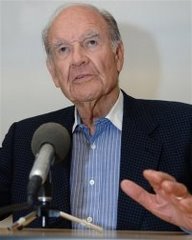
George McGovern's "Blueprint" for ending the war in Iraq

Note: I am publishing an e-mail I sent to peace activists, elected officials, along with the McGovern "Blueprint" for a way out of Iraq, followed by a commentary... this is a very lengthy post but the major media has refused to tolerate discussion. You may also access the original McGovern article in Harper's by clicking on the title.

Marie Braun;

I am a member of Minnesotans for Peace and Social Justice, an organization that began in order to try to stop the war in Iraq from starting in the first place. I spoke out at numerous anti-war rallies and demonstrations, met with numerous public officials and their staffs as you are doing now, and have continued to speak out against this dirty war as a union activist and union organizer. I am also a member of the Minnesota Democratic Farmer-Labor Party State Central Committee from Roseau County--- our County Convention unanimously passed a resolution “for ending the illegal and immoral war in Iraq, a war based upon lies and deceit.” You may obtain the resolution from our County Chair, Ley Soltis.

I received this letter of yours via Shove’s “Progressive Calendar:

From: braun044

Subject: Klobuchar/demands 1.18 10am

Dear Peacemakers,

I want to invite you to join members of the Peace Community at Senator Amy Klobuchar's Office this Thursday, January 18 at 10:00 am. We will meet with Sarah Grewing, State Director, and Zach Rodvold, Military & Veteran's Policy Specialist, to present our positions on the war on Iraq.

The Senator is temporarily using Senator Dayton's office space at:

Bishop Henry Whipple Building

1 Federal Drive, Suite 298

Fort Snelling, MN 55111

The Twin Cities Peace Campaign is coordinating visits with each of the Minnesota Congresspersons or their staff members during early January to urge our representatives to support an immediate end to the war. Roxanne Abbas and I will be presenting the position of the Twin Cities Peace Campaign and others can express their personal perspectives or their group's position.

Let's present a unified position to:

1. End the occupation and begin bringing the troops home now.
2. Cut off all further funding for the war.
3. Close all U.S. bases in Iraq.
4. Assume responsibility for reparations.

If you can come to the meeting, you might want to give me a call so that we have some idea how many people will be there and what groups will be represented.

Marie Braun for Twin Cities Peace Campaign-Focus on Iraq


As a long-time peace activist, I have a suggestion… I believe that you should put forward George McGovern’s “Blueprint” for ending the war in Iraq in your meetings with Klobuchar staff and others… this is the most sensible solution, given the circumstances, for ending the war in Iraq.

In addition to meeting with elected officials, I would encourage you to also meet with the various representatives of all political parties in Minnesota and urge their governing bodies to take up these four points, perhaps a fifth, which I will conclude this letter with.

The only other alternative is a complete bloodbath involving the senseless escalation of the killing of Iraqis which will then result in an unprecedented violent retaliatory killing of U.S troops… with the United States being driven from Iraq, as in Vietnam.

The time has come for the “peace movement” to enter into the political arena in a responsible manner that unites not only the peace movement, but the American people who went to the polls on November 7 voting with the anticipation that this dirty war for oil will end. Your responsibility is to reflect the wishes of these voters, as well as the peace movement; and in doing so present something that will bring all of these voters into the peace movement, the “peace community,” in a very active way.

The policy of U.S. imperialism has been to push religious, national, and ethnic conflicts with the escalation of violence in Iraq… the very--- intentional--- gruesome manner in which the hangings have been carried out has insured violent religious, national, and ethnic animosities will continue for a long time.

No one should find it strange, or in any way odd, that the United States government would be using, as a tactic, the inciting of national, ethnic, and religious conflict in Iraq. Such has been the policies of the government of the United States from its very inception… beginning with the genocidal campaigns against the First Nations Peoples, then to justify slavery, then to justify cheap wages, this was a widely used tactic to disrupt the socialist countries following World War II and to prevent many western European countries from taking the road to socialism; and during the civil rights movement here in the United States the case of civil rights activist Dr. Walter Bergman in which a United States Federal District Court Judge ruled that the United States Department of Justice and the FBI incited racial hatreds as a means to try to prevent a united Black and white response to racial injustice with the FBI planting its people inside of the KKK, not to gather information on this racist and terrorist organization, or to bring it down, but rather, to use this racist organization as part of government strategy aimed at protecting segregation and Jim Crow. The tactic was later employed in South Africa and finally the years of fomenting and inciting national, ethnic, and religious animosities and hostilities paid off in the Soviet Union... the CIA and the National Security Agency had plans to use these disruptive tactics for many years and it is common knowledge that the CIA and NSA used Nazi war criminals in their strategies inside the Soviet Union for many years. Today in China the CIA is hard at work fostering such divisions, also.

The very gruesome manners in which the hangings have been carried out have been intentionally meant to further inflame violent ethnic, national, and religious conflict for many years to come in Iraq.

To date, only the McGovern “Blueprint” for ending U.S. involvement in Iraq considers this important question relating to these ethnic, national, and religious conflicts and that is why both Democrats and Republicans who support the general policies of U.S. imperialism abroad, which includes Amy “Republican Lite” Klobuchar, have refused to address and respond to the McGovern “Blueprint.”

I believe as representatives of the peace movement meeting with the staffs of elected politicians you have the responsibility to bring the McGovern “Blueprint” forward… the call for ending the war now--- “Out Now”--- and cutting all funding is simply not good enough because unless there is an actual plan to mobilize the American people around taking into consideration the very real situation that has been created and fostered by an intentional strategy of which ethnic, religious, and national hatreds have been incited and inflamed… we are going to see the United States take the opportunity to spread this war into Iran, Syria, and further into Lebanon using the very same tactics that will assure conflict in the Middle East for many years to come.

It is incumbent on peace activists in Minnesota to bring forward the McGovern “Blueprint.” To date… the Minnesota DFL, its leadership, its state Central Committee, and elected officials have refused to discuss the McGovern “Blueprint” for ending the war in Iraq while ending the ethnic, national, and religious tensions and animosities intentionally set in motion as part of the strategy used by U.S. imperialism in its drive to not only conquer the oil fields, but to attain political domination of the region.

The same right-wing, pro-war Israeli lobby that has tried to marginalize Jimmy Carter on the Israeli/Palestinian question has worked over-time to silence George McGovern… and they began working against him from the day he was elected to the United States Senate and during his campaign for the presidency… it is this very same lobby that refused to tolerate my voice for peace as an elected member of the DFL State Central Committee and has refused to inform me of meetings and has removed me from participation in the DFL state central committee list serve when I spoke out vigorously against the Israeli carnage in Lebanon… not one other member of the DFL State Central Committee raised their voice in protest… and some members of the “peace community” on this same central committee have sat in silence as these McCarthyite tactics of red-baiting have been employed against me. In fact, it was members of the DFL Progressive Caucus, members of the “peace community” who were used to incite this red-baiting campaign against me.

I would note, that the peace community did not respond to the calls from Walter Mondale for a pre-emptive strike against North Korea--- there was almost universal silence… it has been this Humphrey/Mondale/Klobuchar grouping that has slavishly served the interests of U.S. imperialism and has received the financial backing of the very right-wing, very pro-war, Israeli lobby of the military-financial-industrial complex--- the war machine… it is this lobby that has been detrimental and created disunity in the ranks of peace activists in Minnesota… now with your meetings you have the opportunity to put forward a real alternative to the war in Iraq and distance the peace movement from the aims of U.S. imperialism; and distance the peace movement from this pro-war lobby that has tried to pawn itself off on Minnesotans as being “liberal” and even as “progressive.”

I hope you will take the McGovern “Blueprint” into these meetings with elected officials as representatives of the peace movement in Minnesota; this will help build the peace movement in Minnesota and give the McGovern “Blueprint” the higher profile it deserves.

I hope you will make it clear that the peace community supports using the funds now being squandered in this senseless, criminal, imperialist war for oil and regional domination to create a world-class, single-payer, universal health care system here in the United States… I assume that you could include this as a fifth demand on your list as demonstrating the need to spend on social programs is a very important alternative that needs to be put forward in order to bring the majority of the American people and Minnesotans who voted for an end to this dirty war into the active “peace community.”

I will be posting this e-mail on my daily blog today:

http://thepodunkblog.blogspot.com/

Alan L. Maki

A founding member; Minnesotans for Peace and Social Justice

58891 County Road 13

Warroad, Minnesota 56763

Phone: 218-386-2432

Cell phone: 651-587-5541

E-mail: amaki000@centurytel.net


Bcc: All Board members, Minnesotans for Peace and Social Justice

Bcc: various political leaders, elected officials and their staff members, peace activists

This was e-mailed to the following:

CharleyUnderwood; member of DFL State Central Committee
charleyunderwood@hotmail.com

United States Congressman Keith Ellison, 5th Congressional District
keith@keithellison.org

State Representative Bill Hilty
rep.bill.hilty@house.mn

Peter Makowski, Staff Representative U.S. Congressman James Oberstar peter.makowski@mail.house.gov';

David Kaplan fund raiser

David Shove, originator of "Progressive Calendar '

State Representative David Olin, District 1 A
rep.david.olin@house.mn

The Way Out of War

A blueprint for leaving Iraq now

Posted on Wednesday, November 8, 2006.

Originally from October 2006.

By George S. McGovern and William R. Polk.

Staying in Iraq is not an option. Many Americans who were among the most eager to invade Iraq now urge that we find a way out. These Americans include not only civilian “strategists” and other “hawks” but also senior military commanders and, perhaps most fervently, combat soldiers. Even some of those Iraqis regarded by our senior officials as the most pro-American are determined now to see American military personnel leave their country. Polls show that as few as 2 percent of Iraqis consider Americans to be liberators. This is the reality of the situation in Iraq. We must acknowledge the Iraqis’ right to ask us to leave, and we should set a firm date by which to do so.

We suggest that phased withdrawal should begin on or before December 31, 2006, with the promise to make every effort to complete it by June 30, 2007.

Withdrawal is not only a political imperative but a strategic requirement. As many retired American military officers now admit, Iraq has become, since the invasion, the primary recruiting and training ground for terrorists. The longer American troops remain in Iraq, the more recruits will flood the ranks of those who oppose America not only in Iraq but elsewhere.

Withdrawal will not be without financial costs, which are unavoidable and will have to be paid sooner or later. But the decision to withdraw at least does not call for additional expenditures. On the contrary, it will effect massive savings. Current U.S. expenditures run at approximately $246 million each day, or more than $10 million an hour, with costs rising steadily each year. Although its figures do not include all expenditures, the Congressional Research Service listed direct costs at $77.3 billion in 2004, $87.3 billion in 2005, and $100.4 billion in fiscal year 2006. Even if troop withdrawals begin this year, total costs (including those in Afghanistan) are thought likely to rise by $371 billion during the withdrawal period. Economist Joseph Stiglitz and Linda Bilmes, a former assistant secretary of commerce, have estimated that staying in Iraq another four years will cost us at least $1 trillion.

Let us be clear: there will be some damage. This is inevitable no matter what we do. At the end of every insurgency we have studied, there was a certain amount of chaos as the participants sought to establish a new civic order. This predictable turmoil has given rise to the argument, still being put forward by die-hard hawks, that Americans must, in President Bush’s phrase, “stay the course.” The argument is false. When a driver is on the wrong road and headed for an abyss, it is a bad idea to “stay the course.” A nation afflicted with a failing and costly policy is not well served by those calling for more of the same, and it is a poor idea to think that we can accomplish in the future what we are failing to accomplish in the present. We are as powerless to prevent the turmoil that will ensue when we withdraw as we have been to stop the insurgency. But we will have removed a major cause of the insurgency once we have withdrawn. Moreover, there are ways in which we can be helpful to the Iraqis—and protect our own interests—by ameliorating the underlying conditions and smoothing the edges of conflict.The first of these would be a “bridging” effort between the occupation and complete independence.

* * *

To this end, we think that the Iraqi government would be wise to request the temporary services of an international stabilization force to police the country during and immediately after the period of American withdrawal. Such a force should itself have a firm date fixed for its removal. Our estimate is that Iraq would need this force for no more than two years after the American withdrawal is complete. During this period, the force could be slowly but steadily cut back in both personnel and deployment. Its purpose would be limited to activities aimed at enhancing public security. Consequently, the armament of this police force should be restricted. It would have no need for tanks or artillery or offensive aircraft but only light equipment. It would not attempt, as have American troops, to battle the insurgents. Indeed, after the withdrawal of American troops, as well as British regular troops and mercenary forces, the insurgency, which was aimed at achieving that objective, would almost immediately begin to lose public support. Insurgent gunmen would either put down their weapons or become publicly identified as outlaws.

We imagine that the Iraqi government, and the Iraqi people, would find the composition of such a force most acceptable if it were drawn from Arab or Muslim countries. Specifically, it should be possible under the aegis of the United Nations to obtain, say, five contingents of 3,000 men each from Morocco, Tunisia, and Egypt. Jordan and Syria might also be asked to contribute personnel. If additional troops were required, or if any of these governments were deemed unacceptable to Iraq or unwilling to serve, application could be made to such Muslim countries as Pakistan, Bangladesh, and Indonesia. Other countries might be included if the Iraqi government so wished.

It would benefit both Iraq and the United States if we were to pay for this force. Assuming that a ballpark figure would be $500 per man per day, and that 15,000 men would be required for two years, the overall cost would be $5.5 billion. That is approximately 3 percent of what it would cost to continue the war, with American troops, for the next two years. Not only would this represent a great monetary saving to us but it would spare countless American lives and would give Iraq the breathing space it needs to recover from the trauma of the occupation in a way that does not violate national and religious sensibilities.

The American subvention should be paid directly to the Iraqi government, which would then “hire” the police services it requires from other governments. The vast amount of equipment that the American military now has in Iraq, particularly transport and communications and light arms, should be turned over to this new multinational force rather than shipped home or destroyed.

* * *

As the insurgency loses its national justification, other dangers will confront Iraq. One of these is “warlordism,” as we have seen in Afghanistan, and other forms of large-scale crime. Some of this will almost certainly continue. But the breakdown of public order will never be remedied by American forces; it can only be addressed by a national police force willing to work with neighborhood, village, and tribal home guards. Ethnic and regional political divisions in Iraq have been exacerbated by the occupation, and they are unlikely to disappear once the occupation is over. They are now so bitter as to preclude a unified organization, at least for the time being. It is therefore paramount that the national police force involve local leaders, so as to ensure that the home guards operate only within their own territory and with appropriate action. In part, this is why Iraq needs a “cooling off” period, with multinational security assistance, after the American withdrawal.

While the temporary international police force completes its work, the creation of a permanent national police force is, and must be, an Iraqi task. American interference would be, and has been, counterproductive. And it will take time. The creation and solidification of an Iraqi national police force will probably require, at a rough estimate, four to five years to become fully effective. We suggest that the American withdrawal package should include provision of $1 billion to help the Iraqi government create, train, and equip such a force, which is roughly the cost of four days of the present American occupation.

Neighborhood, village, and tribal home guards, which are found throughout Iraq, of course constitute a double-edged sword. Inevitably, they mirror the ethnic, religious, and political communities from which they are drawn. Insofar as they are restricted each to its own community, and are carefully monitored by a relatively open and benign government, they will enhance security; allowed to move outside their home areas, they will menace public order. Only a central government police and respected community leaders can possibly hope to control these militias. America has no useful role to play in these affairs, as experience has made perfectly clear.

* * *

It is not in the interests of Iraq to encourage the growth and heavy armament of a reconstituted Iraqi army. The civilian government of Iraq should be, and hopefully is, aware that previous Iraqi armies have frequently acted against Iraqi civic institutions. That is, Iraqi armies have not been a source of defense but of disruption. We cannot prevent the reconstitution of an Iraqi army, but we should not, as we are currently doing, actually encourage this at a cost of billions to the American taxpayer. If at all possible, we should encourage Iraq to transfer what soldiers it has already recruited for its army into a national reconstruction corps modeled on the U.S. Army Corps of Engineers. The United States could assist in the creation and training of just such a reconstruction corps, which would undertake the rebuilding of infrastructure damaged by the war, with an allocation of, say, $500 million, or roughly the cost of two days of the current occupation.

Withdrawal of American forces must include immediate cessation of work on U.S. military bases. Nearly half of the more than 100 bases have already been closed down and turned over, at least formally, to the Iraqi government, but as many as fourteen “enduring” bases for American troops in Iraq are under construction. The largest five are already massive, amounting to virtual cities. The Balad Air Base, forty miles north of Baghdad, has a miniature golf course, 2 PXs, a Pizza Hut, a Burger King, and a jail. Another, under construction at al-Asad, covers more than thirteen square miles. Although Secretary of Defense Donald Rumsfeld stated on December 23, 2005, that “at the moment there are no plans for permanent bases. . . . It is a subject that has not even been discussed with the Iraqi government,” his remarks are belied by action on the ground, where bases are growing in size and being given aspects of permanency. The most critical of these are remote military bases. They should be stood down rapidly. Closing these bases is doubly important: for America, they are expensive and already redundant; for Iraqis, they both symbolize and personify a hated occupation. With them in place, no Iraqi government will ever feel truly independent. It is virtually certain that absent a deactivation of U.S. military bases, the insurgency will continue. The enormous American base at Baghdad International Airport, ironically named “Camp Victory,” should be the last of the military bases to be closed, as it will be useful in the process of disengagement.

We should of course withdraw from the Green Zone, our vast, sprawling complex in the center of Baghdad. The United States has already spent or is currently spending $1.8 billion on its headquarters there, which contains, or will contain, some 600 housing units, a Marine barracks, and more than a dozen other buildings, as well as its own electrical, water, and sewage systems. The Green Zone should be turned over to the Iraqi government no later than December 31, 2007. By this time, the U.S. should have bought, or rented, or built a “normal” embassy for a considerably reduced complement of personnel. Symbolically, it would be beneficial for the new building not to be in the Green Zone. Assuming that a reasonable part of the Green Zone’s cost can be saved, there should be no additional cost to create a new American embassy for an appropriate number of not more than 500 American officials, as opposed to the 1,000 or so Americans who today staff the Green Zone. Insofar as is practical, the new building should not be designed as though it were a beleaguered fortress in enemy territory.

Withdrawal from these bases, and an end to further construction, should save American taxpayers billions of dollars over the coming two years. This is quite apart from the cost of the troops they would house. America should immediately release all prisoners of war and close its detention centers.

* * *

Mercenaries, euphemistically known as “Personal Security Detail,” are now provided by an industry of more than thirty “security” firms, comprising at least 25,000 armed men. These constitute a force larger than the British troop contingent in the “Coalition of the Willing” and operate outside the direct control—and with little interference from the military justice systems—of the British and American armies. They are, literally, the “loose cannons” of the Iraq war. They should be withdrawn rapidly and completely, as the Iraqis regard them as the very symbol of the occupation. Since the U.S. pays for them either directly or indirectly, all we need to do is stop payment.

Much work will be necessary to dig up and destroy land mines and other unexploded ordinance and, where possible, to clean up the depleted uranium used in artillery shells. These are dangerous tasks that require professional training, but they should be turned over wherever possible to Iraqi contractors. These contractors would employ Iraqi labor, which would help jump-start a troubled economy and be of immediate benefit to the millions of Iraqis who are now out of work. The United Nations has gained considerable knowledge about de-mining—from the Balkans, Afghanistan, and elsewhere—that might be shared with the Iraqis. Although cleanup will be costly, we cannot afford to leave this dangerous waste behind. One day’s wartime expenditure, roughly $250 million, would pay for surveys of the damage and the development of a plan to deal with it. Once the extent of the problem is determined, a fund should be established to eradicate the danger completely.

These elements of the “withdrawal package” may be regarded as basic. Without them, Iraqi society will have little chance of recovering economically or governing itself with any effectiveness. Without them, American interests in the Middle East, and indeed throughout the world, will be severely jeopardized. These measures are, we repeat, inexpensive and represent an enormous savings over the cost of the current war effort. Building on them are further actions that would also help Iraq become a safe and habitable environment. To these “second tier” policies we now turn.

* * *

Property damage incurred during the invasion and occupation has been extreme. The World Bank has estimated that at least $25 billion will be required to repair the Iraqi infrastructure alone—this is quite apart from the damage done to private property. The reconstruction can be, and should be, done by Iraqis, as this would greatly benefit the Iraqi economy, but the United States will need to make a generous contribution to the effort if it is to be a success. Some of this aid should be in the form of grants; the remainder can be in the form of loans. Funds should be paid directly to the Iraqi government, as it would be sound policy to increase the power and public acceptance of that government once American troops withdraw. The Iraqis will probably regard such grants or loans as reparations; some of the money will probably be misspent or siphoned off by cliques within the government. It would therefore benefit the Iraqi people if some form of oversight could be exercised over the funds, but this would tend to undercut the legitimacy and authority of their government, which itself will probably be reconstituted during or shortly after the American occupation ends. Proper use of aid funds has been a problem everywhere: America’s own record during the occupation has been reprehensible, with massive waste, incompetence, and outright dishonesty now being investigated for criminal prosecution. No fledgling Iraqi government is likely to do better, but if reconstruction funds are portioned out to village, town, and city councils, the enhancement of such groups will go far toward the avowed American aim of strengthening democracy, given that Iraqis at the “grass roots” level would be taking charge of their own affairs.

We suggest that the United States allocate for the planning and organization of the reconstruction the sum of $1 billion, or roughly four days of current wartime expenditure. After a planning survey is completed, the American government will need to determine, in consultation with the Iraqi government (and presumably with the British government, our only true “partner” in the occupation), what it is willing to pay for reconstruction. We urge that the compensation be generous, as generosity will go a long way toward repairing the damage to the American reputation caused by this war.

Nearly as important as the rebuilding of damaged buildings and other infrastructure is the demolition of the ugly monuments of warfare. Work should be undertaken as soon as is feasible to dismantle and dispose of the miles of concrete blast walls and wire barriers erected around present American installations. Although the Iraqi people can probably be counted on to raze certain relics of the occupation on their own, we should nonetheless, in good faith, assist in this process. A mere two days’ worth of the current war effort, $500 million, would employ a good many Iraqi demolition workers.

Another residue of war and occupation has been the intrusion of military facilities on Iraqi cultural sites. Some American facilities have done enormous and irreparable damage. Astonishingly, one American camp was built on top of the Babylon archaeological site, where American troops flattened and compressed ancient ruins in order to create a helicopter pad and fueling stations. Soldiers filled sandbags with archaeological fragments and dug trenches through unexcavated areas while tanks crushed 2,600-year-old pavements. Babylon was not the only casualty. The 5,000-year-old site at Kish was also horribly damaged. We need to understand that Iraq, being a seedbed of Western civilization, is a virtual museum. It is hard to put a spade into the earth there without disturbing a part of our shared cultural heritage. We suggest that America set up a fund of, say, $750 million, or three days’ cost of the war, to be administered by an ad-hoc committee drawn from the Iraqi National Museum of Antiquities or the State Board of Antiquities and Heritage, the British Museum, the World Monuments Fund, the Smithsonian Institution, and what is perhaps America’s most prestigious archaeological organization, the Oriental Institute of the University of Chicago, to assist in the restoration of sites American troops have damaged. We should not wish to go down in history as yet another barbarian invader of the land long referred to as the cradle of civilization.

* * *

Independent accounting of Iraqi funds is urgently required. The United Nations handed over to the American-run Coalition Provisional Authority (CPA) billions of dollars generated by the sale of Iraq petroleum with the understanding that these monies would be used to the benefit of the Iraqi people and would be accounted for by an independent auditor. The CPA delayed this audit month after month, and it was still not completed by the time the CPA ceased to exist. Any funds misused or misappropriated by U.S. officials should be repaid to the proper Iraqi authority. What that amount is we cannot predict at this time.

Although the funds turned over to the CPA by the U.N. constitute the largest amount in dispute, that is by no means the only case of possible misappropriation. Among several others reported, perhaps the most damaging to Iraq has been a project allocated to Halliburton’s subsidiary Kellogg, Brown & Root as part of a $2.4 billion no-bid contract awarded in 2003. The $75.7 million project was meant to repair the junction of some fifteen pipelines linking the oil fields with terminals. Engineering studies indicated that as conceived the project was likely to fail, but KBR forged ahead and, allegedly, withheld news of the failure from the Iraqi Ministry of Petroleum until it had either spent or received all the money. Despite this, KBR was actually awarded a bonus by the Army Corps of Engineers, even though Defense Department auditors had found more than $200 million of KBR’s charges to be questionable. There would seem to be more greed than prudence in the repeated awards to Halliburton in the run-up to the war, during the war itself, and in contracts to repair the war damages. Especially given that Vice President Dick Cheney was formerly CEO of Halliburton, the U.S. should make every effort to investigate this wrongdoing, prosecute and correct it, and depart from Iraq with clean hands.

* * *

The United States should not object to the Iraqi government voiding all contracts entered into for the exploration, development, and marketing of oil during the American occupation. These contracts clearly should be renegotiated or thrown open to competitive international bids. The Iraqi government and public believe that because Iraqi oil has been sold at a discount to American companies, and because long-term

“production-sharing agreements” are highly favorable to the concessionaires, an unfair advantage has been taken. Indeed, the form of concession set up at the urging of the CPA’s consultants has been estimated to deprive Iraq of as much as $194 billion in revenues. To most Iraqis, and indeed to many foreigners, the move to turn over Iraq’s oil reserves to American and British companies surely confirms that the real purpose of the invasion was to secure, for American use and profit, Iraq’s lightweight and inexpensively produced oil.

It is to the long-term advantage of both Iraq and the United States, therefore, that all future dealings in oil, which, after all, is the single most important Iraqi national asset, be transparent and fair. Only then can the industry be reconstituted and allowed to run smoothly; only then will Iraq be able to contribute to its own well-being and to the world’s energy needs. Once the attempt to create American-controlled monopolies is abandoned, we believe it should be possible for investment, even American investment, to take place in a rapid and orderly manner. We do not, then, anticipate a net cost connected with this reform.

* * *

Providing reparations to Iraqi civilians for lives and property lost is a necessity. The British have already begun to do so in the zone they occupy. According to Martin Hemming of the Ministry of Defence, British policy “has, from the outset of operations in Iraq, been to recognize the duty to provide compensation to Iraqis where this is required by the law. . . . [B]etween 1 June 2003 and 31 July 2006, 2,327 claims have been registered . . .” Although there is no precise legal precedent from past wars that would require America to act accordingly, American forces in Iraq have now provided one: individual military units are authorized to make “condolence payments” of up to $2,500. The United States could, and should, do even more to compensate Iraqi victims or their heirs. Such an action might be compared to the Marshall Plan, which so powerfully redounded to America’s benefit throughout the world after the end of the Second World War. As we go forward, the following points should be considered.

The number of civilians killed or wounded during the invasion and occupation, particularly in the sieges of Fallujah, Tal Afar, and Najaf, is unknown. Estimates run from 30,000 to well over 100,000 killed, with many more wounded or incapacitated. Assuming the number of unjustified deaths to be 50,000, and the compensation per person to be $10,000, our outlay would run to only $500 million, or two days’ cost of the war. The number seriously wounded or incapacitated might easily be 100,000. Taking the same figure as for death benefits, the total cost would be $1 billion, or four days’ cost of the war. The dominant voice in this process should be that of Iraq itself, but in supplying the funds the United States could reasonably insist on the creation of a quasi-independent body, composed of both Iraqis and respected foreigners, perhaps operating under the umbrella of an internationally recognized organization such as the International Federation of Red Cross and Red Crescent Societies or the World Health Organization, to assess and distribute compensation.

In the meantime, a respected international body should be appointed to process the claims of, and pay compensation to, those Iraqis who have been tortured (as defined by the Geneva Conventions) or who have suffered long-term imprisonment. The Department of Defense admits that approximately 3,200 people have been held for longer than a year, and more than 700 for longer than two years, most of them without charge, a clear violation of the treasured American right of habeas corpus. The number actually subjected to torture remains unknown, but it is presumed to include a significant portion of those incarcerated. Unfortunately, there exists no consensus, legal or otherwise, on how victims of state-sponsored torture should be compensated, and so it is not currently possible to estimate the cost of such a program. Given that this is uncharted legal territory, we should probably explore it morally and politically to find a measure of justifiable compensation. The very act of assessing damages—perhaps somewhat along the lines of the South African Truth and Reconciliation Commission— would, in and of itself, be a part of the healing process.

* * *

America should also offer—not directly but through suitable international or nongovernmental organizations—a number of further financial inducements to Iraq’s recovery. These might include fellowships for the training of lawyers, judges, journalists, social workers, and other civil-affairs workers. Two days’ cost of the current war, or $500 million, would ably fund such an effort.

In addition, assistance to “grass roots” organizations and professional societies could help encourage the return to Iraq of the thousands of skilled men and women who left in the years following the first Gulf war. Relocation allowance and supplementary pay might be administered by the Iraqi engineers’ union. Medical practitioners might receive grants through the medical association. Teachers might be courted by the teachers’ union or the Ministry of Education. Assuming that some 10,000 skilled workers could be enticed to return for, say, an average of $50,000, this would represent a cost to the American taxpayer of $500 million. Roughly two days’ cost of the war would be a very small price to pay to restore the health and vigor of Iraqi society and to improve America’s reputation throughout the world.

We should also encourage the World Health Organization, UNICEF, and similarly established and proven nongovernmental organizations to help with the rebirth of an Iraqi public-health system by rebuilding hospitals and clinics. One reason for turning to respected international organizations to supervise this program is that when the CPA undertook the task, funds were squandered.

At last count, some seventeen years ago Iraq possessed an impressive health-care infrastructure: 1,055 health centers, 58 health centers with beds, 135 general hospitals, and 52 specialized hospitals. Many of these facilities were badly damaged by a decade of sanctions and by the recent warfare and looting. If we assume that fully half of Iraq’s hospitals and health centers need to be rebuilt, the overall outlay can be estimated at $250 million, one day’s cost of the current war. Equipment might cost a further $170 million. These figures, based on a study prepared for the United Nations Millennium Development Goals project, throw into sharp relief the disappointing results of the American “effort”: one American firm, Parsons Corporation, has been investigated for having taken a generous “cost plus” contract to rebuild 142 clinics at a cost of $200 million; although the company put in for and collected all the money, only twenty clinics were built.

Estimating the cost of staffing these facilities is more complicated. Theoretically, Iraq has a highly professional, well-trained, reasonably large corps of health workers at all levels. Yet many of these people left the country in the years following the 1991 war. The Iraqi Health Ministry has estimated that about 3,000 registered doctors left Iraq during the first two years of the American occupation. Hopefully these workers will return to Iraq once the occupation and the insurgency have ended, but even if they do so, younger replacements for them need to be trained. The UNMDG study suggests that the training period for specialists is about eight years; for general practitioners, five years; and for various technicians and support personnel, three years. We suggest that a training program for a select number, say 200 general practitioners and 100 advanced specialists, be carried out under the auspices of the World Health Organization or Médecins Sans Frontières, especially given that some of this training will have to be done in Europe or America. Even if the estimated cost of building and equipping hospitals turned out to be five times too low, even if the American government had to cover the bulk of salaries and operating costs for the next four years, and even if additional hospitals had to be built to care for Iraqis wounded or made ill by the invasion and occupation, the total cost would still be under $5 billion. It is sobering to think that the maximum cost of rebuilding Iraq’s public-health system would amount to less than what we spend on the occupation every twenty days.

* * *

The monetary cost of the basic set of programs outlined here is roughly $7.25 billion. The cost of the “second tier” programs cannot be as accurately forecast, but the planning and implementation of these is likely to cost somewhere in the vicinity of $10 billion. Seventeen and a quarter billion dollars is a lot of money, but assuming that these programs cut short the American occupation by only two years, they would save us at least $200 billion. Much more valuable, though, are the savings to be measured in what otherwise are likely to be large numbers of shattered bodies and lost lives. Even if our estimates are unduly optimistic, and the actual costs turn out to be far higher, the course of action we recommend would be perhaps the best investment ever made by our country.

Finally, we as a nation should not forget the young Americans who fought this war, often for meager pay and with inadequate equipment. As of this writing, more than 2,600 of our soldiers have been killed, and a far greater number wounded or crippled. It is only proper that we be generous to those who return, and to the families of those who will not.

That said, we should find a way to express our condolences for the large number of Iraqis incarcerated, tortured, incapacitated, or killed in recent years. This may seem a difficult gesture to many Americans. It may strike them as weak, or as a slur on our patriotism. Americans do not like to admit that they have done wrong. We take comfort in the notion that whatever the mistakes of the war and occupation, we have done Iraq a great service by ridding it of Saddam Hussein’s dictatorship. Perhaps we have, but in the process many people’s lives have been disrupted, damaged, or senselessly ended. A simple gesture of conciliation would go a long way toward shifting our relationship with Iraq from one of occupation to one of friendship. It would be a gesture without cost but of immense and everlasting value—and would do more to assuage the sense of hurt in the world than all of the actions above.

About the Author
George S. McGovern, the United Nations Global Ambassador on Hunger, was the Democratic candidate for president in 1972. He is the author of numerous books, including The Third Freedom: Ending Hunger in Our Time. William R. Polk was a member of the Policy Planning Council responsible for the Middle East and, later, professor of history and founder-director of the Center for Middle Eastern Studies at the University of Chicago. His latest book on the Middle East is Understanding Iraq. This essay was adapted from the book Out of Iraq, which is being published this month by Simon & Schuster.

This is The Way Out of War, a feature, originally from October 2006, published Wednesday, November 8, 2006. It is part of Features, which is part of Harpers.org.

******

Commentary on the McGovern "Blueprint"

OpEdNews

Original Content at http://www.opednews.com/articles/genera_sherwood_060927_blueprint_for_iraq_w.htm

September 27, 2006

Blueprint For Iraq Withdrawal From George McGovern and William Polk

By Sherwood Ross

BLUEPRINT FOR AMERICAN WITHDRAWAL FROM IRAQ PROPOSED
BY 1972 DEMOCRATIC PRESIDENTIAL CANDIDATE GEORGE McGOVERN

By Sherwood Ross

American and British troops in Iraq could be replaced over a phased, six-month period starting next January by a force of 15,000 men drawn from Arab or Muslim countries and paid for by the United States, former Democratic presidential nominee George McGovern proposes.

In a wide-ranging article appearing in the October issue of "Harper's" magazine, McGovern spelled out a comprehensive "blueprint" for the withdrawal of Coalition troops.

"Withdrawal will not be without financial costs, which are unavoidable and will have to be paid sooner or later," McGovern wrote, in an article co-authored with William Polk, founder-director of the Center for Middle Eastern Studies at the University of Chicago. "But the decision to withdraw at least does not call for additional expenditures. On the contrary, it will effect massive savings."

Current U.S. expenditures in Iraq cost about $246-million per day, a rate that continues to climb, and will come to about $100.4-billion in fiscal 2006, the authors write, adding one estimate puts the cost of remaining in Iraq another four years at $1-trillion.

McGovern and Polk urged the creation of a "stabilization force" from Morocco, Tunisia, Egypt, Jordan, Syria, Pakistan, Bangladesh, and Indonesia, to be selected at the determination of the Iraqi government. The authors estimate that a force of just 3,000 troops from five countries would be sufficient to keep the peace.
At a cost of $500 for maintaining one man per day, the overall cost to support a 15,000-man army would be $5.5-billion, "approximately three percent of what it would cost to continue the war, with American troops, for the next two years," the authors pointed out.

McGovern and Polk called for the "rapid withdrawal" of 25,000 armed "security" firm personnel and the phased withdrawal of the U.S. and British forces, said to number 120,000 and about 10,000 respectively.

They also called for putting a halt to work on U.S. military bases, the immediate release of all prisoners of war and closing of detention centers, payment of at least $25-billion to rebuild the Iraqi infrastructure, voiding of all oil contracts entered into during the U.S. occupation, and reparations to Iraqi civilians for lives and property. They also asked for creation of an international body to be named to arrange compensation for Iraqis tortured by Anglo-American troops.

The Harper's article urged, again at U.S. expense, the rebuilding of damaged and destroyed hospitals and clinics and training their medical personnel, training a national police force, clearing the country of depleted uranium and land mines, and the rehabilitation of damaged historical sites. Personnel to clean up the ordnance could be recruited from among the "millions" of unemployed Iraqis, the authors said.

"We cannot prevent the reconstruction of an Iraqi army, but we should not, as we are currently doing, actually encourage this at a cost of billions to the American taxpayer," the authors write. "If at all possible, we should encourage Iraq to transfer what soldiers it has already recruited for its army into a national reconstruction corps modeled on the U.S. Army Corps of Engineers."

McGovern and Polk go on to say that nearly half of more than 100 U.S. military bases in Iraq have already been turned over to the Government but as many as 14 "enduring" bases are being built "and should be stood down rapidly" due to their expense and also as they "symbolize and personify a hated occupation" to a population only two percent of whom consider the Americans as "liberators." What's more, the Green Zone in Baghdad should be turned over to the Iraqi Government no later than the end of 2007.

The authors also call upon the U.S. "to dismantle and dispose of the miles of concrete blast walls and wire barriers erected around American installations." This could be accomplished for about $500-million and could employ many Iraqi workers.

Scrap Oil Contracts

The U.S. "should not object to the Iraqi government voiding all contracts entered into for the exploration, development, and marketing of oil during the American occupation," McGovern and Polk wrote.

"These contracts clearly should be renegotiated or thrown open to competitive international bids" as the Iraqis believe their oil has been sold at a discount to U.S. oil companies and that long-term "production-sharing agreements" have been highly favorable to the Americans and could cost Iraq as much as $194-billion in lost revenues.

"To most Iraqis, and indeed to many foreigners, the move to turn over Iraq's oil reserves to American and British companies surely confirms that the real purpose of the invasion was to secure, for American use and profit, Iraq's lightweight and inexpensively produced oil," McGovern and Polk asserted.

They said, "any funds misused or misappropriated" by U.S. officials from the sale of Iraqi petroleum "should be repaid" to the proper Iraqi authorities.

The authors compared their call to indemnify Iraqi war victims to the U.S. post-World War II "Marshall Plan," which redounded to America's benefit by energizing the European economy. They note the number of Iraqi dead have been put at between 30,000 and 100,000 killed "with many more wounded or incapacitated."

"Assuming the number of unjustified deaths to be 50,000, and the compensation per person to be $10,000, our outlay would run to only $500-million, or two days' cost of the war," the authors said. And estimating the number seriously wounded and incapacitated at 100,000, the total cost for their compensation would be $1-billion.
McGovern and Polk called for creation of a "respected international body" to process the claims of, and pay compensation to, Iraqis who have been tortured or suffered long-term imprisonment. More than 3,200 prisoners have been held for longer than a year and more than 700 for longer than two years, they note, "most of them without charge, a clear violation of the treasured American right of habeas corpus."

Finally, the authors urged the U.S. to find a way "to express our condolences for the large number of Iraqis incarcerated, tortured, incapacitated, or killed in recent years. ...A simple gesture of conciliation would go a long way toward shifting our relationship with Iraq from one of occupation to one of friendship."

The Harper's article, "The Way Out of War," is excerpted from the book "Out of Iraq", to be published next month by Simon & Schuster. Co-author McGovern, the presidential nominee of the Democratic Party in 1972, was defeated by President Richard Nixon.
#
(Sherwood Ross is an American reporter and columnist. Reach him at sherwoodr1@yahoo.com)

Authors Bio: Sherwood Ross has worked in the civil rights movement and as a reporter for major dailies and wire services.

Tuesday, January 16, 2007

Get Involved: Health Care Demonstration; Health Care Forum

Get Involved: Health Care Demonstration; Health Care Forum

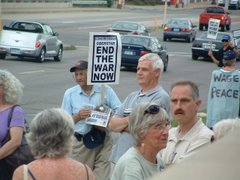
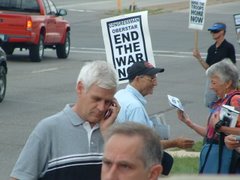
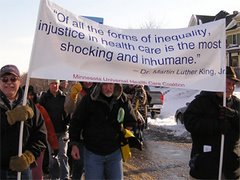
See pictures at bottom right of article.
This is an e-mail I distributed widely, please feel free to copy and paste any or all of this into an e-mail to distribute---

This is the kind of story on single-payer, universal health care that should be distributed widely, and reprinted often and everywhere…

This is an excellent article to post to websites, blogs, do newspaper articles from, to reprint for inclusion in newsletters… it would make a good leaflet; print and post on refrigerators; bulletin boards at work, school, churches, community centers, senior centers, union halls… anyone working in the health care field should distribute this widely… please click forward and pass this e-mail on to family and friends as well as your state and federal legislators.

Someone might want to pass this article on to Congressman John Conyers the proponent of H.R. 676 in Congress; we don’t want single-payer, universal health care derailed like what has happened with impeachment proceedings.

The Roseau County DFL Convention passed a resolution calling for, “comprehensive, all-inclusive, no-fee, single-payer, universal health care that is publicly funded and publicly administered.” The delegates to the State Convention of the Minnesota Democratic Farmer-Labor Party overwhelmingly passed a resolution in support of single-payer, universal health care. The Minnesota AFL-CIO also supports single-payer, universal health care as does Minnesotans for Peace and Social Justice and the Red Lake Casino, Hotel, and Restaurant Employees’ Union Organizing Committee…

All of which begs the questions:

Why are Minnesota DFL legislators dragging their feet on getting single-payer, universal health care legislation passed?

Why are some DFL legislators like Senator Linda Berglin and Rep. Bernie Lieder and Tom Huntley trying to undermine our efforts for single-payer, universal health care by putting forward all kinds of legislative schemes and scams aimed at insuring the profitability of the insurance companies and HMOs rather than putting the health care needs of Minnesotans first?

Minnesotans are fed up with seeing their hard earned tax-dollars wasted on death and destruction in Iraq when those funds should be used here in Minnesota to finance single-payer, universal health care.

Hopefully the Minnesota DFL State Central Committee will put ending this war in Iraq and getting legislation for single-payer, universal health care as their two top priorities and send a strong message to all DFL elected officials; they have a mandate from Minnesotans and their own convention to prioritize these two issues.

Following this news article is a notice of a public forum on “Health Care” in Stillwater, Minnesota that is free and open to the public.

What you can do:

> Organize demonstrations and vigils like the one below
> Write letters to the editor
> Write letters to state and federal legislators
> Meet with public officials
> Initiate petition campaigns

For more information, contact:

All Unions Committee for Single Payer Healthcare--HR 676
c/o Nurses Professional Organization
1169 Eastern Parkway, suite 2218
Louisville, KY 40217
(502) 636-1551
email: Nursenpo@aol.com


*****

Marchers rally for single-payer health care

by Lorna Benson, Minnesota Public Radio
January 15, 2007

Single-payer health insurance advocates recalled the words of Dr. Martin Luther King on Monday as they made their case for health care reform during an annual Martin Luther King Jr. Day march in St. Paul. They also called on state lawmakers to take a bolder approach to fixing Minnesota's health care system.

St. Paul, Minn. — Single-payer supporters say this is the first time they've paired their cause with St. Paul's annual Martin Luther King Jr. Day march from Central High School to Concordia University. But the Minnesota Universal Health Care Coalition says the pairing actually makes perfect sense.

The organization's vice chair, Dr. Jim Hart, says King was deeply troubled by health care inequality. To prove that point, single-payer marchers carried banners quoting King that said, "Of all the forms of inequality, injustice in health care is the most shocking and inhumane."

Hart says, like King, single-payer advocates believe that all Americans could and should have health care. But he says the U.S. will never achieve that goal with its current market-oriented system.

"We spend about 20-percent of our health care dollar on insurance functions, both at the insurance companies and at the clinics and hospitals that have to deal with this complicated system. So there would be ways to save but it would take a bolder approach than what we're seeing so far," he said.
Hart says single payer is that bolder approach. Often the mere mention of that model elicits groans from people who see it as leading to the rationing of health care. But fellow marcher Dr. Chris Reif says the definition of single payer is not necessarily what people assume.

"Single payer doesn't mean it always happens the same way," Reif said. "It just means that you try to get the economies of scale and try to get better care. Right now there's a move, like in Utah, to have single application forms for insurance. That's one step toward single payer. There's also a move to have our electronic medical records be the same or talk to each other. That's a move toward single payer."

If those arguments don't win over skeptics, single-payer advocates believe the eroding health insurance market will.

Eric Angell is with the Universal Health Care Action Network, another single payer organization that also marched at the King Day rally. Angel points to a recent vote by thousands of Twin Cities janitors who agreed to walk off the job if they don't get a more affordable health-care package.

"This is not an anomaly," according to Angell. "A lot of other unions have decided to go on strike for the exact same reason: the rising health care costs. Employers are not able to provide health care to their employees the way they once did and the obvious reason is the rising health care costs."

Angell says he's skeptical about lawmakers' willingness to look seriously at a single-payer system. But Dr. Jim Hart says he's impressed by at least one bill at the Capitol this session that would extend health care coverage to all children in Minnesota. Hart says the bill uses a single-payer approach to making health care affordable for kids.

Sen. John Marty, DFL-Roseville, who also participated in the march, says if lawmakers passing the "cover all kids" bill, it would be a huge step. But he says he's already detecting some backtracking among people who originally supported the idea.

"It's certainly a tough fight," Marty said. "We're not used to thinking this way. Much of the rest of the world does think that way but in the U.S. the health care industry is set up in a way that doesn't cover people and I think there's been a lack of vision in the political system." Rep. Keith Ellison campaigned on a single-payer system before getting elected to Congress. He says he still believes in the approach and will push the idea in Washington. But he says Minnesota lawmakers need to do their part too.

"Everybody should do what they can do. We're not putting the brakes on any effort," Ellison said. "If we can get a single-payer program in the state of Minnesota, great. If we can do it at the federal level, great. Ultimately it has to be a nationwide thing. But maybe a step toward that goal is a statewide program."

Ultimately single-payer advocates would like to see the state take over the way health care is financed. They admit there are plenty of obstacles to that goal. But they believe Minnesotans are more receptive to the idea now than they've ever been.

BROADCAST DATES
• All Things Considered, 01/15/2007, 5:23 p.m.

******

Obtained From: "Progressive Calendar"
< David Shove [shove001@tc.umn.edu] >

From: Dr. James Hart
From: Lee Salisbury [mailto:leesal@comcast.net]
Subject: Health care forum 1.18 7pm

River Valley Action
HEALTH CARE FORUM

Thursday, January 18, 2007

Time: 7-9pm

Trinity Lutheran Church (Garden Room)
115 4th St. N.
Stillwater, MN 55082

Phone: 651-439-7400

PURPOSE:
Citizens and area legislators are invited to attend this informative health care forum to learn more about our options for future health care coverage across our state and nation.

PANELISTS:

JIM KOPPEL, from Children's Defense Fund-MN, will discuss solutions for covering all the children in our state.

KIP SULLIVAN, from MN Universal Health Care Coalition, and author of The Health Care Mess: How We Got into It and How We Can Get out of It, will present ways to address the current situation.

GEOFF BARTSCH, from HealthPartners, will look at insurance industry alternatives and perspectives.

Each panelist will have 30 minutes to present their ideas and solutions. The final half hour is reserved for audience participation and questions.

For more information:

contact Karen Fitzpatrick at karenjimfitz@msn.com or 651-426-3530

This event is FREE and OPEN to the public.


Distributed by:

Alan L. Maki
58891 County Road 13
Warroad, Minnesota 56763
Phone: 218-386-2432
Cell phone: 651-587-5541
E-mail: amaki000@centurytel.net

Please check out my daily blog:

http://thepodunkblog.blogspot.com/

Monday, January 15, 2007

Dr. Martin Luther King, Jr.

Today is Martin Luther King Day.

Most of the problems that Dr. King sought to correct still plague our nation--- racism, discrimination, inequality, poverty, lack of access to health care, unemployment. And, once again people are dying in a senseless, immoral, and illegal, imperialist war based upon lies and deceit.

Racism is a dirty tool used to keep people divided and remains the main obstacle to forging the kind of unity that is needed to correct all the other problems. Racism, combined with a heavy dose of anti-communism has been the concoction that has been used by big-business corporate interests for over one hundred years to poison the minds of the American people, especially the working class, in order to keep people from understanding the true nature of capitalism and its present stage of imperialism which many refer to as capitalist globalization.

The struggle for jobs at real living wages for all workers has to be placed on the agenda today. The corporations have people fighting one another for poverty wage jobs like dogs fighting over bones.

The struggle for single-payer, universal health care must become a top priority. We need to reject all the phony schemes and "Band-Aid" solutions promising to "fix" the health care mess which are really, like racism and anti-communism, just being thrown into the capitalist witches' brew in order to disorient our struggle to achieve access to health care for all. There is no such thing as "affordable" universal health care. In order for health care to be universal it must be comprehensive, all-inclusive, free, publicly financed and publicly administered.

Dr. Martin Luther King, Jr. advocated building a progressive movement for social change; the foundation of which is created from equality, jobs for all at real living wages, access to health care for all, and peace.

These were, and remain, the central features of a progressive agenda that all liberal and progressive thinking people can unite around...

Building this progressive movement is part of the legacy, and unfinished work, left to us by Dr.King.

Dr. King recognized the centrality of bringing working people into this progressive struggle... as he focused on doing this he was murdered.

Saturday, January 13, 2007

Labor & Sustainability Conference

Labor & Sustainability Conference

January 19th-20th, 2007

Next weekend --- mark your calendar

please distribute widely

UNITED AUTO WORKERS 879 Union Hall

2191 Ford Parkway, St. Paul, MN

Phone: 651-699-4246

[To go to the web site click on the title]

Free & Open To The Public

FRIDAY EVENING PROGRAM --- January 19

6:00 PM Reception

7:00 PM Speakers

“Building A Movement For Sustainability: How Labor Can Respond to the Climate Crisis”
Jack Rasmus, Chairperson of Bay Area National Writers Union 1981 (UAW) & Author of The War At Home: The Corporate Offensive From Reagan To Bush and Fire On Pier 32.

Bill Onasch, Amalgamated Transit Union Local 1287 Retiree (Kansas City, MO Bus Drivers), Labor Party Interim National Council & U.S. Labor Against the War Steering Committee.

SATURDAY SCHEDULE--- January 20

8:00 AM Registration

9:00 AM Welcoming Address by Lynn Hinkle, Health & Safety Director, UAW 879

10:00 AM First Workshop Session

12:00 Lunch-Time Press Conference in the Rotunda of the MNSCU Training Center

1:00 PM Second Workshop Session

3:00 PM Plenary to Discuss & Vote on Action Resolutions

DINNER-TIME PANEL DISCUSSION

Charles Griffith, Auto Project Director, Ecology Center, Ann Arbor, MI

Bracken Hendricks, Executive Director, Apollo Alliance

8:30 PM Poetry by members of the Minnesota Spoken Word Association

9:00 PM Dance

Free & Open To The Public.

Endorsed By:

AFSCME 3800, Douglas County Supervisor Adam Ritscher, 4th & 5th CDs Green Party, IMPACT, Labor Education Service, Mac CARES, Mayday Books, Mpls. CLUC, MN AFL-CIO, MN-CPUSA, MNs For Peace & Social Justice, Prof. Peter Rachleff, Red Lake Casino, Hotel & Restaurant Employees’ Union Org. Cmte., Save Our Bog, St. Paul Area Trades & Labor Assembly, State Rep. Frank Hornstein, 3CTC, UAW 879, UFCW 789, UTU 650, WAMM, WILPF-MN Metro.

For More Information: www.laborandsustainability.org

Email: info@laborandsustainability.org Or Phone: 651-699-4246.

Friday, January 12, 2007

The Problem with Research, Facts, Figures, and Statistics

A politician called me today and asked why I don't rely more on research, facts, figures, and statistics to back up what I write about in this daily blog; insinuating that facts and figures don't support what I write about.

My other blogs offer many facts, figures, and statistics arrived at through meticulous research that more often than not includes first hand personal observations and research... which includes my daily associations with working people.

It is not that I have a disdain for statistics; but anyone can see that this country is all screwed up.

To provide another example... I received an e-mail asking me to provide the figures for how much the war in Iraq was costing and how much a single-payer, universal health care system would cost in response to writing that we should stop pissing away money on this dirty war in Iraq and use that money to create a world class single-payer, universal health care system.

I don't think I have to use specific figures to justify that there would be enough money for a single-payer, universal health care system if the war was stopped and the money was used for health care.

Whether there would be enough money to completely finance such a health care system from what is being spent on this war is not relevant. It is simply enough that I say spending this money for health care would be good while spending this money to kill people is wrong.

Perhaps there would be enough just from this source, perhaps not. What difference does it make? By any standards the United States is the wealthiest country in the world... certainly we can provide at least the level of health care a small country like Cuba provides for its people... or even like Canada.

This debate over facts, figures, and statistics reminds me of the discussion I had with Minnesota Governor Tim Pawlenty. In response to my suggestion that social programs should be expanded and improved, rather than cut, Governor Pawlenty told me he had figures that prove what I was saying was wrong and he started quoting me "figures" supporting his cuts to social programs... in response, I told him, "Mr. Pawlenty, all your facts and figures don't mean a goddamn thing to me; you can take your facts and figures and shove them where the sun doesn't shine; what I want to know is how you are going to feed the little kid who is going to bed hungry; what I want to know is how you are going to provide the worker without a job with a job, not how many people your piece of paper says are going to be working." I told the Governor that what I wanted to know is how his cuts to social service budgets were going to affect real living, breathing, human beings; not be read facts and figures from a notebook. Politicians are very comfortable reciting facts and figures; put a live human being with a particular problem in front of them and they squirm.

Right now we are witnessing two levels of government--- federal and state--- arguing over budgets based on research, facts, figures, and statistics... all this paperwork can be burned for all I care because none of it explains why many people are dying in a senseless war in Iraq based upon lies and deceit as other people are going without health care and others are going homeless and others hungry.

The debate in this country has to shift to a new way of thinking that considers the very real life situations of living, breathing, human beings. On any given day I can introduce any politician in this country to someone having some kind of problem because priorities in this country are all screwed up... these politicians don't want to come out and meet people with problems... in fact, like State Representative Tony Cornish they get up out of their nice cushy chairs and run the other way when they see me coming with someone with a problem. These politicians want to remain completely isolated and aloof from anyone with a problem... choosing instead to recite facts, figures, and statistics.

Whether it is Republican Governor Tim Pawlenty or President George Bush or Teddy Kennedy... these people just don't get it... working people are suffering because the priorities in this country are all screwed up and these politicians have no concept of the problems working people are experiencing because the closest they ever get to our problems is seeing a few figures on pieces of paper... if they had to shiver in the cold and go hungry they would solve these problems real quick.

If you don't have access to health care you are simply one out of so many percentage points. Neither George Bush, Tim Pawlenty, nor Teddy Kennedy is going to feel the pain and agony of having their homestead foreclosed on because they can't afford a hospital bill; and neither are they going to cry over the casket containing one of some three thousand human beings killed in Iraq [we know they aren't going to cry over Iraqi deaths]; nor are they ever going to wonder where they are going to come up with the money to heat their homes or get the next dollar to buy food for this evening's dinner; they just don't get it.

I do not need to research anything to know the daily suffering working people have to endure. I do not have to read that so many people are unemployed; I do not have to have the figures for how many people are without health care; I do not have to read a United Nations' periodical to know that there are people in this world who are going hungry. I just have to know someone is going hungry to understand that the solution is seeing to it that person gets fed.

As long as the policies of this country are ass-backwards and skewed to allowing the rich to get richer as people suffer from war, hunger, disease, and poverty the only thing that I need to know is that it is time to do things differently by putting the needs of people first. The fact of the matter is that a few people are getting richer as the direct result of so many other people suffering. Just look at Dick Cheney or George Bush at any given time... you can tell just by looking at them they are playing us all for fools and suckers.

No one can tell me that the place to start changing priorities is not by ending this stupid and criminal war and using those funds for the social programs needed by people to live decent lives... I don't need to do any research or produce any facts, figures, or statistics to prove my point... every filled body bag does that.

What kind of fools stand up in an empty hall pretending they are talking to others as they recite facts and figures anyways?

What I want to know, is if these politicians cannot even come up with a solution to this health care mess or bring a halt to a senseless, criminal war that was begun based upon lies and deceit... how can these politicians be trusted to solve any problems? This is the question that needs to be asked; not where are my facts and figures to prove we can afford single-payer, universal health care.

I don't see any of these politicians holding up a copy of the Wall Street Journal and saying, "OK, CEO's, bring out your books and lets see your financial records to see if you need to close this plant today and throw two-thousand workers out on the street?" But the same politician who lacks the political courage to ask the corporate CEOs for their facts and figures has the unmitigated gall to tell me to "prove" that this country can afford single-payer, universal health care and to "prove" that we can finance it by stopping the war in Iraq--- only a very sick society could produce such a troubled health care system along with a politician who would ask me for facts and figures to back this up.

Thursday, January 11, 2007

The Democratic Party and Minnesota Democratic Farmer-Labor Party just don't get it

Yesterday hundreds of Minnesotans were shipped off to Iraq... for what? To occupy a country, and steal the oil.

Funding for this dirty war should end immediately and all troops should be brought home now in line with George McGovern's "Blueprint" to end the war in Iraq. All the money being poured into death and destruction in Iraq should be used instead to create a single-payer, universal health care system here at home.

The Democrats are pushing right ahead with their feeble and miserly so-called "minimum wage increase," which is not an increase at all but will lead to a drastic reduction in living standards for millions of already impoverished working people as they "soar" over the thresh-holds for many social programs from which they will now be excluded.

Here in Minnesota the MNDFL has turned its back on the will of Minnesotans and the majority of the grassroots activists who have repeatedly insisted that the one and only solution at this point to the health care mess is single-payer, universal health care. Even the delegates to the state convention of the Minnesota Democratic Farmer-Labor Party endorsed single-payer, universal health care at its most recent state convention; the vote in support of single-payer, universal health care was overwhelming... the media has ignored this as it focuses on the pitiful proposals of conservative DFL legislators intent on undermining the democratic will of Minnesotans.

The New York Times lectures Hugo Chavez about democracy and private enterprise while ignoring the plight of working people here in the United States who don't have access to health care and are being ripped off by the pharmaceutical companies and insurance companies.

What is it the Democratic Party and the MNDFL do not understand about what people want from them? I was tempted to ask what it is that they don't understand what people "expect" from them... but after talking to people the last few days it is quite obvious that people "expected" nothing more from the Democrats... they only voted against the Republicans, "hoping" for more from the Democrats.

The response of the Democrats in the U.S. House and the Senate along with DFL members of the Minnesota State Legislature have pretty much dashed any "hopes" the people had that Democrats would respond to the very progressive agenda people had in mind as they voted on November 7.

In the Minnesota legislature the DFL has refused to even acknowledge the massive problems people are experiencing and the threats to our living environment... together in "bi-partisan unity" with the Republicans the DFL members of the Minnesota legislature by-and-large are ignoring the facts:

People are losing the family homestead because they cannot afford the high cost of health care;

People are being foreclosed on left-and-right by the predatory lenders that are stalking this state in quest of their next prey;

Poverty is on the rise, and it is children who suffer the most;

We continue to experience a hemorrhaging of real jobs, paying real wages, with real benefits as the Ford Twin Cities Assembly Plant is allowed to close without any opposition in the state legislature, and the Ford hydro dam is sold off at a bargain basement price after being heavily subsidized by tax-payers for so many years;

Minntac continues to contaminate the streams, rivers, lakes and land of northern Minnesota and state legislators look away in indifference;

Peat mining in the Big Bog continues to proceed under a permit issued by the MNDNR to a Canadian multi-national corporation completely subsidized by our tax dollars... as Berger brings from Quebec its vile, disgusting, and dirty politics into Minnesota that includes everything from bribery to get the permit to using the most pernicious and perverted attacks on opponents of this boondoggle;

Children and abused mothers have no place to turn for help as state legislators continue to ignore the need for shelters across this state; and, in counties like Washington County corruption is so rampant among judges it is a joke.

Over twenty thousand casino workers in Minnesota and hundreds of thousands more nationally continue to go to jobs in smoke-filled casinos at poverty wages and without any rights under state or federal labor laws proving conclusively that Democrats at the state and federal level have not one iota of concern for working people...

But the issues that expose the Democrats as being without any back-bone and very weak in the knees are the war in Iraq and their lack of response to this health care mess in which their primary concern, like the Republicans, is to insure that the profits keep flowing to the insurance industry which has been ripping working people off for years as it has gorged itself at this trough while pretending to provide people with health care coverage when nothing could be further from the truth.

The time has come to begin searching for alternatives to this two party trap in order to break free from the web that has been spun by the corporate greed of the capitalist system in which we are caught--- as these capitalist parasites continue to feed off of working people. We must keep the pressure on the Democratic Party and the MNDFL as we seek an alternative that will bring together liberals, progressives, socialists, and communists... working people are going to have to be more aggressive in seeking out real solutions to the quagmire we are stuck in... not just in Iraq, but here at home, also.

The capitalist system has turned into a dangerous imperialism that is rotten to its very core; and, has become cannibalistic as it sucks in the profits, chews up the people, and spits them out like seeds from an apple.

Let's talk about the politics and economics of livelihood as we sit around our kitchen tables discussing how we can free ourselves from this sticky capitalist web, the real "inconvenient truth" that has been treated as if the subject matter is taboo.

Wednesday, January 10, 2007

Venezuela... on the road to socialism

Why must we always be forced to read between the lines and research the truthfulness of the statements that our great "free media" indiscriminately passes off as the truth... when in fact, more often than not, it is mere fiction and inuendo?

It is bad enough that the media bought the Bush line of lies and deceit concerning the reasons for going to war in Iraq; then turned around and pushed these lies at us day and night... now we are getting a replay, this time with Venezuela.

One two-bit, fascist dictator--- Augusto Pinochet, was brought to power by the CIA in Chile after similar "concerns" were raised regarding the democratically elected government of Salvador Allende, a coalition government representing workers, peasants, socialists, and communists; today, in Venezuela, a very similar government has been democratically elected in spite of the best efforts of corporate America and the CIA to meddle and undermine the democratic process.

We must not forget the CIA drenched the democratic will of the Chilean people in one of the bloodiest coups in history... the methods employed to topple the very popular Allende government by Pinochet under the direction of the United States Central Intelligence Agency were truly barbaric, savage, and canabilistic... If ever anyone deserved to be nailed to a cross and stoned to death it was Augusto Pinochet, whom the CIA protected to his last breath.

All signs are here again... this time in Venezuela... Chavez may live to regret that he has tolerated the U.S. corporate and CIA bank-rolled opposition; but that is his problem and concern, not ours.

Our responsibility as Americans is to see to it that neither our government nor U.S. based multi-national corporations intervene in the democratic process now underway in Venezuela.

We know what Hugo Chavez said about George Bush being a "devil" was a word much too kind, uttered in diplomacy. Bush is a murderer and war criminal... Bush believes he has some kind of God-given power to reign as master over the entire planet as he struts about making decisions of who will live and who will die.

All Hugo Chavez did was put a "d" in front of the word George Bush has repeatedly used... if not against Fidel Castro, then against the entire peoples of North Korea, and agaist Chavez. Bush has used the word "evil" to describe the revolutionaries now fighting for power in the Philippines, and those fighting to establish democracy in Somalia; anything that challenges U.S. corporate domination is "evil" to the Bush/Cheney gang which is the epitome of corruption and perversion... to put a "d" in front of the word "evil" was very appropriate... people needed to hear this.

Several points:

1)Talk about democracy; Chavez is simply carrying out his campaign promises, on the basis of which he was overwhelmingly elected

2) The biggest electric utility is owned by AES, a Virginia corporation, the phone company is owned by Verizon

3) The proposal would merely return them to their previous publicly owned status; they were privatized in a fit of marketization some years ago.

It is interesting to note that the Conservative government that came to power in Manitoba, Canada privatized the publicly owned phone company which offered Manitobans the cheapest and best phone service in North America... now they have one of the most expensive and most unreliable phone services in the world.

I can understand why Venezuelans would be upset with phone company privatization... take a look at your own phone bill and you will see why. Then take a look at your electric bill. We could use public ownership of the utilities right here in the United States. Maybe if we watch closely how they accomplish public ownership of the utilities in Venezuela we will learn something.

Below are two examples from the primary sources of where Americans get their news and information... these are hardly news reports based upon facts... rather, they are the same kind of fiction intended to set the stage for U.S. imperialist intervention in Venezuela as the bloodbath which took place in Chile... I would note the shameful role the International Trade Union Confederation (ITUC) and the AFL-CIO has played at the direction of the CIA in trying to destabilize the democratically elected government in Venezuela led by Hugo Chavez which includes a true reflection of a very broad cross-section of the population...

If only our own government was as democratically elected as in Venezuela after such vigorous and public debate with all views allowed to be expressed--- maybe we would have single-payer, universal health care and a real living minimum wage instead of a war in Iraq.

This first article is from the Associated press; the following article is from Reuters:

Chavez: Will nationalize telecoms, power

By IAN JAMES, Associated Press Writer ; January 8, 2007

President Hugo Chavez announced plans Monday to nationalize Venezuela's electrical and telecommunications companies, pledging to create a socialist state in a bold move with echoes of Fidel Castro's revolution in Cuba.

Chavez, who will be sworn in Wednesday to a third term that runs until 2013, also said he wanted a constitutional amendment to eliminate the autonomy of the Central Bank and would soon ask the National Assembly, solidly controlled by his allies, to give him greater powers to legislate by presidential decree.

"We're moving toward a socialist republic of Venezuela, and that requires a deep reform of our national constitution," Chavez said in a televised address after swearing in his new Cabinet. "We're heading toward socialism, and nothing and no one can prevent it."

Before Chavez was re-elected by a wide margin last month, he promised to take a more radical turn toward socialism. His critics have voiced concern that he would use his sweeping victory to consolidate more power in his own hands.

Cuba, one of Chavez's closest allies in the region, nationalized major industries shortly after Castro came to power in 1959. Bolivia's Evo Morales, another Chavez ally, moved to nationalize key sectors after taking office last year.

"The nation should recover its ownership of strategic sectors," Chavez said. "All of that which was privatized, let it be nationalized," he added, referring to "all of those sectors in an area so important and strategic for all of us as is electricity."

The nationalization appeared likely to affect Electricidad de Caracas, owned by Arlington, Virginia-based AES Corp., and C.A. Nacional Telefonos de Venezuela, known as CANTV, the country's largest publicly traded company.

Chavez said lucrative oil projects in the Orinoco River basin involving foreign oil companies should be under national ownership. He did not spell out whether that meant a complete nationalization, but said any vestiges of private control over the energy sector should be undone.

"I'm referring to how international companies have control and power over all those processes of improving the heavy crudes of the Orinoco belt — no — that should become the property of the nation," Chavez said.

Chavez did not appear to rule out all private investment in the oil sector. Since last year, his government has sought to form state-controlled "mixed companies" with British Petroleum PLC, Exxon Mobil Corp., Chevron Corp., ConocoPhillips Co., Total SA and Statoil ASA to upgrade heavy crude in the Orinoco. Such joint ventures have already been formed in other parts of the country.

The United States remains the top buyer of Venezuelan oil, which provides Chavez with billions of dollars for social programs aimed at helping Venezuela's poor as well as aid for countries around the region.

Chavez threatened last August to nationalize CANTV, a Caracas-based former state firm that was privatized in 1991, unless it fully complied with a court ruling and adjusted its pension payments to current minimum-wage levels, which have been repeatedly increased by his government.

CANTV is the dominant provider of fixed-line telephone service in Venezuela, and also has large shares of the mobile phone and Internet markets.

Electricidad de Caracas is the largest private electricity firm in Venezuela. U.S.-based AES, a global power company that today has businesses in 26 countries, bought a majority stake of Electricidad de Caracas in a hostile takeover in 2000.

After Chavez's announcement, American Depositary Receipts of CANTV — the only Venezuelan company traded on the New York Stock Exchange — immediately plunged 14.2 percent to $16.84 before the NYSE halted trading. An NYSE spokesman said it was not known when trading might resume.

Investors with sizable holdings in CANTV's ADRs include some well-known names on Wall Street, including Deutsche Bank Securities Inc., UBS Securities LLC and Morgan Stanley & Co. But the biggest shareholder, according to Thomson Financial, appears to be Brandes Investment Partners LP, an investment advisory company in California.

Also holding a noteworthy stake is Julius Baer Investment Management LLC, a Swiss investment manager.

CANTV said it was aware of Chavez's remarks but added in a statement: "No government representatives have communicated with the company, and the company has no other information."

Chavez cited the communist ideals of Karl Marx and Vladimir Lenin at other points in his speech.

"I'm very much of (Leon) Trotsky's line — the permanent revolution," he said.

In the fiery address, the president also used a vulgar word roughly meaning "idiot" to refer to Organization of American States Secretary-General Jose Miguel Insulza. He lashed out at Insulza for questioning his government's decision not to renew the license of an opposition-aligned TV station.
****

Reuters

Chavez seeks to radicalize Venezuela in new term
By Christian Oliver January 10, 2007

CARACAS (Reuters) - Re-elected Venezuelan President Hugo Chavez will be sworn in on Wednesday for a new term ending in 2013 while promising a radical socialist revolution and nationalizations that have dragged down financial markets.

Emboldened by his landslide victory last month, the anti-U.S. leader has brazenly courted controversy, refusing to renew the license of an opposition television channel and vowing to take over major companies, including some owned by foreign investors.
"We are moving toward a socialist republic of Venezuela," the leader of the OPEC nation said on Monday, outlining policies such as stripping the central bank of its autonomy and asking Congress to grant him special legislative powers.

Financial markets took fright at the deepening of Chavez's leftist drive. The stock market lost almost a fifth of its value on Tuesday, debt prices tumbled to a six-week low and the currency changed hands at nearly twice the official rate.

The opposition has accused Chavez, in power since 1999, of seeking to transform the fourth-biggest oil exporter to the United States into a Cuban-style centralized economy.

Chavez, who won 63 percent of the vote in December, has amplified comparisons with Cuban leader Fidel Castro by forming a single party to steer his revolution, but insists he will always tolerate opposition.

He already controls parliament and the judiciary and has said only his supporters can work in the army and state oil company. By focusing on the media and utilities, he is homing in on two sectors that could complete his state control.

Chavez insists he needs more power to save Venezuela from exploitation and even attack by capitalist countries, particularly the United States, whose President George W. Bush he has labeled "the devil."

Chavez's nationalization plans remain hazy and the utilities and foreign investors want to know whether he plans to take a 51-percent governing stake or seize all of their enterprises.

Threatened firms in the country's giant oil sector include Chevron, ExxonMobil, ConocoPhillips, BP, Statoil and Total.

Chavez has already confiscated large cattle ranches, run by the likes of British meat producer Vestey, to distribute to farmers.

But nationalizing the country's biggest telecommunications company CANTV and power firms represents a bold new policy.

"He is speaking like the master of Venezuela ... he is trying to drive Venezuela into the darkness," opposition leader Manuel Rosales said.

But Foreign Minister Nicolas Maduro defended the plans.

"This is a rescue mission for the sovereignty of Venezuela."
****