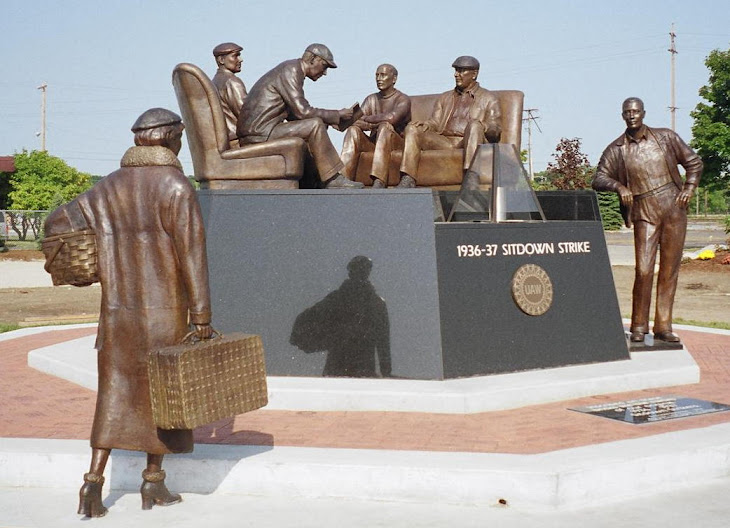
The past as prologue? Lining up for food and water, Louisville, Kentucky, 1937. By Margaret Bourke-White/Time & Life Pictures/Getty Images.
This is the way the American working class responded...

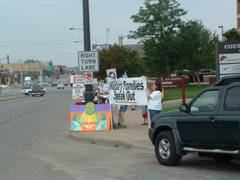
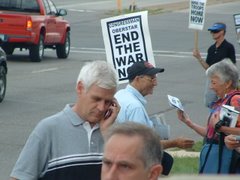
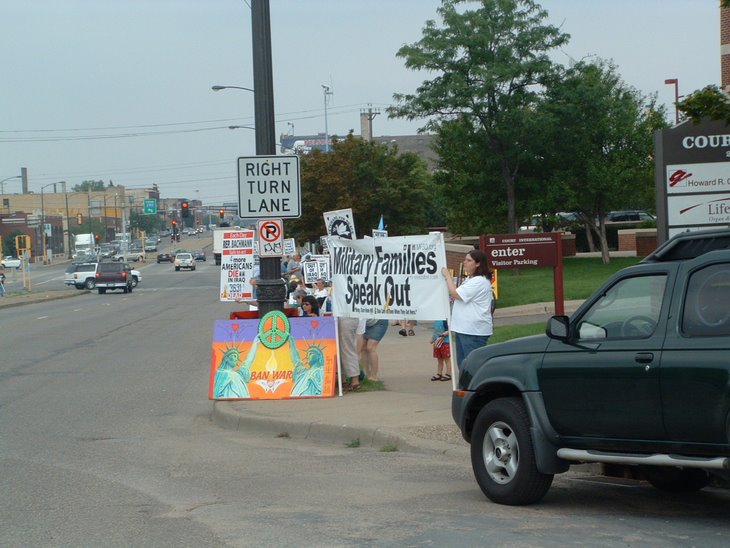
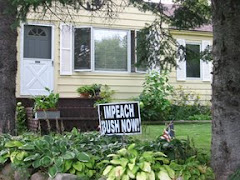
Billboard in Milwaukee, Wisconsin


CRONY COMMUNIST OR BUSINESSMAN?
Campaign for America's Future STAFF
By David Sirota
October 9th, 2008 - 11:19am ET
Is Henry Paulson a crony communist or a businessman? The answer could be the difference between economic disaster and recovery.
Understanding Paulson's role in stopping —or fueling — the credit crisis requires a review of two axioms from Economics 101: 1) A credit crisis occurs when banks stop lending and 2) The amount banks can lend is a multiple of the capital in their vaults. Therefore, ending a credit crisis means prompting new lending — and that means maximally increasing bank capital.
Enter Paulson, the former Goldman Sachs executive and current Treasury secretary. The bailout he fearmongered through Congress aims to waste almost a trillion taxpayer dollars buying banks' bad mortgages — a scheme all but ensuring a disastrous outcome.
If Paulson pays banks exactly what their mortgages are worth, he will not increase banks' capital (or their lending ability) — he will merely convert one asset (mortgages) into another (cash), making no impact on the credit crisis. If, to protect taxpayers, he buys mortgages at lower prices than banks list them, banks will have to write down their capital and consequently contract lending — and the credit crisis will worsen. If Paulson overpays for mortgages, he may marginally augment bank capital, but also incur massive taxpayer losses when he later resells the mortgages at their real price.
The silver lining is a little-noticed provision in the bailout bill allowing Paulson -- if he chooses — to buy ownership stakes in banks. According to Robert Johnson, the Senate Banking Committee's former chief economist, this would cost roughly $375 billion less than the mortgage-buying plan — and, better yet, more aggressively attack the credit crisis.
Mortgages may be underpriced today, but they retain some value on banks' books. So rather than purchasing mortgages (a capital-neutral transaction), Paulson could buy bank stock, infusing banks with new capital on top of their mortgages. That would exponentially increase lending capacity, prevent taxpayers from buying toxic assets, give the public a share of future profits, and grant regulators ownership leverage to restructure bank management.
This is where Paulson's personal proclivities come in.
A crony communist looking to socialize risk and privatize gain would consider these options and choose to buy mortgages — that is, choose to ignore the credit crisis, reward discredited executives and permit banks to keep any subsequent profits — all while inhibiting a potential government-mandated housecleaning of Wall Street. Indeed, the Financial Times' Wolfgang Munchau says Paulson's mortgage-buying program is driven by "a wish to benefit the investment banks he once chaired, and which stand to gain handsomely from such a package."
A businessman, by contrast, would limit taxpayers' exposure, give us a stake in future gains and demand management control. He would, in short, treat taxpayers like Warren Buffett treats his Berkshire Hathaway shareholders when buying banks with their money.
This is how Sweden successfully confronted its banking crisis in 1992, and how England is addressing its own meltdown today. In fact, world leaders are citing our crony communism as a cautionary tale. "This is not the American plan," said British Prime Minister Gordon Brown in announcing his bank rescue. "We will have a stake in the banks — we are not simply giving money."
The bailout bill's failure to make this course of action mandatory should have killed the legislation in Congress. But banking CEOs and their lobbyists turned "should have" into "didn't." They love crony communism and hate government ownership stakes because, as financial analyst Luigi Zingales says, "Nobody likes to pay for their own mistakes — it is much better to have the taxpayers pay."
Considering the opposition, then, it is a miracle any ownership stake language slipped into law. Whether Paulson now uses that language will signal how deep Washington corruption runs.
Chickens Home to Roost
http://www.ourfuture.org/blog-entry/2008104107/untie-noose-rebuild-us-manufacturing#comment-8874
By Leo Gerard, President, USW
October 7th, 2008 - 10:12am ET
While the recently passed bailout bill may or may not help to stabilize the credit markets (and on Monday it looked as if it may have in fact made it worse) it is absolutely clear that it does nothing to address the fundamental cause of this crisis – declining home prices and eight years of stagnant wages for the overwhelming majority of working families.
George W. Bush’s chickens have come home to roost, and they’re not pretty.
With the full support of Arizona Sen. John McCain, who voted with him 90 percent of the time, eight years of the Bush-McCain philosophy have left us in a terrible mess:
138 trade deals – every single one enthusiastically supported by McCain – have contributed to a loss of 3.9 million manufacturing jobs and the growth of our current account balance by $4.4 trillion.
A federal budget, which was running a $236 billion surplus in 2000, will balloon to an estimated deficit of $407 billion in fiscal 2008, and perhaps $500 billion in 2009.
And last week we learned that another 159,000 jobs were lost last month, many more than expected and the worst job losses in five years.
We have mortgaged not just our homes but our entire future to foreign governments that have made clear in recent days that they care not one wit for the concerns of America’s working families. The people with the leverage are now the Chinese, the Russians and the oil-producing countries, each of whom will want assurances that the debt they hold now and the new debt they will soon be buying are worth something.
If anything good can come out of this awful mess, we must begin by clearly and unequivocally recognizing the absolute bankruptcy of the Bush-McCain approach.
Congress and the next president, together with all those who care about America, need to come together and develop concrete plans for supporting real productive activity in this country and making meaningful public investments in our economy. We must create real wealth in our economy, and value-added manufacturing is the best answer.
Over and above creating millions of jobs and preserving countless more, investments in the “real economy” also offer the greatest opportunity to get something back on the hundreds of billions of bad loans which our government is about to acquire from Wall Street on behalf of the American people who live on Main Street. Just as we cannot consume our way to financial health, neither can we “swap” enough paper to re-create a vibrant economy.
Government must take the lead in revitalizing the economy that Wall Street speculators have almost destroyed. To create jobs, we need to invest in rebuilding our crumbling infrastructure – our roads, schools and bridges. We need to rebuild our outdated electricity grid and build new broadband lines to connect all of America. And we need to create the jobs of the future by transforming our energy economy, tapping our natural gas reserves, investing in clean coal, and finding ways to safely harness nuclear power.
We must also invest in affordable, renewable sources of energy – wind power, solar power and the next generation of biofuels, investments that will lead to new industries and millions of new jobs that pay well and can’t be offshored.
We need to once and for all bury the philosophy that worships only business, free markets, deregulation and free trade, and replace it with an economic program that restores the balance of power between workers and business, rebuilds the middle class and curbs corporate excesses.
HEY DIPSTICK. Your an idiot and I'm embarrassed to see that you would try to use a title as though you are part of the labor movement. All you are is an embarrassment to those of us who actually fight for working people each and every day. Rather than always having a negative attitude and complaining, why don't you have some sort of meaningful ideas that will actually help people. My personal feeling is the real agenda here is to try and make the labor movement look idiotic. Get a life! Maybe you should come out of your shack once in a while and visit the real world.
Once again stop sending me your commie bull shit!
Erik Skoog
Teamsters Local 320
Special Projects Director
Monday, October 6, 2008
Middle class bail out or working class bail out?
We need more concrete proposals from Barack Obama on how he intends to save "Main Street"... As anyone can see, people are expecting much more than what is in your typical newspaper story about "middle class bail out."
We especially need to end this talk about "middle class bail out;" we need to be talking about solving the problems of the "working class."
Solving the problems of the working class means talking about specific solutions aimed at eradicating poverty, which at a minimum, requires a massive redistribution of wealth in this country.
People want, and expect, Barack Obama to get specific. How are we going to bail working class people out of poverty?
Wall Street received its "bail out," now the working class is entitled to its bail out... a working class "bail out" requires two legislative acts--- 1.) make the minimum wage a real living wage; and, 2.) socialized health care.
All this talk about "the middle class" which has become so popular in the politicians' vocabulary is nothing more than an excuse for evading what really is required and needs to be done to eliminate poverty.
Anyone with an ounce of common sense, compassion and empathy for human beings understand that what is required is a detailed program and plan of action to eradicate poverty.
October 17 is the International Day of Action for the Eradication of Poverty yet we haven't heard a mention of this by Barack Obama or his campaign.
December 10, 2008 marks the 60th Anniversary of the United Nations' Universal Declaration of Human Rights--- Barack Obama and his campaign have ignored this important document which clearly enunciates and articulates the rights all human beings are entitled to by birth.
As long as our country's resources are squandered on weapons of war and militarism and the interests of the Wall Street coupon clippers remains of paramount importance in the United States, poverty will remain and our basic and fundamental rights articulated in the United Nations' Universal Declaration of Human Rights will not be attainable for the vast majority of the working class, of which many working people are impoverished; most working class people know nothing about a "middle class" life.
The Wall Street bail out will lead to further impoverishment of the working class.
Posted by Alan L. Maki at 8:08 PM
For McCain and Team, a Host of Ties to Gambling
By JO BECKER and DON VAN NATTA Jr.
Published: September 27, 2008
http://www.nytimes.com/2008/09/28/us/politics/28gambling-web.html?pagewanted=all
Senator John McCain was on a roll. In a room reserved for high-stakes gamblers at the Foxwoods Resort Casino in Connecticut, he tossed $100 chips around a hot craps table. When the marathon session ended around 2:30 a.m., the Arizona senator and his entourage emerged with thousands of dollars in winnings.
Mr. McCain supported tax breaks for casinos over the years, including one that helped Foxwoods in Connecticut. He has also gambled there.
A lifelong gambler, Mr. McCain takes risks, both on and off the craps table. He was throwing dice that night not long after his failed 2000 presidential bid, in which he was skewered by the Republican Party’s evangelical base, opponents of gambling. Mr. McCain was betting at a casino he oversaw as a member of the Senate Indian Affairs Committee, and he was doing so with the lobbyist who represents that casino, according to three associates of Mr. McCain.
The visit had been arranged by the lobbyist, Scott Reed, who works for the Mashantucket Pequot, a tribe that has contributed heavily to Mr. McCain’s campaigns and built Foxwoods into the world’s second-largest casino. Joining them was Rick Davis, Mr. McCain’s current campaign manager. Their night of good fortune epitomized not just Mr. McCain’s affection for gambling, but also the close relationship he has built with the gambling industry and its lobbyists during his 25-year career in Congress.
As a two-time chairman of the Indian Affairs Committee, Mr. McCain has done more than any other member of Congress to shape the laws governing America’s casinos, helping to transform the once-sleepy Indian gambling business into a $26-billion-a-year behemoth with 423 casinos across the country. He has won praise as a champion of economic development and self-governance on reservations.
“One of the founding fathers of Indian gaming” is what Steven Light, a University of North Dakota professor and a leading Indian gambling expert, called Mr. McCain.
As factions of the ferociously competitive gambling industry have vied for an edge, they have found it advantageous to cultivate a relationship with Mr. McCain or hire someone who has one, according to an examination based on more than 70 interviews and thousands of pages of documents.
Mr. McCain portrays himself as a Washington maverick unswayed by special interests, referring recently to lobbyists as “birds of prey.” Yet in his current campaign, more than 40 fund-raisers and top advisers have lobbied or worked for an array of gambling interests — including tribal and Las Vegas casinos, lottery companies and online poker purveyors.
When rules being considered by Congress threatened a California tribe’s planned casino in 2005, Mr. McCain helped spare the tribe. Its lobbyist, who had no prior experience in the gambling industry, had a nearly 20-year friendship with Mr. McCain.
In Connecticut that year, when a tribe was looking to open the state’s third casino, staff members on the Indian Affairs Committee provided guidance to lobbyists representing those fighting the casino, e-mail messages and interviews show. The proposed casino, which would have cut into the Pequots’ market share, was opposed by Mr. McCain’s colleagues in Connecticut.
Mr. McCain declined to be interviewed. In written answers to questions, his campaign staff said he was “justifiably proud” of his record on regulating Indian gambling. “Senator McCain has taken positions on policy issues because he believed they are in the public interest,” the campaign said.
Mr. McCain’s spokesman, Tucker Bounds, would not discuss the senator’s night of gambling at Foxwoods, saying: “Your paper has repeatedly attempted to insinuate impropriety on the part of Senator McCain where none exists — and it reveals that your publication is desperately willing to gamble away what little credibility it still has.”
Over his career, Mr. McCain has taken on special interests, like big tobacco, and angered the capital’s powerbrokers by promoting campaign finance reform and pushing to limit gifts that lobbyists can shower on lawmakers. On occasion, he has crossed the gambling industry on issues like regulating slot machines.
Perhaps no episode burnished Mr. McCain’s image as a reformer more than his stewardship three years ago of the Congressional investigation into Jack Abramoff, the disgraced Republican Indian gambling lobbyist who became a national symbol of the pay-to-play culture in Washington. The senator’s leadership during the scandal set the stage for the most sweeping overhaul of lobbying laws since Watergate.
“I’ve fought lobbyists who stole from Indian tribes,” the senator said in his speech accepting the Republican presidential nomination this month.
But interviews and records show that lobbyists and political operatives in Mr. McCain’s inner circle played a behind-the-scenes role in bringing Mr. Abramoff’s misdeeds to Mr. McCain’s attention — and then cashed in on the resulting investigation. The senator’s longtime chief political strategist, for example, was paid $100,000 over four months as a consultant to one tribe caught up in the inquiry, records show.
Mr. McCain’s campaign said the senator acted solely to protect American Indians, even though the inquiry posed “grave risk to his political interests.”
As public opposition to tribal casinos has grown in recent years, Mr. McCain has distanced himself from Indian gambling, Congressional and American Indian officials said.
But he has rarely wavered in his loyalty to Las Vegas, where he counts casino executives among his close friends and most prolific fund-raisers. “Beyond just his support for gaming, Nevada supports John McCain because he’s one of us, a Westerner at heart,” said Sig Rogich, a Nevada Republican kingmaker who raised nearly $2 million for Mr. McCain at an event at his home in June.
Only six members of Congress have received more money from the gambling industry than Mr. McCain, and five hail from the casino hubs of Nevada and New Jersey, according to data from the Center for Responsive Politics dating back to 1989. In the presidential race, Senator Barack Obama has also received money from the industry; Mr. McCain has raised almost twice as much.
In May 2007, as Mr. McCain’s presidential bid was floundering, he spent a weekend at the MGM Grand on the Las Vegas strip. A fund-raiser hosted by J. Terrence Lanni, the casino’s top executive and a longtime friend of the senator, raised $400,000 for his campaign. Afterward, Mr. McCain attended a boxing match and hit the craps tables.
For much of his adult life, Mr. McCain has gambled as often as once a month, friends and associates said, traveling to Las Vegas for weekend betting marathons. Former senior campaign officials said they worried about Mr. McCain’s patronage of casinos, given the power he wields over the industry. The officials, like others interviewed for this article, spoke on condition of anonymity.
“We were always concerned about appearances,” one former official said. “If you go around saying that appearances matter, then they matter.”
The former official said he would tell Mr. McCain: “Do we really have to go to a casino? I don’t think it’s a good idea. The base doesn’t like it. It doesn’t look good. And good things don’t happen in casinos at midnight.”
“You worry too much,” Mr. McCain would respond, the official said.
A Record of Support
In one of their last conversations, Representative Morris K. Udall, Arizona’s powerful Democrat, whose devotion to American Indian causes was legendary, implored his friend Mr. McCain to carry on his legacy.
“Don’t forget the Indians,” Mr. Udall, who died in 1998, told Mr. McCain in a directive that the senator has recounted to others.
More than a decade earlier, Mr. Udall had persuaded Mr. McCain to join the Senate Indian Affairs Committee. Mr. McCain, whose home state has the third-highest Indian population, eloquently decried the “grinding poverty” that gripped many reservations.
The two men helped write the Indian Gaming Regulatory Act of 1988 after the Supreme Court found that states had virtually no right to control wagering on reservations. The legislation provided a framework for the oversight and growth of Indian casinos: In 1988, Indian gambling represented less than 1 percent of the nation’s gambling revenues; today it captures more than one third.
On the Senate floor after the bill’s passage, Mr. McCain said he personally opposed Indian gambling, but when impoverished communities “are faced with only one option for economic development, and that is to set up gambling on their reservations, then I cannot disapprove.”
In 1994, Mr. McCain pushed an amendment that enabled dozens of additional tribes to win federal recognition and open casinos. And in 1998, Mr. McCain fought a Senate effort to rein in the boom.
He also voted twice in the last decade to give casinos tax breaks estimated to cost the government more than $326 million over a dozen years.
The first tax break benefited the industry in Las Vegas, one of a number of ways Mr. McCain has helped nontribal casinos. Mr. Lanni, the MGM Mirage chief executive, said that an unsuccessful bid by the senator to ban wagering on college sports in Nevada was the only time he could recall Mr. McCain opposing Las Vegas. “I can’t think of any other issue,” Mr. Lanni said.
The second tax break helped tribal casinos like Foxwoods and was pushed by Scott Reed, the Pequots’ lobbyist.
Mr. McCain had gotten to know Mr. Reed during Senator Bob Dole’s 1996 presidential campaign, which Mr. Reed managed. Four years later, when Mr. McCain ran for president, Mr. Reed recommended he hire his close friend and protégé, Rick Davis, to manage that campaign.
During his 2000 primary race against George W. Bush, Mr. McCain promoted his record of helping Indian Country, telling reporters on a campaign swing that he had provided critical support to “the Pequot, now the proud owners of the largest casino in the world.”
But Mr. McCain’s record on Indian gambling was fast becoming a difficult issue for him in the primary. Bush supporters like Gov. John Engler of Michigan lambasted Mr. McCain for his “close ties to Indian gambling.”
A decade after Mr. McCain co-authored the Indian gambling act, the political tides had turned. Tribal casinos, which were growing at a blazing pace, had become increasingly unpopular around the country for reasons as varied as morality and traffic.
Then came the biggest lobbying scandal to shake Washington.
Behind an Inquiry
At a September 2004 hearing of the Indian Affairs Committee, Mr. McCain described Jack Abramoff as one of the most brazen in a long line of crooks to cheat American Indians. “It began with the sale of Manhattan, and has continued ever since,” he said. “What sets this tale apart, what makes it truly extraordinary, is the extent and degree of the apparent exploitation and deceit.”
Over the next two years, Mr. McCain helped uncover a breathtaking lobbying scandal — Mr. Abramoff and a partner bilked six tribes of $66 million — that showcased the senator’s willingness to risk the wrath of his own party to expose wrongdoing. But interviews and documents show that Mr. McCain and a circle of allies — lobbyists, lawyers and senior strategists — also seized on the case for its opportunities.
For McCain-connected lobbyists who were rivals of Mr. Abramoff, the scandal presented a chance to crush a competitor. For senior McCain advisers, the inquiry allowed them to collect fees from the very Indians that Mr. Abramoff had ripped off. And the investigation enabled Mr. McCain to confront political enemies who helped defeat him in his 2000 presidential run while polishing his maverick image.
The Abramoff saga started in early 2003 when members of two tribes began questioning Mr. Abramoff’s astronomical fees. Over the next year, they leaked information to local newspapers, but it took the hiring of lobbyists who were competitors of Mr. Abramoff to get the attention of Mr. McCain’s committee.
Bernie Sprague, who led the effort by one of the tribes, the Saginaw Chippewas in Michigan, hired a Democratic lobbyist who recommended that the tribe retain Scott Reed, the Republican lobbyist, to push for an investigation.
Mr. Reed had boasted to other lobbyists of his access to Mr. McCain, three close associates said. Mr. Reed “pretty much had open access to John from 2000 to at least the end of 2006,” one aide said.
Lobbyist disclosure forms show that Mr. Reed went to work for the Saginaw Chippewa on Feb. 15, 2004, charging the tribe $56,000 over a year. Mr. Abramoff had tried to steal the Pequots and another tribal client from Mr. Reed, and taking down Mr. Abramoff would eliminate a competitor.
Mr. Reed became the chief conduit to Mr. McCain’s committee for billing documents and other information Mr. Sprague was digging up on Mr. Abramoff, Mr. Sprague said, who said Mr. Reed “did a great to service to me.”
“He had contacts I did not,” Mr. Sprague said. “Initially, I think that the senator’s office was doing Reed a favor by listening to me.”
A few weeks after hiring Mr. Reed, Mr. Sprague received a letter from the senator. “We have met with Scott Reed, who was very helpful on the issue,” Mr. McCain wrote.
Information about Mr. Abramoff was also flowing to Mr. McCain’s committee from another tribe, the Coushatta of Louisiana. The source was a consultant named Roy Fletcher, who had been Mr. McCain’s deputy campaign manager in 2000, running his war room in South Carolina.
It was in that primary race that two of Mr. Abramoff’s closest associates, Grover Norquist, who runs the nonprofit Americans for Tax Reform, and Ralph Reed, the former director of the Christian Coalition, ran a blistering campaign questioning Mr. McCain’s conservative credentials. The senator and his advisers blamed that attack for Mr. McCain’s loss to Mr. Bush in South Carolina, creating tensions that would resurface in the Abramoff matter.
“I was interested in busting” Mr. Abramoff, said Mr. Fletcher, who was eventually hired to represent the tribe. “That was my job. But I was also filled with righteous indignation, I got to tell you.”
Mr. Fletcher said he began passing information to John Weaver, Mr. McCain’s chief political strategist, and other staff members in late 2003 or January 2004. Mr. Weaver confirmed the timing.
Mr. McCain announced his investigation on Feb. 26, 2004, citing an article on Mr. Abramoff in The Washington Post. He did not mention the action by lobbyists and tribes in the preceding weeks. His campaign said no one in his “innermost circle” brought information to Mr. McCain that prompted the investigation.
The senator declared he would not investigate members of Congress, whom Mr. Abramoff had lavished with tribal donations and golf outings to Scotland. But in the course of the investigation, the committee exposed Mr. Abramoff’s dealings with the two men who had helped defeat Mr. McCain in the 2000 primary.
The investigation showed that Mr. Norquist’s foundation was used by Mr. Abramoff to launder lobbying fees from tribes. Ralph Reed was found to have accepted $4 million to run bogus antigambling campaigns. And the investigation also highlighted Mr. Abramoff’s efforts to curry favor with the House majority leader at the time, Tom DeLay, Republican of Texas, a longtime political foe who had opposed many of Mr. McCain’s legislative priorities.
Mr. McCain’s campaign said the senator did not “single out” Ralph Reed or Mr. Norquist, neither of whom were ever charged, and that both men fell within the “scope of the investigation.” The inquiry, which led to guilty pleas by over a dozen individuals, was motivated by a desire to help aggrieved tribes, the campaign said.
Inside the investigation, the sense of schadenfreude was palpable, according to several people close to the senator. “It was like hitting pay dirt,” said one associate of Mr. McCain’s who had consulted with the senator’s office on the investigation. “And face it — McCain and Weaver were maniacal about Ralph Reed and Norquist. They were sticking little pins in dolls because those guys had cost him South Carolina.”
Down on the Coushattas reservation, bills related to the investigation kept coming. After firing Mr. Abramoff, the tribe hired Kent Hance, a lawyer and former Texas congressman who said he had been friends with Mr. McCain since the 1980s.
David Sickey, the tribe’s vice chairman, said he was “dumbfounded” over the bills submitted by Mr. Hance’s firm, Hance Scarborough, which had been hired by Mr. Sickey’s predecessors.
“The very thing we were fighting seemed to be happening all over again — these absurd amounts of money being paid,” Mr. Sickey said.
Mr. Hance’s firm billed the tribe nearly $1.3 million over 11 months in legal and political consulting fees, records show. But Mr. Sickey said that the billing statements offered only vague explanations for services and that he could not point to any tangible results. Two consultants, for instance, were paid to fight the expansion of gambling in Texas — even though it was unlikely given that the governor there opposed any such prospect, Mr. Sickey said.
Mr. Hance and Jay B. Stewart, the firm’s managing partner, defended their team’s work, saying they successfully steered the tribe through a difficult period. “We did an outstanding job for them,” Mr. Hance said. “When we told them our bill was going to be $100,000 a month, they thought we were cheap. Mr. Abramoff had charged them $1 million a month.”
The firm’s fees covered the services of Mr. Fletcher, who served as the tribe’s spokesman. Records also show that Mr. Hance had Mr. Weaver — who was serving as Mr. McCain’s chief strategist — put on the tribe’s payroll from February to May 2005.
It is not precisely clear what role Mr. Weaver played for his $100,000 fee.
Mr. Stewart said Mr. Weaver was hired because “he had a lot of experience with the Senate, especially the new chairman, John McCain.” The Hance firm told the tribe in a letter that Mr. Weaver was hired to provide “representation for the tribe before the U.S. Senate.”
But Mr. Weaver never registered to lobby on the issue, and he has another explanation for his work.
“The Hance law firm retained me to assist them and their client in developing an aggressive crisis management and communications strategy,” Mr. Weaver said. “At no point was I asked by Kent Hance or anyone associated with him to set up meetings with anyone in or outside of government to discuss this, and if asked I would have summarily declined to do so.”
In June 2005, the tribe informed Mr. Hance that his services were no longer needed.
Change in Tone
After the Abramoff scandal, Mr. McCain stopped taking campaign donations from tribes. Some American Indians were offended, especially since Mr. McCain continued to accept money from the tribes’ lobbyists.
Resentment in Indian Country mounted as Mr. McCain, who was preparing for another White House run, singled out the growth in tribal gambling as one of three national issues that were “out of control.” (The others were federal spending and illegal immigration.)
Franklin Ducheneaux, an aide to Morris Udall who helped draft the 1988 Indian gambling law, said that position ran contrary to Mr. McCain’s record. “What did he think? That Congress intended for the tribes to be only somewhat successful?” Mr. Ducheneaux said.
Mr. McCain began taking a broad look at whether the laws were sufficient to oversee the growing industry. His campaign said that the growth had put “considerable stress” on regulators and Mr. McCain held hearings on whether the federal government needed more oversight power.
An opportunity to restrain the industry came in the spring of 2005, when a small tribe in Connecticut set off a political battle. The group, the Schaghticoke Tribal Nation, had won federal recognition in 2004 after producing voluminous documentation tracing its roots.
The tribe wanted to build Connecticut’s third casino, which would compete with Foxwoods and another, the Mohegan Sun. Facing public opposition on the proposed casino, members of the Connecticut political establishment — many of whom had received large Pequot and Mohegan campaign donations — swung into action.
Connecticut officials claimed that a genealogical review by the Bureau of Indian Affairs was flawed, and that the Schaghticoke was not a tribe.
The tribe’s opponents, led by the Washington lobbying firm Barbour Griffith & Rogers, turned to Mr. McCain’s committee. It was a full-circle moment for the senator, who had helped the Pequots gain tribal recognition in the 1980s despite concerns about their legitimacy.
Now, Mr. McCain was doing a favor for allies in the Connecticut delegation, including Senator Joseph I. Lieberman, a close friend, according to two former Congressional aides. “It was one of those collegial deals,” said one of the aides, who worked for Mr. McCain.
Barbour Griffith & Rogers wanted Mr. McCain to hold a hearing that would show that the Bureau of Indian Affairs was “broken,” said Bradley A. Blakeman, who was a lobbyist for the firm at the time.
“It was our hope that the hearing would shed light on the fact that the bureau had not followed their rules and had improperly granted recognition to the Schaghticoke,” Mr. Blakeman said. “And that the bureau would revisit the issue and follow their rules.”
Mr. McCain’s staff helped that effort by offering strategic advice.
His staff told a lobbyist for the firm that the Indian Affairs Committee “would love to receive a letter” from the Connecticut governor requesting a hearing, according to an e-mail exchange, and offered “guidance on what the most effective tone and approach” would be in the letter.
On May 11, 2005, Mr. McCain held a hearing billed as a general “oversight hearing on federal recognition of Indian tribes.” But nearly all the witnesses were Schaghticoke opponents who portrayed the tribe as imposters.
Mr. McCain set the tone: “The role that gaming and its nontribal backers have played in the recognition process has increased perceptions that it is unfair, if not corrupt.”
Chief Richard F. Velky of the Schaghticokes found himself facing off against the governor and most of the state’s congressional delegation. “The deck was stacked against us,” Mr. Velky said. “They were given lots of time. I was given five minutes.”
He had always believed Mr. McCain “to be an honest and fair man,” Mr. Velky said, “but this didn’t make me feel that good.”
Mr. Velky said he felt worse when the e-mail messages between the tribe’s opponents and Mr. McCain’s staff surfaced in a federal lawsuit. “Is there a letter telling me how to address the senator to give me the best shot?” Mr. Velky asked. “No, there is not.”
After the hearing, Pablo E. Carrillo, who was Mr. McCain’s chief Abramoff investigator at the time, wrote to a Barbour Griffith & Rogers lobbyist, Brant Imperatore. “Your client’s side definitely got a good hearing record,” Mr. Carillo wrote, adding “you probably have a good sense” on where Mr. McCain “is headed on this.”
“Well done!” he added.
Cynthia Shaw, a Republican counsel to the committee from 2005 to 2007, said Mr. McCain made decisions based on merit, not special interests. “Everybody got a meeting who asked for one,” Ms. Shaw said, “whether you were represented by counsel or by a lobbyist — or regardless of which lobbyist.”
Mr. McCain’s campaign defended the senator’s handling of the Schaghticoke case, saying no staff member acted improperly. The campaign said the session was part of normal committee business and the notion that Mr. McCain was intending to help Congressional colleagues defeat the tribe was “absolutely false.”
It added that the senator’s commitment to Indian sovereignty “remains as strong as ever.”
Within months of the May 2005 hearing, the Bureau of Indian Affairs took the rare step of rescinding the Schaghticokes’ recognition. A federal court recently rejected the tribe’s claim that the reversal was politically motivated.
Making an Exception
That spring of 2005, as the Schaghticokes went down to defeat in the East, another tribe in the West squared off against Mr. McCain with its bid to construct a gambling emporium in California. The stakes were similar, but the outcome would be far different.
The tribe’s plan to build a casino on a former Navy base just outside San Francisco represented a trend rippling across the country: American Indians seeking to build casinos near population centers, far from their reservations.
The practice, known as “off-reservation shopping,” stemmed from the 1988 Indian gambling law, which included exceptions allowing some casinos to be built outside tribal lands. When Mr. McCain began his second stint as chairman of the Indian Affairs Committee three years ago, Las Vegas pressed him to revisit the exceptions he had helped create, according to Sig Rogich, the Republican fund-raiser from Nevada.
“We told him this off-reservation shopping had to stop,” Mr. Rogich said. “It was no secret that the gaming industry, as well as many potentially affected communities in other states, voiced opposition to the practice.”
In the spring of 2005, Mr. McCain announced he was planning a sweeping overhaul of Indian gambling laws, including limiting off-reservation casinos. His campaign said Las Vegas had nothing to do with it. In a 2005 interview with The Oregonian, Mr. McCain said that if Congress did not act, “soon every Indian tribe is going to have a casino in downtown, metropolitan areas.”
Prospects for the proposed California project did not look promising. Then the tribe, the Guidiville Band of Pomo Indians, hired a lobbyist based in Phoenix named Wes Gullett.
Mr. Gullett, who had never represented tribes before Congress, had known Mr. McCain since the early 1980s. Mr. Gullett met his wife while they were working in Mr. McCain’s Washington office. He subsequently managed Mr. McCain’s 1992 Senate campaign and served as a top aide to his 2000 presidential campaign. Their friendship went beyond politics. When Mr. McCain’s wife, Cindy, brought two infants in need of medical treatment back to Arizona from Bangladesh, the Gulletts adopted one baby and the McCains the other. The two men also liked to take weekend trips to Las Vegas.
Another of Mr. McCain’s close friends, former Defense Secretary William S. Cohen, was a major investor in the Guidivilles’ proposed casino. Mr. Cohen, who did not return calls, was best man at Mr. McCain’s 1980 wedding.
Scott Crowell, lawyer for the Guidivilles, said Mr. Gullett was hired to ensure that Mr. McCain’s overhaul of the Indian gambling laws did not harm the tribe.
Mr. Gullett said he never talked to Mr. McCain about the legislation. “If you are hired directly to lobby John McCain, you are not going to be effective,” he said. Mr. Gullett said he only helped prepare the testimony of the tribe’s administrator, Walter Gray, who was invited to plead his case before Mr. McCain’s committee in July 2005. Mr. Gullett said he advised Mr. Gray in a series of conference calls.
On disclosure forms filed with the Senate, however, Mr. Gullett stated that he was not hired until November, long after Mr. Gray’s testimony. Mr. Gullett said the late filing might have been “a mistake, but it was inadvertent.” Steve Hart, a former lawyer for the Guidivilles, backed up Mr. Gullett’s contention that he had guided Mr. Gray on his July testimony.
When asked whether Mr. Gullett had helped him, Mr. Gray responded, “I’ve never met the man and couldn’t tell you anything about him.”
On Nov. 18, 2005, when Mr. McCain introduced his promised legislation overhauling the Indian gambling law, he left largely intact a provision that the Guidivilles needed for their casino. Mr. McCain’s campaign declined to answer whether the senator spoke with Mr. Gullett or Mr. Cohen about the project. In the end, Mr. McCain’s bill died, largely because Indian gambling interests fought back. But the Department of Interior picked up where Mr. McCain left off, effectively doing through regulations what he had hoped to accomplish legislatively. Carl Artman, who served as the Interior Department’s assistant secretary of Indian Affairs until May, said Mr. McCain pushed him to rewrite the off-reservation rules. “It became one of my top priorities because Senator McCain made it clear it was one of his top priorities,” he said.
The new guidelines were issued on Jan. 4. As a result, the casino applications of 11 tribes were rejected. The Guidivilles were not among them.
Kitty Bennett and Griff Palmer contributed to reporting.
CUPE supports Windsor faculty
The Faculty at the University of Windsor is now entering its second week of strike.
In the hope of helping WUFA get a fair deal, Paul Moist offered CUPE’s support to WUFA’s bargaining team. “We offered them our support dealing with their strike campaign and we had a very positive relation with the committee, said Moist. I hope they can benefit from CUPE’s vast experience in the post-secondary sector. This is a perfect example of public sector workers who need our support in these crucial times.”
On campus, CUPE locals 1001, 1393, 4580 and 1281 are coalition partners, working closely with WUFA.
WUFA president, Professor Brian E. Brown said “Too much misinformation has been released by the university giving an entirely unjust view of the situation. The truth is that 47% of our Faculty are part time staff. They are underpaid, overworked and increasingly treated as casual labour. We can’t attract and keep the best new faculty with uncompetitive salaries and poor working conditions. Pay equity and employment equity imbalances are important issues that have to be addressed.”
Brown also noted both the Graduate Student Society and the University of Windsor Students' Alliance have voted to support WUFA. "Too much is at risk at this institution. Students and faculty have united to preserve quality education at the University of Windsor."





















 Length: 00:48:55